
• 224c (was 228). Friedrich Schlegel to Caroline in Jena: Berlin, early March 1799 [*]
[Berlin, early March 1799]
|522| For heaven’s sake just not in the Garden! The least of the inconveniences there is that you and Auguste would be living under extremely inferior and uncomfortable circumstances. Imagine a room in which 10–15 people have just eaten and drunk till 12:00, a room that just barely held them even as it is, and then what it will be like to have to sleep in that Mephistean air. We two were able do so in an emergency — but you? [1] — It would not be all that much of a loss that you would see virtually nothing of Berlin itself. — But you would also have to do without seeing virtually anything of Schleiermacher, Tieck, and Dorothea. And since it is only a certain number of people that have ventured into the black cave, I, too, would see almost nothing of you, and you almost nothing of me, assuming you were planning to see me to begin with. —
But since this is the way things are, and since I know for a fact that it is not love for the rural life but rather pure malice toward me that is prompting the old cat lady to separate you from people entirely and make my life difficult as well, |523| I intend to obstruct this by any means necessary. I am not advising, I am requesting that you decline the offer. Please trust me on this, I am doubtless in a much better position to assess things here on site. Otherwise you might answer Unger — should his own arrangements prove incapable of being altered — that you intend to take a chambre garnie [2] in the vicinity of the theater where you could still see one another at any time. [3] A proposal of that sort could be quite cordially disguised. — For that is yet another unpleasant circumstance, namely, that the Garden apartment is so far from the theater that you could go to and fro only with considerable trouble, and not at all were there extreme heat or dust and dirt. It is hardly half that distance from Dorothea’s apartment.
A chambre garnie — out of consideration for her who deserves not the least consideration at all. Things would have to very bad indeed could I not secure three proper rooms for 20 rh. for four weeks, including one elegantly furnished. But even should it cost thirty, Wilhelm must allow me to pay back this infinitely small part of my otherwise considerable debt. I would rather you not come at all than for you to end up staying there in the Garden apartment. —
You have no idea what sort of creature she is; “cat” is much too good for her. Among other things, she does not possess even a modicum of manners, and the entire winter never invited me over a single time, not even with the Schützes. [4] Given these particular circumstances, I intend to take the liberty of writing Unger a billet about it today. And that is the mildest form of action; truth be told, she deserves for me to write to her directly.
But enough of this aggravating story. One more thing: She also intercepted one of my billets to Unger. The same day I received Wilhelm’s letter with the instructions concerning the 10 louis d’ors. I wrote Unger a billet in which I also lamented having missed him yet again the evening before. |524| She had probably said absolutely nothing to him about it so that he would think my visits rather infrequent, and wanted to avoid the question of why she never said anything to him. — In the response to Wilhelm, I did not mention my having secured the 10 louis d’ors because I thought it self-evident. — It is possible, of course, that the billet got lost in the comptoir, [5] but highly improbable.
That I did not realize the Ungers . . . so gracious to you —
[End of sheet.]
Notes
[*] Was letter 228 but now redated from “March 1799” to “early March 1799” according to KFSA 24:242.
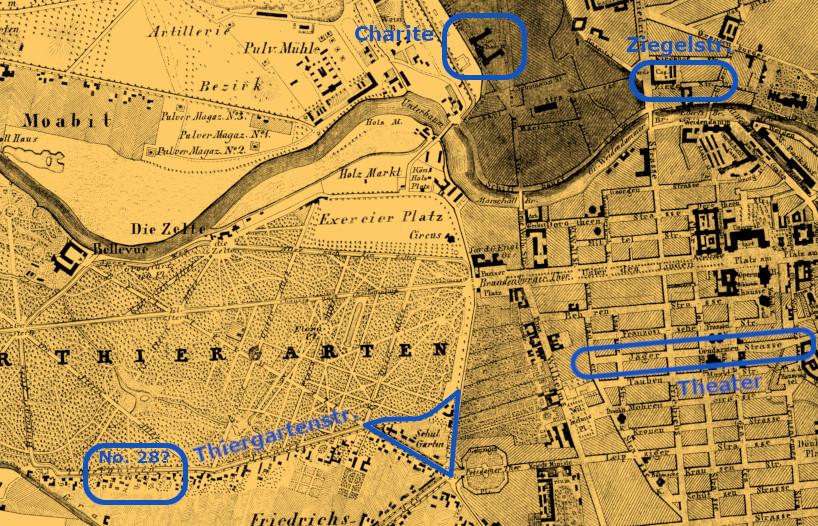
At issue in this letter are the anticipated accommodations for Wilhelm Schlegel, Caroline, and Auguste in Berlin. For reference: the map of Berlin and the locales in question from Friedrich’s letter to Caroline in late March 1799 (letter 195a), though that letter is directly referenced in the inital note below (Bernhard Metzeroth, Berlin [Hildburghausen 1832], from Meyer’s StädteAtlas, vol. 2 [Berlin 1832]; Zentral- und Landesbibliothek Berlin B 54/97 a:1832):
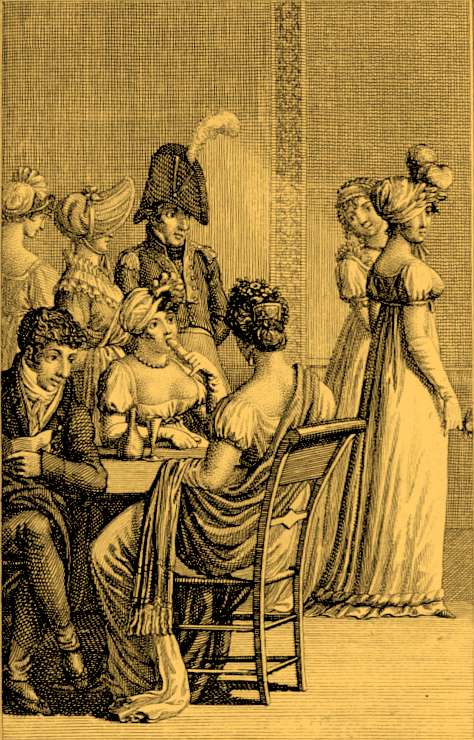
[1] Göttingischer Taschen-Kalender für das Schalt-Jahr 1808; Inhaltsverzeichnis deutscher Almanache, Theodor Springmann Stiftung:
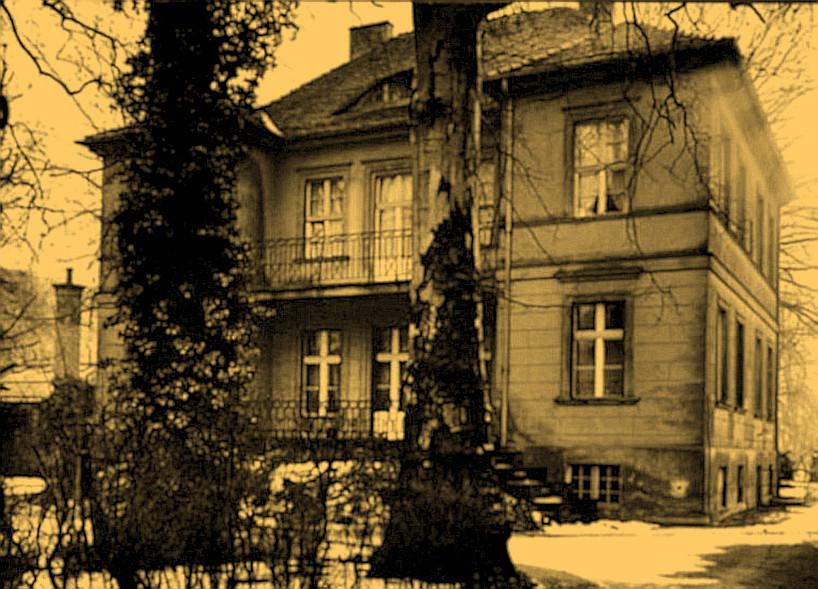
In 1789 Johann Friedrich Unger and his wife, Friederike, moved into a house at Jägerstraße 43 in Berlin that previously had housed the Royal Lottery Administration; they later purchased a summer house at the edge of the Tiergarten in Berlin, later Tiergartenstrasse 28, next door to August Wilhlem Iffland (Iffland’s house was at no. 29; see Ella Horn’s essay on the background to the premiere of Hamlet in Berlin, note 69), where they occasionally also invited guests for an evening of music. Concerning its location (with maps) and for orientation concerning Friedrich’s vehement argumentation in this present letter against Caroline and Auguste staying there, see his letter to Caroline in mid-February 1798 (letter 195a) with note 6 (which includes the map above); here in any case the house in a photograph from 1930 [Bundesarchiv B 145 Bild-P062794]):
[2] Fr., “furnished apartment.” Back.
[3] It was the anticipated premiere of Caroline and Wilhelm’s translation of Hamlet in Berlin that made it important to be nearer the theater.
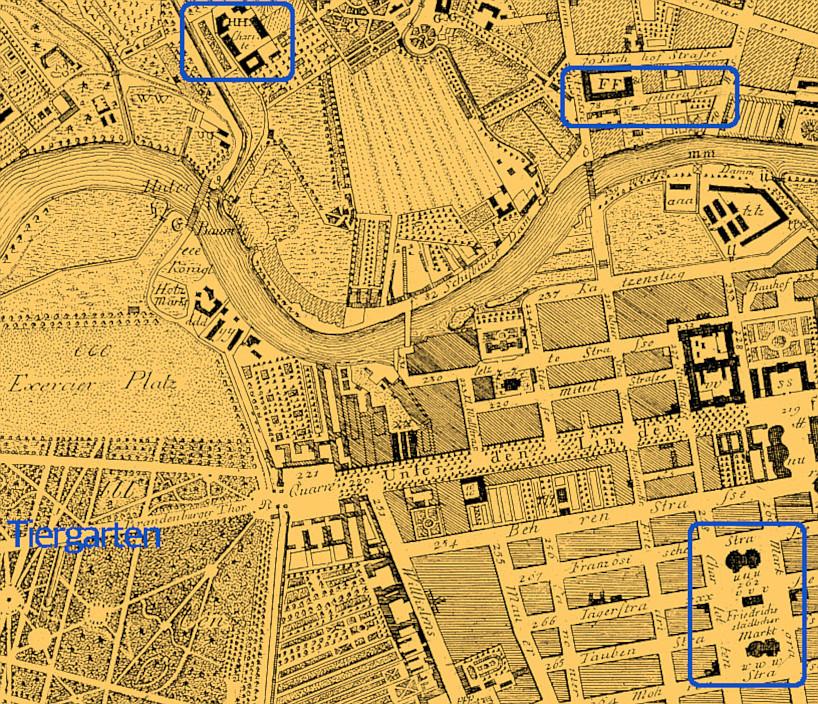
At the time, plays in Berlin were performed in the “French Theater” (Französisches Schauspielhaus) on the former Gens d’Armes Square in Berlin, also known as the Friedrichsstädtscher Markt (at lower right in the following map). In 1799 Dorothea Veit’s initial apartment on the Ziegelstrasse was located just north across the river; see Grundriss der Königl. Residenzstädte Berlin Im Jahr 1786 von neuen zusammengetragen und gestochen durch D. F. Sotzman (Berlin, Stettin 1786), on which the theater is the rectangular edifice labeled “vvv” at the lower right (the Tiergarten begins at the left of the map; note also the Charité hospital complex to the west, where Friedrich lived with Schleiermacher):
Here the theater (the smaller rectangular edifice to the left) in 1788 (illustration by Carl Traugott Fechhelm):
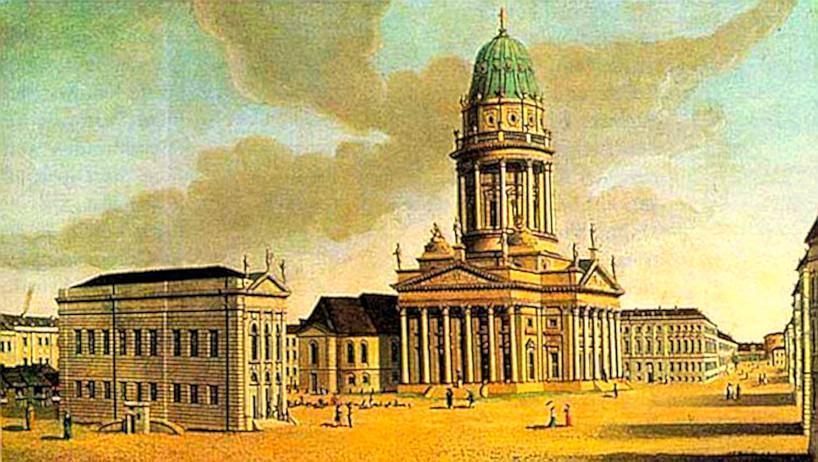
Here an illustration from C. Schäffer and C. Hartmann, Die Königlichen Theater in Berlin: Statistischer Rückblick auf die künstlerische Thätigkeit und die Personal-Verhältniss währen des Zeitraums vom 5. December 1786 bis 31. December 1885 (Berlin 1886), 276:

See the description of Friedrich Nicolai (keyed to the map above: “vvv”) in Beschreibung der königlichen Residenzstädte Berlin und Potsdam, aller daselbst befindlicher Merkwürdigkeiten, und der umliegenden Gegend, 3rd ed., vol. 1 (Berlin 1786), 203:
vvv) The French Theater [Schauspielhaus]. The king had it build at his own cost in 1774 by the architect Boumann the Elder. The portal, which the king had Unger design, is reached by way of an open staircase decorated with four grooved Ionic pillars in relief between which three large entrances are situated leading into the foyer.
The final performance in this edifice took place in December 1801, after which it was demolished and replaced by a new edifice (which, however, burned in 1817). Concerning the French Theater and the successor New Theater in Berlin, see also Wilhelm Schlegel’s letter to Goethe on 28 April 1801 (letter 312c), notes 6 and 7. Back.
[4] Christian Gottfried Schütz and his wife, Henriette, had just spent time in Berlin; in her undated letter to Luise Gotter in late 1798, early 1799 (letter 214), Caroline mentions that they had just departed for Berlin, then in her letter to her on 25 February 1799 (letter 222a) that they had already returned to Jena. Back.
[5] Fr., here: “desk, cashier’s desk.” Back.
Translation © 2013 Doug Stott