
• 72. Caroline to Lotte Michaelis in Göttingen: Clausthal 1786?
[Clausthal 1786?]
[Beginning of letter is missing.]
|154| . . . Auguste is indescribably charming; she will doubtless never be beautiful, her nose alone will keep that from happening, but she already possesses everything that replaces beauty, and may God grant that she also be good! [1]
I am keeping some of the books here yet. Moritz’s Reise and especially the description of the cavern near Castleton delighted me. [2] But once again wailing and woe for the poor wretch who in his little provincial town is copying the author of the Contemporaines in Paris. [3]
|155| Have someone remind Blumenbach of the books Böhmer requested, and send me some of the small red ones.
Adieu, my dear, dear child.
Notes
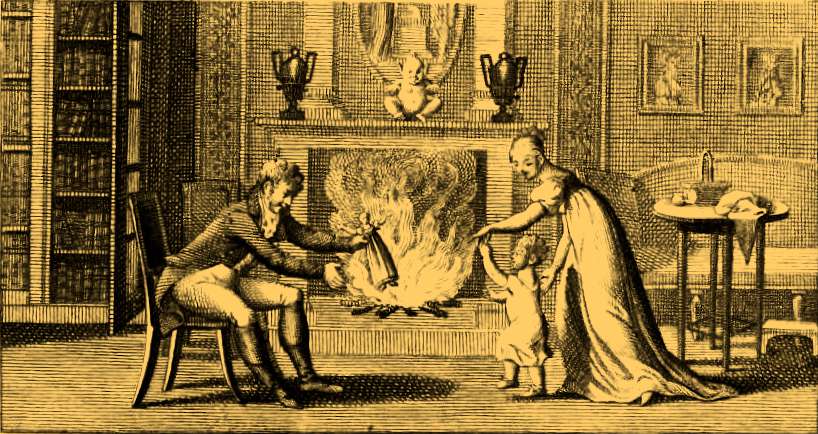
[1] Taschenbuch für das Jahr 1813: Der Liebe und Freundschaft gewidmet:
[2] Karl Philipp Moritz, Reisen eines Deutschen in England im Jahre 1782 (Berlin 1783; 2nd ed. 1785); Eng. Charles P. Moritz [Karl Philipp Moritz], “A literary gentleman of Berlin,” Travels, chiefly on foot, through several parts of England in 1782. Described in letters to a friend, translated from the German by a Lady, 2nd ed. (London 1797).
In the passage Caroline references (Eng. trans. 213–25), Moritz is given a tour of one of the caves in Castleton, Derbyshire, in the Hope Valley between the Dark and the White Peak areas of the Peak District; his description (including the entrance below the castle and the presence of rope makers) suggests he toured Peak Cavern, a cave formally known as the Devil’s Arse (because of the flatulent-sounding noises from inside the cave, to which Moritz’s passage may also allude), in the center of the village and directly below Peveril Castle. It has the largest natural cave entrance in Britain and the second largest in the world (Moritz mentions its “monstrous aperture”), and its damp atmosphere was favorable for rope making (frontispiece to the edition of 1783):
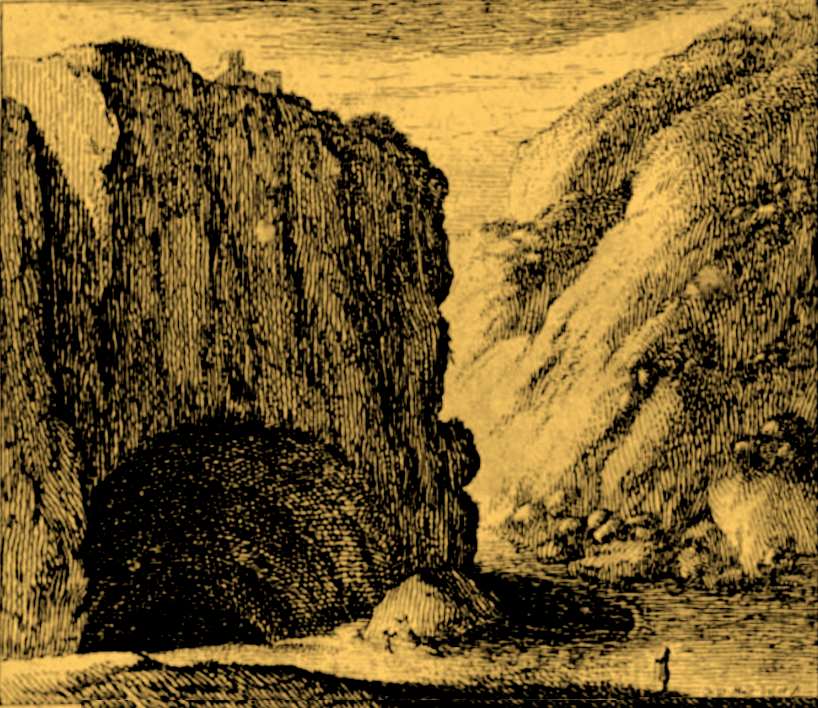
For Moritz’s text and additional illustrations, see supplementary appendix 72.1. Back.
[3] Uncertain but intriguing allusion. Caroline’s reference is to Les contemporaines; ou, Avantures des plus jolies femmes de l’âge présent, 42 vols. in 12 (Leipsick 1780–85) by the controversial author Retif (or Restif) de la Bretonne.
This work, whose multiple volumes were just appearing, was a robust collection of stories, vignettes, and anecdotes from society illustrating, as Retif opined, the complete history of eighteenth-century customs, habits, and manners. Concerning the content of the collection, however, scholars (A Guide to French Literature: From Early Modern to Postmodern, ed. Jennifer Birkett and James Kearns [1997], 94) have remarked that
women are the centre of Restif’s work. Much of his writing focused on the organization of sexuality and the family, which he (like the Napoleonic Code) saw as fundamental to the organization of the State. The classification and regulation of women in their social and sexual functions — daughter, spinster, wife, mother, whore — were the subject matter of the observations and anecdotes and vivid and vigorous dialogue in Les Contemporaines (1780–6), Les Françaises (1786), Le Palais-Royal (1790), which put the flesh on the bones of the legislative proposals in his Le Pornographe (1769), advocating state-run brothels to cement social stability, or in Le Thesmographe (1789), sketching new laws on property, marriage and divorce. In all these, securing the status and sexual freedom of men like himself is his first concern.
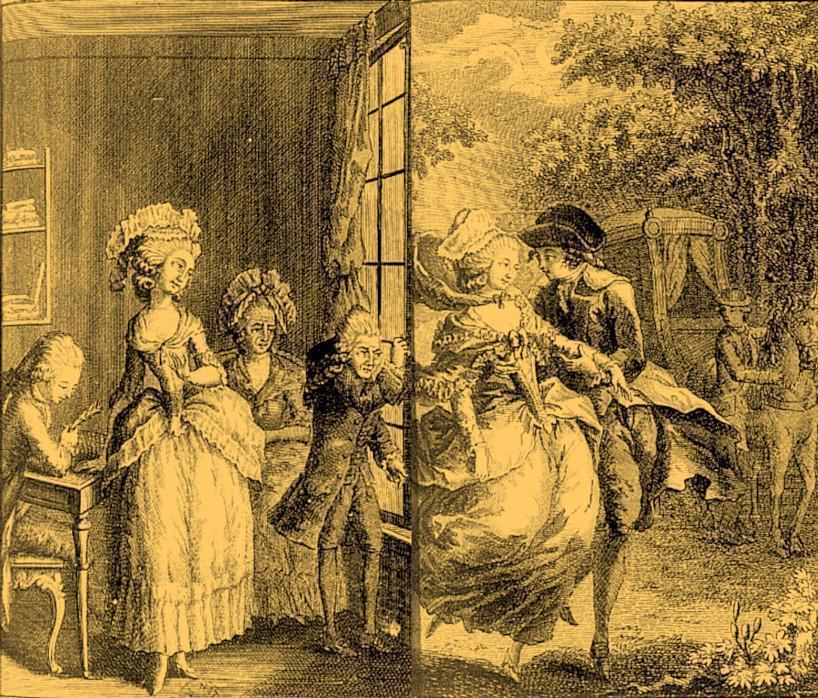
Apart from their more overtly salacious offerings, these volumes also engage in considerable moralizing, not least concerning young (sometimes very young) women and girls. One such series illustrates the alleged “five crises” faced by “pretty girls” (illustrations from vol. 6 [1780], plates following [in order] 522, 536, 562, 574, 620):
Crisis 1: Forced marriage. A mother orders her young daughter to marry a short, humpback man. The girl looks at him sadly, her hand on the table where her young lover is writing. “Ah! How ugly he is!”
Crisis 2: Abduction. The girl’s young lover tries to persuade her to elope, ready to force her into the waiting carriage if necessary. She: “Ah! But my friend! I am making a mistake!”
Crisis 3: The libertines. The young girl emerges from her hiding place in a disreputable locale where libertines have just turned things upside down trying to find her; the old, corrupt woman watches them leave. One of the libertines catches sight of the girl and signals to her; the old woman says, “And who would take them to be thieves!”
Crisis 4: The polite lover. The young girl escapes from the embrace of tender Mr. Durichemont, exclaiming to him, “Oh, my! What are you thinking, Monsieur?”
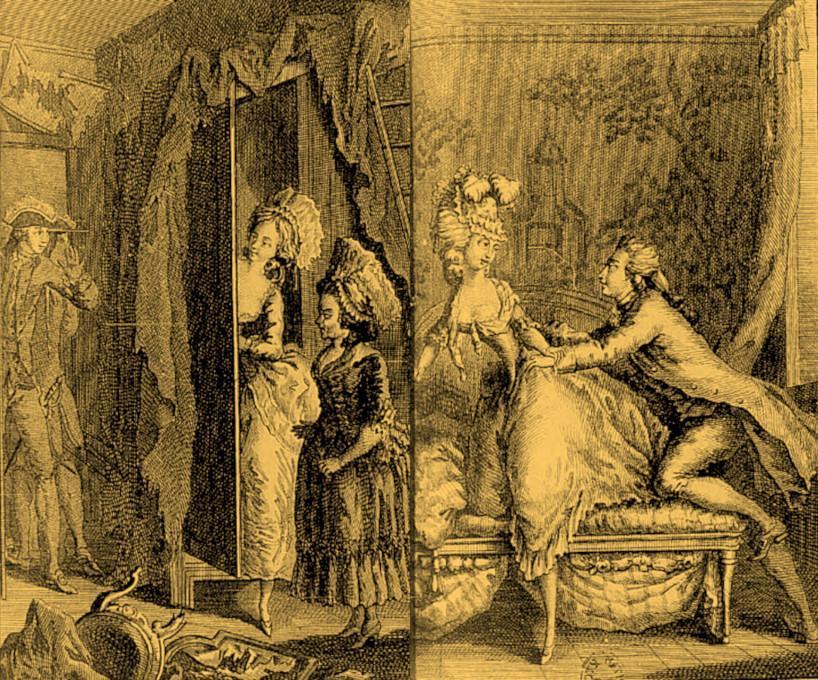
Crisis 5: The choice. The young girl must choose between two lovers, one of whom, her favorite, has abducted her to save her from being sacrificed to a monster; the other saves her honor and offers her his fortune and his hand before getting to know her: “Your rights are equal; I give myself to the most generous.”
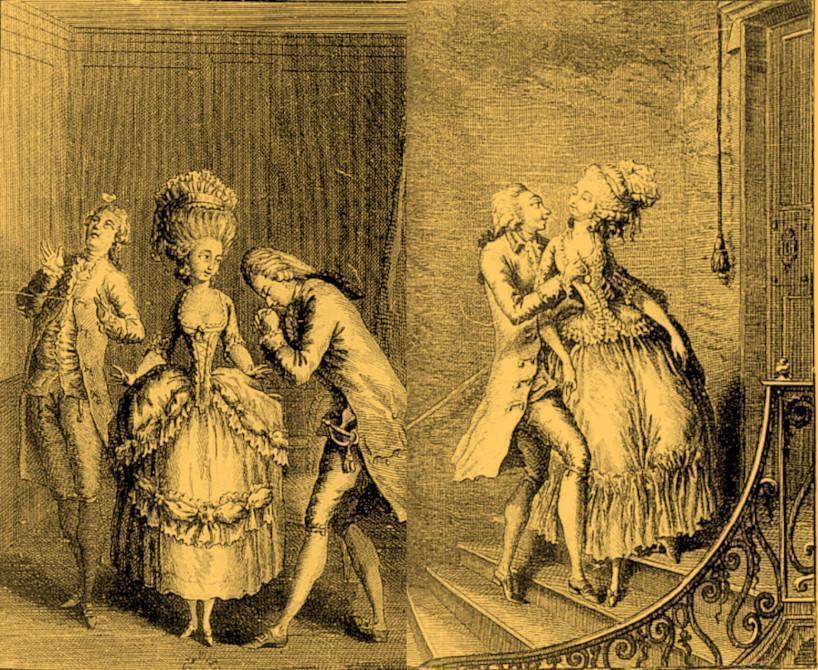
Lack of references in Caroline’s letters prevents a more detailed assessment of her (or her and her sisters’ or friends’) acquaintance with or opinions on the more risqué literature of the time, though this and a later passage do document her acquaintance with Retif de la Bretonne.
See in any case Caroline’s postscript to her and Wilhelm Schlegel’s letter to Karl August Böttiger on 23 March 1797 (letter 181a); her preceding letter to Lotte Michaelis on 28 May 1786 (letter 70), note 1; and her remarks in an early letter to Julie von Studnitz on 21 July 1779 (letter 8), and the accompanying note 4. One document attesting Caroline’s more extensive familiarity with Bretonne is her letter to Friedrich Ludwig Wilhelm Meyer on 1 March 1791 (letter 100), in which she expresses her disappointment in Lotte’s development, referring to her as an “incorrigible coquette“:
The consequences of early depravity are now becoming visible in her in an extremely base fashion . . . Lies and indiscretions separate friends as well as lovers. In a word, her portrait would have to be done by the brush of Hermes or Rétif. Back.
Translation © 2011 Doug Stott