
• 71. Caroline to Luise Gotter in Gotha: Clausthal, 18 June 1786
Clausthal, 18 June 1786
|154| . . . When will I be able to recall past times with you there in person, recount the wonderful days of our joyous youth, and compare them with our more serious present? We were daughters — children, and now we ourselves are mothers. And how interesting would it be to examine how each of us has changed, with everything so different and yet everywhere the predisposition of our childhood still discernible. [1] Would you even recognize me right away? I do think so; at the very least I am certain I would recognize you. Would I not perhaps even seem strange to you? I doubt it — it is only since we last saw each other that I have become the creature I now am.
Ah, my dear, were we only there! . . .
They recently did a miserable enough job performing of your husband’s Schwarzer Mann [2] — it shared the fate of Figaro’s Marriage, whose finesse the actors (as little as the public) simply did not comprehend. [3] Ils n’y entendent point de mal. [4] . . .
Notes
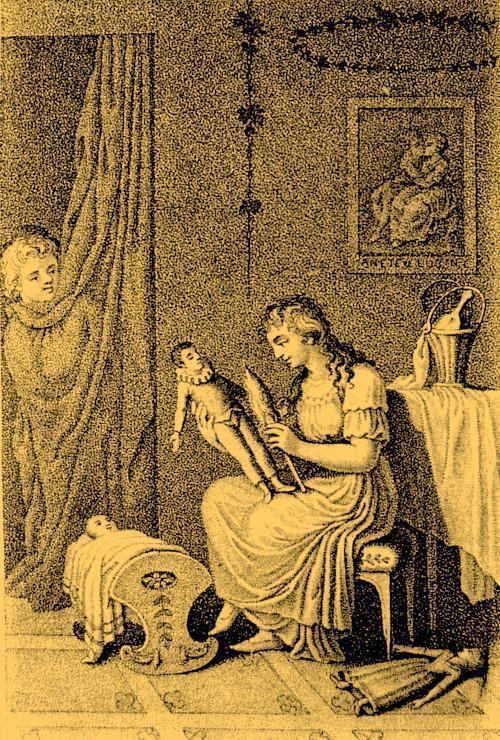
[1] These sentiments resemble that of the young woman in the following illustration who rediscovers her childhood dolls while simultaneously rocking her present — quite real — infant with her foot (illustration from Johann Friedrich Cotta’s Taschenbuch für Damen auf das Jahr 1800 [Tübingen 1800]):
Strictly speaking, Caroline’s reference to their childhood dates to their teenage years beginning at approximately fourteen, when Caroline first attended the boarding school in Gotha. Their friendship endured till Caroline’s death in 1809 (Goettinger Taschen Calender vom Jahr 1784; Inhaltsverzeichnis deutscher Almanache, Theodor Springmann Stiftung):

[2] Caroline assumes that Luise Gotter understands to which performance (and where) she is referring, although such remains unclear for later readers. See below.
Friedrich Wilhelm Gotter, Der schwarze Mann, two-act farce published in Johann Gottfried Dyk’s Theater der Franzosen IX (Leipzig 1784; as a single publication 1785). The farce was based on Maillé de Marencour, L’Homme noir, ou, Le Spléen. Comédie en deux actes et en prose; représentée, pour la première fois, à Paris, sur le Théâtre de l’Ambigu-Comique, le 2 juin 1783 (Paris 1786).
The piece, which premiered in Berlin on 7 August 1783, involves an Englishman whose depressed disposition prompts him to leave his wife and child and ultimately to contemplate suicide, from which his wife’s own death — she has searched him out in Germany — dissuades him. Here the cast of characters from Dyk’s edition of 1784:

The character of a poet or playwright (Theaterdichter) plays a central role in the piece; he observes these events and in fact views them as a drama on whose conclusion he cannot quite decide. The piece was widely viewed as deriding Schiller, and August Wilhlem Iffland did indeed allegedly use the protagonist as a vehicle to do so in the Mannheim premiere on 3 August 1784, though various considerations militate against this assumption.
In any event, although Goethe referred to the play as a “tasteless, pathetic piece,” it was Gotter’s most widespread dramatic success, being performed in Mannheim, Hamburg (as late as 1812), Vienna (as late as 1837), by Gustav Friedrich Wilhelm Grossmann’s company, and even Riga (15 August 1784), Munich, Dresden, Prague, and Breslau, not to speak of performances by lesser companies. Goethe’s remarks notwithstanding, it was performed fourteen times in the Weimar theater itself between 1792 and 1809 (Rudolf Schlösser, Friedrich Wilhelm Gotter, 260–67). Back.
[3] Mozart’s Le nozze di Figaro had premiered in Vienna on 1 May 1786. Back.
[4] Fr., “they mean no harm at all.” Back.
Translation © 2011 Doug Stott