
• 163. Caroline to Luise Gotter in Gotha: Braunschweig, 5 June 1796
Braunschweig, 5 June [17]96
|382| You have forgotten me, my dear Louise. — For months now I have been pleading in vain for some word from you. Auguste is practically pining away — really, I have had a difficult time of it having to soothe her ardent longing for a letter from Cécile; that longing intensifies with every postal day and then invariably breaks out in laments and invectives. How is it that you there are so totally ignoring us? [1]
In our despair, we have resolved to put that question to you in person, and so you should not be startled, my dear, if I genuinely do end up requesting accommodations for one or two nights, perhaps in mid-July. [2] This time you shall not watch for me in vain — for I will be coming with sound protection, though I must beg accommodations for that protection as well. After all, you have two beds, and Gustel can sleep with Cécile. If you cannot make do with this, then go and ask the Chanoinesse; for she is the oracle, and knows all.
|383| Well, that should finally prompt you to respond. Auguste heightens my own joy — I can compare hers with none except that which I felt when I saw the towers of Gotha for the first time again in my 15th year. [3] Her heart is about to jump out of her chest. She truly is fonder of your children than of anything else in the world except me. Please do go ahead and let Cécile write, and tell her that I have a nice little plan to relate to her for the coming summer.
The Chanoinesse will be presenting a request to you that I strongly recommend. Please write soon, also give my regards to Gotter and Aunt Lorchen. Gotter will certainly receive my protector well, and indeed receive him into his own protection. And please, by the way, do not scold me too severely for remaining silent for so long. So many cares and so much worry can, after all, close one’s heart off a bit, though the first ray of joy opens it up anew if, like mine, it is by nature so disinclined to be closed off in the first place. [4]
Notes
[1] It may be worth noting that Luise’s husband, Friedrich Wilhelm Gotter, would die on 18 March 1797, i.e., within approximately nine months, apparently from consumption (Genealogischer Calender auf das Jahr 1785 [Berlin]; Inhaltsverzeichnis deutscher Almanache, Theodor Springmann Stiftung):

It may be that Luise’s silence derived from the disruption in their household introduced by his deteriorating physical condition. Back.
[2] On the way from Braunschweig to Jena after her wedding on 1 July (Post Karte Durch ganz Deutschland, ed. J. Walch [Augsburg 1795]):
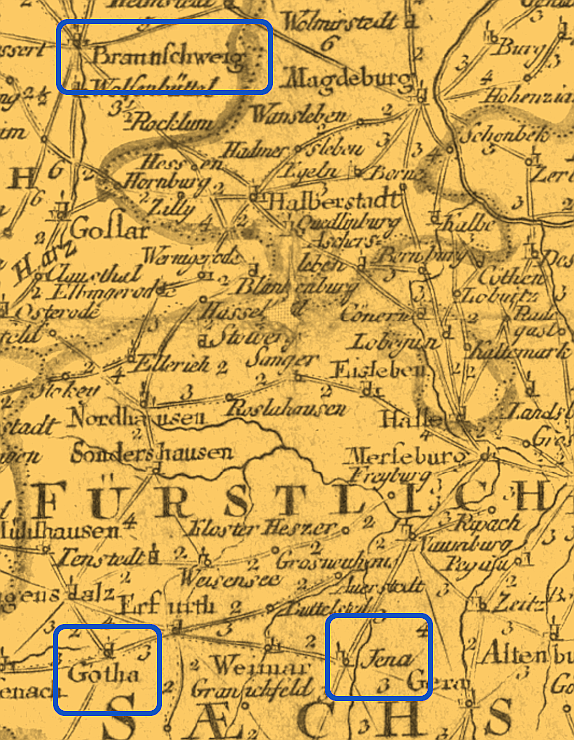
[3] Caroline attended boarding school in Gotha as a young girl, as did her two sisters, Lotte and Luise Michaelis (Post Karte Durch ganz Deutschland, ed. J. Walch [Augsburg 1795]):

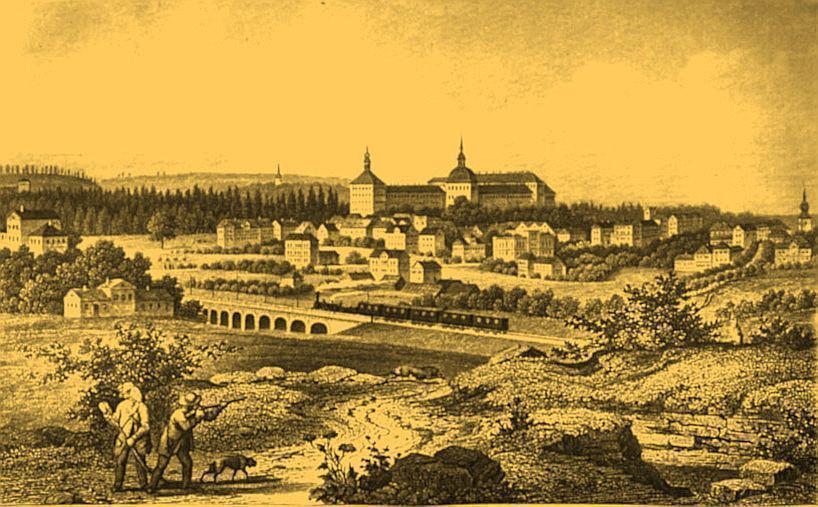
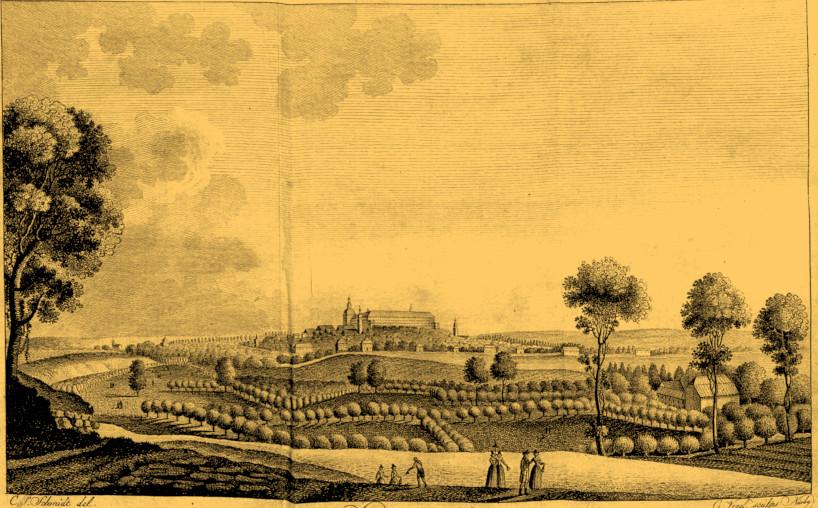
Caroline turned fifteen in September 1778, hence the journey to which she here refers apparently took place between September 1778 and September 1779. Here the towers of Gotha’s Friedenstein Castle from a distance (first illustration: H. Schwerdt and A. Ziegler, Thüringen, Meyers Reisebücher, 2nd ed. [Hildburghausen 1871], plate following 422; second illustration, Gotha from a distance, 1796: frontispiece to A. Klebe, Gotha und die umliegende Gegend [Gotha 1796]):
[4] These “cares” and “worries” may be referring to her anxiety concerning her and Auguste’s future as well as the apparently still unresolved plans to emigrate to America; see Mother (Johanna Christiane Erdmuthe) Schlegel’s letter to Wilhelm Schlegel in 1796 (letter 163c), note 1; Daniel Nikolaus Chodowiecki, Mariane allein auf ihr Kämmerchen macht kummervolle Betrachtungen [ca. 1742–1830]; Herzog August Bibliothek; Museums./Signatur Uh 4° 47 (250); illustration to Pierre Carlet de Marivaux, La Vie de Marianne):

With respect to her imminent marriage to Wilhelm Schlegel on 1 July 1796, she would, moreover, later remark in a letter to Julie Gotter on 18 February 1803 (letter 375) that “I should have been more cautious about entering into marriage with him in the first place, something prompted more by my mother’s urging than by my own desire,” a situation not entirely unlike that of her first marriage, concerning which she had disingenuously written to Julie von Studnitz on 17 February 1784 (letter 39):
My brother will be giving me to the man to whom he destined me from my childhood, namely, his best friend, who has loved me ever since. Through this marriage I will be fulfilling the wishes of my family, my friends, and his friends; moreover, my own heart has long been in accordance with them. Guided by all these powerful motives, I made my choice — and it was literally that same choice.
Translation © 2011 Doug Stott