
• 30. Caroline to Julie von Studnitz in Gotha: Göttingen, 2 March 1782 (Fr.)
Göttingen, 2 March 1782
|59| Ah, how long since I last wrote to my friend! . . .
During the entire time, I was held in suspense regarding plans for a journey to Gotha. My sister Charlotte will be returning at Easter, and we would have gone to pick her up had we found no other opportunity to bring her here. [1] Several of these projects have run aground, and yet as soon as my hope revives, someone is there with yet another project to batter it down anew, and I do believe that in the end my hopes will be completely dashed. Hovering thus between hope and fear, I have been alternately happy and melancholy. You know well how I am completely inclined to excess, so only imagine my situation. . . .
Far from all that is most dear to me, with no friend around whom I might love like those who are absent, separated from my brother, living in a place that, as a university town, is not at all to my taste. Is all that not a decidedly gloomy picture? And yet I also have ample reason to be happy and am sometimes even quite content.
The source of this discrepancy no doubt resides within my own heart. It is my heart that is so inconstant, or constant in nothing but |60| friendship, a truth I sincerely feel. In my mind and heart dwells either heaven itself or its opposite, and it is there that I live amid eternal emotions. How my fantasy does sometimes portray the world! And how my imagination then wanders through it! I am never tranquil, instead flying constantly to and fro between opposing sides.
You have perhaps heard about the modest events that took place here. First, a house not far from ours caught fire, and everyone, mindful of the unfortunate fate of Gera — which has only just emerged from the ashes — was more alarmed than usual. [2]
Then our young students thought it in order to propose and indeed instigate a tumult out of dislike for the current prorector, [3] dislike at least in part quite unjust, and even then deriving more from of a lack of morals and other wretched motives. And as is always the case, it was the least noble of our students who caused the tumult, and street ruffians who assisted them in carrying it out.
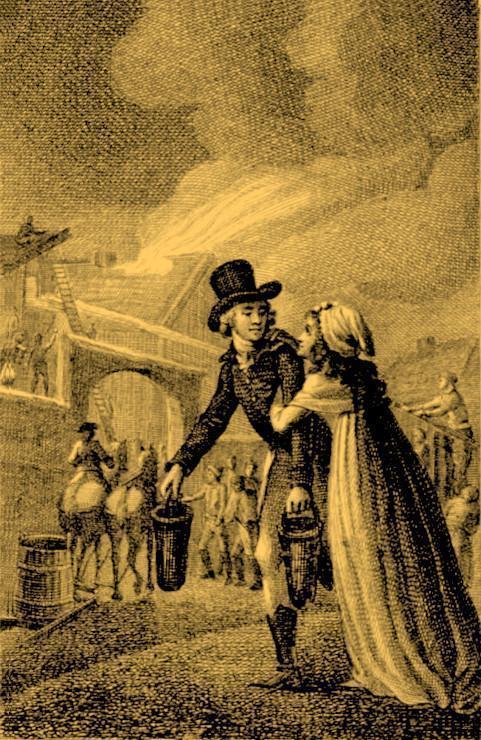
In the meantime, I had a terrible fright for a quarter hour. That same evening, just when everyone was expecting the greatest trouble, someone cried “fire,” the drummer began beating his drum, the bells sounded, and we learned simultaneously that the fire was allegedly in the prorector’s house. It was indeed there, in the orangery of his botanical garden, but was quickly extinguished. It was extremely cold, with the wind blowing toward the city, and since the students would not have helped, Göttingen could easily have been lost. [4] But everything is tranquil at the moment.
My brother writes that he no longer sees either hope or even the possibility that America will be conquered. Clinton is the reason Cornwallis has been forced to surrender. People are saying publicly that Cornwallis was sacrificed. |61| Some generals decided to free him with six thousand men, but Clinton refused to give them those men. [5]
Although the young prince must be quite amiable, the Americans announced his arrival in the following fashion: Yesterday arrived at Newyorck a young puppy of the old whelp, [6] “puppy” being a young dog or Grünschnabel, [7] a “whelp” a suckling dog, a Bube, a Schelm, [8] and at the same time the name of the family of the kings of England. [9]
A friend wrote me something about a picture done by Goethe accompanied by a ballad he sang to the Duchess of Weimar; [10] then about a poem for her birthday sung by the “feminine virtues.” [11] I confess I am quite curious to see those two pieces, and as you, dear Julie, are perhaps able to procure them easily for me, let me entreat you earnestly to do so; I will be enormously grateful to you for your goodness. It goes without saying that I do not wish to have the picture, merely a copy of the two poems. . . .
Notes
[1] Lotte Michaelis would return to Göttingen from Gotha on 17 April 1782; apparently one condition for her return was that Pedro Hockel have already left; concerning his departure, see Caroline’s letter to Luise Gotter on 22 December 1781 (letter 29). Back.
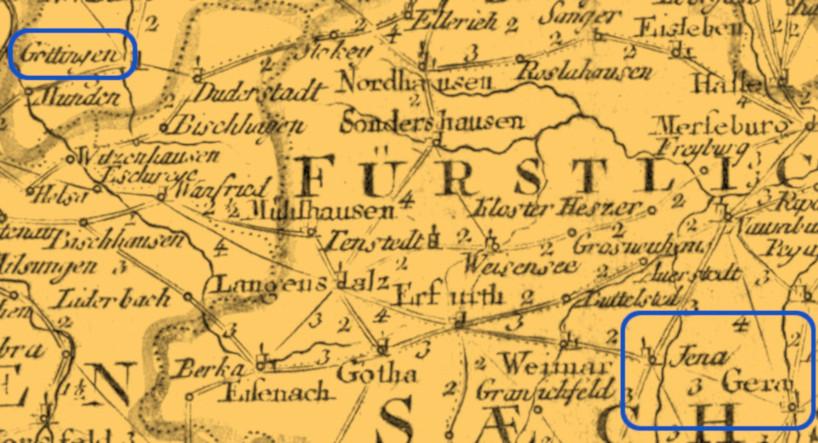
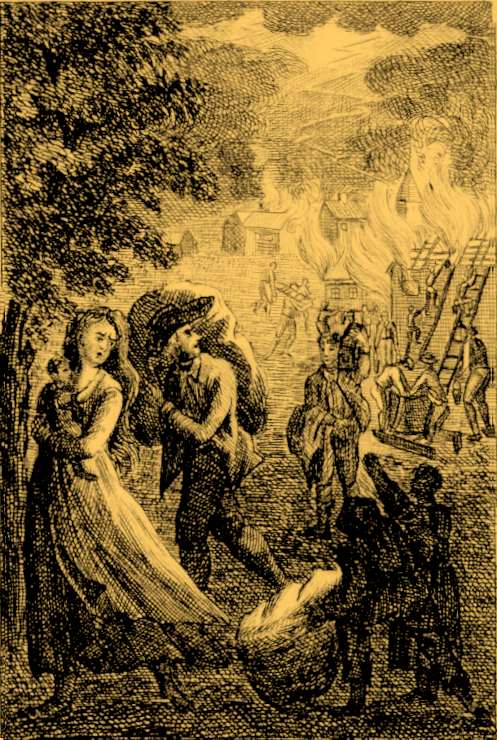
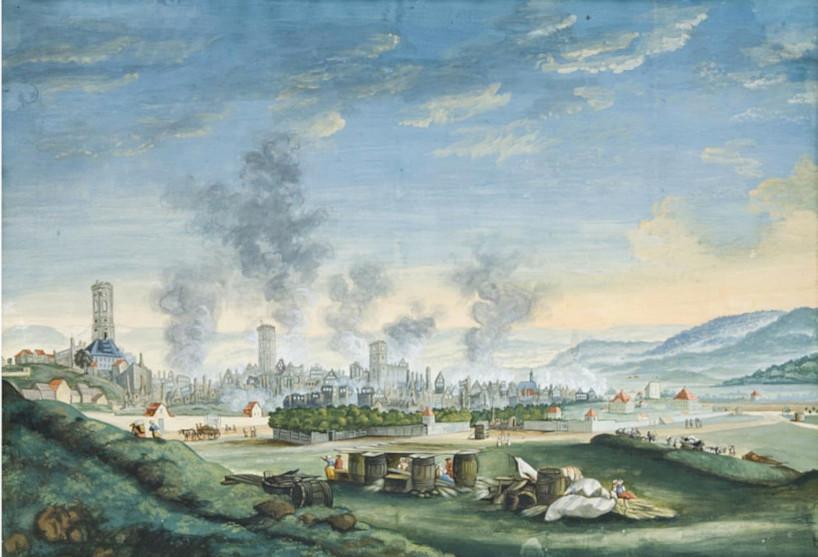
[2] The German town of Gera, just southeast of Jena, where Caroline eventually resides, was devastated and virtually destroyed by fire on 18 September 1780 (frontispiece to Fanny Burney, Georgina eine wahre Geschichte, vol. 1 ;Tübingen 1790]):
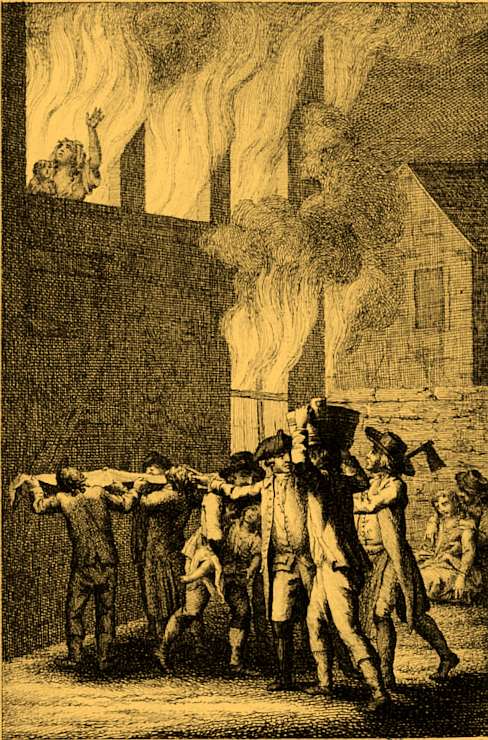
The fire, apparently started by an arsonist (a stonemason), quickly spread throughout the city because of the drought-like conditions and the winds it generated. Of 897 buildings, 785 were destroyed, including the theater; ten people died (Post Karte Durch ganz Deutschland, ed. J. Walch [Augsburg 1795]; representative illustration: Ernst und Scherz: Ein Taschenbuch zur angenehmen und nüzlichen Unterhaltung für das Jahr 1810; Inhaltsverzeichnis deutscher Almanache, Theodor Springmann Stiftung):
Here an anonymous oil painting of the fire (Sammlung: Kunstsammlung Gera):
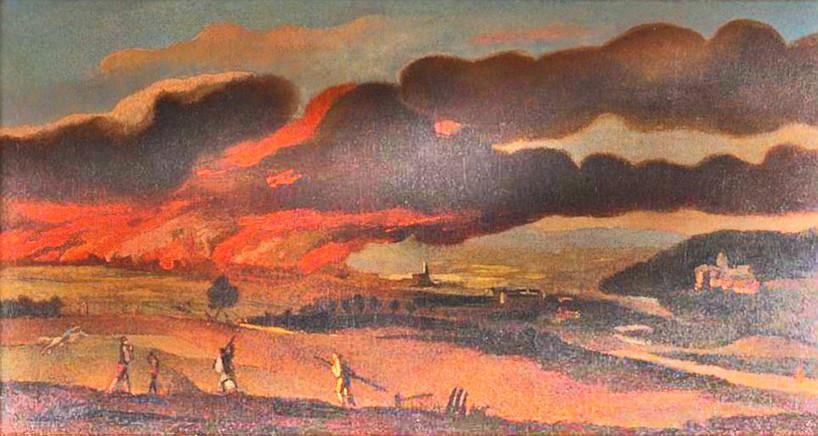
And a later oil painting (1860) by Carl Theodor Bergner showing the town the day after the fire (Sammlung: Kunstsammlung Gera):
[3] The university prorector from 3 July 1781 till 2 July 1782 was Johann Andreas Murray. Back.
[4] Representative illustration Leipziger Taschenbuch für Frauenzimmer zum Nutzen und Vergnügen auf das Jahr 1799:
When the director of the botanical gardens, Professor David Sigismund Augustin Büttner, died in 1768, Murray was appointed his successor. Here the house in 1738, “Residence of the Director of the Botanical Garden in Göttingen from the year 1738” (at far right: the roof of the hothouse), in Albert Peter, Geschichte der Gründung und Entwicklung des botanischen Gartens zu Göttingen (Berlin 1901), 300:

[5] Following the siege of Charleston in May 1780 (see notes to letter 12), General Henry Clinton returned to New York, leaving Charles Cornwallis in command of the British campaign in the South.
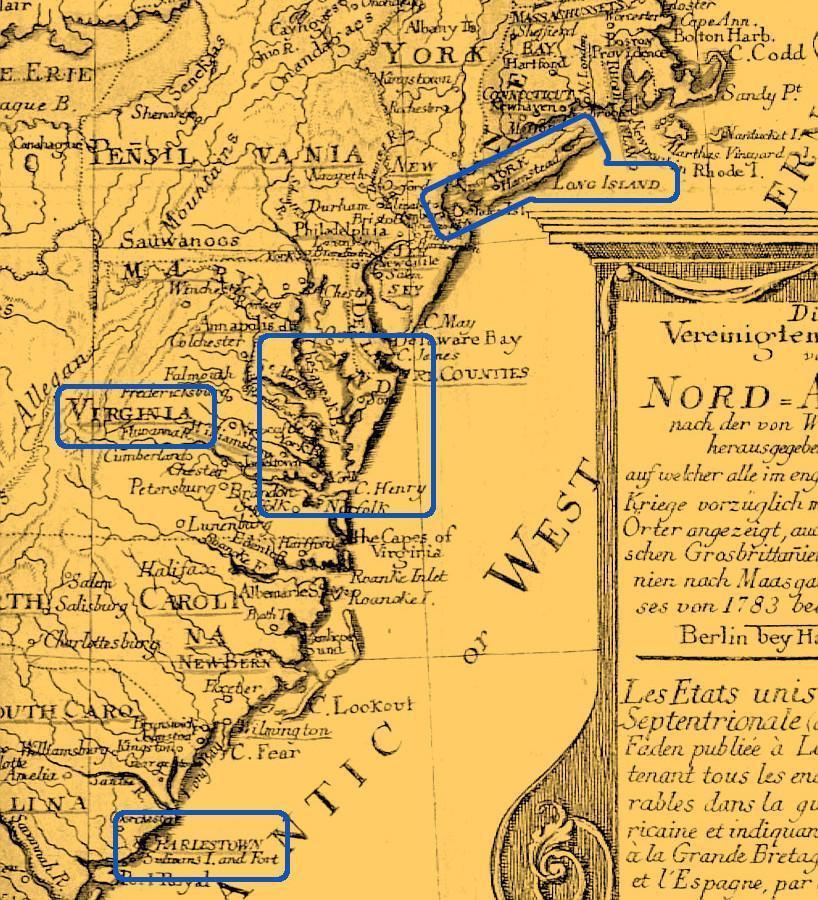
During the course of the ensuing campaign extending into 1781, Cornwallis deduced that most of the supplies for the American forces were coming from Virginia and thus resolved, against the wishes of Clinton, to invade Virginia, hoping to cut those supply lines. Without informing Clinton, Cornwallis marched north into Virginia to engage in raiding operations. Cornwallis then received orders from Clinton to choose a position on the Virginia peninsula and construct a fortified naval post to shelter ships of the line (here the locales mentioned thus far [also below]: Die Vereinigten Staaten von Nord-America nach der von Wm Faden 1783 herausgegebenen Charte, in the Historisch-genealogischer Calender, oder Jahrbuch der merkwürdigsten neuen Weltbegebenheiten für 1784; Inhaltsverzeichnis deutscher Almanache, Theodor Springmann Stiftung):
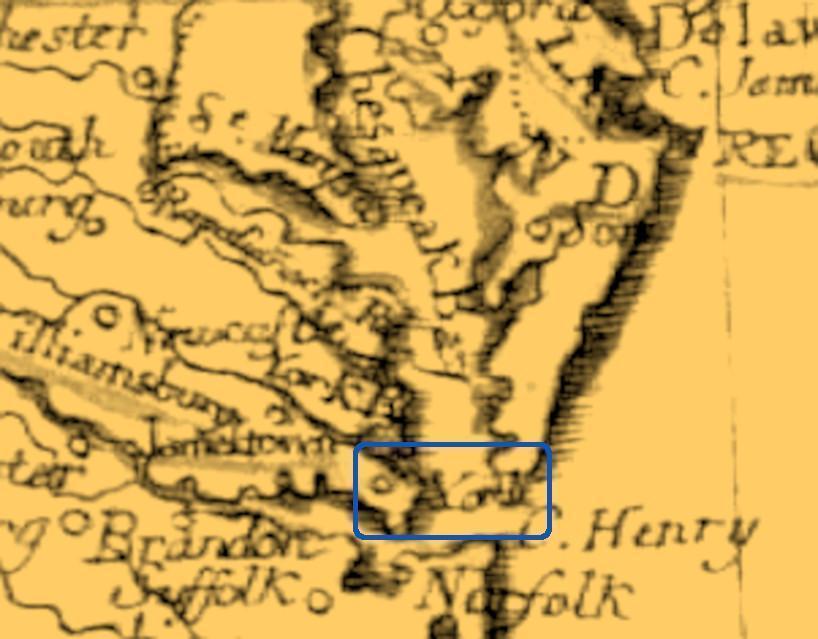
In complying with this order, Cornwallis put himself in a position where it would be easy to become trapped. During the next period, the letters between Cornwallis and Clinton became increasingly acrimonious. With the arrival of the French fleet under François de Grasse and George Washington’s combined Franco-American army, Cornwallis found himself cut off in Yorktown, Virginia (here as “York,” on the peninsula between the James River and York River; note also Jamestown and Williamsburg to the west, the Chesapeake Bay extending to the north):
Realizing the scope of his predicament, Cornwallis managed to send a message to Clinton in New York, who promised that a relief expedition carrying five thousand men would leave by 5 October 1781. After the Royal Navy fleet was defeated by the French at the Battle of the Chesapeake, and the French siege train arrived from Newport, Rhode Island, his position became untenable.
He surrendered to General Washington and the French commander Lieutenant General Jean-Baptist Rochambeau on 19 October 1781, the day Clinton sailed from New York (ibid.: “The Americans take Lord Cornwallis and his army prisoner at Yorktown on 19 October 1781”):

Clinton arrived on 24 October to find, of course, that he was too late. It was the last major land battle of the American Revolutionary War. Back.
[6] In English in original. Back.
[7] In German in original, “young whippersnapper, greenhorn.” Back.
[8] In German in original, “boy, [impudent] youth; rascal, rogue.” Back.
[9] I.e., the House of Welf (Guelf, Guelph). Back.
[10] The ballad by Goethe accompanied by a picture was presumably “Das Neueste von Plundersweilern” (1781) along with the parody painting not by Goethe himself, but by Georg Melchior Kraus:
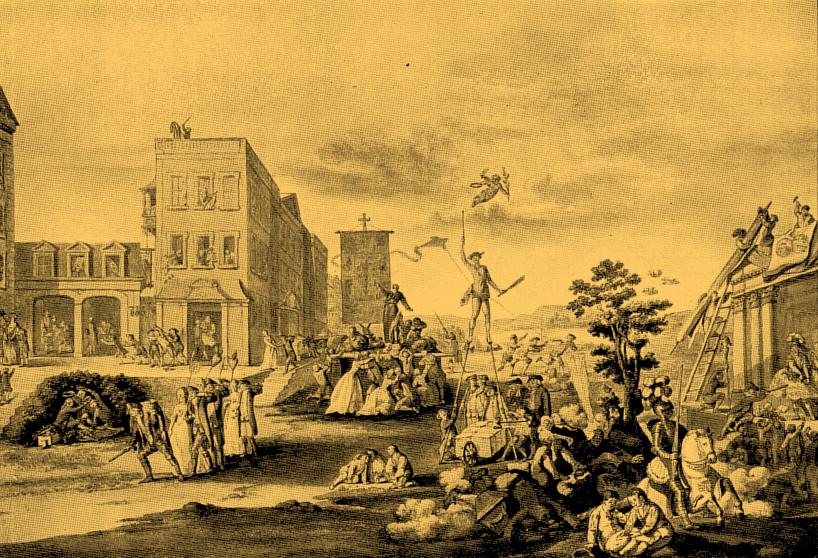
The poem was not published until 1817. Goethe’s preface from 1816 explains the circumstances and connections between the ballad and painting. Weimarer Ausgabe 87:6:1, 288–98, here 288 (Goethe’s preface):
The following poem requires a bit of introduction, without which it may well remain largely incomprehensible.
Duchess Amalia had instituted the gracious custom of distributing gifts to all the persons in her closer circle at Christmas. In a spacious room, tables, frames, pyramids, and other structures were set up where individuals found these gifts, gifts designed in part to reward and delight them for their service to society and in part also to chastise and admonish them variously for ill conduct, bad habits, and mistakes.
At Christmas 1781, several members of this company decided to present the princess herself with a gift that was to be nothing less than a comical look at German literature itself of the most recent years. The subject had been discussed and argued and examined at such length that it was eventually possible to summarize and assemble many of the jesting and disparate elements into a single picture.
After the author developed a draft, Rath [Georg Melchior] Kraus prepared a watercolor painting; at the same time, however, a poem was written to provide at least some explanation for the colorful and strange figures in the picture. The picture itself was then placed in a golden frame and covered over.
After everyone had sufficiently reveled in the traditional gifts, the “market crier of Plundersweilern” entered in the form familiar from Ettersburg [where Anna Amalia spent her summers between 1772 and 1782; Goethe’s earlier version of this motif, Das Jahrmarktsfest zu Plundersweilern, written in 1773, published 1774, with a second version in 1778, was performed in the Ettersburg castle on 20 October 1778, Goethe himself performing the role of the market crier], along with a comical companion, greeted the company, and after the unveiling and illumination of the picture recited this poem, whose individual figures his companion indicated with a pointer as they came up in the poem.
This jest succeeded quite to the enjoyment of the highest patroness herself, albeit not without minor vexation to several of those present who might have felt themselves pricked by the poem.
The picture, which still exists and is yet well preserved, might in the form of a deft copper engraving promote a better understanding of the poem and serve as a harmless bit of entertainment for a German public that considers itself long enlightened with regard to those earlier times.
Weimar, 30 April 1816 Back.
[11] Caroline seems to think the two pieces were done for the same person. But “Das Neueste von Plundersweilern” (if such indeed be her first reference), as seen in note 10 above, was done for the dowager duchess, Anna Amalia, while the second piece, Die weiblichen Tugenden an die regierende Herzogin von Weimar zum 30. Januar 1782 (1782), (Weimarer Ausgabe 16:197), was composed for a birthday redoute in Weimar for Duchess Louise, whose birthday fell on that day. The afternoon part of the celebration does, however, seem to have been conducted at the dowager duchess’s residence in Tiefurt. In any event, the Virtues eventually have Modesty hand over to the duchess ribbons on which the poem was written. See Johann Wilhelm Schaefer, Goethes Leben (Bremen 1851), 322–32:
For the duchess’s birthday [30 January], Goethe arranged a ballet performed largely by children. Fräulein Louise von Göschhausen provides an account:
Once upon a time, a fairy and a magician insulted a powerful spirit, whereupon they lost the privilege of remaining forever young. They then became old along with all the fairies and magicians who were their followers. They were to suffer this punishment until the great garnet was found in a certain mountain crevasse that magically contained what they lacked. So the fairy and magician combined their powers to find this stone. Mountain spirits were conjured, fairies, gnomes, and nymphs did their best in engaging all sorts of magic, and the adventure was successfully completed; the great garnet was then brought forward and opened, whereupon — Amor jumped out.
At that moment, great transformations took place, and from an entire theater full of old women and gnomes there emerged nothing but beautiful girls and boys. These transformations were quite successfully performed, and the accompanying decorations and music quite nice. The performance was mixed with singing and dancing and ended with a grand ballet.
Goethe’s poem “Amor” concluded the birthday ballet (Weimarer Ausgabe 16:198–99):
The Amor who such comely blessings brings
To you from so many hearts,
Is not Amor the
Recklessly vain, the perpetually easy;

But Amor whom loyalty
Took, newborn, unto itself,
When the beautiful world, the new world,
From the hands of the gods did come.

Hungrily did I learn its lessons,
As obedient as a young boy,
And it taught me to respect
What respect does truly merit.

To get on with those who are good
Was my youthful drive at first,
Then with the noble to unite
Made this world my delight.

But alas! how rarely now
Does my earnest greeting delight;
For my false brothers now do
Count for more with easy jests.

Then lonely do I dwell, morose,
Indulging in no joys,
As if in that cliff sequestered,
About which our fable tells.

But, now, of a sudden, do
Hearts emerge resembling my own;
And eternally young do I myself now descend
To secure my realm.

Preserving joys of youth
By revealing, quietly, true happiness,
And guiding even the old
Back to that gracious time.

The good that the good do find
The gods do guide through me.
This Amor does now greet and bless
Thee, his friend, today!
The ribbon with the following greeting was then presented to the duchess (“The Feminine Virtues,” Weimarer Ausgabe 16:197); here: Johann Daniel Falk and Friedrich von Müller, Characteristics of Goethe, 2. vols., trans. Sarah Austin [Philadelphia 1841], 1:161):
We constantly
Surround thy life;
Yet thy will
Bids us quietly
work in silence.

Ah, forgive
That in celebration
Of this festival
We this day
show ourselves more bold'y!

In this press,
Before the multitude,
Meet thee,
And bless thee!" Back.
Translation © 2011 Doug Stott