
• 165. Caroline to Luise Gotter in Gotha: Jena, 11 July 1796
Jena, 11 July [17]96 [1]
|389| Dear Louise, I hope you arrived back in Gotha as safely as we did in Jena. [2] You were surely in the park during the afternoon, except that the orphaned mother did not enjoy it half as much as she would have had she had one of her little sheep with her.
It was just as well you did not come along with us here, since initially things were quite chaotic, though that night we were indeed all able to settle down, and everything else will be fine now. The house is small but quite charming. [3] In only one respect did Schlegel mislead — indeed, betray me! He had mentioned white curtains in his letter. The truth is that only small, gray, tattered rags are hanging in front of the windows. Here you must immediately come to my aid, my dear. . . . I cannot be party to this abomination.
I also left my tea with you, prompting considerable reproaches from Schlegel. So yesterday, when the Hufelands came to see me, I had to borrow tea from Madam Schiller. So please do send that along to me as well . . .
We went to see the Schillers after our meal the day before yesterday, since it was no longer possible that same evening. Everything was just as I had imagined it would be — except that I found Schiller to be more handsome, and his little boy is marvelous. We were just on our way to see them when someone met us with the news that she had just given birth to a second little boy fifteen minutes earlier. [4] Schiller came out to meet us |390| and was just so friendly and cordial. He said he thought I would be able to see her again tomorrow, since she was doing quite well. [5]
The first time, Madam von Kalb came with little Rezia. Madam Schiller managed to get me a maidservant from Rudolstadt, who was already here; to this point she seems extraordinarily accommodating and can also cook. [5a] —
We went from there to the Hufelands, who received us like relatives. [6] Yesterday they were already here again and invited us over for tomorrow evening. I want to visit Madam Schütz before then. Madam Voigt convinced Madam Schiller that she already knew me. But I know nothing about such a thing. [7]
If I left anything else with you, please do not withhold it from me even though I have infinitely more obligations you want me to fulfill in my own turn. We are sincerely grateful to you for all the good, dear things you have done for us. When will we ever be able to repay you even a little? Now, however, having hurtled over hill and dale, we are leaving all that behind and have finally reached a smooth path of the sort to which you have long been accustomed, and one that is nearby as well. And I am indescribably happy. Regards to your family and to Madam and Mademoiselle Schläger and Minchen.
The fresh air got rid of my headache. Schlegel was afraid the rock cliffs at the entrance to the town might frighten me off. [8] But I only paid attention to what is good and pleasant about the place and have already become quite good friends with this romantic valley. Gustel is still living in her memories.
Notes
[1] The Schlegels arrived in Jena on 8 July 1796. See Schiller to Goethe, 9 July (actually: on Monday, 11 July in an addendum to a letter of 9 July; here Correspondence between Schiller and Goethe from 1794 to 1805, trans. by L. Dora Schmitz, 2 vols. [London 1877], 1:202):
To-day I cannot add more, as things are in too unsettled a state. My wife is close upon her confinement, and Stark expects it to-day. I thank you cordially for your friendly offer to take Karl into your house; but he is no trouble to us, as we have taken a few additional persons into our service, and so arranged the rooms that he will not be in the way. . . . Schlegel and his wife have arrived here again. Back.
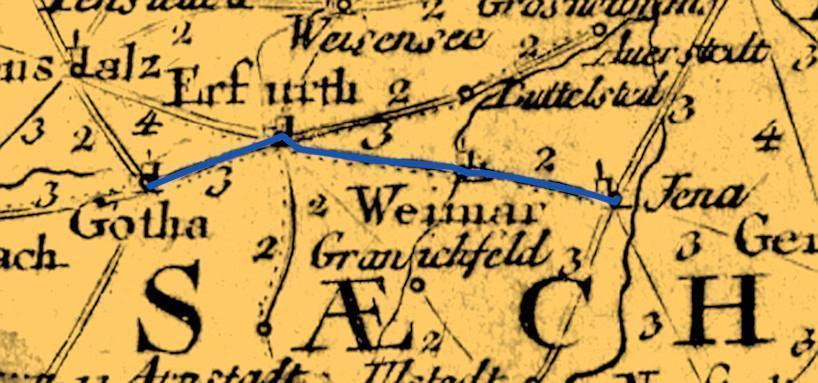
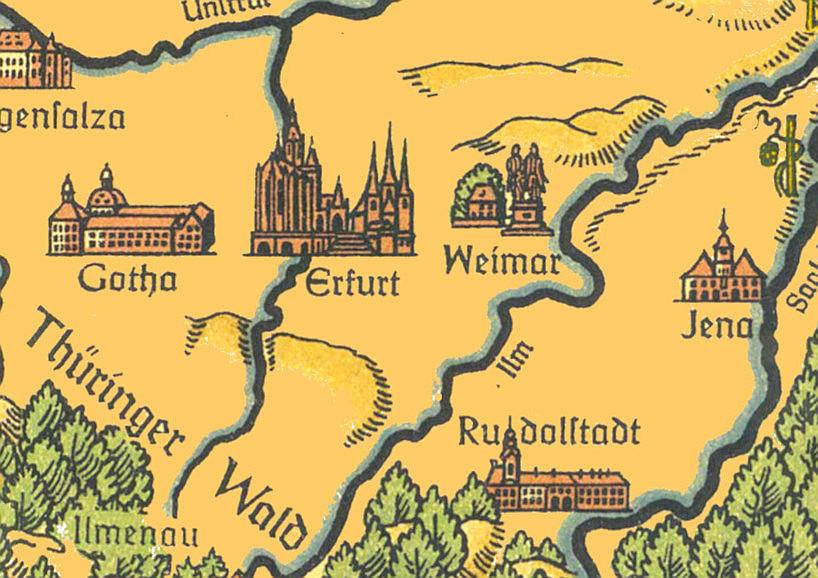
[2] Concerning the Schlegels’ overall route from Braunschweig, see Karl Schlegel’s undated letter to Wilhelm Schlegel in July 1796 (letter 164a), note 1. Luise Gotter seems to have accompanied them part of the way to Jena after the latter had stayed with the Gotters in Gotha (Post Karte Durch ganz Deutschland, ed. J. Walch [Augsburg 1795]; Rudolf Koch and Fritz Kredel, Deutschland und angrenzende Gebiete [Leipzig 1937]):
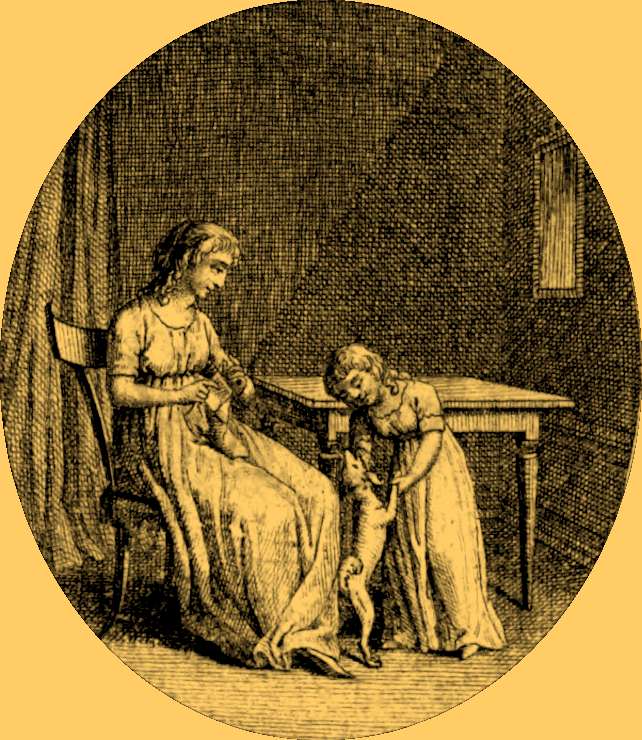
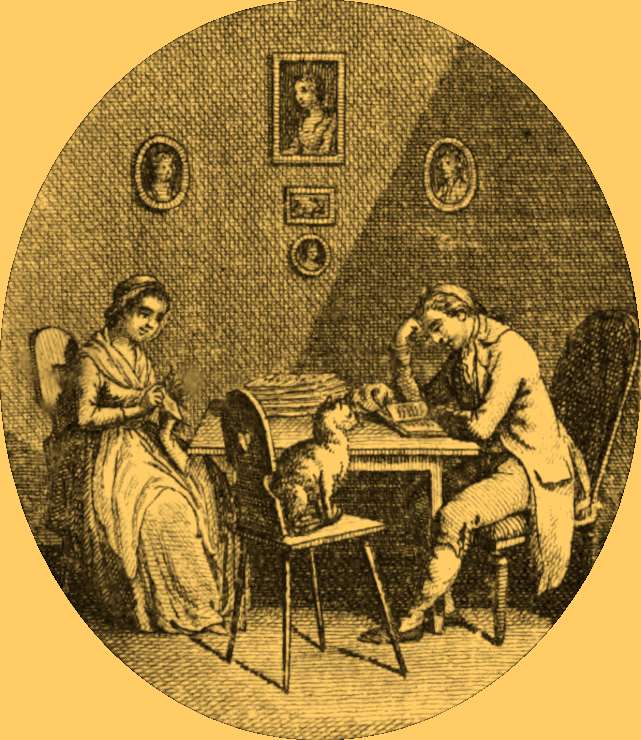
[3] Wilhelm, Caroline, and Auguste seem to have moved initially into a small garden house in the general area between the Löbder Gate and the Paradise greenspace in Jena. Concerning the exact location of this this “garden villa,” see Wilhelm Schlegel’s letter to Georg Joachim Göschen on 24 June 1796 (letter 163h) with note 6 (frontispieces to Gotthelf Wilhelm Christoph Starke, Gemählde aus dem häuslichen Leben und Erzählungen, vols. 1, 3 [Berlin 1800; 1801]):
References to this area will recur in different contexts during the Schlegels’ stay in Jena. Back.
[4] See again Schiller to Goethe on 11 July 1796 (Correspondence between Schiller and Goethe from 1794 to 1805, 1:202):
Monday [11 July] 3:00 in the afternoon
The confinement of my wife took place two hours ago, in a shorter time than was expected, and with Stark’s assistance, easily and happily. My wishes are in every respect fulfilled, for it is a boy, apparently well and strong. You can imagine what a weight is taken from my heart, especially as I had cause to fear that the spasms might make the birth premature. Back.
[5] Concerning the social interest in the Schlegels expressed by Schiller and others:
Wilhelm von Humboldt had written to Wilhelm Schlegel from Berlin on 23 July 1796 in this regard (Anton Klette, Verzeichnis der von A. W. v. Schlegel nachgelassenen Briefsammlung. Nebst Mittheilung ausgewählter Proben des Briefwechsels mit den Gebrüdern von Humboldt, F. Schleiermacher, B. G. Niebuhr und J. Grimm [Bonn 1868], v–vi):
Our correspondence has been interrupted for so long now, my dear friend, that I now can pick up on no thread other than my sincere hope that you have not entirely forgotten me and would like to begin anew with that correspondence, one that ran aground, after all, solely on the distant location of your former residence [Amsterdam] and your subsequent journey back to Germany. . . .
The change in your situation and place of residence, something I learned through our common friend Schiller, enormously delighted me. It happens only very rarely indeed that a person wholly attains in life precisely what earlier constituted the innermost and purest wishes of his own heart, and yet for the more noble and refined persons, those accustomed to complete harmony between their feelings and inclinations, on the one hand, and the needs of their external life, on the other, such good fortune is indispensable not only for a happy, but also a beautiful existence. I hope you will be satisfied with your stay in Jena as well, and I at least am infinitely anticipating recommencing the pleasant and enjoyable days next autumn and winter that we formerly shared in Göttingen [during their student days]. . . .
I do not really have the time to say more today, my good friend, but I did not want to delay in wishing you all the luck in the world with your changed situation, and also to ask that you relate to your wife how sincerely I am looking forward to being able finally to express to her in person the ardent admiration I have already long felt for her, since hitherto I have unfortunately been fated to be often and closely associated with persons whom she herself respects, and yet always to remain a stranger to her herself.
Humboldt, however, had written rather differently to Schiller, on 25 August 1795; after assessing the formal (external) features of two of Wilhelm’s poems in Schiller’s Musenalmanach (“Entsagung und Treue,” “Der letzte Wunsch”), he remarked (Briefwechsel zwischen Schiller und Wilhelm von Humboldt, ed. Albert Leitzmann, 3rd ed. [Stuttgart 1900], 96):
Schlegel’s two poems do exhibit some rather obscure features here and there, and the latter’s conclusion also some harshness. There is a certain emotional vehemence that at the very least lacks any visible connection to nature and truth and for precisely that reason, that is, precisely because it is so abrupt, fails to elicit either respect or sympathy at least from me. It is of the same genre as some of the earlier things by Meyer and several later things by Bürger.
I suspect that both pieces are addressed to the same Madame Böhmer who was mixed up with the Forsters. I do at least know that he is entertaining a — considering the distance and (as far as I know) extreme difference in their ages — genuinely fantastic love for her. She is an extremely cold but romantic and vain creature and has exerted considerable influence on Schlegel’s development.
Then on 9 July 1796 (Neue Briefe Wilhelm von Humboldts an Schiller 1796–1803, ed. Friedrich Clemens Ebrard [Berlin 1911], 95):
I am very glad indeed that Schlegel’s company continues to please you. I hope that his wife will also be pleasant company for Lolo [Charlotte Schiller] and Li. Although I myself do not know her, I have heard flattering things about her.
Finally, Schiller writes to Humboldt on 22 July 1796 (Briefwechsel zwischen Schiller und Wilhelm von Humboldt, ed. Albert Leitzmann, 3rd ed. [Stuttgart 1900], 288; not 25 December 1795, as in Geschäftsbriefe Schillers, ed. Karl Goedeke [Leipzig 1875], 179, letter 109; see notes to letter 172 concerning dating) (that same day, he thanks Goethe for the fish that Goethe provided for the meal he and Charlotte shared together with chère mere [his mother-in-law] and the Schlegels, “whom we invited for the meal”), remarking that Schlegel had already been there for two weeks with his wife, and that
the latter has considerable conversational talent, and one can get along very easily with her; now it depends on whether a lengthier acquaintance, particularly if such is to become more intimate, might not disclose some thorn or other. Back.
[5a] Deutsches Leben der Vergangenheit in Bildern, vol. 2 [Jena 1908], no. 1741:
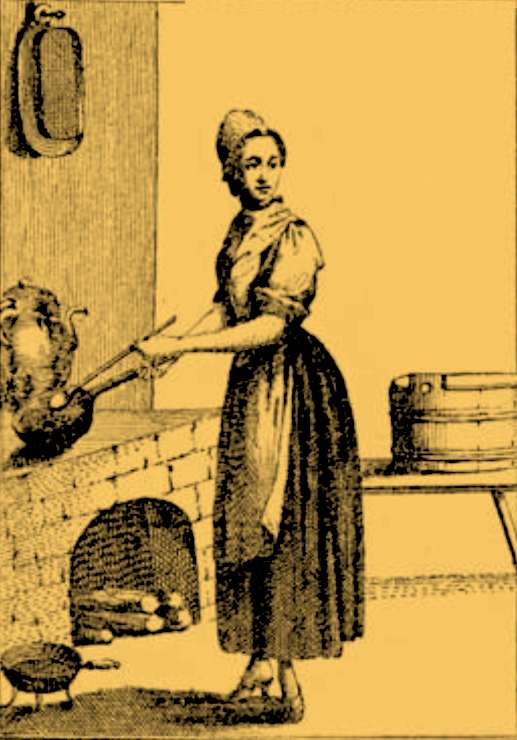
[6] Of course, strictly speaking they were relatives, since Gottlieb Hufeland had married the sister of Christian Rudolf Wilhelm Wiedemann, husband of Caroline’s youngest sister, Luise. Back.
[7] Madam Voigt was likely correct, since she was the sister of Johann Friedrich Blumenbach in Göttingen, one of Caroline’s earliest suitors. Her husband, moreover, Johann Heinrich Voigt, was originally from Gotha, where Caroline had attended school and also visited on several occasions. Back.
[8] Swiss students who studied in Jena were wont to refer to the area around Jena as “little Switzerland” (anonymous, Zeichnung der Universität Jena: Für Jünglinge welche diese Akademie besuchen wollen [Leipzig 1798], 87). Here Jena with its imposing surrounding hills in 1838 (Ludwig Bechstein, Wanderungen durch Thüringen, Das malerische und romantische Deutschland in zehn Sektionen iv [Leipzig 1838], plate following p. 146):

The following panorama provides an even more trenchant illustration of Caroline’s remarks (Panorama-Ansicht von Jena, Städtische Museen Jena, Stadtmuseum; Inv.Nr: SMJ F5,2246,4)

Translation © 2012 Doug Stott