
163f. Mother (Johanna Christiane Erdmuthe) Schlegel to Wilhelm Schlegel: Hannover, June 1796 [*]
[Hannover, June 1796]
Dearest Wilhelm,
I received your letter of 3 June. It was very pleasant for me to hear that you received the title of Rath insofar as, it seems, you yourself were quite pleased with it; [1] it also, by the way, certainly shows that the gentlemen have good intentions toward you as a student. [2]
I will be glad when I am finally reassured that the marriage will not damage your future. The written permission will be sent tomorrow to your Caroline along with a letter from me, which in my opinion is written in a very polite tone, and where I also give her some good advice, something I hope she will not take the wrong way. And so, dear children, write me everything that may interest me and especially anything that can reassure me. — —
She is also the one who has always judged your Caroline the harshest, since she thinks she was once insulted by her pride. [3] So warn Caroline about that and to avoid even the slightest appearance of that sort.
Notes
[*] Source: Waitz (1882), 32. Passages Waitz did not include are indicated by “—.”
At issue in this letter is, again, Caroline’s reputation (Almanac de Goettingue pour l’anneé 1786; Inhaltsverzeichnis deutscher Almanache, Theodor Springmann Stiftung):

[1] Intelligenzblatt of the Allgemeine Literatur-Zeitung (1796) 76 (Saturday, 18 June 1796) 636:
Herr August Wilhelm Schlegel, lately returned [to Germany] following the Dutch revolution [the Batavian Republic in Holland, proclaimed on 19 January 1795] and now residing in Jena, has received the status of a Fürstlich-Schwarzburg-Rudolstädtischer Rath.
The actual document (Sächsische Landesbibliothek: Mscr. Dresd. e 90 II), issued by Ludwig Friedrich II von Schwarzburg-Rudolstadt and dated 28 May 1796 (i.e., while Wilhelm was yet in Jena), was still extant when Josef Körner published his edition of Wilhelm’s letters in 1930 (Körner [1930], 2:14) but not when Roger Paulin researched his biography on Wilhelm (Roger Paulin, The Life of August Wilhelm Schlegel, Cosmopolitan of Art and Poetry [Open Book Publishers 2016], 72fn29).
Schwarzburg-Rudolstadt, with its residence in Rudolstadt, was one of the myriad principalities in Germany at the time, much like — as seen on the map below — Saxon-Gotha with its residence in Gotha, and Saxon-Weimar with its residence in Weimar (Jena also included, which was part of Saxon-Weimar) (Map of the Empire of Germany including all the states comprehended under that name with the Kingdom of Prussia, &c. [London 1782]):

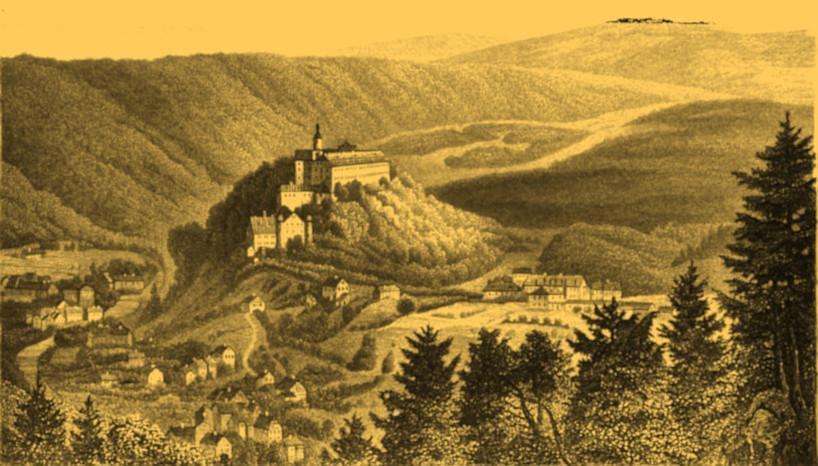
For more on Schwarzburg, which was a favorite excursion goal for Johann Diederich Gries when he lived in Jena, see Wilhelm’s letter to Sophie Bernhardi on 18 September 1801 (letter 329e), note 19 (H. Schwerdt and A. Ziegler, Thüringen, Meyers Reisebücher, 2nd ed. [Hildburghausen 1871], 167):
[2] Waitz (1882) adds a parenthetical exclamation point (!) after this remark, in which Mother Schlegel uses the word for “pupil” rather than, strictly speaking, that for “(university) student”; Wilhelm, of course, had been neither for several years. Back.
[3] An intriguing allusion to an otherwise undocumented episode with the Erxleben family in Göttingen. Back.
Translation © 2011 Doug Stott