
• 151. Caroline to Luise Gotter in Gotha: Braunschweig, 28 June 1795
Braunschweig, 28 June [17]95
|360| Your silence is making me anxious — the entire month has passed without me having heard from even one of my friends. Is this punishment for my sins of neglect, or your own, personal sin? I am finally enclosing for you here the copperplate engraving that has been lying in my chest of drawers for the past 3 weeks. |361| . . .
But what — and here I am making use of my preceding lines — what is Gotter’s excuse for not yet having sent Göschen anything? How can he remain calm knowing that Esther is lying in his desk drawer, since he could instead be turning his talents here to good account? [1]
Please, my child, do permit me to scold him in your name; do not say a word yourself, merely give him this letter to read. Göschen wrote to me. He is so overrun with authors that if he does not receive it soon, he will not be able to print it before the next book fair. I am exceedingly angry, since in the end I will have to create an Esther for him myself. Is the copyist the problem? Can that be it? Why have you yourself not gotten it to copy? After all, you are a woman who writes with a clear hand! Schiller, mortally ill, is busier, since he is now planning on publishing a Musenallmanach, and Reinhard and Dietrich will go bankrupt with their own. [2] I know not who will be publishing it; the only thing I have seen is a letter from Schiller to Schlegel that passed through my hands in which he invited Schlegel to participate. [3]
But please do write soon, my dear, I so long to know what all of you are doing and whether Gotter was in Weimar, though certainly no duchess, no chamberlain could excuse or approve such negligence. Our children, I hope, are babbling on about one another more with their little mouths than with quills. Theirs is, after all, more the time of life for hopping and jumping about than for sitting. I can assure your dear girls that neither mother nor daughter here has forgotten them even in the slightest. Gustel has not yet found a replacement for them here, no one as sensible as Cäcilie, as curious as Julie, or as pleasantly pert as Pauline. Although the Eschenburgs’ little girl is quite beautiful, |362| she is neither well brought up nor particularly bright as far as I have hitherto been able to determine. [4]
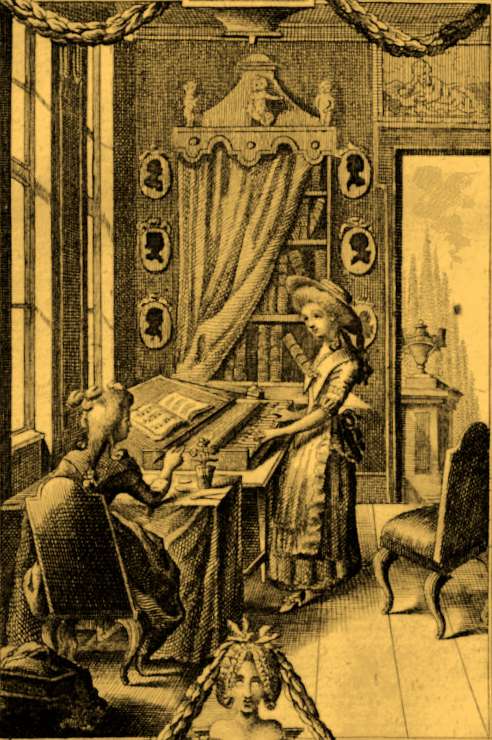
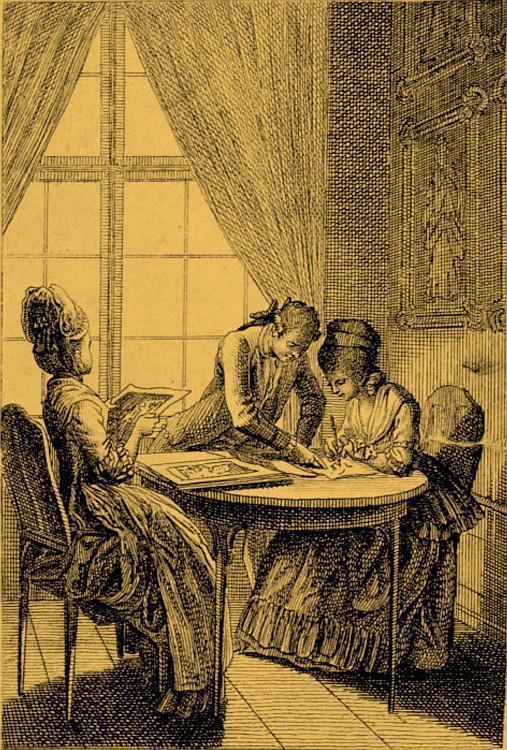
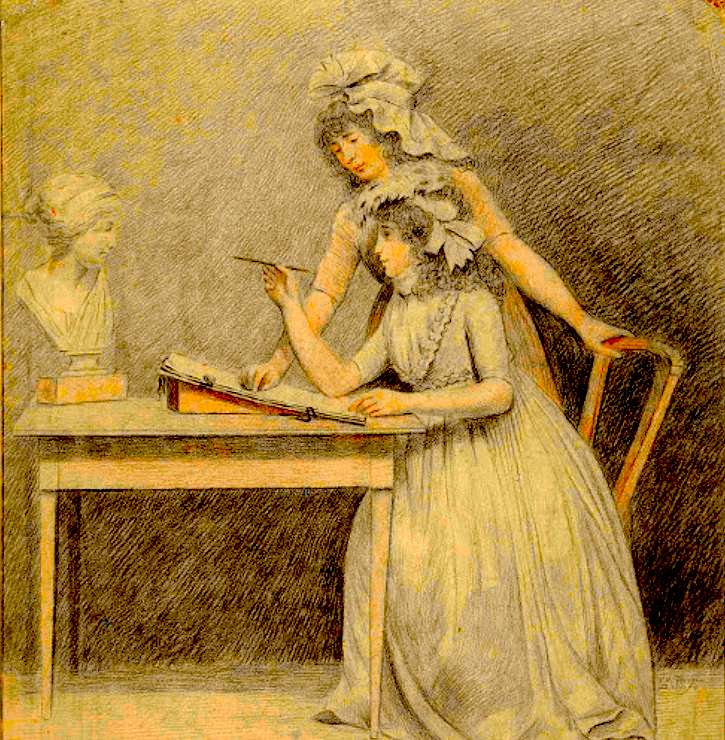
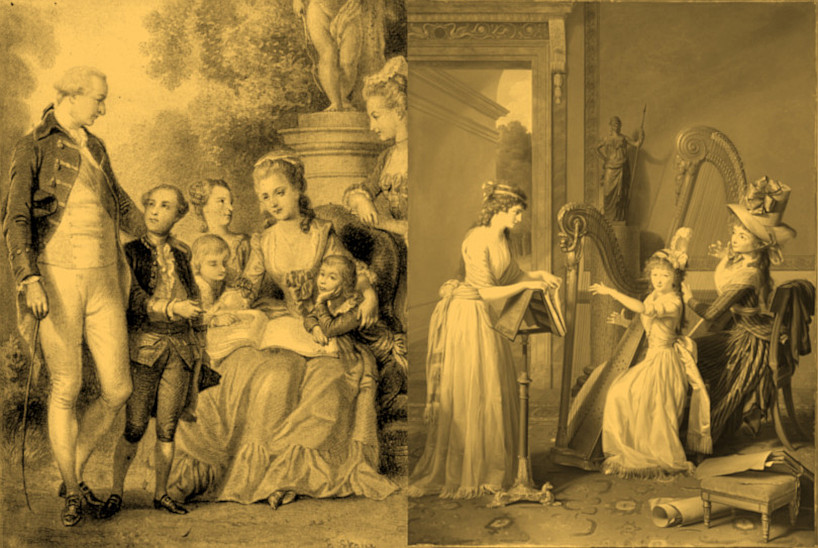
Gustel has quite a few regularly scheduled activities now, from 9:00 to 10:00 piano, which is going very well, especially as far as learning the notes is concerned — though her head is still more nimble than her fingers; [4a] then from 10:00 to 11:00 French, from 11:00 to 12:00 drawing. [5] After lunch she has writing, then toward evening instructional reading. It should end up being a quite praiseworthy edukation, and I will present progress reports to you à la Genlis, with you having to play the role of the reckless vicomtesse (see Adêle und Theodore) and I that of the preposterously reasonable baronne. [6]
. . . Otherwise I have not really found anyone here for more intimate or confidential company. I will certainly be glad to make do if only my mother might find contacts that she could see more often. The town is too large for this to happen very soon, since people generally already have their own private circles. All available hospitality and obligingness toward strangers is exhausted on foreigners; such is the German manner and custom.
Really, the whole thing is quite remarkable: people grumble and carry on about these people because they contribute to inflated prices, but those same people then support them, invite them into society, allow them to displace old acquaintances; and rarely is sympathy or unequivocal fondness the real reason so much is done for them. Our nation’s imbecility just always subjects us so facilely to foreign influence — we allow ourselves to be swept up by the more brazen self-estimation of every other nation; we do not even need to be charmed or persuaded for someone to play the master over us.
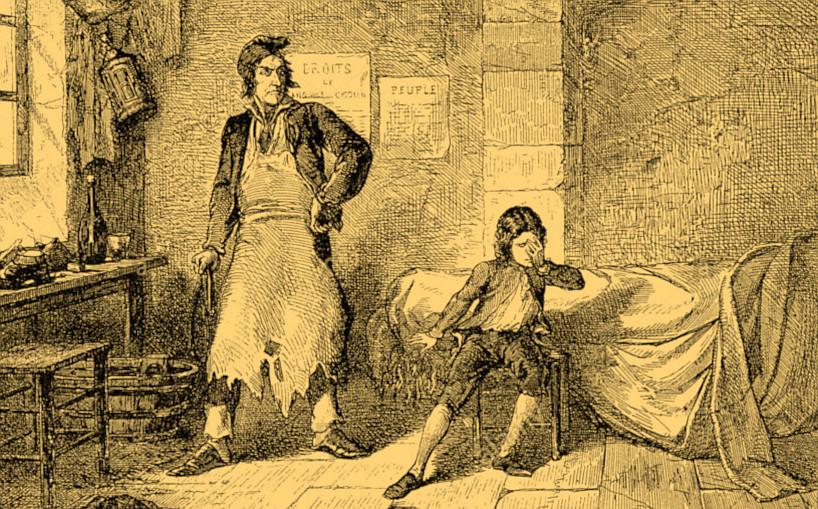
I have always thought it harsh and petty to chase these poor refugees away everywhere, and yet, when I see what is going on here, I think I as a prince would have chosen the part of those who shield you from their visit. |363| I say this not at all as an opponent of their views, but as a German. These good people have wrapped themselves in black crepe since yesterday to mourn for what was hopefully the gentle death of that unfortunate little one who is now no longer lamentable. [7]
As soon as my mother is genuinely satisfied, I myself will be completely so as well, and to that end only a bit more time is needed. We actually have nothing to complain about other than the inflation, but everyone is complaining about that. [8] One of the things we laugh about is Madam Ebert, but only if I tell you in person just how and why could you get the full effect. She does not quite comprehend me because I occasionally stay home when the others go out. She runs around the whole day with an extremely young servant running along behind whom she takes to task in court a couple of times each and every week and yet still refuses to discharge. It surprises me that the Jerusalems tolerate her so; she really does spend a great deal of time at their place.
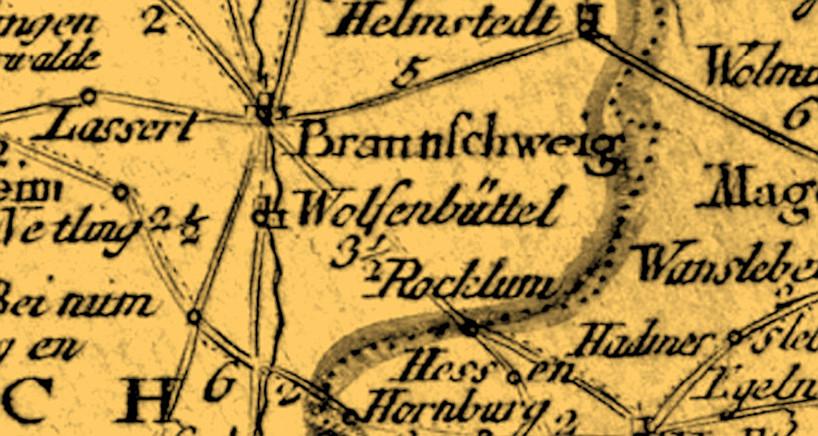
Adieu, my dear. Regards to everyone. In a few days, I will be going to visit the Trapps in Wolfenbüttel. [9] And I will despair if you do not write soon.
Notes
[1] Concerning Esther, cf Caroline’s letters to Friedrich Ludwig Wilhelm Meyer on 24 October 1789 (letter 92) with note 8, on 10 May 1794 (letter 144) with note 11, and on 7 June 1794 (letter 145), note 7. Back.
[2] Although Schiller had considered taking over as editor of the Göttinger Musenalmanach after Gottfried August Bürger’s death on 8 June 1794 despite all that had happened between them, publisher Johann Christian Dieterich had already made arrangements with Karl Reinhard. Dieterich had written to Schiller from Göttingen on 1 August 1794 (Geschäftsbriefe Schiller’s, ed. Karl Goedeke [Leipzig 1875], 97–98):
Because I returned from a mineral-springs stay only a few days ago, I have been unable to answer your letter until now. — I would be delighted to entertain your esteemed Sir’s suggestion concerning the editorship of the Göttinger Musenalmanach, for I am certainly sufficiently persuaded concerning the advantage it would gain through your esteemed editorship. — Unfortunately, right after the death of the late Herr Bürger I entered into a new agreement with Doctor Reinhart [sic] of Göttingen — because that agreement has already been finalized, as much as I might like to I cannot really rescind it. — I would be delighted and indeed count myself quite fortunate might I yet hope to enter into an arrangement with your esteemed person in perhaps some different fashion.
With all due respect I remain your devotedJohann Christian Dieterich Back.
[3] Schiller writes from Jena to Wilhelm Schlegel in Amsterdam on 12 June 1795 (Körner-Wieneke, 7–8):
With your article on Dante in Die Horen, you have made too impressive a contribution to the successful continuation of that journal for me not to be gratefully obliged to you. Let me express that gratitude to you all the more readily insofar as it simultaneously provides me with the opportunity to make your acquaintance in writing and to assure you of my most cordial respect.
I already asked your brother in Dresden to relate to you that we would be extraordinarily obliged if you would continue to contribute to Die Horen. Just send us whatever you have ready for publication; it will invariably enhance the journal, and you yourself will doubtless also be satisfied with the publisher. I am enclosing an avertissement [presumably the entire issue of the Intelligenzblatt of the Allgemeine Literatur-Zeitung (1794) 140 (Wednesday, 10 December 1794) 1129–36; see pp. 1131–32] that will acquaint you with the plan and parameters of the journal.
I do, however, also have a second request to make of you, namely, that you contribute several pieces to a Musenalmanach [Musen-Almanach für das Jahr 1796] I am bringing out at the next Michaelmas book fair. You will find the company there not bad at all. Goethe, Herder, Engel, Matthisson, etc. will all be contributing. Let me, however, also ask that you get your contributions to me sometime between today’s date and 1 August, sending them directly to me in Jena.
I have many good things to tell you about Herder, who admires and indeed is quite fond of your essay on Dante.
Return soon to your fatherland and live a life dedicated to the muses, in whose service you have already so admirably commenced.
Schiller Back.
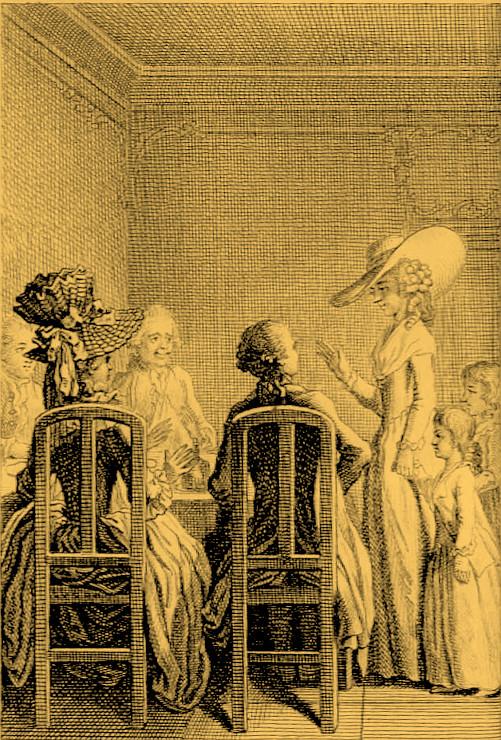
[4] See Caroline’s letter to Luise Gotter on 20 May 1795 (letter 150), note 13 concerning the Eschenburgs’ other children. She and Auguste had already met the Eschenburgs socially on several occasions (illustration from the Leipziger Taschenbuch für Frauenzimmer zum Nutzen und Vergnügen, aufs Jahr 1788; Inhaltsverzeichnis deutscher Almanache, Theodor Springmann Stiftung):
[4a] Frontispiece to Andreas Meyer, Wie soll ein iunges Frauenzimmer sich würdig bilden, 5th ed (Erlangen 1786):
[5] Daniel Nikolaus Chodowiecki did a series of vignettes in 1780 with the title Occupations des dames, in the sense of “pasttimes”; one of those vignettes, “Drawing,” features a young woman receiving instruction in drawing while another woman, perhaps her mother, examines the results (Die Zeichenkunst [1780]; Herzog August Bibliothek; Museums./Signatur Uh 4° 47 [160]):
Here “The Drawing Lesson” by W. M. Obreen (cordial communication from Alessandra Reeves; De tekenles [1700–1800]; Rijksmuseum; Set “Social Life 1800”; Verzamelingen Alessandra Reeves):
[6] Edukation as written in the original, an allusion to Félicité Ducrest de Saint-Aubin, Madame de Genlis, Adèle et Théodore, ou, Lettres sur l’éducation, contenant tous les principes relatifs aux trois différens plans d’éducation des princes, des jeunes personnes, & des hommes (Paris 1782) (English translation by “some Ladies, who through misfortunes, too common at this time, are reduced from ease and opulence, to the necessity of applying, to the support of life, those accomplishments which were given them in their youth, for the amusement and embellishment of it” as Adelaide and Theodore: or Letters on Education, containing all the principles relative to three different plans of education [London 1783]).
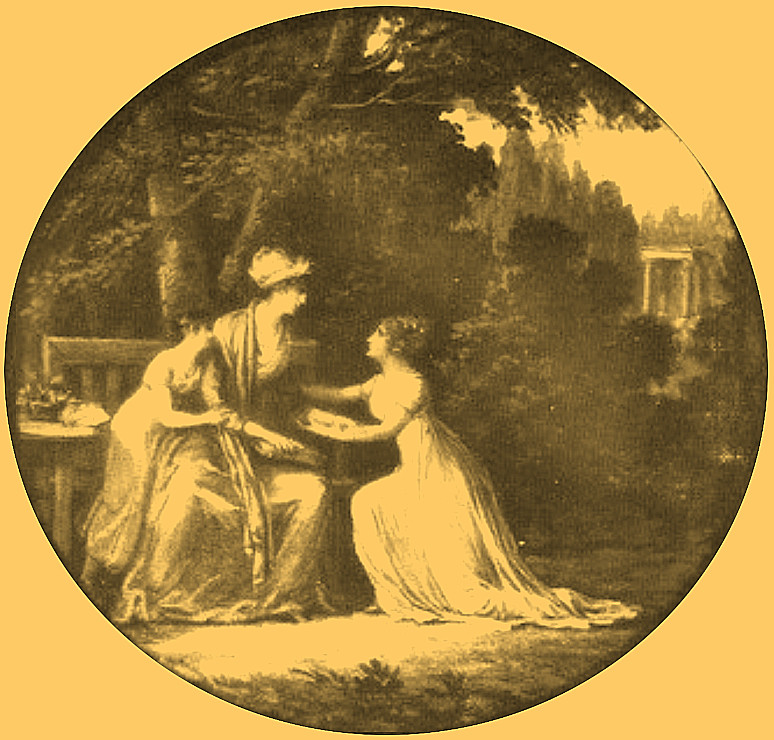
A baronne and vicomtesse (in the English translation: Baroness d’Almane [mother of Adelaide and Theodore] and Viscountess de Limours) are correspondents in this epistolary account of the education of two young aristocratic children in a country setting.
Here Madame Genlis herself with her pupils. Left: Frank Stone, Philipp-Egalité, ses enfants et Madame de Genlis leur apprenant à lire; right: “Mme. de Genlis with her Pupil, Eugène Adelaide Louise, Princess of Orleans, and Pamela,” frontispiece to Jean Harmand, A Keeper of Royal Secrets: Being the Private and Political Life of Madame de Genlis (London 1913); below: anonymous, Madame de Genlis with her daughters Pamela and Henriette (or with the same as above right?):
[7] The dauphin, Louis-Charles, Prince Royal of France, had allegedly died on 8 June 1795 in Paris (anonymous 19th-century engraving):
[8] I.e., inflation caused by the presence of wealthy aristocratic émigrés who had fled revolutionary France. Back.
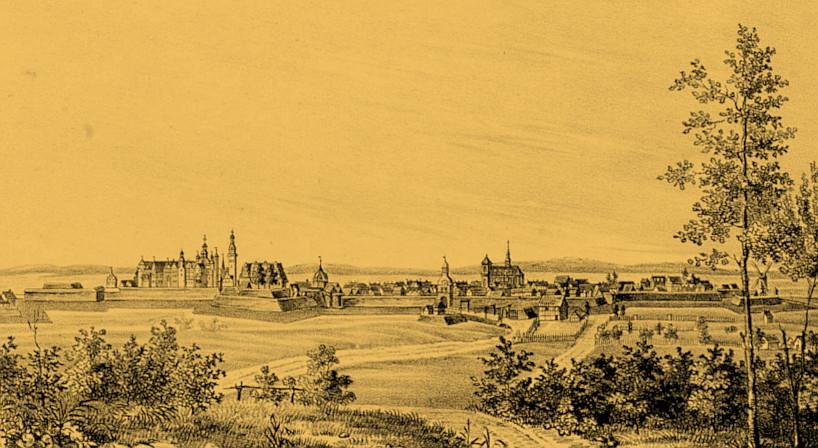
[9] Wolfenbüttel is just south of Braunschweig (Post Karte Durch ganz Deutschland, ed. J. Walch [Augsburg 1795]; illustration: Wolfenbüttel 1650; Herzog August Bibliothek; Museums./Signatur Top. App. 2:448.1):
Translation © 2011 Doug Stott