
• 92. Caroline to Friedrich Ludwig Wilhelm Meyer in London: Marburg, 24 October 1789 [*]
Marburg, 24 October [17]89
|182| It is not as if I was standoffish in casting your goblet from me — no, my dear friend, I drank it, savored it to the very last drop — that is not the reason I was silent; I was simply, I know not, perhaps too happy to answer you out of need, and yet still did not have enough self-esteem or enough self-confidence to do it on your account. Then I also wanted to tell you whether your prophecies had indeed come true — for some time now I have not known where you were, nor even where this letter might find you. [1]
I will not, however, allow such uncertainty to delay it, prompted as it is by a specific occasion. Although this occasion is but an idea, one should lock away as few |183| ideas as possible. My brother and I came upon it simultaneously. The crown prince of Kassel is living here under the guidance of a very bright man, Herr von Dörnberg; besides Dörnberg and a cavalier, he also has a tutor, who has been with the prince since the latter’s youth but whom they would like to replace were another to present himself. The prince is 13 years old and will likely be staying here but a very short time, after which he will go to Switzerland. [2]
What do you think? Would this position not be too modest for you? It goes without saying that the salary would be respectable and that you would have a title as well as prospects for the future. I am not selfish, I would hardly wish to see you here, but would want instead that the implementation of this project [?] might be delayed until the prince leaves Marburg, for I cannot see how Meyer could endure here. It is a small, restricted, and doubtless extremely boring style in which the prince is living, he himself being yet merely a child to whom one tells Bible stories. The place has no distinction apart from a beautiful setting, for us it would be a desert island to which I simply could not invite you with me.
I have also heard you yourself are planning to travel to Italy, and I certainly do not want to keep you from that might it be arranged such that you could come here when you return — that would be my plan. [3] My brother believes something would have to come of it sooner if it is to succeed. Write me what you think, then my brother will speak with Dörnberg, whom he has already inclined to give a favorable hearing with regard to this point, and if possible you might then come yourself.
Thus the outline of the “castle in the air” with which I have been so fondly occupying myself because you are worth it to me, but which I mistrust precisely because over the course of the world’s turning one does indeed inevitably breathe in unbelief of all |184| sorts. Please remain silent for now regarding the entire matter, and all the more so if you really do want it to come about. Dörnberg is the only person through whom the matter might be initiated, and we have him here.
My brother sends his regards to you. He is performing meritorious service for me with his good will, and you can well imagine that I do not contradict him, whereas I am certainly performing no more such service for you with my own — not even with the selflessness with which I renounce everything that would not make you happy even though it might give me great joy. I do in any case hope the suggestion will soon come to your attention.
You have given me truth that has an irresistible magic for me. It is the only thing that might deceive me. Anyone who loves it more ardently than do I must have enormous capabilities — or is beneath all comparison. But do you know that one can offer it without being more [true?]? Although I am not suspecting you, I do own — I have not yet fathomed you, and wish that you would speak as much about yourself as you do about me.
What is it that resides most deeply in your being? Does the frivolity of your head or the earnestness of your heart rule where your most vehement passion speaks? Do you vacillate between the two? I have never comprehended you completely, nor have I ever really been able to do so, for I knew you so little through myself. When I first got to know you, you were interesting to me on the basis of my own taste — which many people call false — and on the basis of a peculiar concurrence with that which flatters the most hushed, only half-understood images of my imagination.
I might have wanted to arouse emotions of the sort you described, and yet not your own — for my heart had weaned itself from all reality — I no longer knew how to deal with it. That created in me an earnestness toward you |185| that you merely intended to reciprocate, but returning it such that it did not seem natural to me. I trusted you only through others. I knew very well that your assessment of my situation was completely correct, but I could also not be open about that because I had to rescue the last illusion that made my fate bearable for me, the last illusion of love: tenderness. Too delicate, too good, too gentle to cast it away — perhaps also much too hemmed in — I kept it within, and it yet lives on even in my memory, though I think back to that time with fear and trembling and speak about it the way a prisoner speaks about his dungeon with a certain terrible satisfaction.
I have been living here for 4 months now essentially the way you foresaw; [4] I thoroughly enjoyed the summer and am moving into winter already anticipating spring blossoms. Lotte is with me, for she no longer liked Göttingen — the parting from which cost me nothing, as little as it did you.
Marburg has little — but it suffers neither from stultifying uniformity nor from the conceit of an imperial city. The people here are not as cultivated and are more talkative, but they are also more tolerant. [4a] I am very well liked here because my heart casts a cloak over the merits of my mind such that the expressions of both are then credited to me as something of merit. That I can leave whenever I want prompts me to stay despite all the trouble — the kind of inertia of a person who does not fear death.
I have set a goal for my stay here — then on farther, to wherever my attendant daemon extends — for I fear that fate and I are no longer able to influence each other — I have no use for its beneficent offerings — and I simply refuse to respect its malicious tricks. Wishes cease to be modest when our ultimate, sweetest happiness comes to reside in their fulfillment |186| — those no longer count on miracles who themselves feel capable of performing such and indeed of coercing recalcitrant fate by means of an ardent, overflowing heart that revels in both joy and sorrow.
My children are precious creatures. [5] Would that you came, Meyer — with a gentle and yet firm step a friend would similarly come out to meet you in the person of
Caroline
It is not at all nice of you to put down the sublime French nation every chance you get, as in the essay on a piece by General Loyd. [6] I could certainly be aggrieved at you. Also for having spoken so much in your last letter about “purposes” and for imputing intentions to people who — regardless of how mad and crazy they otherwise may well be — are not at all the people who would be thinking of such things.
Gotter wants me to tell you that he was recently in Weimar and that the duchess and Einsiedel inquired a good deal about you, indeed deigning to express themselves quite graciously concerning you. [7] Gotter evoked a proud Vastha [Vasthi] and a humble Esther, which he read aloud there. [8]
Notes
[*] Caroline seems to have departed Göttingen for Marburg toward Whitsun, which in 1789 fell on May 31; see Georg Ernst Tatter’s letter to Friedrich Ludwig Wilhelm Meyer on 25 January 1789 (letter 89), with note 3. See the editorial note there concerning Meyer’s presence in England.
Marburg is situated on the Lahn River ca. 120 km southwest of Göttingen; a direct postal route connected the two towns (Post Karte Durch ganz Deutschland, ed. J. Walch [Augsburg 1795]):

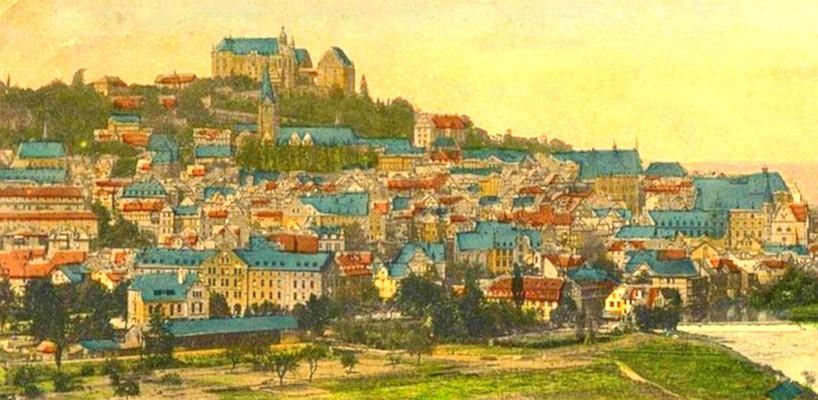
Here a view from the south in a postcard ca. 1900:
[1] Meyer had been in England since 25 August 1788 and had done considerable traveling in the interim. At the time of this letter, he was back in London. Concerning Meyer’s travels during this period in general, see the editorial note to Georg Ernst Tatter’s letter to Meyer on 25 January 1789 (letter 89). Back.
[2] The crown prince was the later Wilhelm II of Hesse-Kassel, who studied in Marburg 1789–92, accompanied by Karl Ludwig von Dörnberg. The prince’s tutor was Ferdinand Karl Wilhelm Heinrich Schenck zu Schweinsberg, who had studied law in Marburg himself and returned with the prince, who was twelve years old at the time, in 1788 from a position in the upper appellate court in Kassel. Back.
[3] Meyer would indeed yet travel to France and Italy before returning to Hamburg in 1791. Back.
[4] This passage helps date Caroline’s arrival in Marburg (see editorial note above). See also her letter to Luise Gotter on 8 May 1789 (letter 91). Back.
[4a] The reference to the “free imperial city” is a political one, i.e., to the fifty cities that were “independent except of the Emperor, and are thence called “free imperial cities”; see the supplementary appendix on Germany in the late-eighteenth century, esp. chapter 4, “Form of Government and Religions.”
Caroline had landed in Marburg because her half-brother, Fritz, was lecturing as part of the medical faculty. That is, she was still living in a university town; at the time, and by official count, Marburg had 780 students, of which 392 were studying theology, 283 law, and 105 medicine (Medicinisches und Physisches Journal, ed. Baldinger, 6 [1790] nos. 21–24 [Göttingen 1790], 25).
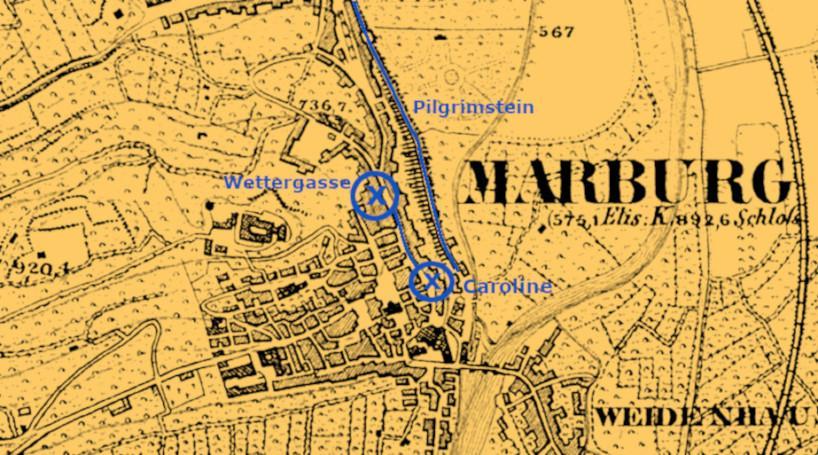
Marburg had just under 6000 residents at the time and only slightly more around 1860 (Historisches Ortslexikon, Landesgeschichtliches Informationssystem Hessen, s.v. Marburg). Two photographs from the nineteenth century — one from ca. 1849 — still evoke the late-eighteenth/early-nineteenth-century character of the town as Caroline knew it. The first is of Pilgrimstein in the year 1877, a street (running approximately north-south to the right on the map below) that still runs just below Caroline’s apartment in her brother’s house at Reitgasse 14. The other captures three houses on Wettergasse in ca. 1849, a street that still merges into Reitgasse today just below Caroline’s residence (the “x” at the top center of the map below). Caroline’s residence is indicated at center bottom (Kurfürstenthum Hessen: Niveau-Karte auf 112 Blättern, Karte 60: Marburg, ed. Kurfürstlich Hessischer Generalstab [Marburg n.d.]):
Photograph of Pilgrimstein running just below Caroline’s residence: Ludwig Bickell, “Marburger Pilgrimstein, 24 April 1877,” Historische Bilddokumente, Landesgeschichtliches Informationssystem Hessen:
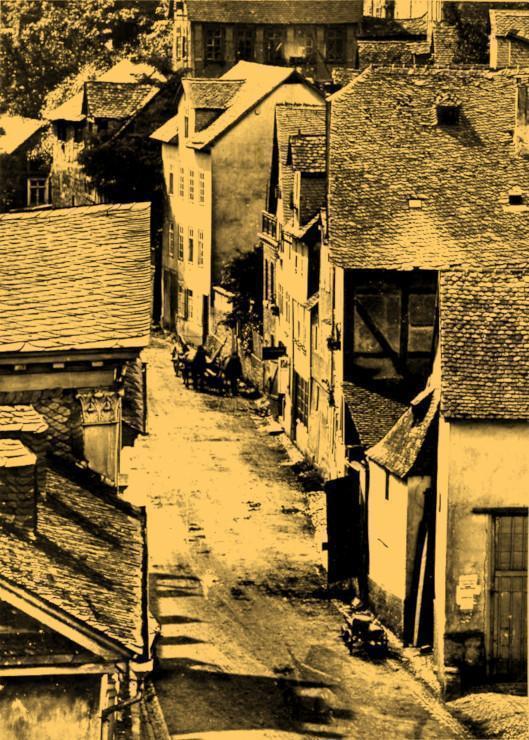
Photograph of Wettergasse: Ludwig Hach (uncertain attribution), “Häuser in der Marburger Wettergasse,” (13 August 1849), capturing Wettergasse 42 and 43 along with Renthof 1; Historische Bilddokumente, Landesgeschichtliches Informationssystem Hessen. The house at left was that of the saddle-maker Burghard Barth; the display window contains purses, belts, and other leather wares. The middle house was that of the baker and innkeeper Peter Matthäi (the sign reads “Beer-Brewery, Coffee-Tavern”); note the table in front with bakery goods for sale:


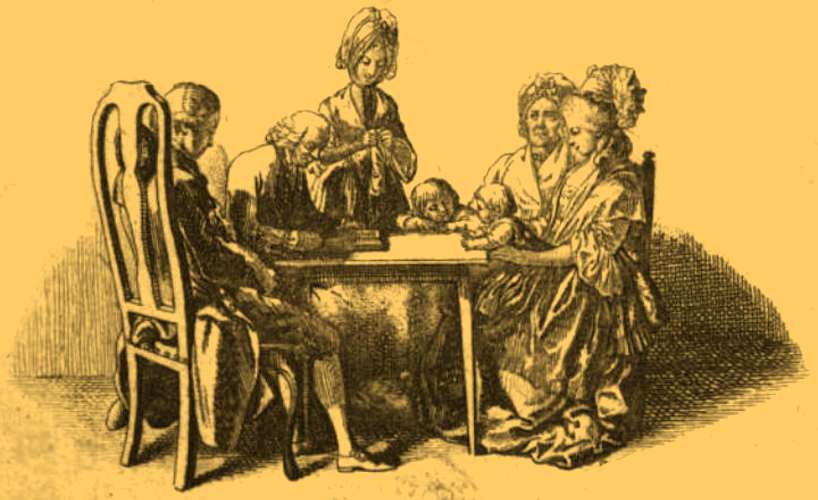
[5] Auguste and Therese Böhmer (title vignette to Heinrich Matthias August Cramer, Unterhaltungen zur Beförderung der Häuslichen Glückseligkeit [Berlin 1781]):
[6] Uncertain reference. Back.
[7] Meyer had visited Weimar twice during his extensive journey between 26 May 1787 and 28 June 1787 (see Caroline’s letter to Luise Gotter on 3 December 1787 [letter 82], note 1), and had also visited Weimar the previous year, 1786. Back.
[8] Friedrich Wilhelm Gotter’s play Die stolze Vasthi, a one-act prelude to Esther, a play in six acts; despite this reading for Duchess Anna Amalia, Gotter did not publish these pieces until 1795, in Schauspiele von Friedrich Wilhelm Gotter (Leipzig 1795) (vol. 1 Die stolze Vasthi, 7–40; vol. 2 Esther, 41–194 [volumes are through-paginated; vol. 3 was Die Basen, 195–301]). Moreover, the plays were performed publicly only once (see below).
In 1794 Luise Gotter would finally overcome her husband’s disinclination to send the plays to Friedrich Ludwig Schröder for performance, but the result was a humiliating letter of rejection (see Caroline’s letter to Meyer on 7 June 1794 [letter 145]). The two plays were composed for the amateur theater in Gotha, and both were parodies prompted by the new Esther insertion in Goethe’s recently reworked Jahrmarktsfest zu Plundersweilern (Rudolf Schlösser, Friedrich Wilhelm Gotter, 156, 271–74).
The dowager duchess had Vasthi performed on 28 October 1800 for her birthday celebration; for the text of Goethe’s prologue, see Bernhard Suphan, “Nachspiel zu Gotters Vasthi,” Goethe Jahrbuch 11 (1890), 20–24. Goethe’s epilogue was composed on 24 October 1800 but not recited until 28 October (Schlösser, Friedrich Wilhelm Gotter, 274, incorrectly dates the performance to 24 October), for which date Goethe’s diary remarks: “This evening with Her Serene Highness the dowager duchess, where Friedrich Wilhelm Gotter’s Vasthi was performed.” Back.
Translation © 2011 Doug Stott