
• 152. Caroline to Friedrich Schlegel in Pillnitz: Braunschweig, June 1795? [*]
[Braunschweig, June 1795?]
[Beginning of letter is missing.]
|363| . . . occurred that you, who have, after all, been to school, certainly cannot have banished the beautiful from the moral sphere — else how could you delineate its parameters in the enjoyment of love? In this regard, you provide me with weapons with which I can subdue my highly respected adversary on his own turf. [**]
Fritz, there are 2 books you must read, and if I remember correctly, one of them takes up the substance |364| of knowledge. And that is Condorcet. [1] He belongs to your field — insofar as you want to define the stages of culture of a nation and the value of this culture over against the concept we are able to formulate of earliest human perfection. Although Condorcet knows nothing of what you conceive as the one, grand, individual transition [2] — he does know infinitely more than we two ever dreamed about oscillations into the infinite. He greatly accentuates the act of knowing — it is through knowledge that he constructs bridges for us leading to the celestial climes.
As much as I myself do acknowledge that such construction is indeed necessary and welcome, I cannot, despite my humility — for the most humble among us are often also the most proud — refrain from believing that he who lacks the more artful instinct for bridge building is instead given the simple instinct of flying by means of which the lark hovers high in the sky on a beautiful morning. The metaphor of the eagle that flies up toward the sun was simply too ornate for me here.
Although Condorcet writes with grand views, perhaps his spirit was nonetheless not quite free — it is not as if the pressure of circumstances was fettering him — I see a different kind of fetter, one he considers to be his measuring instrument and accommodates to everything — In a word — he applies mathematics and calculation not only to the sensory world, but also to the non-sensory world that generated it.
You will see how fleetingly he touches on human morality and how it is to emerge from numbers, as a number, nor is even viewed as the sum of the calculation. And yet it is not to be sought among the celestial bodies, whither the numerical ladder extends — it is not there — it is here — indeed, it is not primarily to be found in the feeling with which we return, worshipful, from that particular observation.
Relationships with other human beings are |365| more important to human beings than is that with the Creator, and to me the latter has often seemed only weakly connected in any event. Of course, this does suggest how many stages we yet have to traverse, though eternity will grant us the time to do so. It is only on earth, I fear, that our lot is restricted — and the inadequacy I sense in Condorcet, in this one person’s overview of humankind, strongly reminds me of the imperfection he would like to withdraw from view by his imagery here — if focusing on what is immediate were not to do so as well — focusing instead on all the prejudices of which he saw less in his own circle, since he, after all, lived among the brightest people of a bright nation at its moment of highest tension — and on the ill will and triviality above which only very few individuals are ever able to rise in any case. [3]
See to it that you do not fail to read this and the works of a certain Fulda, who must have been a magister with a fairly genuine, original feeling for people. [4] Some things about him reminded us of you.
[End of sheet.]
Notes
[*] Reprinted in KFSA 23:235–36. This letter is the first extant letter from Caroline to Friedrich Schlegel. — Pillnitz is located just outside Dresden. Back.
[**] According to Michael Bernays (“Caroline [1871, December],” in Schriften zur Kritik und Litteraturgeschichte, vol. 2 [Leipzig 1898], 283–311, here 311), the reference here seems to be to Friedrich’s essay “Über die Grenzen des Schönen,” in Der Neue Teutsche Merkur (1795) issue 5 (May) no. 5, 79–92 (reprinted in Jugendschriften 1:21–27), concerning which Schiller made such disparaging remarks to Christian Gottfried Körner on 5 July 1795 (The Correspondence of Frederick Schiller with C. G. Körner, trans. Leonard Simpson, 3 vols. [London 1849], 3:5):
I read some time back an article in the German “Mercury” by your Schlegel, on the “Limits of the Beautiful.” What a confusion of ideas and harshness of expression! You must not allow such a thing to pass unnoticed, if you have promised to tell him the truth. He is well-informed, and thinks over his subject. But he does not arrive at clearness, and his diction consequently does not flow freely. I almost fear he is not fitted for [i.e., fit to be] an author. Back.
[1] Marie Jean Antoine Nicolas Caritat Marquis de Condorcet, Esquisse d’un tableau historique des progrès de l’esprit humain (Paris 1795). Friedrich’s grander review, like Wilhelm’s anticipated avertissement, was to remain unfinished. In his letter of 4 July 1795 welcoming Wilhelm back to Germany after his stay in Amsterdam (here letter 152a, though this passage not included), however, Friedrich summarizes at considerable length several essays on which he is working. Oskar Walzel remarks concerning these essays in a note (Walzel, 223n2):
. . . of all the enumerated essays, only “Über die Grenzen des Schönen” [Der Neue Teutsche Merkur (1795) issue 5 (May), 79–92; repr. in Jugendschriften 1:21–27] and “Über die Diotima” [Berlinische Monatsschrift 26 (1795) July, 30–64; August, 154–86; repr. in Jugendschriften 1:46–74] actually appeared; . . . at most one might recognize a reworking of the essay “Über antiken und modernen Republikanismus” [which Friedrich mentions in the letter] in the essay “Versuch über den Begriff des Republikanismus. Veranlasst durch die kantische Schrift zum ewigen Frieden” [Deutschland 3 (1796) issue 7, no. 2, 10–41; repr. in Jugendschriften 2:57–71] . . . and seeds of the review of Condorcet’s Esquisse d’un tableau historique des progrès de l’esprit human. 1795 [Philosophisches Journal einer Gesellschaft Teutscher Gelehrten, ed. F. J. Niethammer, vol. 3, no. 2 (1795), 161–72; repr. Jugendschriften 2:50–56; KFSA 7:3–10] in the [anticipated] essay “Theorie der Geschichte der Menschheit” [which Friedrich also mentions in the letter].
Friedrich writes to Wilhelm on 30 January 1796 (Walzel, 260):
Can you not give me an idea of what you are thinking about writing about Condorcet? and in what form you intend to present it? I hope you do not think me so pedantic as to believe I intended seriously what I wrote explicitly as a contrast and in the most ill humor. You will not find much in my own review of it [Condorcet]. It is paltry, for I merely wanted to offer an assessment rather than genuinely hold forth myself the way I allowed myself in the other.
Walzel (260n1) adds in a footnote:
Friedrich Schlegel wrote the [previously mentioned] review of Condorcet’s Esquisse at Caroline’s behest. . . . [Jakob] Minor’s suspicion [Jugendschriften 2:vi–vii] that Wilhelm merely wanted to smuggle Friedrich’s essay into Die Horen under his own name is refuted by the passage above. A remnant of Wilhelm’s own plan is fragment 195 in Athenaeum.
See Athenaeum, fragment 195, Athenaeum (1798), 227; it was widely held that after having been imprisoned on 26 March 1794 on charges of treason, Condorcet took poison in prison on 28 March 1794 (Death of Condorcet, engraving after E. Viollat):
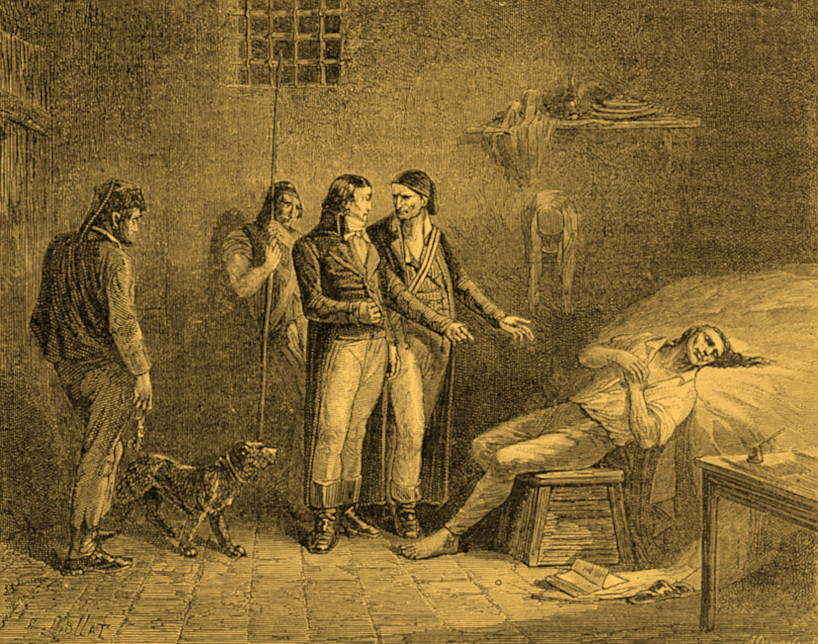
Did Condorcet not erect a more beautiful monument to himself when, surrounded by imminent threats of death, he wrote his book on the progrès de l’esprit humain instead of using the short period of time left to him to present — not those infinite perspectives, but rather — his own, finite individuality? How better could he have appealed to posterity than by forgetting his self precisely in dealing with it?
Wilhelm apparently chose not to write the lengthier review because Schiller had expressed some reserve about publishing it. Back.
[2] From antiquity to modernity by way of Christianity. Back.
[3] KFSA 23:471–72n3 presents a succinct exposition of the general points Condorcet makes in his piece, in which he delineates by way of a positivistic method and a mathématique sociale how in the way each moment and event influences the next one can discern the principle of ultimate perfectibility as a natural law in human development, albeit as an indefinite progression, eventually issuing in a society characterized by such startling concepts as universal education and suffrage, equality before the law, freedom of thought and speech, the right of self-determination for colonial peoples, distribution of wealth, social security for retirees, socialized medicine, and equal rights for women.
Friedrich gave the piece an extremely favorable review in the Philosophisches Journal (see previous note), not least because he himself was currently working on the notion of infinite perfectibility (progression) as it applies to the course of history down to the modern world (see KFSA 23:472 for bibliography). Back.
[4] Carl Friedrich Fulda’s natürliche Geschichte der Teutschen und der menschlichen Natur. Ein Pendant zu seinem Wurzelwörterbuche und Commentar über Tacitus Germania. Hrsg. und mit einem Versuch über des Verfassers Leben und Schriften begleitet von D. F. Gräter, ed. David Friedrich Gräter [not D. A. Gräter as in Schmidt (1913), 1:708, and KFSA 23:472] (Nürnberg, Altdorf, 1795). Caroline seems to have obtained a copy of this book soon after its publication and read it rather quickly. Back.
Translation © 2011 Doug Stott