
141a. Friedrich Schlegel to Wilhelm Schlegel in Amsterdam: Dresden, 27 February 1794 [*]
Dresden, 27 February 1794
. . . [Financial problems.] You must have misunderstood something either in my last letter or in what Caroline wrote. We are doubtless quite of one mind concerning how you have acted toward me. —
I have often, indeed quite often given you the opportunity to demonstrate your friendship through sacrifice, and you have always done far more than I had reason to hope. This is my innermost conviction, so let us hold on to it, the essential thing here, and forget all insignificant differences of opinion. . . .
After a cursory reading, I was quite pleased by [the translation of] an ode from Pindar that Caroline showed me, and several choruses from Aeschylus in the Berlinische Monatschrift, both by the eldest Humbold[t]. [1] . . .
Caroline read Iphigenie aloud to me. [2] You already know how well she reads, and I confess that the music of this piece seems to me to approach the soaring fullness and powerful tenderness of the ancients. [3] . . .
I received news from Caroline after her arrival in Gotha and am now quite curious to hear more. [4] I fear she will not feel as comfortable being around people again. Please send me news about your “return to the fatherland.” [5]
Notes
[*] Sources: Walzel, 168–72; KFSA 23:183–87. Back.
[1] Wilhelm von Humboldt, Pindars zweite Olympische Ode, metrisch übersetzt (Berlin 1792); “Die Eumeniden. Ein Chor aus dem Griechischen des Aeschylus,” Berlinische Monatsschrift 23, no. 8 (August 1793), 149–56.
Johann Friedrich Unger’s publication of Humboldt’s translation of Pindar’s “Second Olympic Ode” in an Antiqua font rather than the customary Fraktur is noteworthy. Here the initial lines of the ode:
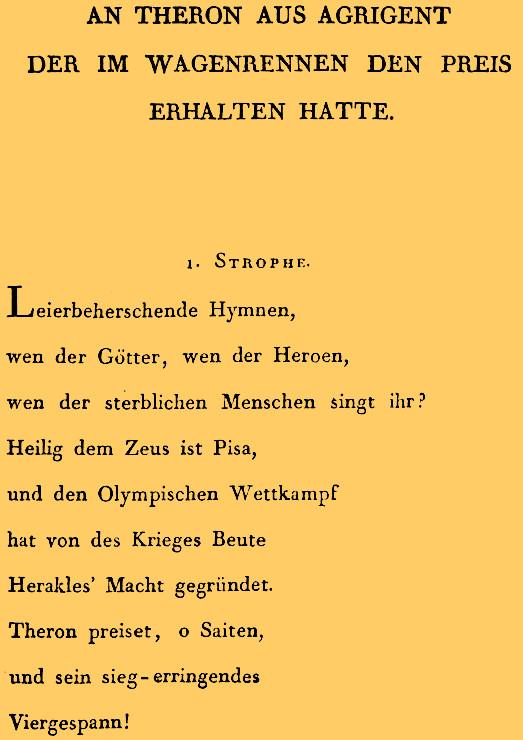
Translation from The Odes of Pindar in English Prose, 2 vols. (Oxford 1824), 13:
To Theron of Agrigentum
Conqueror in the Four-horse Car
Ye hymns, rulers of the lyre,
say what god shall we resound,
what demi-god, what mortal? —
Pisa sure is Jove's sacred land:
next the Olympic games Hercules founded,
firstlings of the war:
but, for his triumphant four-horse car,
it behoves us loudly to proclaim in song Theron. Back.
[2] Goethe’s Iphigenie auf Tauris. Ein Schauspiel, in Goethe’s Schriften, vol. 3 (Leipzig 1787), 1–136. Concerning the differences between Goethe’s version and the original by Euripides, see supplementary appendix 432a.1; for the original illustrations to this 1787 volume with Iphigenie, see Caroline’s letter to Luise Gotter and Wilhelmine Bertuch on 28 May 1784 (letter 41), note 8. Concerning Caroline’s special relationship with this play, see her letter to Johann Diederich Gries on 18 April 1808 (letter 432a), note 2. See also the following footnote. Back.
[3] Concerning Caroline’s skill at reading Goethe’s play Iphigenie auf Tauris, see Wilhelm Schlegel, “Betrachungen über Metrik: An Friedrich Schlegel,” Sämmtliche Werke, 7:155–96, here 196 (composed during the second half of the 1790s; not previously published), in a discussion of the advantages and disadvantages of iambic pentameter in German:
Although no prosodist has yet developed the subtle rules governing this type of verse, they are evident enough in the praxis of our best poets, at least as evident as the rules of hexameters probably were during Homer’s age. More on this in my work on metrics. Contra those who believed that in our [the Germans’] iambic verse the iambic itself must be the only metrical foot or rhythm, Klopstock has admittedly already won, since such is neither beautiful nor even possible. So, now where is the alleged monotony? But do tell me seriously, has Goethe’s Iphigenie, when read aloud by, say, Caroline, ever seemed monotonous? Well, then may God and St. Klopstock help you!
In this same context, see her letter to Johann Diederich Gries on 18 April 1808 (letter 432a), note 2. Back.
[4] Caroline had arrived in Gotha on 8 February 1794; see her letter to Friedrich Ludwig Wilhelm Meyer on 20 February 1794 (letter 140): “I have been here for 12 days now.” Back.
[5] Although the topic had obviously been raised between the brothers, Wilhelm would not return to Germany (Braunschweig) from Amsterdam until the summer of 1795. Back.
Translation © 2011 Doug Stott