
• 177. Caroline to Luise Gotter in Gotha: Jena, early 1797
[early 1797]
[Beginning of letter is missing.]
|413| . . . We heard here that Jacobs is going to Oldenburg as director of the Gymnasium — Dorette did not yet know anything about it; but I do believe it to be true. Heaven help us! For what will |414| happen when our good Jacobs, toward whom I have always remained so well-disposed with all my heart, has been reduced to his wife and 3 sons? [1]
Tell Cecile that there is a painting academy here she can attend when she comes to visit us, which we are absolutely counting on. [2] If everything goes as it should and can, we will be traveling to Dresden and Berlin in the spring, [3] and after our return you will bring us Cäcilie! . . .
Adieu, my dearest, best Louise. Schlegel kisses your hand. I am aggrieved at Gotter, so do not give him my regards. [4]
Notes
[1] Dorette Seidler’s elder sister Christiane Seidler, who died in 1812, had married Friedrich Jacobs in 1792 and was thus married to him at the time of this letter (Dorette married him in 1817). His three sons from that marriage at this time were (given Caroline’s reference to three) Friedrich Wilhelm Josias Jacobs (1793–1833), Wilhelm Jacobs (dates unknown), and Gustav Jacobs (dates unknown); later children included the painter Paul Emil Jacobs (1802–66) and a daughter, Marie Jacobs (dates unknown), mother of the geographer Ernst Behm (1830–84).
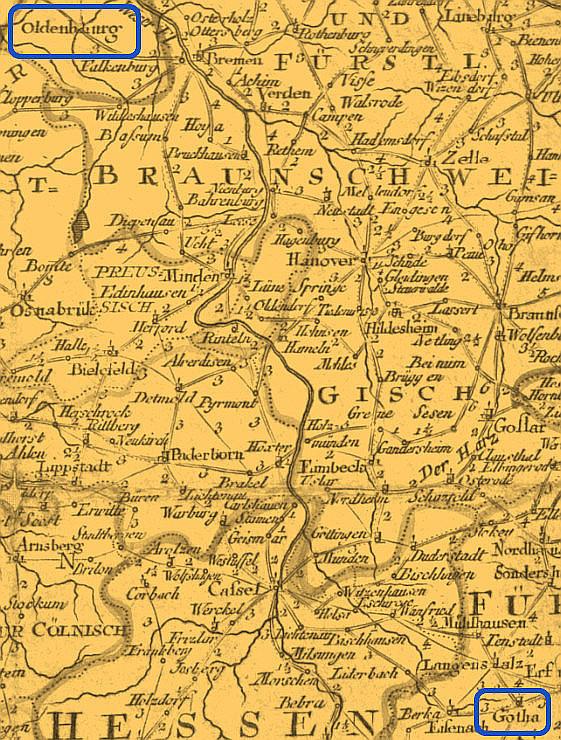
Jacobs did not move to Oldenburg, some 300 km northwest of Gotha (Post Karte Durch ganz Deutschland, ed. J. Walch [Augsburg 1795]):
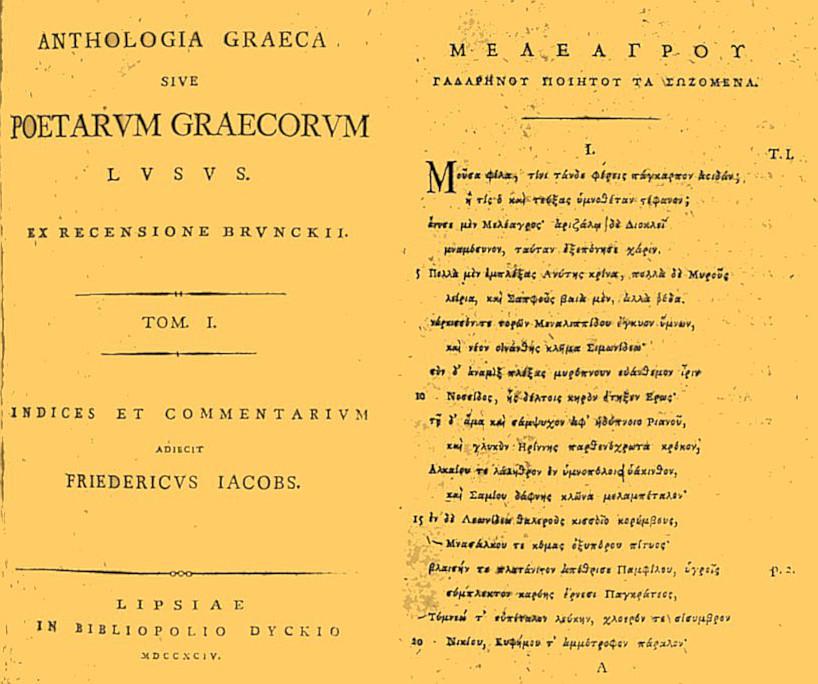
He seems to have been considering the move because of his modest salary under Duke Ernst II of Gotha. In 1797, however, the latter did finally grant him a stipend to work on his Greek anthology (see esp. Caroline’s letter to Luise Gotter on 13 February 1797 [letter 179]), Anthologia graeca, 13 vols. (Leipzig 1794–1814), one that subsequently established his respected scholarly reputation. Here the title page and first text page of vol. 1 (1794):
[2] Caroline is referring to the Fürstliche freye Zeichenschule in Weimar, which would indeed have been an ideal instructional experience for Cäcilie Gotter.
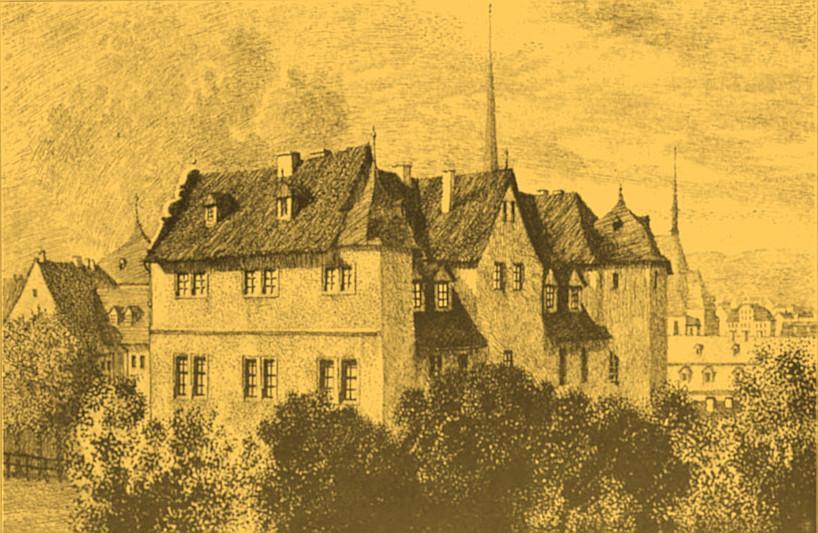
The school was founded in 1776 and fully chartered in 1779 by Karl August at the initiative of Friedrich Justin Bertuch and Georg Melchior Kraus. Its intention was to provide male and female pupils of all ages and from all social classes with free instruction in order to develop taste, discover and develop hidden talent, and whenever possible to train skilled craftsmen.
Till 1781 it was housed in a private home, then in 1781 was transferred into two generous halls in what was known as the Red Castle, with Melchior Kraus as director, who lived in an adjoining building (summarized from “Auszug eines Schreiben aus Weimar von 16. März,” Allgemeine deutsche Bibliothek 53 [1783], 2:616–17; illustration from Wilhelm Bode, Damals in Weimar [Weimar 1912], 40):
Instruction in geometry was provided, Goethe himself initially provided instruction in osteology and anatomy, and Justus Christian Loder from Jena in anatomy. Instruction was given twice weekly, Wednesdays and Sundays, female students in the morning, male students in the afternoon. Those wishing to devote themselves entirely to art, e.g., as a profession, worked every day under Kraus’s guidance.
The school continued to operate until 1930. Caroline worked conscientiously over the next few years trying to place Cäcilie in an appropriate instructional environment in which to develop her artistic talent. Back.
[3] The Schlegels did not travel to Berlin in the spring of 1797 (Rudolf Koch and Fritz Kredel, Deutschland und angrenzende Gebiete [Leipzig 1937]):

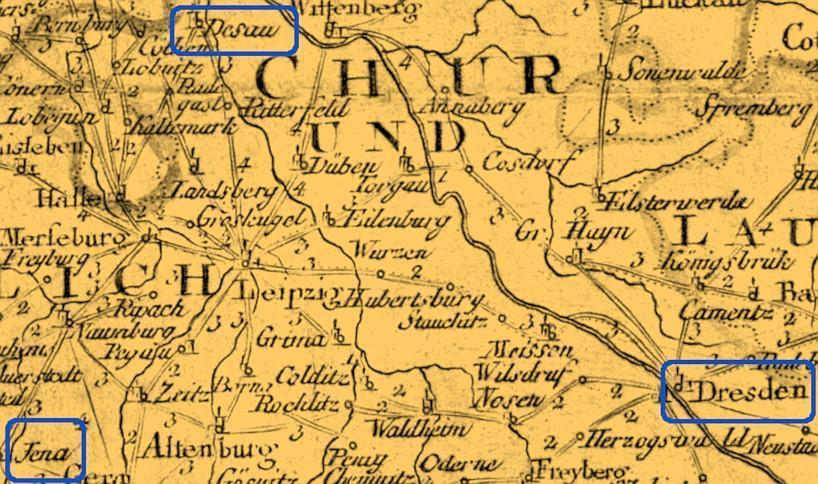
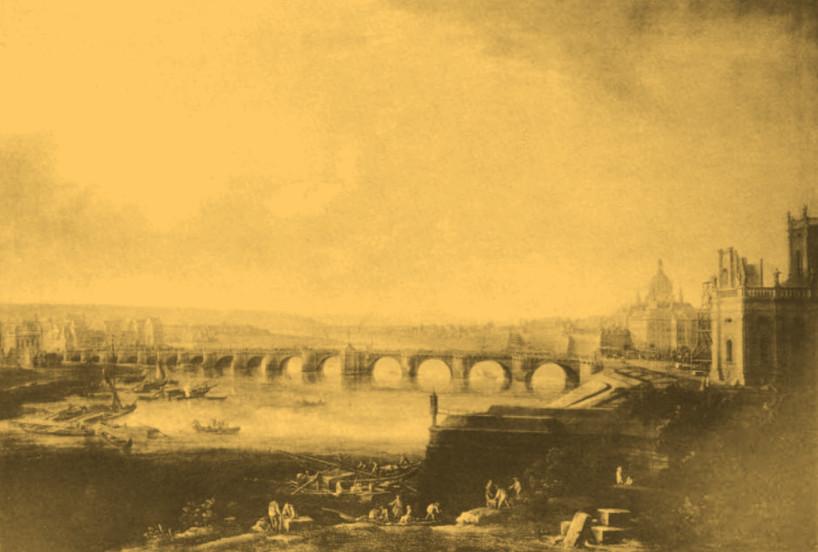
They did, however, travel to Dresden and Dessau in the spring of 1797 (Post Karte Durch ganz Deutschland, ed. J. Walch [Augsburg 1795]; illustration of Dessau: engraving by Mattäus Merian [1650]; illustration of Dresden: Bernardo Bellotto, called Canaletto, Dresden from the right bank of the Elbe below the Augustus Bridge, inventory 1754:1 543; Gal. no. 606, from The Splendor of Dresden: Five Centuries of Art Collecting [New York 1978], 66):

[4] Daniel Nikolaus Chodowiecki, Alcest (1775); Herzog August Bibliothek; Museums./Signatur Uh 4° 47 (121):

Caroline is jesting, of course, with her remark about Friedrich Wilhelm Gotter, who was gravely ill with consumption at this time and died on 18 March 1797 (one factor in dating this letter to early 1797). It is uncertain just how aware Caroline was of the severity of his illness. Back.
Translation © 2012 Doug Stott