
176a. Karl August Böttiger to Wilhelm and Caroline Schlegel in Jena: Weimar, 18 January 1797 [*]
Weimar, 18 January 1797
. . . Today I am also sending the files of valiant Rulfs — whom you, my kind lady friend, no doubt also acknowledge as being innocent — from Göschen to Becker in Gotha. [1] We must now let peal the bells of publicity, since the gentlemen in Mainz seem to be sleeping the deep slumber of sinners.
[*] Source: Körner (1930), 1:50. Back.
[1] Böttiger wrote to Wilhelm and Caroline on 29 January 1797 (Körner [1930], 1:51):
Precisely because I know your good Caroline — please excuse me for using this more intimate but for me more salutary form of address — is very fond of Rulfs, I wrote that I intended to say something publicly in the next issue of Mercur about this most abominably abused man.
Caroline seems to have known Rulffs in Mainz, apparently quite well, and as has been evident in this correspondence, both she and Wilhelm were quite fond of Göschen, who had provided such extraordinary help for Caroline after she was released from Königstein.
In any event, Josef Körner writes in his annotations to Böttiger’s remarks (2:21–22):
The Kaiserlicher privilegierter Reichsanzeiger (1797) 37 (13 February 1797) 382, which R. Z. Becker had published since 1791, contained the following notice:
In the Hamburger Correspondent (1796) 157 (30 September 1796) I read that “in Mainz certain elements of collusion between the Clubbists and the French had been discovered allowing the conclusion that the former had arranged to enable the French easy entry into the town. The entire matter, however, consisted in nothing more than a maliciously perpetrated cabal probably involving some scoundrel from Mainz sending a letter to two Mainz citizens (not Clubbists) inquiring concerning the strength of the garrison. This letter was passed on to the government. Since one could establish no culpability in the citizens who were thereupon arrested in the matter, they were declared innocent and released after four months of imprisonment.”
One of these citizens was the Mainz merchant and “father of the poor,” August Friedrich Rulffs, Georg Joachim Göschen’s benefactor (The Life and Times of G. J. Goschen [London 1903], 1:452–57).
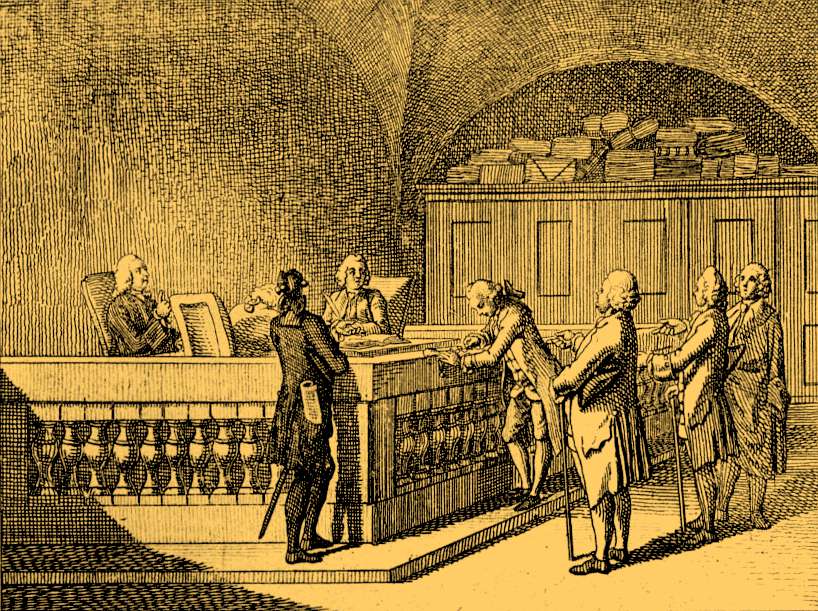
These events, of course, took place in 1792–93, so it is not immediately clear why the matter was still an issue in 1796 and 1797. The passages in The Life and Times of G. J. Goschen referenced by Körner give a detailed account of the incident and of Göschen’s presumed contribution to Rulffs’s release, but then add (The Life and Times of G. J. Goschen, 457; courtroom illustration: Daniel Nikolaus Chodowiecki, “Die Geldstrafe vor Gericht,” Kupfersammlung zu J[ohann] B[ernhard] Basedows Elementarwerke für die Jugend und ihre Freunde: Erste Lieferung in 53 Tafeln. Zweyte Lieferung in 47 Tafeln von L bis XCVI [Leipzig, Dessau, Berlin 1774], plate XXXIV):
But this was not all. Apparently all that Rulffs possessed was confiscated, and my grandfather [Georg Joachim Göschen] made provision for his wife and children, whilst some suit, by which Rulffs sought redress, was going on. Böttiger writes as late as 1796 that this unfortunate family was being maintained at that time at [Georg Joachim] Goschen’s expense. Allusions occur in many letters to Rulffs’ health and anxieties and to the prospect of his gaining his cause.
At last in 1798, more than five years after his imprisonment, he obtained final justice in the highest Court of Appeal for Germany, in Wetzlar
Goschen’s energy had been as continuous as his gratitude [for Rulffs’s earlier help] and benevolence. Back.
Translation © 2012 Doug Stott