
• 128. Caroline to Friedrich Wilhelm Gotter in Gotha: Kronenberg, 15–16 June 1793 [*]
Kronenberg, 15 [–16] June [17]93
|290| This is a late answer, but an answer nonetheless — I have hardly been able to get out of bed for 3 weeks now, for while the spirit is willing, the flesh is weak. [1]
At times you there have seemed wonderfully comical to me — Louise imagines that if her duchy were to fire all its cannons at once, it might just approximate a single Mainz salvo, [2] and you yourself dispatch me, the imprisoned, oppressed, abused one, with such a touch of gallantry! Wonderful works of the spirit and hands! Indeed, indeed — petitions — supplications — and socks and shirts for my child!
Only go there yourself, my dear Gotter, and behold the awful place |291| I left yesterday — breathe in the harsh air that reigns there — feel the draft, polluted by the most foul, malevolent fumes — behold the sad figures who hourly are driven out into the open air to shake the vermin from their bodies, vermin that you yourself then have trouble fending off — imagine being in a room with 7 other people, not a moment’s peace and quiet, where you have to clean your surroundings every hour to keep from perishing in the filth [3] — and then with a heart full of the most profound indignation over the so highly extolled system of justice, indignation that increases daily with the laments of the unfortunate, plucked up at random and now languishing there without any investigation — can I help but laugh at the two of you?
You seem to think my stay in Königstein was like a cool summer dream, and yet I experienced days there when the terrors and anxiety and torments of a single person would suffice to drive even the most cheerful disposition crazy. And yet the trouble of the present was nothing compared to the other consequences of my barbaric imprisonment.
My health has been greatly weakened — but, truly, the inner serenity of my soul is so little dampened that today, here, in a room of my own which even has chairs (since 8 April, the only thing I beheld was tall wooden benches) and in a place where I no longer have to see prison guards or sentries, [4] I have the courage to feel happy even though I am plagued by headaches and by an incessant cough that has now become chronic.
You may perhaps already have learned that the prince elector (influenced by extremely urgent factors that were indeed able to exert some influence in the matter) gave us the choice between two small towns |292| where we might remain under house arrest without guards. We chose this town, located but an hour from Königstein and 2 from Frankfurt.
The intention to treat us as hostages is quite firm, there being no talk now of personal culpability. We finally turned to our own government and asked for their protection, and to the king of Prussia as well. [5] —
I cannot be satisfied with this conditional freedom — I must be able to depart this setting entirely. Is this amelioration — which is the least one could do if Königstein was not to become my grave — really liberation? Who will compensate me for these horrible months, for the public reproaches I could never have merited, for the loss of my most precious hopes? —
You speak about formalities, but such formalities presuppose accusation, defense, investigation — where have such taken place? Brigandage has been practiced on us, not formalities — and you are ill-advised to insinuate, with German zeal, robbers’ craft to but one nation only. At least to me you do not have to say it, I who have seen 160 prisoners who passed through German hands, plundered and beaten to within an inch of their lives, and who, though only the smallest number of them really were followers of the French, now cannot but curse German magnanimity.
Königstein is producing zealous sons of freedom — what strength is left in these arms now rises up against what is happening here. I can understand the necessity of harsh punishment, but for completely innocent people to have to suffer so long, with absolutely no hearing — since the Mainz administration does not have to take M[ainz] again and has leisure enough for the administration of justice — that is irresponsible, and extremely unpolitical. [6]
I beg you to pardon my animated manner all the more, dear G[otter], |293| insofar as at the very least it cannot but serve as a not entirely unwelcome demonstration to your friendship that the harshness of fate has not entirely beaten me down into the dust.
I hear absolutely nothing now from our good Porsch — between us, I think he has become a bit wild since her death, which makes me very sorry. [7]
If anyone should want to write me, please have them send it to Herr Franz Wenner, in care of the Varrentrapp and Wenner Bookstore — from now on, the trouble of open letters is no longer necessary.
I embrace Louise and Wilhelmine — please do not be angry with me, my dear people — I laugh at the great and despise them even as I humbly supplicate before them, but I am in truth merely a good woman, and no heroine. I would give a good portion of my life not to have been torn away forever, at least in Germany, from the feminine sphere of anonymity.
16 June
Please place a separate cover around the enclosure and send it to Meyer in Berlin, in care of Chief Architect Itzig, and please send it off immediately. [8]
I am not feeling well at all — this cough is stubborn and agonizing. Adieu, dear Gotter.
Notes
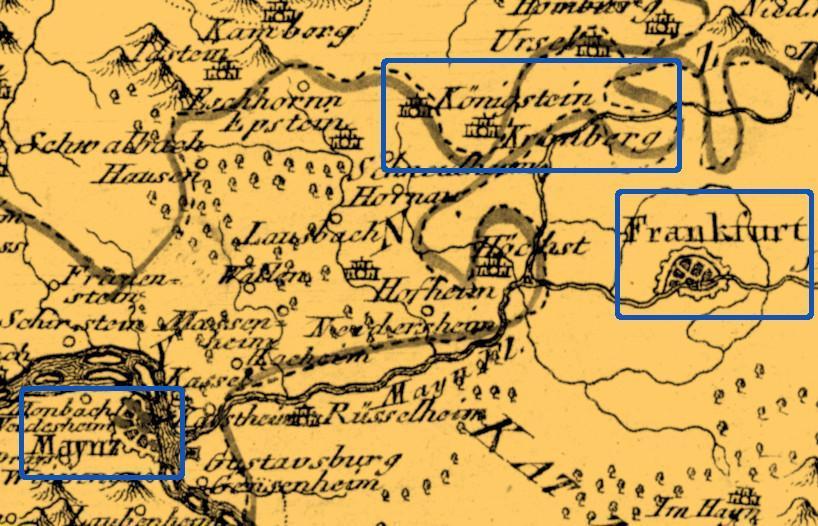
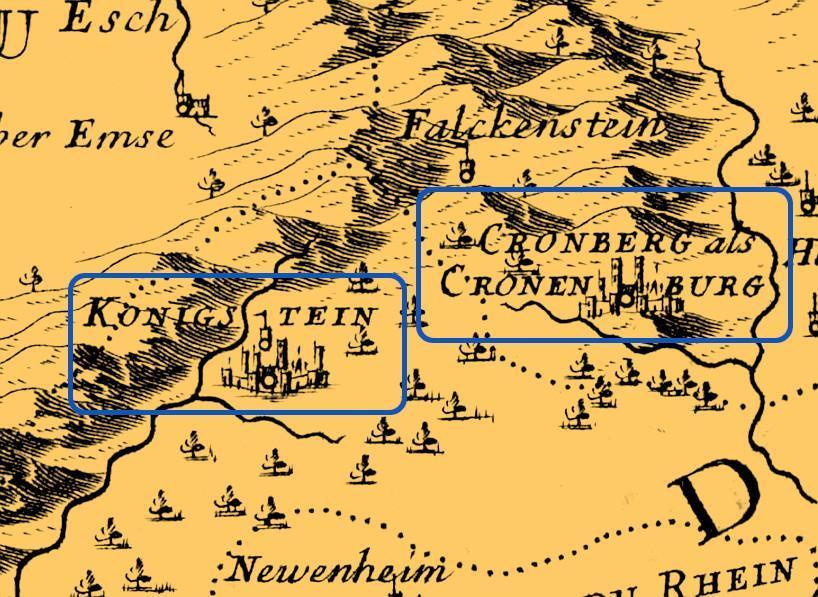
[*] Kronenberg, contemporary Kronberg (till 1933 officially Cronberg; Caroline spells it Kronenberg; when Erich Schmidt [1913] adds the name in brackets, he uses the contemporary spelling Kronberg) is adjacent (on its western edge) to Königstein and located barely 13–14 km outside and northwest of Frankfurt am Main (first map: excerpt from Franz Johann Joseph von Reilly, Das Erzstift und Kurfürstenthum Maynz, no. 223 [Vienna 1791]; second map: excerpt from Guillaume Sanson, Vangiones. Partie du diocèse de l’archevché de Mayence… Landgraviat de Hesse -Darmstadt [Paris 1675]; Bibliothèque nationale de France):
Here in an engraving from 1818; the stream in the foreground is the Rentbach (by Veith after A. Radl [1818])

As Caroline points out in the initial paragraph, she had been under house arrest here since the previous day, 14 June 1793. Samuel Thomas von Sömmerring wrote from Frankfurt to Christian Gottlob Heyne in Göttingen on 18 June 1793 (Forster’s Briefwechsel mit Sömmerring, 628): “Madam Böhmer, as you probably already know, is under [house] arrest in Cronenburg; her brother, who just returned from Italy, traveled over to see her yesterday.” Back.
[1] Mt. 26:41 (NRSV), on the Mount of Olives, before Jesus’s arrest: “Stay awake and pray that you may not come into the time of trial; the spirit indeed is willing, but the flesh is weak.” Caroline was also now over four months pregnant (Christoph Weigel, Historia von Iesu Christi unsers Heylandes Geburt, Lebenswandel, Wunderwercken, Gleichnußreden, Leiden, Sterben, Auferstehen und Himmelfahrt: Zur Einpflanßung von Jugend auf, und state Unterhaltung Gottseelige betrachtungen auß denen heyligen Evangelisten Mattheo, Marco, Luca, und Johanne, vorgebildet [Augsburg 1695]):

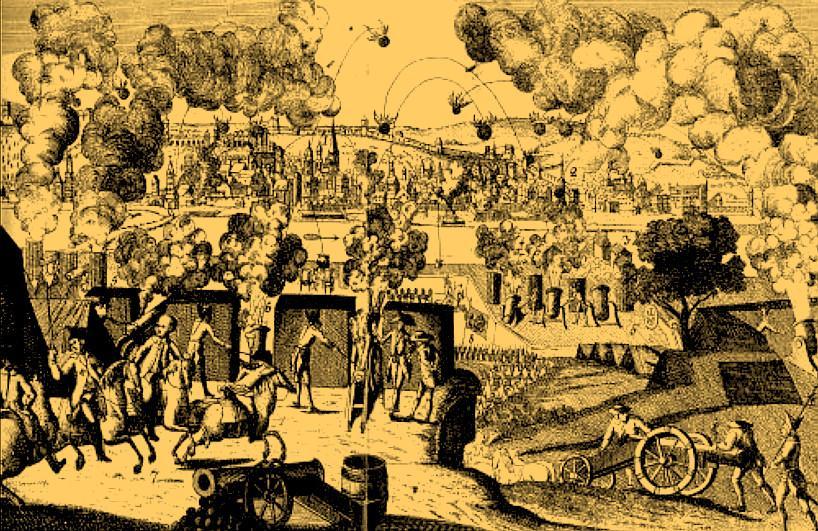
[2] I.e., a single salvo of the sort the Prussians were firing at Mainz at the time. Here the heavy bombardment of Mainz from the heights across the river (Heiner Stauder, Die Belagerung der Festung Mainz 1793) and in a painting by J. G. Schütz:

[3] Joseph Richter, Bildergalerie weltlicher Misbräuche: Ein Gegenstück zur Bildergalerie katholischer und klösterlicher Misbräuche (Frankfurt, Leipzig 1785), illustration following p. 202:

This paragraph dates Caroline’s release and transfer to house arrest in Kronberg to 14 June 1793. Back.
[4] (1) Leipzig Taschenbuch für Frauenzimmer zum Nutzen und Vergnügen aufs Jahr 1789 Inhaltsverzeichnis deutscher Almanache, Theodor Springmann Stiftung; (2) François Marie Isidore Quéverdo, Gespräch zwischen Louise und dem Gefängniswärter (ca. 1768–1802); Herzog Anton Ulrich-Museum; Museums./Signatur Queverdo nach AB 3.4


Caroline and her companions had been arrested on 2 April and taken to the fortress at Königstein on 8 April. Back.
[5] As a native of Göttingen, Caroline was a subject of the Electorate of Hannover. See the chapter on Lower Saxony in the supplementary appendix on Germany in the late eighteenth century, esp. the section on the Elector of Hannover.
As far as Friedrich Wilhelm II of Prussia is concerned, Caroline may already be anticipating her brother Philipp Michaelis’s decision to appeal directly to the king. As Luise Wiedemann remarks in her biography of Caroline in her Erinnerungen, pp. 81–82, Philipp “happened to be in Pisa at the time, where Prince Augustus was also currently staying, who himself had studied in Göttingen; Tatter was with him.”
Philipp returned from Italy on 17 June and immediately came to Kronenberg, and on 19 June, because the Hannoverian administration’s appeal to Friedrich Wilhelm II had been rebuffed, decided to address the king directly himself (see Luise Wiedemann’s account in her biography of Caroline in her Erinnerungen, pp. 81–82).
The king responded favorably, issuing a rescript on 4 July; Caroline would be freed on 11 July 1793. This was an astonishing bit of good luck considering the king had already declined the Hannoverian appeal. Even Goethe, in a letter to Friedrich Heinrich Jacobi as late as 7 July 1793 (Weimarer Ausgabe 4:10:90), remarked that it would be “difficult to do anything for the prisoners at this point; they have been delivered over and left to the prince elector.” Back.
[6] See esp. the more extensive account of conditions in the Königstein prison published two years later by Johann Heinrich Liebeskind, father of Adalbert, Meta Forkel’s child born the previous October. After receiving his law degree in Göttingen (where he knew Meta) on 30 January 1793, he arrived in Frankfurt at the end of March, remaining then close to Meta even in Königstein (Post Karte Durch ganz Deutschland, ed. J. Walch [Augsburg 1795]):
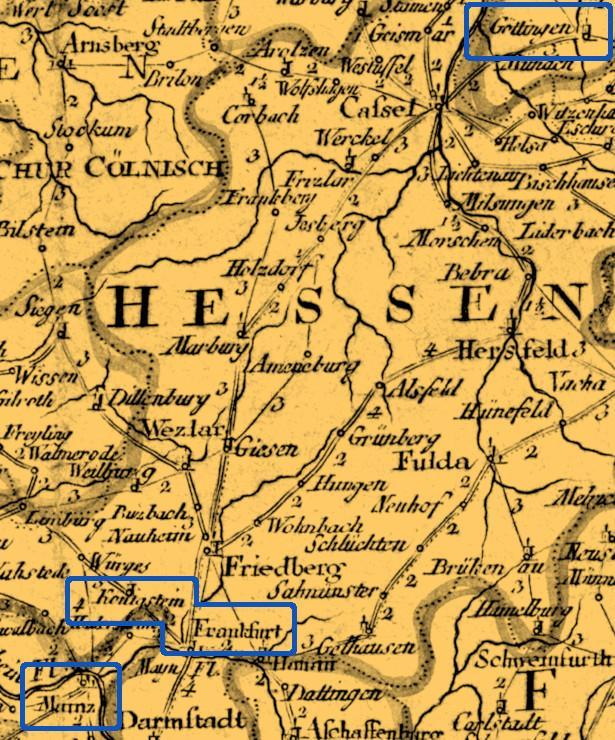
He later published his and Meta’s (and by extenstion also Caroline’s) experiences in the memoir Rükerinnerungen von einer Reise durch einen Theil von Teutschland, Preussen, Kurland und Liefland, während des Aufenthalts der Franzosen in Mainz und der Unruhen in Polen (Strasburg 1795); parts of Liebeskind’s account coincide remarkably, even with regard to word choice, with Caroline’s epistolary accounts (for excerpts, see supplementary appendix 128.1). Back.
[7] The actor August Heinrich Porsch (not “Franz,” as in Erich Schmidt [1913], 2:701, 711) had been delivering letters to Caroline. Since 1789 Porsch had been married to a relative of Mozart, a divorced Madam Wersing, née Buchner; Mozart writes to his wife, Constanze, from Frankfurt on 30 September 1790 (The Letters of Wolfgang Amadeus Mozart (1769–1791), 2 vols., trans. from the collection of Ludwig Nohl [Mozarts Briefe (Salzburg 1865)] by Lady Wallace [New York 1866], 2:262):
Whom do you think I met here? the girl who so often played at hide-and-seek with us in the Auge Gottes [Constanze’s former residence in Vienna where Mozart also lived for a while]: I think her name was Buchner; she is now Madame Porsch, and is married for the second time. She requested me to send you very kind messages from her. Back.
[8] Possibly the letter to Meyer similarly written on 15 June 1793 (letter 129). Back.
Translation © 2011 Doug Stott