
• 129. Caroline to Friedrich Ludwig Wilhelm Meyer in Berlin: Kronenberg, 15 June 1793
Kronenberg, 15 June [17]93
|293| Back in March, you remembered me and considered me capable of a measure of former virtue — albeit while yet suspecting me capable of considerable foolishness. I know not what your opinion is now. I recently wrote Gotter, “When Meyer hears |294| what has happened to me, he will surely detest me, and he would have every right to do so had I myself really brought it about.” [1]
Although there is certainly much I could tell you now, you would be no more the wiser even were you to hear it, since you are already long familiar with human folly and wickedness and with the wondrous interconnections of unavoidable coincidence. — I have just lived through two horrible months — and my health has suffered quite severely — but give me peace and seclusion tomorrow and I will forget everything and be happy again.
From January on, I had firmly resolved to leave Mainz and go to Gotha [2] — you, too, I had included in my reckoning — I was hoping to see you in Gotha. But my concern for Forster, who at precisely that time was to learn that Therese intended to administer half-justice and separate from him, kept me in Mainz. [3]
My utter ignorance of everything that was going on outside Mainz led me to view this postponement as a matter of indifference, and I viewed myself as utterly insignificant in any case given my lifestyle, a lifestyle utterly uninterrupted and untainted by even a single public act or by a single gesture of approval or any foolishness of the sort you mention (no man seems capable of avoiding the fate of having fairy tales spun around him). Nor was I guilty of keeping the company of my crazy brother-in-law, who never even set foot in my residence.
But my connection with Forster in his wife’s absence, in which I functioned more as a nurse offering moral support, did indeed cast a suspicious light on me from the perspective of morality and politics, and I paid too little attention to it because I rarely ask in any case how something of that sort might appear to others if in my own eyes I am standing there ingenuous or justified. [3a]
—
Heaven knows what loyal concern I |295| bore for F[orster]. I knew nothing of Therese’s plans — at the end of December she wrote me, “Love and take care of F[orster] and do not think about leaving before the spring; by that time, many nice things can come about.” That was the last — and only — letter since her departure — not a single syllable since then, neither to Madam Forkel nor to me.
In the meantime, I guessed her intentions, and saw how it would sooner be F[orster] who would suffer from every delay, since he did not seem to suspect anything — which is why I wrote to Huber in January, from whom I received the response: “It is good and kind of you to alert me in this way, and I would like to thank you for making me sense more urgently that any delay would be ignoble.” A letter from him to George [sic] followed soon thereafter, which fell to me to deliver personally. —
Therese wrote at the same time — and it was settled that Huber was to get Th[erese] and Clara, while George was to keep the eldest child. Forster’s mood was so unstable that it took every ounce of unflagging patience and feminine, sisterly friendship to endure him, though you, who are familiar with all his more attractive personality traits, can probably easily enough comprehend how precisely these traits, combined with his pitiable weaknesses, prompted me to persevere in an utterly voluntary, utterly selfless fashion.
I am enclosing a couple of notes from him that I would like to ask you to keep — these are the only ones I still have, otherwise I destroyed everything from his hand and am no longer keen on keeping even these with me. During the middle of February, he traveled out into the country, staying away for 3 weeks [4] —
I had in the meantime become so sick with attacks of gout that I had to stay in bed and was unable to travel. — Till the end of March I suffered sometimes more, sometimes less with such pain that on the 26th I still did not think myself capable of traveling and instead lay there in fear of death. On the 24th, George went to Paris, and I separated from him forever.
I finally set out |296| on the 30th with Meta and her elderly mother to travel by way of Mannheim on to Gotha, where Gotter had already long prepared a place for me to stay after arriving. We had to turn around because the Prussians had already taken control of the countryside —
In order to travel directly to Frankfurt, we entrusted ourselves to a man who is one of those people who, though reputed to be upright, out of fearful timidity is nonetheless capable of committing all sorts of villainous tricks — that was stupid of us, not least because this was the first time I had ever even seen him — but why would I be thinking of betrayal when it never occurred to me that I myself might be under suspicion in the first place? [5]
As soon as we were stopped because of our ominous names, [6] this person delivered us over in order to keep his own loyalty above suspicion — Still not suspecting how terrible things would turn out, we remained in Frankfurt for 3 days and faithfully adhered to the restricted town arrest imposed on us while he went to the headquarters, an expedition after which we were first put under house arrest with a guard and then transported to Königstein. [7]
I am relating this to you quite cursorily, without describing any emotions; hardhearted as you may well be, you can doubtless still put yourself into our position and sense those emotions. I was always just a woman, never any sort of unnatural heroine — and I felt everything without succumbing — the only thing that made me weak was the sight of my child.
After several weeks of imprisonment, we learned that they intended to use us as hostages over against citizens of Mainz who had been taken to France — they anticipated that out of despair we would do everything to effect an exchange and would be able to bring it about through Forster and W[edekind]. We have steadfastly opposed this even up to this very moment, and such a step would inevitably be fruitless in any case — frequent and urgent intercessions finally managed to obtain local arrest for us here instead of the unhealthy, frightful, |297| undeserved prison in Königstein —
I still know not how they are planning to resolve this matter — we have now appealed to our own government — there I can at least secure proof that I am not to be used as a hostage — but even then, they can still harass me with false accusations — had they started with an investigation, I could already be completely redeemed — as it is, they imposed anticipatory punishment — to satisfy their own bitterness toward Forster, which I must unfortunately now share — in case nothing could be proven. I still have not learned of a single fact on account of which I am really being considered guilty, nothing but vague, disgraceful, absurd rumors.
I cannot be satisfied with this conditional freedom — I must be able to depart this setting soon if I am not to perish. [8] I wish to God you were nearby and I could speak with you. — Concerning my guilt and innocence, I can tell you only that since January I have been deaf and uninterested with regard to anything political — at the beginning, I was ardently enthusiastic, and Forster’s opinion naturally swept mine up along with it — but never have I been either a public or a clandestine proselytizer, and in my entire life have never been as aristocratically more reserved in my dealings than during this democratic period. Nothing of which I have been accused is true. In even the most stringent investigation, only one careless act might witness against me, something about which, moreover, I have not yet been able to learn whether anyone even knows and whose fault is precisely solely that of a lack of prudence. [9]
You must take me at my word — it may quite possibly be the last I speak to you.
Huber is still writing to me, whereas I have no signs of life or of concern from Therese. I detest attributing my own misfortune to someone else, — and yet otherwise I might well ask: who enticed me |298| to Mainz in the first place? And why, for whose sake, did I stay there? — But I no longer think of Therese. I did write to Forster — perhaps he has not yet been able to answer. Well, — let them all concern themselves only with themselves.
My existence in Germany is over. There is no man on whom I might be dependent or whom I might love enough to want to spare him. Tatter could have saved me with a bit more manly courage and a decisive act of intervention — the only man whose protection I ever desired failed to provide it. [10]
My extremely resolute, instinctive inclination toward independence never allowed me to consider exploiting my power over anyone else. Tatter will torment himself — but why was that the only thing he was able to do for me? He did not want to be happy — and for me the time had also passed when doing without constituted a pleasure. If in December, after I had anxiously written him about my future, Tatter had said — “Leave Mainz,” I would have obeyed — instead he writes — “I despair at not being able to do anything for you.” My patience was becoming exhausted, my heart regained its freedom, and in this position, without any aim, it seemed to me that I could do no better than to lighten a friend’s troubled hours and otherwise — divert myself. — I have not written Tatter since January, nor will I do so again — except in one case.
Although I am now isolated in the world, I am still a mother, and as such I will try to maintain and save myself. The thing that worries me, and occasionally weakens my cheerfulness, is the condition of my health — and the sufferings of my mother. The same week I lost my freedom, Lotte lost her life in childbirth. [11] My mother is grieving, but Lotte is better off this way — she was happy when she died, and yet she could still have experienced so much misfortune had she lived longer. [12]
|299| I must remain silent concerning my future because I cannot commit to writing everything that concerns the present. Please write me immediately and tell me how long you will yet remain in Berlin. You can be assured of doing so securely, and the answer is important to me. [13] Address an envelope to Herr Franz Wenner in care of the Varrentrapp and Wenner Bookstore in Frankfurt. I received your letter of 9 March a couple of days ago through Huber, to whom Amalie had sent it.
Farewell. Regardless of what you may hear about me now that I have been disgracefully handed over to a spiteful public — and regardless of the decisions I might make — consider that I have remained the same woman you always knew in me, destined never to transcend the boundaries of quiet domesticity but torn out of my sphere by an incomprehensible fate, but without having forfeited the virtues of that sphere and without having become an adventuress. Again, farewell. [14]
Notes
[1] In her letter to Friedrich Wilhelm Gotter on 16 May 1793 (letter 127) (with slightly different wording). Back.
[2] This statement concurs with Caroline’s letter to Luise Gotter on 24 January 1793 (letter 120) Post Karte Durch ganz Deutschland, ed. J. Walch (Augsburg 1795):
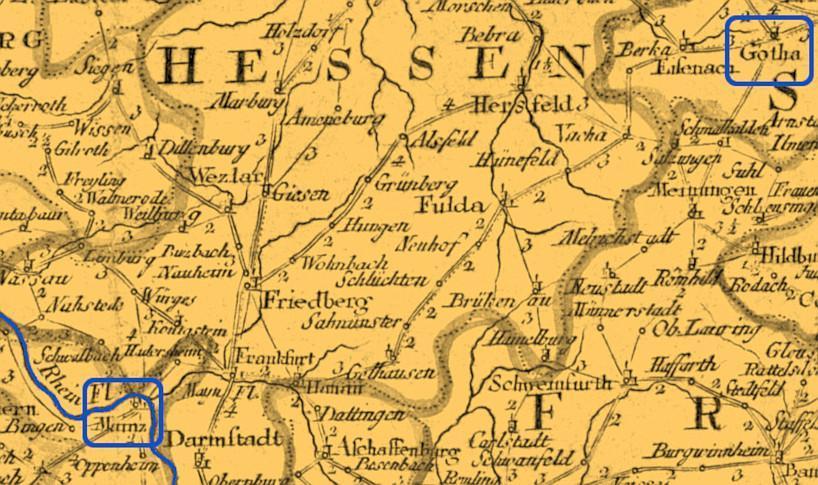
[3] Therese Forster had left Mainz and her husband, Georg Forster, on 7 December 1792 with her two daughters, Therese and Claire, and traveled to Strasbourg. Concerning her itinerary, see Caroline’s letter to Meyer on 17 December 1792 (letter 119), note 5. Back.
[3a] Although Caroline’s true relationship with Forster during this period can probably never be reliably determined, see in any case her letter to Friedrich Wilhelm Gotter on 16 May 1793 (letter 127), note 9 (Goettinger Taschen Calender Für das Jahr 1794):

[4] These notes from Georg Forster have apparently not been preserved.
Forster had left Mainz before scheduled elections concerning incorporation into France; he was sent out as a kind of commissar to convince other locales to vote for such incorporation; his stops included Grünstadt and Kirchheim south of Mainz, among others. Back.
[5] Illustration: Carlo Goldoni, Opere complete, vol. 6 (Venice 1909), 165:

[6] Namely, Böhmer and Wedekind. Back.
[7] See Johann Heinrich Liebeskind’s account of this journey and of conditions in the Königstein fortress in his Rükerinnerungen von einer Reise durch einen Theil von Teutschland, Preussen, Kurland und Liefland, während des Aufenthalts der Franzosen in Mainz und der Unruhen in Polen (Strassburg 1795) (excerpts see supplementary appendix 128.1).
Caroline’s account here, particularly concerning the guard detail, does not square with that provided by Samuel Thomas von Sömmerring in his letter to Christian Gottlob Heyne on 6 April 1793 (letter 121d). Back.
[8] Caroline was now over four months pregnant. Back.
[9] Presumably an allusion to her relationship with Jean-Baptiste Dubois de Crancé. Back.
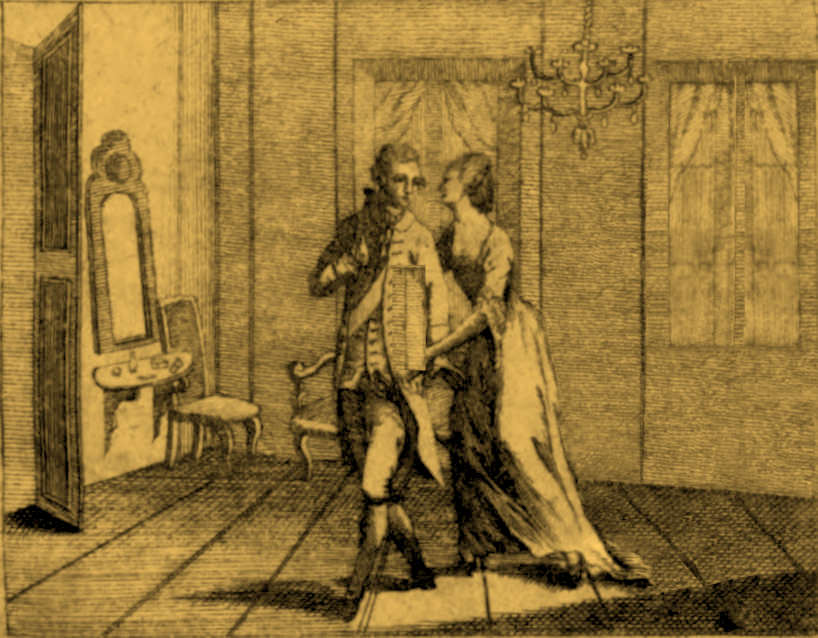
[10] Tatter seems to have visited Caroline in Mainz ca. 20 September 1792 but without anything other than, apparently and to her considerable disappointment, an essentially perfunctory commitment to her (title vignette to Der deutsche Jüngling in Frankreich [Leipzig 1789]):
Thereafter he remained wary and even evasive about his connection with her for professional reasons; it was the last time she ever saw him.
See Luise Wiedemann’s brief assessment of Tatter’s inaction in her biography of Caroline in her Erinnerungen, pp. 81–82, and Tatter’s rationalizations in his own letter to Luise from Rome on 11 May 1793 (letter 125c). Back.
[11] Charlotte Dieterich, née Michaelis, had died on 2 April 1793. Caroline, given her situation after having left Mainz on 30 March 1793 and fallen so quickly into difficult circumstances (indeed, she and Meta Forkel had been arrested the very day of Lotte’s death), could not have been immediately informed of the events surrounding the birth of Lotte Michaelis’s child. Concerning the circumstances and the resulting scandal, see Georg Tatter’s letter to Luise Michaelis on 27 April 1793 with note 1, there also Georg Christoph Lichtenberg’s remarks concerning the sequence of events. Back.
[12] See Luise Wiedemann’s surprising remarks in this regard in her biography of Lotte in her Erinnerungen, p. 90. Back.
[13] Caroline may already have been considering Berlin as a place where she might either securely and anonymously bring her unborn child to term or take up residence afterward; see her response to Meyer on 30 July 1793 (letter 132) after he apparently responded negatively to her query. Back.
[14] The postscript from the “remitter” of the letter concludes: “Caroline’s liberation might be just the task for a knight of your sort.” Meyer, however, like Tatter, and arguably predictably, did nothing (Goettinger Taschen Calender für das Jahr 1791; Inhaltsverzeichnis deutscher Almanache, Theodor Springmann Stiftung):

Translation © 2011 Doug Stott