
Lotte
|85| Charlotte Wilhelmine Michaelis, born 27 October 1766. Father Michaelis noted all the children and their birthdays in a Bible my mother gave to Dr. Michaelis in Harburg for safekeeping.
Unfortunately, after his death, no one attended to it, and it can no longer be found. Hence I am unable to give the precise days of birth. —
Lotte was a beautiful child, probably one of the things soliciting an extra measure of tenderness and affection from her mother’s heart, though the latter never really gave preference to any of her children.
That said, however, she [the mother] was sooner cold than emotional, and given my father’s more forceful personality it was indeed fortunate |86| that she was calm and acquiescent. Nor to my knowledge was their marital happiness ever really disrupted.
Lotte was the only child my mother nursed herself for a time, albeit with considerable trouble, and that is probably also why Lotte was a bit closer to her heart. Although people used to say she gave preference to Lotte, I myself cannot really say, and I never noticed any of us being neglected or put behind any other. —
And just as Lotte was a beautiful child, so also did she become a beautiful young girl about whose beauty I still heard men speak and recall with delight even many years later, such as Wiedemann [?] and many others as well. It was just that she was too small, though with a delicate build, with the most beautiful head atop her small body. Her curly black hair and the most beautiful dark eyes stirred many a heart. [1] —
Even at a very early age, she went her own way with clothing. She did not at all like wearing her hair in a stiff curled hairdo after the traditional fashion, and similarly hated wearing a pannier, which is also why she was chided from an early age because of how she altered her clothes from current fashion, the latter of which she wore only because she had to and because it was considered unseemly to wear neither petticoats nor such a hairdo.
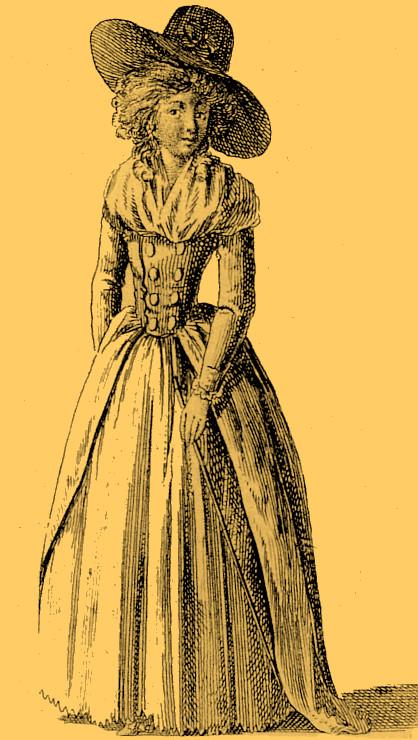
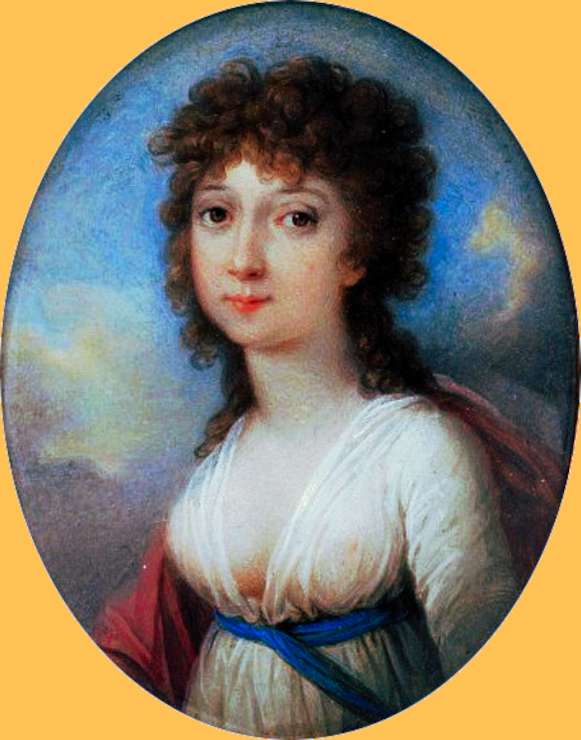
Which is why she was criticized, except that she never let it keep her from wearing her hair in loose locks hanging around her head, she then in a simple dress with a wide belt beneath her bosom, just as a miniature portrait still portrays her that the later renowned Professor Tychsen painted, as did a copper engraving by the famous Madam Jordan that was purchased that bears a remarkable resemblance to her in clothing, facial features, and figure, and which is still there with the miniature portrait. [2]
She was an orinelle [original] and quite romantic [Germ. romanhaft] girl who was influenced by everything that was romantic [Germ. romantisch]. [3] When she was about 12 years old, she similarly returned from Gotha, [4] where everything had a profound influence on her, such as her social contacts in the Gotters’ house. He, who lived solely for poesy and the theater — and the theater company itself, which was particularly good at the time, with Ekhof, Boek, and Madam Seiler etc., all of whom were brilliant. A good model for her.
Not that she planned on being an actress, but she did acquire from it [the theater] a considerable gift for reading aloud — something she afterwards frequently practiced, especially with Professor Meyer, who worked in the library [and with whom she] often read together in the Böhmers’ house. Like my eldest sister [Caroline], |87| so also did she find a girlfriend in this family, which was such close friends [with ours], and soon also a suitor in one of the sons, who later died as a counselor in the higher court of appeals in Zelle.
Unfortunately, she felt no affection for him. How differently would her life have turned out, and how, given her passionate personality, would such a restricted life have been for her, void of all poesy and love.
She was hardly 14 years old [late 1780] when my father thought it advisable to send her to Gotha yet again when a wholly dissolute young man from Portugal who lived in the adjacent wing of our house began pursuing her there at home. I do not know whether she had any affection for him. Apparently so, according to what Poel later wrote in his autobiography. [5]
But he does her too much injustice — she was so young — and my sister great injustice as well, [6] just as he was similarly excessively prejudiced in favor of Hoek [Hockel], since afterward even he writes about Hoek’s [Hockel’s] depravity.
My father was quite justified in removing her from such influence and in having her confirmed in Gotha; there, untouched by such poisonous vapors, she lived among some excellent people, albeit strict, perhaps even too much so, but then was also spoiled and put on a pedestal by a married woman whom she visited daily. Here she also made the acquaintance of Musäus, who is familiar from his fairy tales. Kotzebue also paid her his attentions as a young man — and in later years he never passed through Göttingen without eulogizing her [see letter 25a].
When she returned at 15 years old [April 1782], everyone was taken by her beauty, though there was also no lack of envy, and she was worshiped from afar. So also, for example, by a young man whom Poel incited, taunting him, out of hatred [toward Lotte] because of Hoek, into sending her letters. I believe they may even never have spoken to each other.
It was a certain Herr von Elze, from an old family. At that time there could be absolutely no thought of securing any consent to marriage. For him, however, the jest turned serious, and though he could not act against his family’s wishes, he did reappear in Göttingen a year later. I remember only that my father and the elderly Böhmer traveled out to the Krone [an inn on Weender Strasse; Goethe had stayed there during a visit in September 1783] and returned after an hour. A stranger then came to see and speak with my sister (it was von Herr von Elze, I recognized him), lingering with her a while probably to hear from her own lips that our father would not consent to any alliance because his relatives (his |88| uncle was the Electoral Prince of [gap in manuscript] and lived in Coblenz) opposed it.
Then someone got wind of a plan that Herr von Elze would be coming and was perhaps intending to take her with him — but the men’s intervention thwarted it, and Lotte took leave of a man with whom I know not how or where she could ever have spoken in a normal situation.
But then her romanticism received new impetus after she had been rather disgruntled for a time. Notwithstanding all the attentions paid her, she never attended balls at that time. Although there were indeed social gatherings, things generally remained the same. —
At that time we also became acquainted with the Bethmann family, who were often accompanied at social gatherings by a certain distinguished young Russian, Miloradovich, who greatly favored Lotte with distinctions — though it was really nothing more than goodwill. —
His cousin, at the time still a young boy, was my playmate along with the youngest Bethmann girl, Sophie, Lotte’s girlfriend.
But now Lotte was grown up, distinguishing herself, moreover, with all the gifts of the intellect as well. Professor Tychsen also helped draw her victory chariot but was unfortunately rejected, afterward only painting her portrait, whose original drawing, by the way, he kept for himself for another Livonian, who never, however, received it.
His name was Blankenhagen, a completely free person, though excellent not particularly as regards intelligence, but of a good reputation. He also had a companion, and his two cousins, von Grote, Livonians, were also in Göttingen at the time. All were aware of Blankenhagen’s affection [for Lotte]. He was also friends with Tatter, Lotte’s friend and advisor. Von Blankenhagen departed [1787], intending to travel to France etc.
He ardently loved Lotte and greatly respected her. There was no alliance or engagement, since couples did not always begin with such at that time, trying instead to get to know each other first. He wrote to her for a year, saying he intended to court her when he was back in Livonia. But then [the] letters came less frequently, and finally ceased.
Lotte genuinely loved Blankenhagen and was totally destroyed. Tatter wrote to Blankenhagen’s companion, [who responded that] Blankenhagen had fallen into the snares of a certain woman in Stuttgart who had corrupted his manners, which had hitherto been quite strict; in a word: this woman’s arts had degraded him, and he later |89| died from the consequences of a life he should never had led given his weak constitution.
Lotte was utterly destroyed, and once again it is incomprehensible how such an excellent person had felt attracted to this good but weak man, indeed had genuinely loved him. She wanted to die. —
She went to visit Caroline and my brother in Marburg, where she lived amid very pleasant company. They read a great deal, moreover, just as at home, where Schiller’s “Götter Griechenlands” [in Der Teutsche Merkur (March 1788)] and his other works, such as Kabale und Liebe [1784], spoke directly to her sensibility — just as did all such books that stimulated her imagination.
From Marburg she then traveled to Mainz to visit Madam Forster, whom she idolized. Although she met a great many quite distinguished people there, I know of none who touched her heart. She was likely good friends with Hermins [?], who often visited Forster. Philipp was also in Mainz at this time, and through him she made the acquaintance of Madam Möhn, the daughter of Madam La Roche, and Madam La Roche as well, with whom she spent several weeks — the purest nourishment for her romantic spirit.
Madam La Roche worshiped Lotte, of which I still have evidence. After her [Lotte’s] death, she asked for her diary, parts of which Lotte had already related to her [see letter 142a].
Back in Göttingen, she soon made the acquaintance of bookseller Dieterich’s son, an extremely frivolous man who nonetheless loved Lotte more than anything after making her acquaintance, also seeking to continue the relationship. His father opposed any marriage because of his hatred toward my father, and did everything he could to undermine the relationship even though he saw how [the young] Dieterich had begun to change, and what [positive] effect Lotte was having on him, the latter doubtless attracting him more to him [her?] along with the hindrances his father was putting in their way.
After a year, however, he [the father] gave in, and the wedding took place in 1792, after my father had already died. I do not believe he would have opposed it, though he would have preferred Tychsen, something to which he often jestingly alluded, saying, “Which of the two of you wants him? He is so suggestive toward me that I almost feel I should outright offer him one of my daughters.” But neither of us was interested, and so Lotte became Dieterich’s wife, loved and respected by the elderly Dieterich and everyone else [in the family], and also esteemed so highly because she had turned her husband from his ill-chosen paths.
|90| In April of the following year [1793], she gave birth to a daughter — and died [7] — ! and her daughter 2 years later — and [Lotte] was probably fortunate to die, for I do not believe she would have kept Dieterich on his previous straight path.
Although everything she wrote attested her happiness — she not only would never have lived through a relapse [on Dieterich’s part], but it also would have plunged her into profound unhappiness, indeed, given her passionate nature, into a self-chosen [death?]. —
Nor could she ever have directed the firm’s business matters, as did his second wife. Although she [Lotte] had more intelligence than the latter, and imagination, she did not have her practical sense, which managed to revive and indeed maintain the ruined business.
I was extremely fond of his second wife, and gave her the child. We moved to Braunschweig, the child died. Janette always remained my dear friend, and her daughters my dear nieces. Dieterich managed to stay on track until shortly after his second marriage.
Although it was always awkward and painful for me to see him from time to time, I would have overcome my reservations when, on the occasion of the jubilee [1837] and when he had come down ill, I came to Göttingen for several days and found him dying. He knew I was in the house, sent his greetings to me, and thus relieved me of an extremely painful and upsetting farewell. Although he genuinely did love Lotte — and Janette as well — his frivolous, irresponsible nature always, on every occasion, got the better of him. —
It was so fortunate that Lotte did not have to experience his demise. But how sad for my poor mother to lose her daughter after having anticipated so much joy. Death now beneficently cut short all future sufferings, illuminating God’s obscure counsel of not imposing more suffering on the poor woman [i.e., Lotte] than she could have borne, instead allowing Lotte to die at the pinnacle of her happiness.
I have included some material from her as a supplement, e.g., letters and notes [e.g., letters 123a, 125c, 142a, 150b], things that present her more vividly, and testimonies to her intellect and understanding. There is also a letter from Dieterich, and the silhouettes.

She was always a dear sister to me. Why, however, were we so reticent about talking about certain things? How good would an open exchange have been, whereas instead we remained silent about our most intimate relationships.
Notes
[1] August Kotzebue confirms this description in letter 25a. Here a representative illustration of a young woman similar to both his and Luise’s (and Georg Ernst Tatter’s; see letter 89) description, incidentally from a 1789 Göttingen publication (Goettinger Taschen Kalender vom Jahr 1789; Inhaltsverzeichnis deutscher Almanache, Theodor Springmann Stiftung):
[2] Julius Steinberger, Erinnerungen 144, identifies this allusion (Madam Jordan) as Mme. Jourdan in Paris (also with the signature Fme Jourdan or F. Jourdan) who did engravings for French and Swiss publishers during the second half of the eighteenth century (Allgemeines Lexikon der bildenden Künstler von der Antike bis zur Gegenwart, ed. Ulrich Thieme and Felix Becker, vol. 19: Ingouville–Kauffungen [Leipzig 1926], 198).
The location of the miniature portrait of Lotte herself is unfortunately no longer known.
That said, given the descriptions of Lotte still extant, she may perhaps have resembled, however distantly, the young lady in the following late-18th-century miniature portrait by Adolf Ulrik Wertmüller. N.B. this illustration is intended solely as a representative illustration and as a stimulus to the reader’s imagination with respect to a young woman who emerges in these letters as a singularly charming and ebullient, even guileless personality who died much too young:
[3] See Caroline’s characterization in letter 29: “Her character is composed of vanity, half-affected sentimentality, thoughtlessness, and a love of leisure and of everything that goes by the name of ‘novel’ [Roman] and resembles such in everyday life.” Back.
[4] Luise is presumably referring to Lotte’s attendance at Madam Schläger’s boarding school. Lotte returned to Gotha, however, in late 1780, returning to Göttingen in April 1782. Back.
[5] See supplementary appendix 21.1 and supplementary appendix 29.1. Back.
[6] Poel (supplementary appendix 21.1) speaks of Caroline’s “jealous attention” in the matter. Back.
[7] Concerning Lotte’s death and the resulting scandal, see supplementary appendix 123a.1 and supplementary appendix 123a.2. Back.
[8] Portrait: from the silhouette album of Gregorius Franz von Berzeviczy; by permission, Erika Wagner and Ulrich Joost, Göttinger Profile zwischen Aufklärung und Romantik (Neustadt: Dosse 2011), 74. Back.