
• 119. Caroline to Friedrich Ludwig Wilhelm Meyer in Berlin: Mainz, 17 December 1792
[Mainz] 17 December [17]92
|277| I feared you were sick, and sensed as much as well — otherwise you would have behaved more humanely. Why do you go out and break a leg — why ruin your stomach with no one nearby who might take care you, who might ease your physical ailments and wrest out of the hands of your moral failings the dagger whose point they turn against themselves? How absurdly beautiful a statement that is! O behold not my sublime words, for my deeds would be no less sublime for them. Do you doubt I would like to be in a position to care for you or that I would do so loyally? —
I do not know you well enough? — That may be, but if I am badly mistaken, it is certainly not to your advantage. We should “make do with goodwill and respect”? — Fair enough, as long as I may perceive such in my own fashion — and I would counter that your “goodwill and respect” should not be weaker or toned-down expressions, be they otherwise ever so highbrow.
Do you understand what I am saying? I am probably not being very clear today — such would then not be by virtue of example, but rather a legacy — as you will come to see at the end of this letter. You are reconciled, but my étourderie [1] does continue to exert an influence. Meyer, I am not interested in humbling myself, or in casting aspersions on my own intellect, but it is nonetheless true that I am capable of committing étourderies that in fact look like acts of stupidity. My transgression against you is of that nature. After I have seen the light, I no longer comprehend myself. Ought one not be able to forgive a woman for such a thing with all one’s heart? — Am I to know what sort of thing “Baiocco Romano” is?
I once heard of “Beggar Labre” and even read about such from the pen of another Meyer [2] — (so! it is to the Meyers that I owe |278| my acquaintance with beggars!). Have I really read his epigrams? And am I always capable of distinguishing between wit and insipid jokes? My good brother, forgive me. Who can say how soon a bullet may find its way into my head? Then you would be sorry. I will entreat you for the last time — I cannot stand being either rewarded or chastised beyond merit. —
“We will talk again after the peace” — does that mean I am not supposed to write you as long as we are en état de guerre? [3] Well, I will not obey — I want to write — the way I go about it, it cannot be disadvantageous to you — and thus will be advantageous. I suspected that you were viewing us en horreur. But who gives you, O Pilgrim in the vale of tears, the right to ridicule thus? [4] You who are free in every clime and happy in none? Can you seriously laugh when the poor peasant who works three out of every four days sweating blood for his overlord, drying that sweat indignantly each evening — when this peasant then feels that things could, indeed should be better for him?
This is the simple perspective from which we begin; it can indeed lead one astray — this does not, however, permit you to believe that we are crazy and have been listening to prophets different from those to whom we have always listened, prophets who do not include W[edekind] and B[öhmer].
Therese is no longer here. She has gone to Strasbourg with the two children [5] — why? — ask me not. From a human perspective, this is the worst decision she has ever made, and the first step of which I disapprove without reservation. [6] She who vehemently reproached every refugee, who had such fiery enthusiasm for the cause, leaves at a time when every security measure makes an impression and increases the pathetic indecision |279| of the masses — leaving him behind completely inundated with responsibilities and tasks — and burdened with having to worry about household finances — leaves him to pay for two households at a time when all salaries are being withheld.
One cannot help but notice. Nor did he want this to happen — I know neither which secret reasons she may have nor which reasons she presented to him — but she managed to push it through. Unless I am quite mistaken, this time the motives driving her were less of the pardonable than of the passionate sort, perhaps the urge for change, and to play a role there of the sort she was not able to play here. Many suspect she is planning a separation [7] — you and I certainly not among them. Would she be that just? —
This is the first time you have heard me talk thus — because this is the first time I am thinking thus — but this has also infuriated me. Nor might the ending be entirely disadvantageous for her — but that cannot change my judgment.
She does have an excuse — the disgraceful events in Frankfurt shook her imagination [8] — but that might have prompted a different turn had she not already been inclined to give it just that turn to begin with. And he is the most wondrous man — I have never loved and admired anyone so much and yet simultaneously thought so little of the same person. He traversed his political path quite alone and was well advised to do so — Her spirit is not suited for that sphere, more active than efficacious in it. He goes about with a certain nobility — intelligence — modesty — selflessness — were that but all!
But lying in ambush is weakness, the need for her approval, the pathetic repression of just demands — and a hot-tempered assertion of lesser ones. He lives off attention and pines for love and is also able to bear this eternal struggle — and does not have the strength to tear himself away of the sort one also needs when acknowledging superiority |280| even if doing so causes us to fall out with ourselves. I hate [9] egoism — but either one must, with simplicity of heart, worship perfection — or be steadfast enough never to think less of oneself even than that which we recognize over us.
This man’s unfortunate receptivity and her ungenerous selfishness condemn him to eternal torment. I have seriously wondered whether one might open his eyes in the matter — it goes without saying that I must not and will not contribute, either directly or indirectly, to such — I have found that although one might well be able to extinguish his love, one could not extinguish his affection or devotion. Does not this alone already sentence him?
She occupies him, entertains him — no creature can replace that for him — that is why she is unique — she teases his vanity because he sees that she also attracts the attention of others, and hence he never learns how disadvantageous are the judgments that even these others pass on her. Those who do not like her, she flees — a new triumph! Thus does she keep him — goes around using his name and parading it with pride. Which is not proper — and yet, alas, he deserves it. My good Forster, do go and reproach the gods.
I am staying here — one grows accustomed to everything, even to the daily prospect of a siege. [10] Write to me by way of Gotha [11] — you can do so with complete security. I must know whether you are healthy.
Notes
[1] Fr., “thoughtlessness, thoughtless or rash act, blunder,” viz. her assumption that Meyer was the author of the satirical poem “Huberulus Murzuphlus oder der poetische Kuss” in the Göttinger Musenalmanach (1793), 178–88, which was signed by the pseudonym “Baiocco Romano.” See her letter to Meyer on 22 September 1792 (letter 115) with cross references. Here and in the next occurrence of this term, Caroline is using the Germanized version of the French, namely, Etourderie (same as French form except for the upper-case initial letter) and pl. Etourderien. I have rendered both here in French. Back.
[2] Both Waitz (1871), 1:108, and Schmidt (1913), 1:277, read “Cabre,” though the Krakau manuscript reads “Labre” (albeit in Latin rather than Current handwriting).
In any event, the name is “Beggar Labre,” the figure Benedict Joseph Labré, and the source the book Caroline mentioned earlier in her letter to Luise Gotter from Mainz on 20 April 1792 (letter 112), namely, Friedrich Johann Lorenz Meyer, Darstellungen aus Italien, published by Christian Friedrich Voss (Berlin [Potsdam] 1792), 215–21. Here the frontispiece, title page vignette, and final vignette:

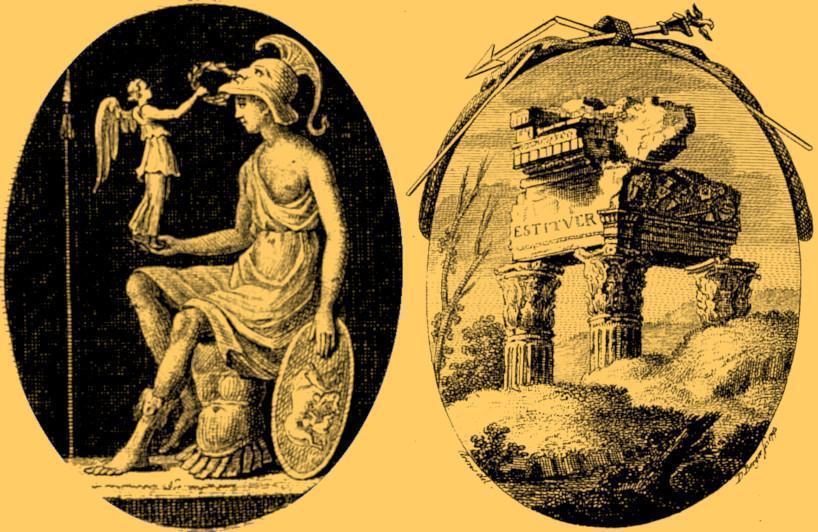
For the Labre passage, see supplementary appendix 119.1. Back.
[3] Fr., “in a state of war,” i.e., in Mainz; corresponding (or indeed associating) with citizens or residents of Mainz during the French occupation could be risky for Germans. Such is presumably why Caroline refers to some individuals (e.g., at the end of this paragraph) only by the person’s initials. Back.
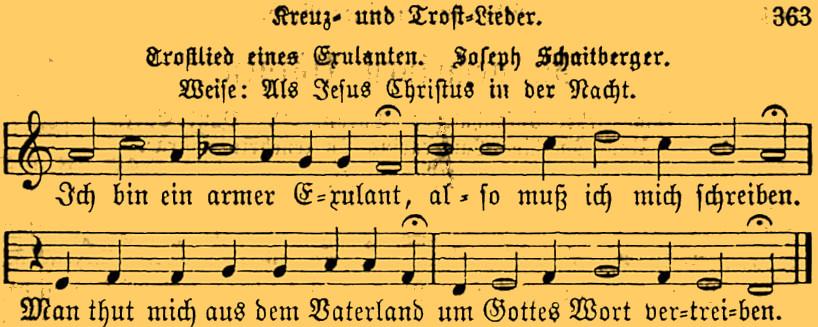
[4] An evocation of what is known as the Exulantenlied (The emigrant’s song; “Trostlied eines Exulanten”) by Joseph Schaitberger (1658–1733), a Protestant miner from Dürrnberg outside Salzburg who was exiled from his country in 1686 as a heretic along with a significant number of others after being forced to choose either exile or a return to the Catholic faith.
He composed the song in the popular style of a Volkslied as consolation for having to leave his home and even his children. The song was extremely popular among the Salzburg emigrants who were exiled in 1731 to what was then East Prussia and elsewhere (frontispiece to Christoph Sancke, Ausführliche Historie Derer Emigranten Oder Vertriebenen Lutheraner Aus dem Ertz-Bißthum Saltzburg, vol. 1 [Leipzig, 1732]):

Caroline conflates parts of verses 3 and 12. Joseph Schaitberger, Biblischer Glaubens-Grund Oder Christliches Religions-Gespräch Zwischen einem Catholischen und Evangelischen Christen / Auf Begehren frommer Hertzen in Hundert und sechs und viertzig Frag und Antwort geschrieben / Und den Einfältigen zum Unterscheid der Religion / deutlich und Schrifft-mässig fürgestellt von Einem Bekenner der Wahrheit Und um dess Glaubens willen vertriebenen Berg-Mann Joseph Schaitberger (1732), penultimate hymn (unpaginated), fourteen verses, two (10 and 11) in parentheses; translation cited in P. A. Strobel, The Salzburgers and Their Descendants: Being the history of a colony of German (Lutheran) Protestants, who emigrated to Georgia in 1734, and settled at Ebenezer, twenty-five miles above the city of Savannah (Baltimore 1855), 39–40, twelve verses, not including 10 and 14 of the original (14 being a reference to Schaitberger himself; music from Christliches Kirchen- und Haus-Gesangbuch: für evangelisch-lutherische Gemeinen: nebst einem Gebetbuch, einem Lectionarium und dem kleinen Katechismus D. Martin Luthers , ed. Karl P. Crome, 2nd ed. [Elberfeld 1861], 363):
1. I am a wretched exile here —
thus must my name be given —
From native land and all's that dear,
For God's word, I am driven.

2. Full well I know, Lord Jesus Christ,
thy treatment was no better:
Thy follower I now will be;
To do thy will I'm debtor.

3. Henceforth, a pilgrim I must be,
In foreign climes must wander;
O Lord! my prayer ascends to thee,
That thou my path will ponder.

4. O faithful God! be thou my stay;
I give me to thy keeping;
Forsake me not in this my day,
Nor when in death I'm sleeping.

5. Thy faith I freely have confessed:
Dare I deny it? Never!
Not though they call me "heretic,"
And soul and body sever.

6. My ornament, the galling chain;
For Jesus' sake I wear it,
And scarcely feel its weight or pain,
While in his faith I bear it.
7. Though Satan and the world conspire
To seize each earthly treasure,
If in my heart true faith but dwell,
I'm rich beyond all measure.

8. Thy will, O God! be done! May I
Still cheerfully obey thee!
And may thy arm of power and love
Encompass still, and stay me!

9. Though I go forth to poverty,
For Christ's sake I am going,
And see in heaven, reserved for me,
A crown with glory glowing.

10. Forth from my home I now must go:
My children! Must I leave them?
O God! my tears in anguish flow —
Shall I no more receive them?

11. My God conduct me to a place,
Though in some distant nation,
Where I may have thy glorious word,
And learn thy great salvation.

12. And though in this dark vale of tears
I yet awhile must tarry,
I know that thou to heaven, at length,
My ransomed soul will carry! Back.
[5] Therese Forster had left Mainz on 7 December 1792 with her daughters Therese and Claire for Strasbourg, from which she would travel on to Basel, Switzerland, staying there 5–8 January 1792 (Post Karte Durch ganz Deutschland, ed. J. Walch [Augsburg 1795]):
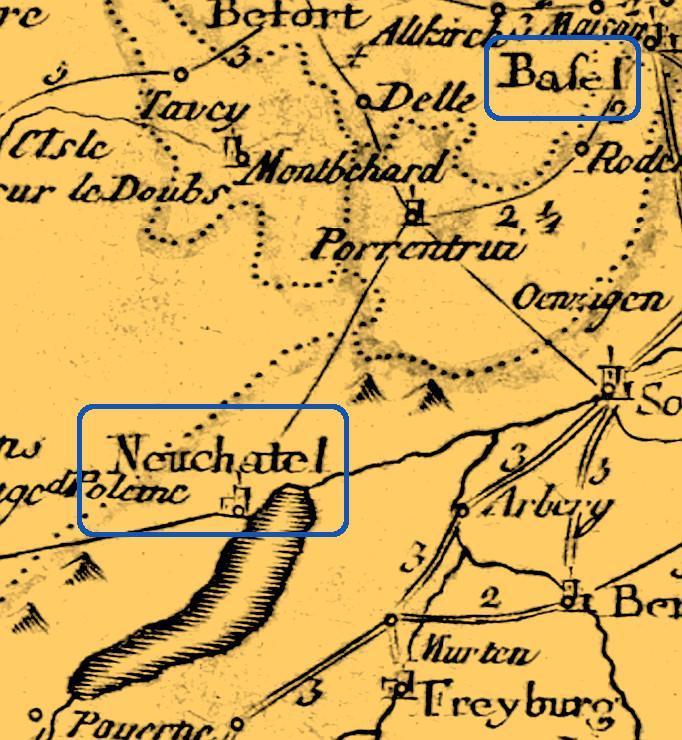
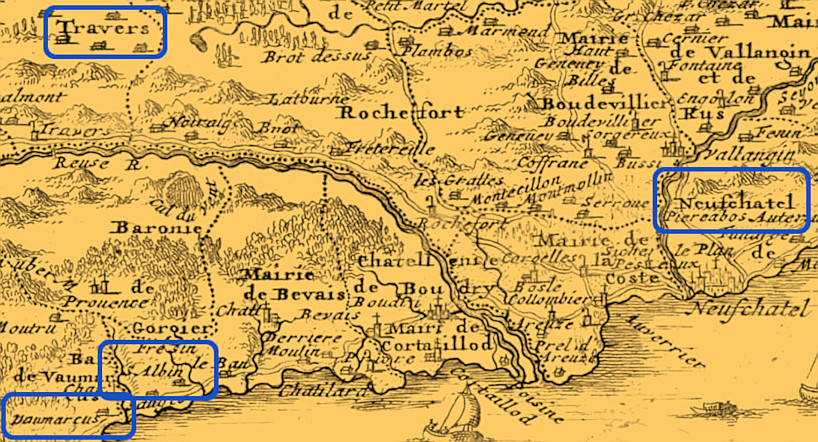
In mid-January, she and the children then journeyed on to Neuchâtel, Switzerland, staying with a family in St. Albin (also Aubin) until May 1793. After a stay in Vaumarcus, Switzerland, in June 1793 (see map below), she and the children move to Neuchâtel at the end of June, where Ludwig Ferdinand Huber had since arrived after resigning his diplomatic position. In the meantime, Georg Forster would leave Mainz on 25 March 1793 for Paris, where he delivered the request of the Mainz Republic for incorporation into France.
Late in 1793, however (3–5 November), Forster met with Therese Forster, the children, and Huber in Travers, Switzerland (Erich Schmidt suggests Therese, the children, and Huber were in Pontarlier at the time), apparently in an unsuccessful attempt to work out a domestic arrangement (Daniel de la Feuille, Caarte, van Neufchatel et Valangin [1706; reissue 1747]):
Forster died in Paris on 10 January 1794, after which Therese Forster and Huber married on 10 April 1794; the “separation” (divorce) about which Caroline speaks later in this letter was thus never effected (chronology, Therese Huber Briefe, 1:759–60). Back.
[6] Erich Schmidt (1913), 1:700, points out how Waitz (1871), 1:113n2, quite correctly understood how this particular passage disproves the malicious assessments which, for example, Samuel Thomas von Sömmerring related to Christian Gottlob Heyne over the course of several letters (Forster’s Briefwechsel mit Sömmerring, 608 [29 January 1793]; 612 [19 March]; 613 [30 March]). Christian Gottlob Heyne’s own blind antipathy toward Caroline was excessive (Ludwig Geiger, “Aus Therese Hubers Herzensleben,” Westermanns Illustrierte Deutsch Monatshefte 94 [April–September 1903] 681 [11 April 1793]; Albert Leitzmann, “Aus Heynes Briefen an seine Tochter Therese und seine Schwiegersöhne Forster und Huber,” Archiv für das Studium der neueren Sprachen und Litteraturen 121 [1908] 10 [27 February 1792, just before Caroline’s departure for Mainz]; 13 [3 September 1793]; 14 [November 1793]) (texts see supplementary appendix 119.2). Back.
[7] I.e., a divorce, though such never came about. Therese married Ludwig Ferdinand Huber on 10 April 1794 only after Georg Forster’s death on 10 January of that year. Back.
[8] Uncertain reference, possibly an allusion to the tribute General Adam Philippe de Custine had demanded from wealthier citizens of Frankfurt for having helped French emigrés, a demand prompting protests and resistance (see Sigrid Damm, Caroline Schlegel-Schelling: Die Kunst zu leben, insel taschenbuch 3160 [Frankfurt 2005], 449–50n193). Caroline mentions the tribute in her letter to Meyer on 16 October 1792 (letter 117) with note 18.
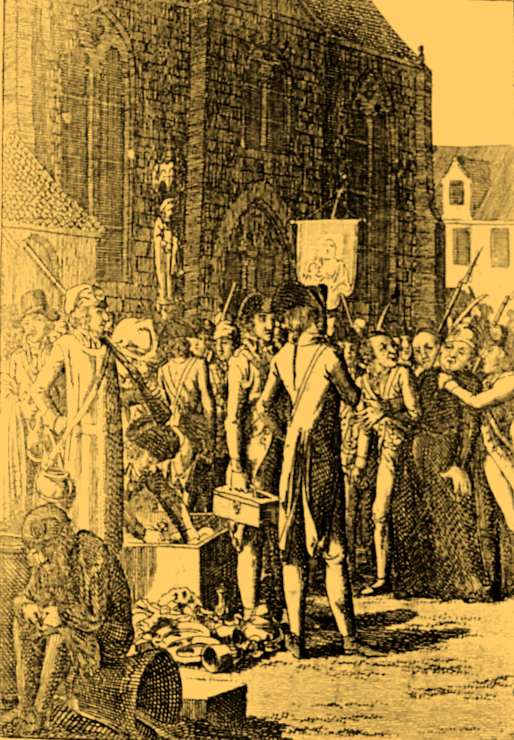
This tribute along with the treatment of various wealthy Frankfurt citizens and French plundering of nearby areas prompted the town’s tradesmen — quite to the surprise of the French — to resist the French attempts to persuade them that the revolution was in fact supposed to benefit Germany, and the tradesmen issued a statement to that effect. Here French troops plundering a church (Taschenbuch für die neuste Geschichte [1795]; Inhaltsverzeichnis deutscher Almanache, Theodor Springmann Stiftung):
When on 2 December 1792 the Hessians, as part of the coalition to retake Frankfurt, were trying to enter through one of the town gates, the tradesmen blocked the path of the French, damaged their cannons, and eventually opened the gate themselves, allowing the Hessians into the town. Here in an illustration from the reactionary Revolutions-Almanach von 1794 (Inhaltsverzeichnis deutscher Almanache, Theodor Springmann Stiftung):

[9] Schmidt follows this verb, which he reads as heiße, “I call,” by a bracketed question mark “[?]” indicating an uncertain reading. The Krakau manuscript seems sooner to read haße, “I hate” (Caroline forms her “a” similarly elsewhere in the letter), and the absence of a definite article preceding Egoismus fits that reading, as does the context. Back.
[10] Friedrich Schlegel writes from Leipzig to Wilhelm Schlegel in Amsterdam on 26 December 1792 (Walzel, 72; KFSA 23:80): “Respond soon and to everything I mentioned. Also write and tell me about Caroline, whether she intends to wait out the siege in Mainz etc.” Back.
[11] I.e., in care of Friedrich Wilhelm and Luise Gotter. Back.
Translation © 2011 Doug Stott