
• 112. Caroline to Luise Gotter in Gotha: Mainz, 20 April 1792
Mainz, 20 April [17]92 [*]
|249| This is a supplement to the letter to Wilhelmine, which I just finished because I came to the end of the sheet — or that letter is a supplement to this one — however you like — only do not be misled by, as I just noticed, my having started backward — good things can still be written in it. — Mirabeau wrote the most divine things in his dungeon on scraps of paper that he tore from printed books [1] — but please do not expect anything of that sort from me — in direct proportion as my own circumstances are more favorable, the material itself will be worse.
The only thing of concern to you is to hear how Frau Obstinacy is faring, who as far as your husband is concerned came away with the additional, somewhat derisive nickname “Cold One” on a certain occasion that, as a matter of fact, precisely did not attest her coldness. [2] He basically thinks I am a rapturous enthusiast — is that not true? — and you as well, my dear, good woman?
But such rapturous enthusiasm can appear in so many different shapes that I dare not adduce the coldness of my deliberations as evidence to the contrary — though what is so bad about wedding such coldness in as humane a fashion as possible to reality itself, without ostentatious signage of any sort, doing so instead under the veil of the most tranquil normalcy? In that case, such rapturous enthusiasm merely constitutes the peculiar, at most slightly deviant nature of a person.
I have been here for 8 weeks now, [3] and am right — |250| saying something of that sort at the beginning of one’s stay in a completely strange place is saying a lot, a place where one cannot possibly already have established one’s existence in any full sense. And I sense as well that I have not yet really done so, and that I would certainly benefit from more activity. Time will introduce more variety into my lifestyle here, since it will indeed create connections.
Not a single moment passes by empty — my participation in Forster’s household, diligent activity, reading, and my child — all that is already quite a bit — but I was so accustomed to taking care of several people and to having the enjoyment of being around several! [4]
But please do not view this as dissatisfaction — but rather simply as evidence that, far removed from being blinded by the novelty of my situation, I am instead well aware of its deficiencies — but they are necessary, and are less grievous than the grievous problems attaching to my previous situation, and are of such a nature that virtually every object that presents itself to my restive activity — virtually every individual joy and every task I take up suspends them. —
I have already had the pleasure of enjoying springtime through the most wonderful carriage rides and walks — but spring has disappeared again for a while. I am finding more joy in my little one than ever before. [4a]
In a word, I can tell you that everything is just as I expected. We may yet see some rather lively scenes here should war break out [5] — not for the life of me would I leave — only imagine, I will be able to tell my grandchildren how I experienced a siege, and how the people cut off an old clergyman’s long nose and the Democrats then roasted it publicly in the market place — we are, after all, living in an extraordinarily interesting time politically, and that along with the insightful things I hear during the evenings at the tea table has given me an enormous amount to think about when, just as I am doing now, I sit alone in my quite lovely, quiet room in this narrow street and sew handkerchiefs. [6]
A great many Frenchmen are living here in my neighborhood — you hear |251| and see them everywhere — the men are on average more handsome than the Germans, and have a more spiritual appearance, and among them the same degree of depravity does not exhibit the same character of dull, lethargic weariness — among the women I have found none even half as charming and simple as my French acquaintance in Gött[ingen], Madam de Liocon, [7] the only thing that, along with her small circle, I miss from there. —
The people here are making it expensive — at least for families — I do not feel it as much in my own arrangements — my logis is also quite reasonably priced, though otherwise such is extremely expensive, alongside craftsmen who work on ameublement [7a] — as is laundry, wood, and all groceries except bread and meat.
I have already read a great deal, and, what is more: much that is good. — Are you familiar with Mirabeau’s letters, those he wrote to his beloved from a dungeon? I think Reichard is translating them [8] — but just between us: how does that feeble person intend to render into appropriate language the utterances of this most powerful of men? or to translate into another language what in the original — flowing as inexorably as it does from the very source itself — speaking as it does to the soul, the heart, the senses?
My dear Madam Luise, you, too, could read things of this sort after sending your little ones to bed, after their noisy, theatrical protestations against your doing precisely that — but I do realize that you yourself then become tired, and then in your sleep you demand the goose leg from Ketterchen — so you can give it to me for my journey — since you, my dear, are always taking care of your close friends and paying no attention to an ugly scoundrel of the sort the extraordinary Mirabeau was, who had virtues and talents and energy enough left over for a thousand other upright people, and who had too much true spirit to seriously be a scoundrel of that sort, as one might conclude from certain features.
He may well have been ugly, |252| and he himself often says as much in these letters — and yet Sophie loved him, for it is certainly not beauty that women love in a man — and yet even this ugly man impressed the seditious mob with his external appearance after spending several hours at his toilette before going to the National Assembly.
But I cannot allow him to take up all my space here — for Der Gross-Cophta must also have its allotted space, [9] which must also be fairly broad and spacious indeed, since it is the nature of empty heroes to take up considerable space.
But do let me ask: What do you two think of it? Upon receiving it from Goethe on the first of April, Forster fairly jumped up out of his chair, as if his savior had appeared — for who indeed would not expect excellent things from it, even if in the simplest, most unprepossessing garb — but then this — this so utterly ordinary treatment, in which in an almost willful, wanton fashion all the useful situations have simply been discarded — a mere occasional piece [10] — it seems to me that it can only have the same effect Cagliostro himself would have had as precisely the kind of blatant swindler he appears to be here [11] — and even that constitutes a kind of praise for the piece.
Goethe is a cocky fellow who thinks nothing of the public and merely gives it that with which it is already comfortable. Please write me and tell me whether there is any other assessment of this matter. With the help of the Egyptian loge, it probably came off better in actual performance. —
Emilie Berlepsch wrought horrendous mischief in Göttingen with her readings — she did her recruiting for it among the young gentlemen, who were already reading plays and assigning the various roles — and with aristocratic arts and magic forced the older, learned gentlemen to listen to Don Carlos [12] from 5:00 till 12:00, during which occasion they first learned of its existence.
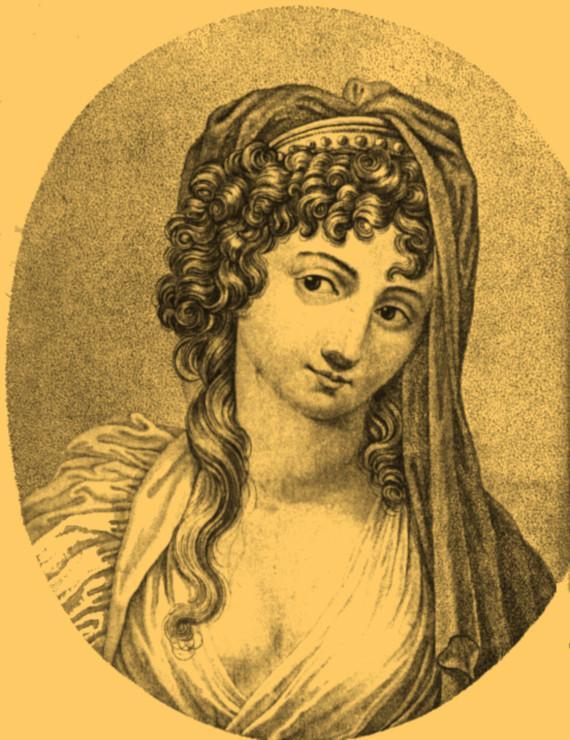
I was not present, since I had not been particularly courteous toward Emilie, |253| I behaved toward her merely the same way as toward any normal lady of standing — as a result of which I was — in view of our former acquaintance — despicably ignored. The French found her and her Elizabeth costume from Carlos — at the ball — horrible! [13] You do realize that the Spanish costume and general modesty allow for a great deal that our own handkerchief obsession sooner prohibits — she danced with a fieriness that shamed even her son, the dear boy.
Someone just wrote me from Hannover that amid a rather large company, an extremely naive young man addressed her with the following words — “Gracious Madam, you are, I believe, an aficionado of such novelties” — “But of which?” “One hears — that you suppressed the 2nd volume of Donamar here.” —
The allegation is that the character of Laurette in D[onamar] — the 2nd volume of which falls short even of the underdeveloped possibilities in the first — is an exact copy of her, which the stupid Boutterweck included out of anger. — You can imagine the rage. [14] — She is currently reading Medea in Hannover before a select auditorium — Klinger’s Medea, that is, [15] which she desecrated in Göttingen before an extremely mixed auditorium in which one of the gentlemen remarked that Medea had certainly henpecked Jason but good — and how it all simply contradicts healthy common sense.
In our own house in Göttingen, the heavens are resounding with wedding violins — the old man is delighted with his daughter-in-law, and the son is still of a mind to make her his wife, which will also irrevocably come to pass after the book fair. [16] So, be praised, O ye gods — and now send Louischen one as well — whose upright qualities lack nothing other than to be an upright man’s wife.
The beaux-esprits have provided us with a great scandal — Bürger now stands exposed to all the world with his Musenallmanach |254| flirtation [17] and has gotten into a squabble with Boutterwek because letters to his wife were sent under the guise of Boutterwek’s cover [18] — there are also noble deeds involved. Just where the lady is, no one seems to know. [19] —
Have you heard nothing from Meyer, who quite accurately prophesized our good Bürger’s fate? [20] Voss in Berlin announced to Forster the publication of Darstellungen aus Italien by Meyer — he thought the crazy fellow had finally gotten around to writing — and then the book arrived in the most elegant form imaginable instead of in the kind of shabby coat the author himself suggested would be the case — and it was instead written by Meyer in Hamburg, that is, by my dear brother-in-law. [21] Good Lord! — I am just in the process of reading it and praising it — which I find to be such dry business when the spirit is not really moving me.
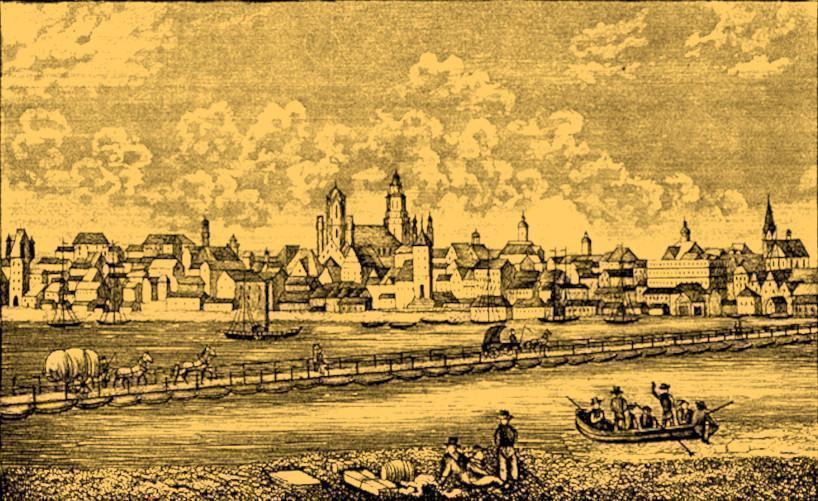
Adieu, my precious, dear woman — for you, the spirit tells me a great deal. Please do not forget me, and consider that you, too, might be able to greet the banks of the Rhine River one day — and those banks will return real, living greetings to you, since your old friend will be standing on the bridge. [22]
Notes
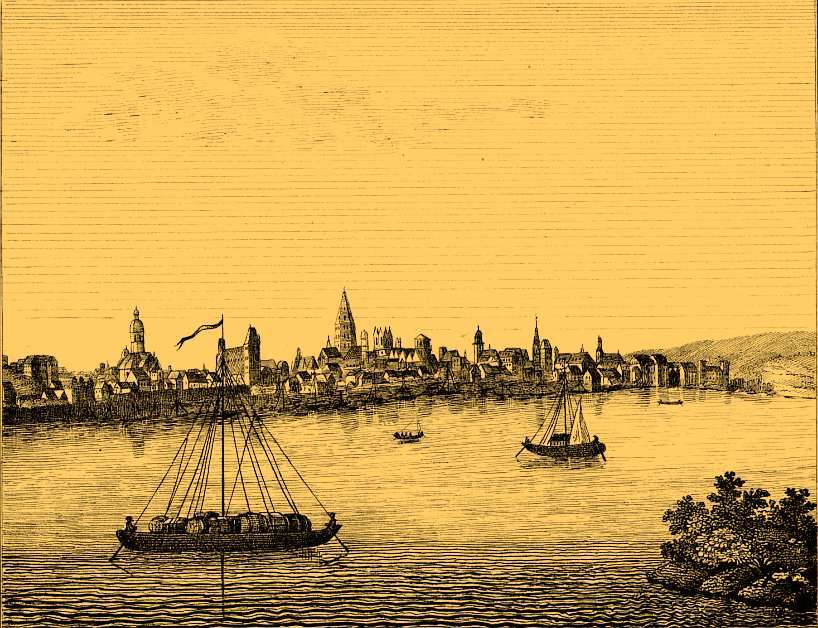
[*] This letter is Caroline’s first extant letter from Mainz (Neue Bildergalerie f.d. Jugend, vol. 5 [Gotha 1832], plate 1, no. 436):
[1] Honoré Gabriel Victor de Riqueti, Marquis de Mirabeau, Lettres originales de Mirabeau: écrites du donjon de Vincennes, pendant les années 1777, 1778, 1779 et 1780, contenant tous les détails sur sa vie privée, ses malheurs et ses amours avec Sophie Ruffei, marquise de Monnier, ed. Louis-Pierre Manuel, 2 vols. (Paris 1792). These letters were written to Mirabeau’s mistress Sophie, a married woman with whom he had fled to Holland, where both were arrested in 1777. Mirabeau was incarcerated in Vincennes, while Sophie was taken to a convent at Gien. Mirabeau wrote these letters during that three-and-a-half-year imprisonment. Back.
[2] Allusions to the episode involving Josias Friedrich Löffler’s courtship of Caroline in Gotha in the autumn of 1791 and the unsuccessful (and frustrating) attempts made by Luise and Friedrich Wilhelm Gotter to persuade her to accept Löffler’s offer of marriage. See letters 105–10, excepting 107a and 108a. Back.
[3] See also Georg Forster to Georg Christoph Lichtenberg, 8 December 1792, Georg Forster’s sämmtliche Schriften, eds. “his daughter” [Therese] and Georg Gottfried Gervinus, 9 vols. (Leipzig 1843), vol. 8, Briefwechsel [2], 185:
The widow Böhmer, daughter of the deceased Professor Michaelis, has been here [Mainz] since the beginning of May [should read: March] and is living an extremely quiet but satisfied life; she does not really leave her residence except to come to our house. She is a bright woman whose society has certainly enriched our own domestic circle.
Bibliographical note: Erich Schmidt (1913) does not cite Forster’s letters consistently, using both Briefe and Briefwechsel as the title; he generally refers to the second of these two editions: (1) Johann Georg Forster’s Briefwechsel. Nebst einigen Nachrichten von seinem Leben, ed. Th. H., geb. H. [Therese Huber, née Heyne], 2 vols. (Leipzig 1829); (2) Georg Forster’s sämmtliche Schriften, eds. “his daughter” [Therese Forster] and Georg Gottfried Gervinus, 9 vols. (Leipzig 1843), vols. 7, 8, 9, Briefwechsel [1, 2, 3] (vol. 9 also contains the play Sakontala). Back.
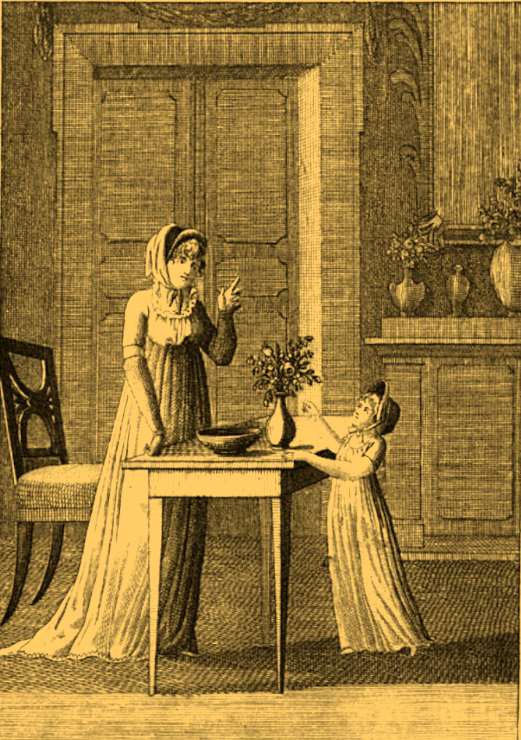
[4] That is, earlier in Clausthal as a wife and mother, then in Göttingen with two children, her parents, and sisters (Lotte and Luise), then in Marburg with her two children and half-brother (with continuing concerns for her sisters and, to a certain extent, younger brother as well), then back in Göttingen again after her father’s death, when she was concerned with her sisters again. After Therese had died in December 1789 in Marburg, in Mainz Caroline was for the first time concerned solely with herself and Auguste (frontispiece to R. L. Edgeworth, Rosamunde: Eine belehrende und unterhaltende Geschichte für Kinder, trans. Friedrich Herrmann [Leipzig 1805]):
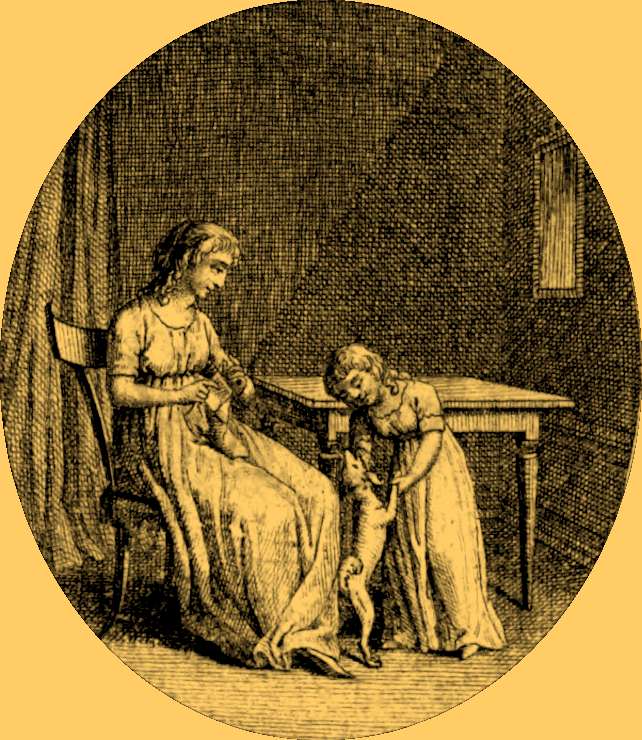
[4a] I.e., Auguste (illustration: frontispiece to Gotthelf Wilhelm Christoph Starke, Gemählde aus dem häuslichen Leben und Erzählungen, vol. 1 [Berlin 1800]):
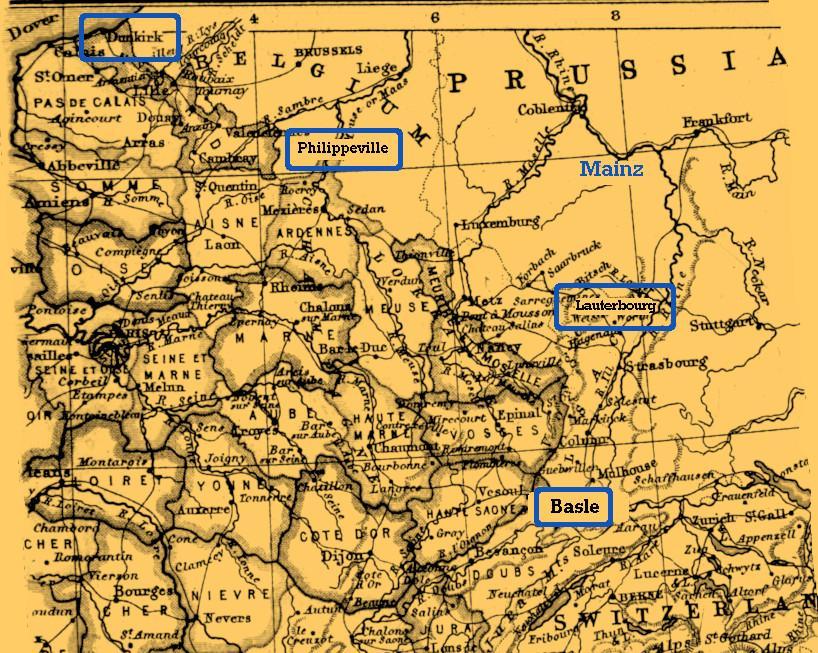
[5] Coincidentally, though in all likelihood without Caroline knowing, on the same day she wrote this letter the French had declared war on Austria and put three armies in the field between Dunkirk and Philippeville; between Philippeville and Lauterburg; and between Lauterburg and Basel (Basle) (J. G. Bartholomew, A Literary & Historical Atlas of Europe [London 1910], 73):
[6] In late July, Caroline remarks in a letter that her residence was located in the “Reidtisches Haus” on the Welsche Nonnen Gasse (“Walloon nuns street”). Here the location of the house on the street in 1784 along with the location of the convent after which the street is named (Grund-Riss der Kurfürstlichen Haupt und Residenzstadt Mainz 1784):
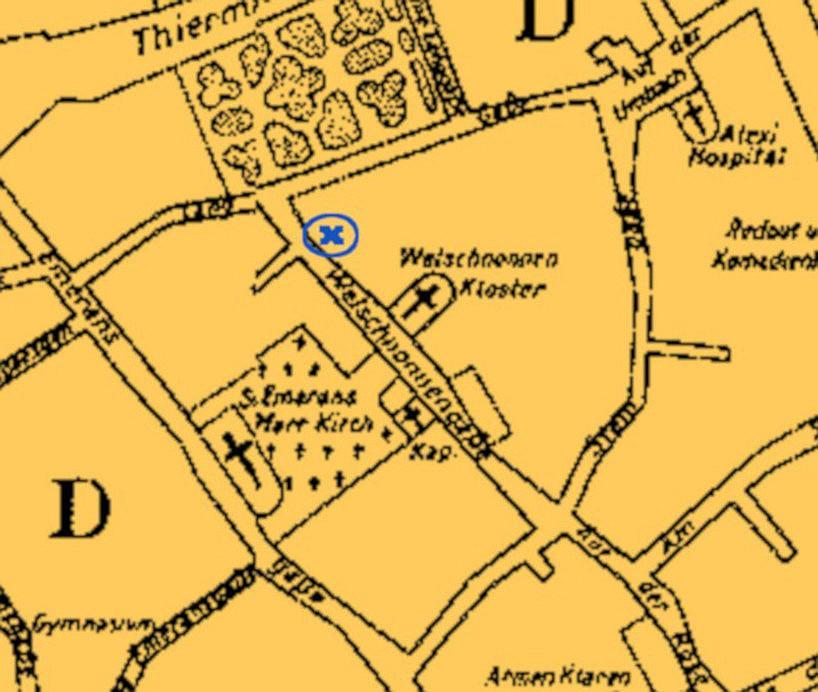
According to Heinrich Schrohe, Die Mainzer Stadtaufnahmen von 1747 und 1785/86 (Mainz 1931), 192, what Caroline is calling the “Reidtische Haus” was located at what is today Welschnonnengasse 3; the owner in 1785/86 was a certain Franz Reider, who was a traiteur (Fr.), a restaurant-keeper or caterer (personal communication Dr. Wolfgang Dobras, Archivdirektor, Landeshauptstadt Mainz Stadtarchiv).
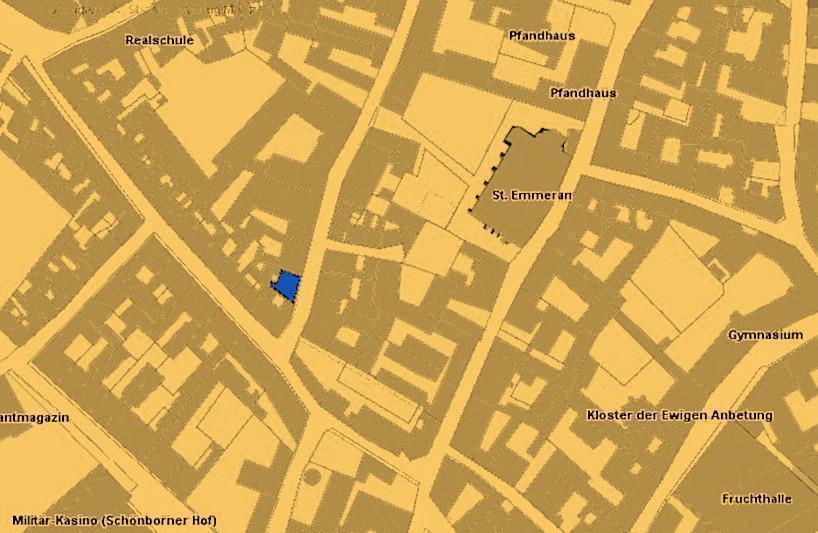
This residence (in blue) was near the church of St. Emmeran (“Häuserbuch Jahr 1866/71,” Das digitale Häuserbuch von Mainz, © Stadtarchiv der Landeshauptstadt Mainz; note the different positioning of the map than above):
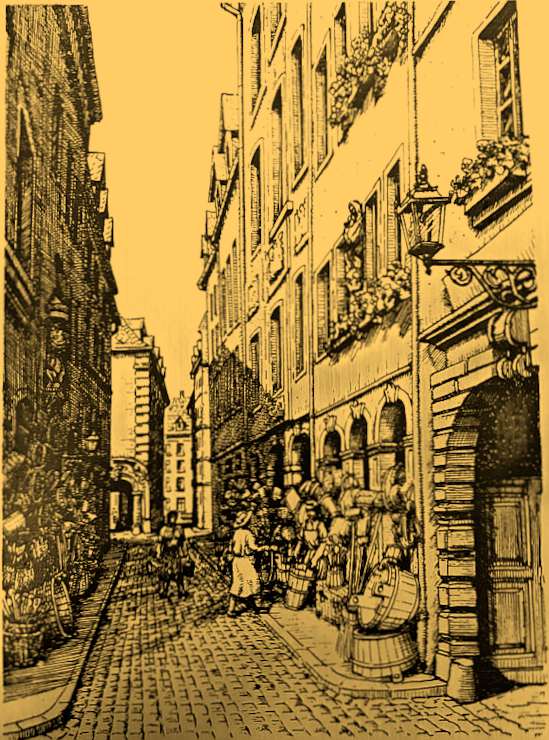
The narrow street seems to have resembled many such others in Mainz, such as Seilergasse (street of the town’s rope makers) toward the river, here in an undated copper engraving:
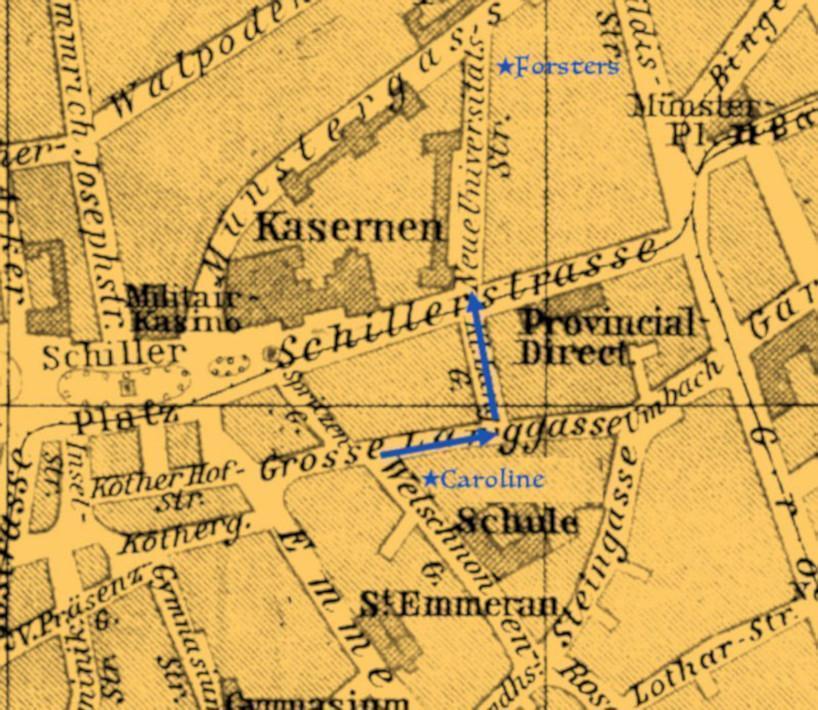
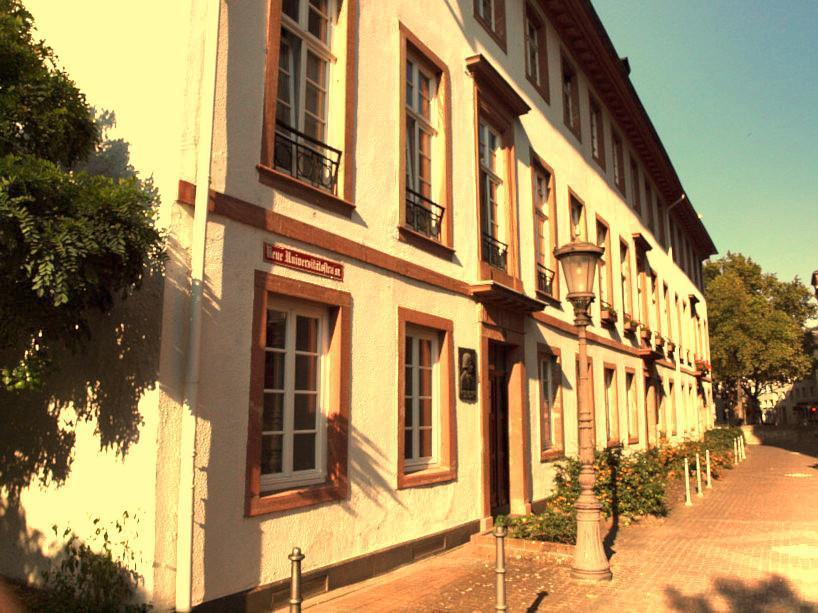
Her residence was also located approx. five minutes around the corner from the house of Georg and Therese Forster at Neue Universitätsstrasse 5, where Caroline would spend considerable time. Here the location of the two houses in the center of town (excerpt from map of Mainz by the Geographische Anstalt von Wagner & Debes [Leipzig 1900]):
Here a map of Mainz from 1646 with the location of the house in which Caroline and Auguste resided, presumably the second house from the corner (Wahrhaffter Geometrischer Grundtriss der Churfürstlichen Statt Maintz sampt den Newen fortificationen, wie solche zum theil vor disem gestanden vnd Annoch im wesen steht [1646] [Universitätsbibliothek Bern, ZB Ryh 3006:23]):
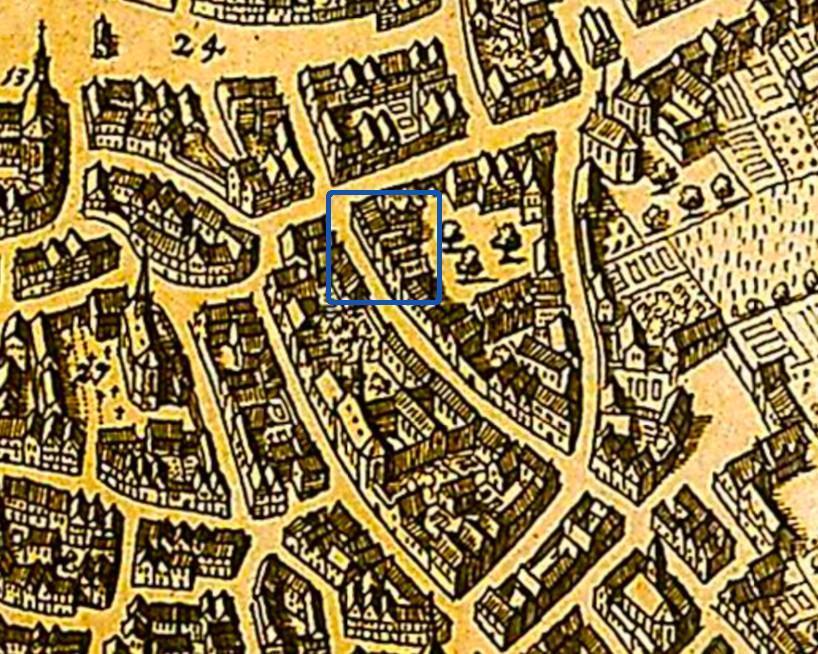
Although nothing more seems to be known about Caroline’s residence at Welschnonnengasse 3, the building itself was included in a survey of architectural monuments in Mainz in 1905: E. Neeb, “Verzeichnis der Kunstdenkmäler der Stadt Mainz. I. Teil (Privatbesitz)” (1905), Zeitschrift des Vereins zur Erforschung der rheinischen Geschichte und Altertümer (Altertums-Verein) in Mainz 4 (1898–1905), 449–82, here 573:
[Welschnonnengasse] 3. On the second story of this simple Baroque edifice, one finds remnants of ornamental stucco ceiling work, coarse patterns from the first quarter of the eighteenth century. In the interior, well-preserved features still include the opulent banister work, perforated (jigsaw) work from the same period, and massive, prominent door casings.
The Forster’s corner residence at Neue Universitätsstrasse 5 still stands today (note commemorative plaque next to door; photo Ralf Mauer):
Concerning the evening tea table at the Forsters’ house, see Justus Erich Bollmann, who recounts how the regular circle at the Forsters’ “would gather at 7:00 around a tea machine after finishing our work, quite in the English fashion, and would remain together until after 9:00” (Friedrich Kapp, Justus Erich Bollmann. Ein Lebensbild aus zwei Welttheilen [Berlin 1880], 24; complete citation in Erich Schmidt’s introduction to Caroline’s period in Mainz, note 3). Back.
[7] Unidentified. Back.
[7a] Fr., “furnishings, suite of furniture.” Back.
[8] See note 1 above concerning Mirabeau’s “letters to Sophie.” These letters were translated into German in several editions; here Caroline is presumably referring to Heinrich August Ottokar Reichard, though no translation of these letters by him is known. Back.
[9] Goethe, Der Gross-Cophta. Ein Lustspiel in 5 Aufzügen (Berlin 1792) (generally written Groß-Cophta), in which Goethe dealt with the French Revolution. Back.
[10] Georg Forster utterly rejected Goethe’s play (see also Caroline’s letters to Friedrich Ludwig Wilhelm Meyer on 29 July and 12 August 1792 [letters 113–14]). Forster writes to Friedrich Heinrich Jacobi from Mainz on 6 April 1792 (Georg Forster’s sämmtliche Schriften, 8 [Briefwechsel 2]:182 [in edition of 1829: 2:142–43]):
I was recently about as dumbfounded as a poor writer can be — Goethe sent me his Gross-Cophta, whose appearance he had already long and rather emphatically announced to us. — We were all eager to see it, none of us having read a single good book in such a long, long time. I virtually jumped out of my seat when I tore open the seal and saw that it was the Gross-Cophta.
And, alas! o what a falling-off was there! [in English in Forster’s original letter; spoken by the ghost in Shakespeare, Hamlet act 1, scene 5]. This thing so utterly without salt, without so much as a single idea one can hold onto, without a single well developed emotion, without a single character for whom one might develop any interest, this flat, quotidian dialogue of the upper nobility, these coarse, common scoundrels, this merely chivalric rescue of the queen, — but he doubtless sent a copy to you as well, so there is no need to describe it further.
So now I must choose between the notion that he simply wanted to pull one over on the people in Weimar who worship him, wanted to see how far such stupid adoration might extend, yet at the same time having too low an estimation of the public to take it into consideration as well — and the notion that the Archbishop of Sevilla in Gilblas is standing before us once again in person [Alain René Lesage, Histoire de Gil Blas de Santillane, 4 vols. (Paris 1715–35), German translation 1768 and 1774. “In book 7, chapters 3 and 4, Lesage describes the Archbishop of Granada, a vain pulpit speaker, who after suffering a stroke can only manage to deliver confused, nonsensical sermons. Gil Blas is the only one who dares criticize him” (Georg Forsters Werke. Sämtliche Schriften, Tagebücher, Briefe, ed. Akademie der Wissenschaften der DDR. Zentralinstitut für Literaturgeschichte, vol. 17: Briefe 1792–1794 und Nachträge, ed. Klaus-Georg Popp. (Berlin 1989), 590]; but then I thought: if that is what happens when the wood is green, what will happen to a dry twig like me [after Luke 23:31]?
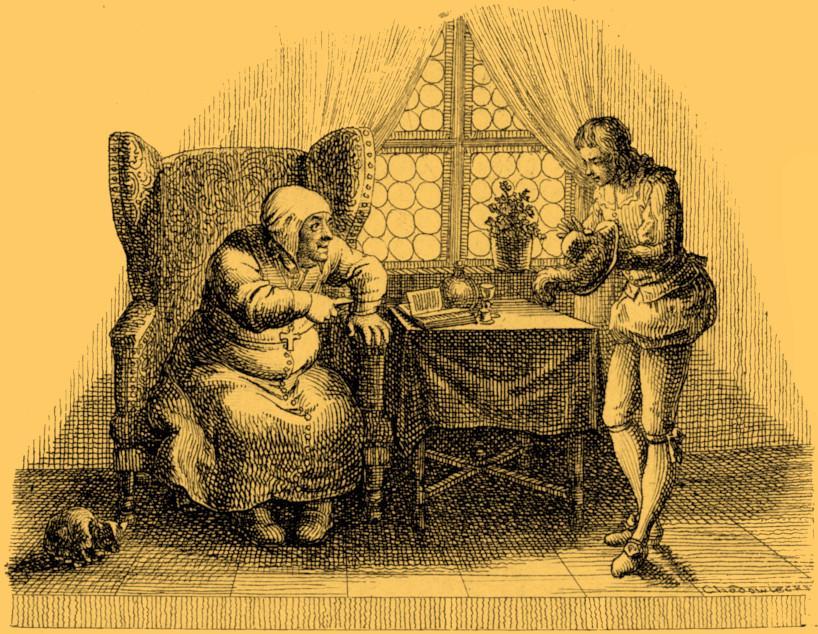
Here the passage from Gil Blas (The Adventures of Gil Blas of Santillane, trans. Tobias Smollett [Boston 1864], vol. 2, 244–45; illustration: Daniel Nikolaus Chodowiecki, Gil Blas ist Haushofmeister beim Erzbischof von Granada [1778]; Herzog August Bibliothek; Museums./Signatur Chodowiecki Sammlung [2-119]):
The archbishop had a stroke of apoplexy. By dint of immediate applications and good nursing, in a few days there was no bodily appearance of disease remaining. But his reverend intellects did not so easily recover from their lethargy. I could not help observing it to myself in the very first discourse that he composed. Yet there was not such a wide gap between the merits of the present and the former ones as to warrant the inference that the sun of oratory was many degrees advanced in its post-meridian course.
A second homily was worth waiting for, because that would clearly determine the line of my conduct. Alas, and well-a-day! when that second homily came, it was a knock-down argument. Sometimes the good prelate moved forward, and sometimes he moved backwards; sometimes he mounted up into the garret, and sometimes dipped down into the cellar. It was a composition of more sound than meaning, something like a superannuated schoolmaster’s theme, when he attempts to give his boys more sense than he possesses of his own, or like a capuchin’s sermon, which only scatters a few artificial flowers of paltry rhetoric over a barren desert of doctrine.
I was not the only person whom the alteration struck. The audience at large, when he delivered it, as if they too had been pledged to watch the advances of dotage, said to one another in a whisper all round the church, Here is a sermon with symptoms of apoplexy in every paragraph. Come, my good Coryphæus of the public taste in homilies, said I then to myself, prepare to do your office. You see that my lord archbishop is going very fast — you ought to warn him of it, not only as his bosom friend, on whose sincerity he relies, but lest some blunt fellow should anticipate you, and bolt out the truth in an offensive manner, in that case you know the consequence; you would be struck out of his will, where, no doubt, you have a more convertible bequest than the licentiate Sedillo’s library.
Forster wrote to Jacobi again from Mainz on 18 May 1792 (Georg Forster’s sämmtliche Schriften, 8:192):
The ancient Greek notion of Aristophanic clarity (alias triteness) is almost assuredly the model the author of the Gross-Cophta had before him, and I for my part certainly prefer this particular explanation over the notion that he is merely mocking his own public. That said, however, the jests of the histrionic at least had some connection with his contemporaries and spiced up his play with bitter satire; what does Gross-Cophta have to show that is comparable?
And on 7 April 1792 (Georg Forster’s sämmtliche Schriften, 8:182–83) [in edition of 1829: 2:143–44], Forster writes similarly to Christian Gottlob Heyne from Mainz:
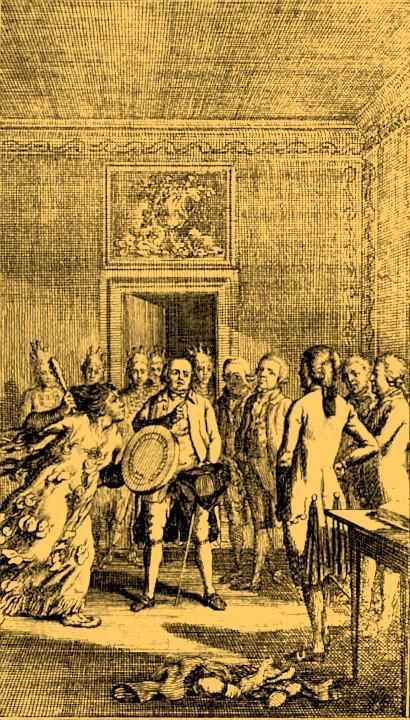
We recently received the Gross-Cophta, a comedy by Goethe; alas, there is nothing at all here of what used to delight us so in his works, not a single spark of spirit, imagination, or aesthetic sensibility; the whole thing is as flat as the Shaman of the empress of Russia [Catherine the Great, Shaman Sibirskoĭ (The Siberian shaman) (St. Petersburg 1786)]. Is it possible that this man, too, has managed to outlive himself in this fashion?
Here the frontispiece to the German translation of Catherine’s play, Der sibirische Schumann (with two other plays), Drey Lustspiele wider Schwärmerei und Aberglauben (Berlin, Stettin 1788):
Or is it just his way of mocking and deriding the boorish deification with which some people pay him such homage, and perhaps also the public’s unreceptiveness for the beauty of his Egmont [in Goethe’s Schriften, vol. 5 (Leipzig 1788)], his Tasso [Torquato Tasso, in Goethe’s Schriften, vol. 6 (Leipzig 1790)], and his Iphigenie [in Goethes Schriften, vol. 3 (Leipzig 1787), 1–136]? I know not which of the two alternatives I should choose. In any event, what a waste of ink and paper.
See also Albert Leitzmann, “Georg Forsters Beziehungen zu Goethe und Schiller und seine Verteidigung Schillers,” Archiv für das Studium der neueren Sprachen und Literaturen 88 (1892) 129–56, here 138–39, where Leitzmann cites yet another letter passage, this one to the bookseller Christian Friedrich Voss in Berlin on 14 April 1792:
I was recently frightened to death by Goethe’s most recent piece, the Grosskophta. May God preserve me from ending up this way! I would rather stop in a timely fashion than to sink from Goethe’s former heights so far down beneath every conceivable mediocrity and then down even further into the most vacuous insipidness! The entire piece contains not a single line one might want to retain or repeat for others, not a shred of imagination, no dialogue, no interest of any sort! As long as I have the capacity to sense how this work falls away from his earlier pieces, I hope I will be able to avoid assessing my own work too highly, or will at least know what my own needs in order to be worthy of both myself and the public.
Leitzmann suggests that Goethe’s public (including Forster and even Gervinus mentioned above) may not have had sufficient distance from the events addressed in the play to perceive the “unifying center” amid the variety that constituted Goethe’s work. Back.
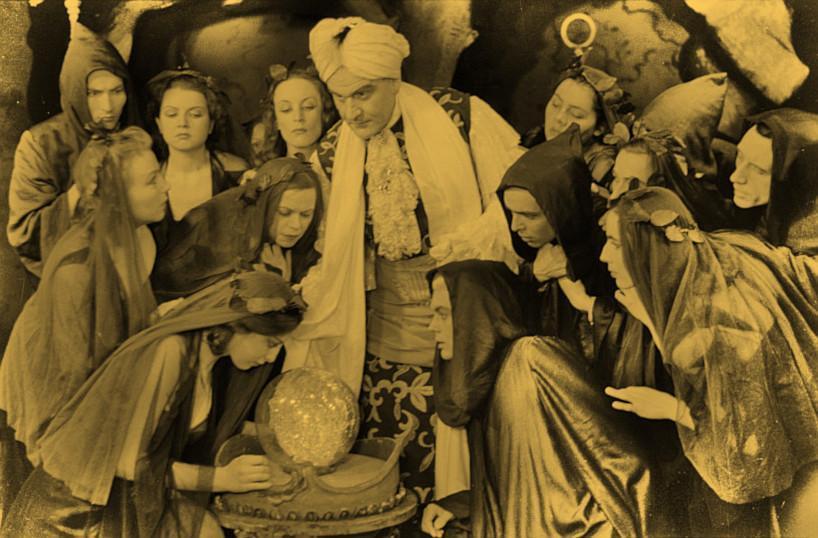
[11] Goethe’s play is in fact a comedy based on Cagliostro’s life, and mentions the affair with the diamond necklace. Cagliostro was, however, also involved with the Freemasons and indeed is credited with having created the Egyptian Rite of the Freemasons, whence also Caroline’s imminent reference to the Egyptian loge, a Freemasonry branch associated with Cagliostro’s rite (illustrations: Daniel Nikolaus Chodowiecki, Cagliostro [1788]; Herzog Anton Ulrich-Museum; Museums./Signatur DChodowiecki AB 3.788; the “Egyptian lodge” ritual with the swindler Count Rostro: photograph by Abraham Pisarek, “Szene mit Walter Süssenguth als Graf Rostro,” from Szenenbilder aus dem Lustspiel “Der Groß-Cophta” von Johann Wolfgang von Goethe im Theater am Schiffbauerdamm Berlin [1950]; Sächsische Landesbibliothek – Staats- und Universitätsbibliothek Dresden, Deutsche Fotothek, Datensatz 88930952):

[12] Dom Karlos: Infant von Spanien, von Friedrich Schiller (Leipzig 1787) (first book edition); it premiered in Hamburg on 29 August 1787. Here the frontispiece:
[13] Horrible in French in original. Back.
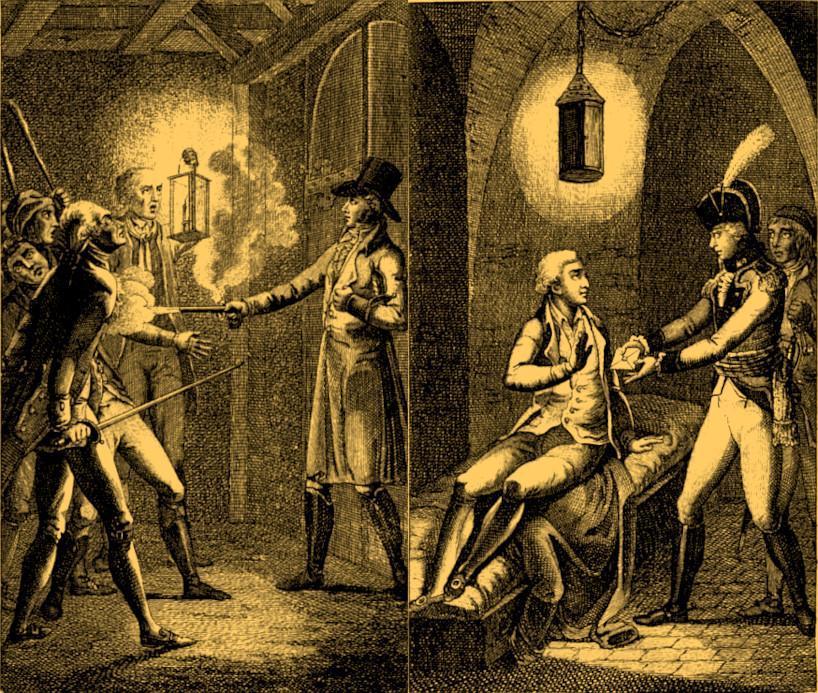
[14] Friedrich Bouterwek (Caroline and Luise Wiedeman [in her Erinnerungen] use different spellings), private lecturer in philosophy in Göttingen, at the time living in ambiguous circumstances; the reference is to his three-volume epistolary novel, Graf Donamar. Briefe, geschrieben zur Zeit des siebenjährigen Krieges in Deutschland, 3 vols. (Göttingen 1791–93). Here the title page to vol. 1 (1791) and the frontispieces to vols. 1, 2, and 3 (1810):

For a synopsis of the novel (and thus also of Laurette’s character) and for Bouterwek’s own assessment especially of the second volume, see Luise Wiedemann’s Erinnerungen, note 43; see also Caroline’s letter to Friedrich Ludwig Wilhelm Meyer on 22 September 1792 (letter 115). Back.
[15] Friedrich Maximilian Klinger, Medea (later Medea in Korinth), in F. M. Klinger’s Theater (Leipzig 1787), though possibly also Klinger’s second play by this name, Medea auf dem Kaukasus (Leipzig 1791). “That is”: as opposed to Friedrich Wilhelm Gotter (Luise’s husband), Medea, music by Georg Benda (Gotha 1775). Back.
[16] The reference is to Lotte Michaelis’s relationship with Heinrich Friedrich Wilhelm Dieterich, which his father had trenchantly opposed.
Luise Wiedemann, née Michaelis, remarks in her Erinnerungen, p. 89, that
[Dieterich’s] father opposed any marriage because of his hatred toward my father, and did everything he could to undermine the relationship even though he saw how [the young] Dieterich had begun to change.
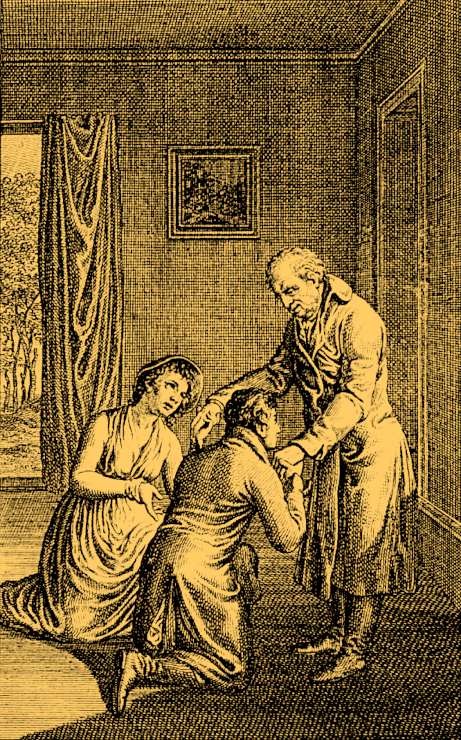
Caroline remarks in her own letter to Philipp Michaelis on 22 June 1791 (letter 102) that Lotte’s “fate will be horrible if God does not change old man Dieterich’s heart to compensate her for the injustice he did her.” See esp. note 1 there. It seems, however, that “old man Dieterich’s” heart had in the meantime indeed changed ([1] frontispiece to Ludwig Ferdinand Huber, Erzählungen, vol. 3 [Braunschweig 1802]; [2] Ludwig Ferdinand Huber, Schauspiele, vol. 2 [Berlin 1795], following p. 250):
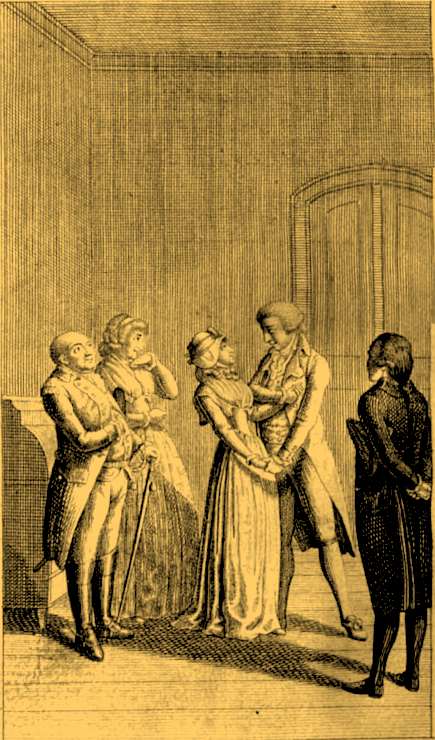
Hence Lotte Michaelis married Heinrich Friedrich Wilhelm Ludwig Dieterich on 3 June 1792, after the Easter book fair in Leipzig, which Dieterich’s father, Johann Christian Dieterich, would invariably have attended. Although Erich Schmidt (1913), 1:697, dates it to October, after the Michaelmas book fair, see Caroline’s letter to Friedrich Ludwig Wilhelm Meyer on 29 July 1792 (letter 113). The St. John’s church registry for 1792, pp. 402–3, no. viii, reads:
On 3 June, out of town at the church in [no place given], after being granted dimissorialibus, the bridegroom Herr Heinrich Friedrich Wilhelm Ludwig Dietrich, local bookseller, eldest son of local publisher Herr Johann Christian Dietrich, married Frälein Scharlotte Wilhelmine Michaelis, 2nd daughter of Herr Johann David Michaelis, Royal and Prince-Electoral Privy Justiz-Rath, Knight of the North Star Order, and professor at the university here. Back.
[17] Concerning Gottfried August Bürger’s courtship of Elise Hahn through poetry, including in the Göttinger Musenalmanach, see Caroline’s letter to Friedrich Ludwig Meyer on 6 December 1791 (letter 111), esp. note 8. Back.
[18] The letters were in fact from Friedrich August Burkhard von Hardenberg, one of Elise Bürger’s lovers. Back.
[19] Elise Bürger had left her and Bürger’s house in Göttingen on 6 February 1792 before being legally divorced from him on 31 March 1792; after spending a few days with her mother in Stuttgart, she worked as a governess in Saxony before pursuing a (successful) career on the stage.
Concerning Bouterwek’s quarrel with Gottfried August Bürger, see Bürger’s letter to his mother-in-law, Frau Hahn, on 12 February 1792 (Strodtmann, 4:190–91):
Moreover she [Elise Bürger, née Hahn] had long made an adventurous man here by the name of B[outerwek] her confidante, a tutor here for a young Herr v[on] W[estphal] and a novelist, using him as an intermediary for carrying on her lascivious correspondence with [Friedrich August Burkhard von] H[ardenberg].
This man got involved with her illicit affairs either against his own better judgment and conscience, or, which seems more likely to me, she was simply able to take him in through her shameful hypocrisy, lies, and deft dissimulation such that he viewed her as a paragon of virtue, she never lacking the ability to gloss things over as easily — as one drinks a glass of water.
This pathetic Don Quixote put himself at her disposal as the knight enabling her to intimidate me in a fashion hardly appropriate even for a schoolboy. He wrote me a letter on Sunday evening that is the non plus ultra of impertinence and imprudence. It incensed me to the point that I was ready to hand the shameful woman over to the authorities. Doctor A[lthof] intervened and mediated the affair such that she was able to depart early the next morning.
In a letter to Goethe on 18 April 1797 (not 28 April as in Schmidt (1913), 1:697), Schiller bemoans the “leaden presence” of this “most shallow, lamentable moron” (i.e., Bouterwek). In a letter to Wilhelm Schlegel from Hannover on 4 September 1791, Caroline Rehberg describes the company she encountered during a stay in Pyrmont (Körner [1930] 1:17):
I saw Bouterweck there for a few days. As you know, he is rather reserved, and his appearance, sickly and melancholy as it is, makes a sad impression, and yet I was greatly pleased to see him and to find in much of what he said traces of that particular spirit that I so love in his poems. Back.
[20] Friedrich Ludwig Wilhelm Meyer had warned Bürger against marrying Elise Hahn; for the text, see Caroline’s letter to Friedrich Ludwig Meyer on 6 December 1791 (letter 111), note 8. Back.
[21] Friedrich Johann Lorenz Meyer, husband of Friederike Böhmer; from 1784 cathedral canon in Hamburg. Caroline has the correct title, Darstellungen aus Italien, published by Christian Friedrich Voss and Son (Berlin [Potsdam] 1792). Here the frontispiece, title page vignette, and final vignette:
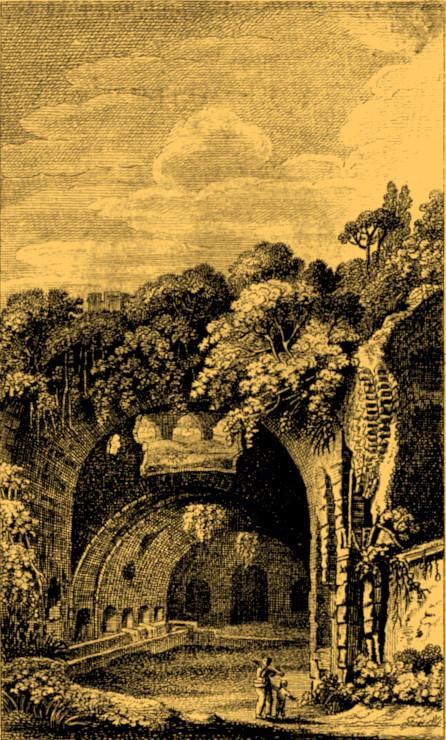
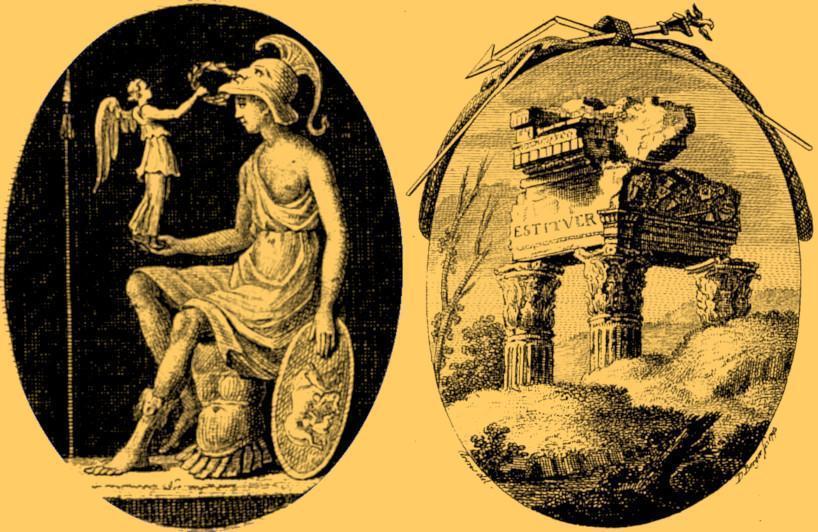
Erich Schmidt (1913), 1:697, notes that an undated accompanying letter commends it to Caroline only “for travel reading in the Lüneburg steppes.” Back.
[22] I.e., on the bridge across the Rhine itself the Rheinbrücke, across which travelers from the east cross into the town (map: Post Karte Durch ganz Deutschland, ed. J. Walch [Augsburg 1795]; bridge illustration: Plan von Mainz 1849; Meyers Handatlas; illustration of Mainz: Balthasar Frederic Leizel, Prospect von der Churfürstl. Residenz-Stadt Maijnz zwischen Rhein und Mayn von Bingen aufwärts anzusehen [ca. 1780]):
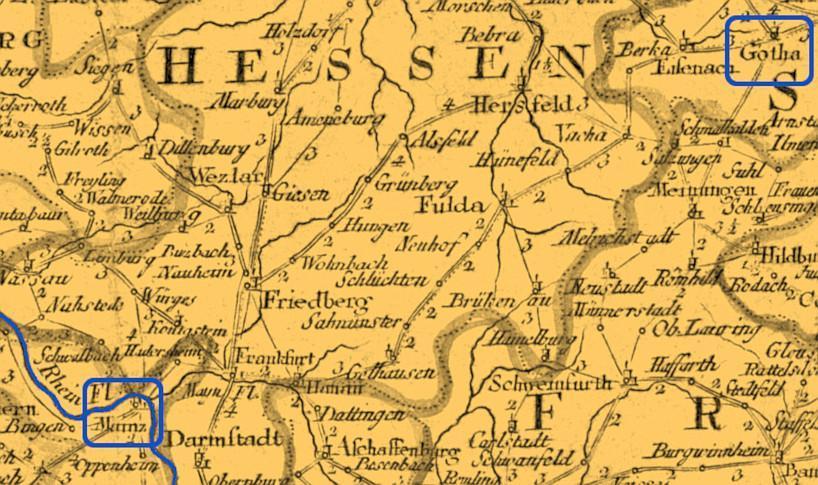

Translation © 2011 Doug Stott