
• 102. Caroline to Philipp Michaelis in Göttingen: Marburg, 22 June 1791
[Marburg] Wednesday morning, 22 June [17]91
|214| I cannot think of you all without feeling genuinely uneasy and distressed — the ill mood there must be unbearable, nor is a single person’s reasoning really honest. Not a single one of you is taking a straightforward, resolute path — external influences are controlling at least his mood, and that mood in its own turn is controlling his behavior. [1]
No one is to be pitied more than Mother, despite whatever mistakes she may well have made — she would like to unite everyone again — the best way to heap all the unpleasantness on his head. I am giving up entirely on my sisters, since I simply cannot see who or what might improve them and since they certainly will never attain any measure of reasonableness or moderation on their own. Burn this letter if you do not want to make a bad situation even worse.
The fact that they no longer listen to me is only a temporary condition with Louise, whereas for Lotte it is the natural consequence of an element of depravity she is trying to justify to herself, cost what it may [2] — she is basing her firmness on new lies now that the old one, namely, her dream of eternal devotion, has evaporated. The entire breadth of her feebleness emerged as soon as she began acknowledging to herself that first deception — the steps she took to bury herself in various distractions — having discovered it was inadvisable to do so in the cool earth — robbed her of all femininity and discretion — something she still talks about — but, then, what does she not talk about? I can only guess what humiliation she will be capable of now.
Her hatred toward me, which I always suspected in her but which I also ignored as long as I thought I could be of some use to her, now erupted with all the symptoms of envy. She would gladly have hurt me [2a] — but whenever she manages to do so for more than a quarter hour, whenever one laughs at her portrayal and is simultaneously |215| contemptuous, inflicting such hurt then ceases to be really worth the trouble [to her]. Meyer wrote me recently regarding her:
Lotte has spirit, a trait I have always valued. What has gone wrong in her character is that she has been allowed to languish. Perhaps few would be as good as she if at 18 she had become the wife of a coarse dragoon; but now so many bad habits are already so deeply ingrained that even the greatest good fortune that might happen to her — namely, a husband — could no longer make her good, and if she should happen not to find one, then she will become one devil of an old maid.
Amen! Unfortunately! It is true enough that sheer chance did everything it could to ruin her, should “chance” also include a person’s initial disposition. Feminine — virginal — pride might have preserved her early youth from the snares of the villainous seducer — alas, she never knew such pride. Her blossom wilted in debilitating, perpetually unsatisfied passion — the way she was, a man could never really, seriously, abidingly attach himself to her — for say what you will, in order genuinely to be captivating in that sense, a person must also possess the useful sort of characteristics with which to make the other person happy. Whenever she attracted someone, he escaped just as she thought she had attained him. Even a weakling, as long as he has some modicum of good sense, can be kept only if one comes to the aid of his weakness — whereas her particular strength is nothing but a sham and a bluff.
And thus did she wear herself out — there is nothing youthful in her coquettishness. She makes herself think she enjoys a certain measure of respect from people, convincing herself of this by every means possible — it would be easy enough to disabuse her of such nonsense, but what would it help? Doing so would not improve her. Kotzebue speaks disparagingly of her [3] — Föltersohm [4] esteems her little, not even her understanding, despite her asseverations — (he did not say this to me himself, being too refined for that; I read it in a letter to Schlegel) and so on!
Her fate will be horrible |216| if God does not change old man Dieterich’s heart to compensate her for the injustice he did her — but Mother’s fate, however, will be even worse, since it is on her neck that the burden will remain.
If Louise still wants to come stay with me 10 or 11 months now after Gr[osse]’s departure, I am fine with it. But do not say anything to her yet. — After what Brentano has related to me — who is, by the way, a duplicitous and, as such, never straightaway reprehensible creature — I cannot comprehend how any reasonable, straightforward person could see and hear Grosse and still believe in him. Satan had a hand in it, taking advantage of the lack of worldliness on the part of all of you. [5]
There are other truths I would like to relate to you if I thought you genuinely had an appropriate opportunity to hear them. What an ideal angel of fantasy Madam Bürger was at the beginning. [6] And now? And I would certainly wager that now the entire sex will have to pay for it! Your early dealings with that sex, your rash pretensions — which derive from when you, a curly-haired little boy, pretended to accompany Marianne and Miss Schlözer to concerts — have quite frankly done you enormous damage.
What did all of you really expect from ties based on pure conceit and vanity, on the earnest hope that one might be found pleasing, and on the premature conviction that one has indeed been found extraordinarily pleasing? Whenever self-interest is the initial hook, you will find that men are as unreliable as women. You will probably counter by asking: “What does that prove except that all people are wretched — instead of merely half the human race?” And, indeed, that statement is worth considering — since in that case one can, after all, sooner calm down at the notion of the inherent imperfection of the race as a whole.
Those who on that account would insist on becoming melancholy or misanthropic would in any event not end up being any stronger than the common mass of people. Not even the most sorrowful experiences can |217| diminish the kind of courage that finds the source of a more beautiful faith in our own breast, faith from which we can draw unshakable support in our conviction that it is at least possible to be good despite the thousands who are in fact bad.
Quite frankly, I have myself only recently entered a period in which I can genuinely speak about “experiences” — before now, I simply did not have that many of them. But they neither depress nor disconcert me. No one with as profound a disinclination toward all that is base and low can be surrounded by more wretchedness than I. Let me regale you with some anecdotes — which admittedly are far enough removed from me personally — lest you lose track of what is going on in Marburg.
Baldinger ended up marrying Mademoiselle Trebbin. [7] Madam Handel was beaten to within an inch of her understanding. Herr Handel and Herr Nebel are animals and play nothing but animalistic tricks. [8] —
Mlle. Wiederhold experienced firsthand a tragic catastrophe. Her fiancé, a certain Herr Schulz from Bovenden, was just coming from her parents to get her assent. Another suitor became infuriated on learning of it and stabbed her that night between 2 and 3 o’clock with a bread knife [9] — but then was so distraught that he also stabbed himself three times, missing his heart by scarcely an inch. [10] But — all the wounded are still alive even as we speak and are not seriously hurt. — Herr von Berger . . .
[End of sheet.]
Notes
[1] Considering Caroline’s remarks later in the letter, the reference seems to be to the intransigent position adopted by Johann Christian Dieterich in opposing any engagement between his son and Lotte Michaelis, though the Michaelises were initially opposed as well. Elise Bürger writes to her mother on 11 October 1791 (Strodtmann, 4:133; illustration: Goettinger Taschen Calender für das Jahr 1785; Inhaltsverzeichnis deutscher Almanache, Theodor Springmann Stiftung):
. . . Everyone in the Michaelis family is in good health. Concerning my good Lotte’s so-called status as a ‘fiancée’, I must limit the story I promised to a few words.
She met the young [Heinrich Friedrich] Diet[e]rich at my house, the eldest son of the bookseller. This young man fell in love with her and won her love in return. Naturally enough, he asked his father for permission to marry her, and certainly none of us ever doubted he would receive it.
But all the son’s entreaties were in vain — his father did not want him to marry the daughter of a privy Justizrat [Johann David Michaelis], she allegedly being too well read and possessing too much understanding amid too little knowledge about what it takes to keep a household, and too little money; in a word, he just did not want her.

His son pleaded and tried to defy him, but all in vain. Her own mother wished simply to facilitate the happiness of her daughter, considering nothing else besides, yet ultimately was herself so vexed by the old man’s behavior that she forbade Lotte from even seeing the young man, who received the same prohibition from his father.
And yet they remain faithful to each other, and I have reason to believe they are carrying on a secret correspondence. Hence at the time I was able to respond to you that Lotte was indeed not a bride. But I do hope with all my heart for this child’s sake that the father will relent and that she does indeed get her beloved.
Georg Christoph Lichtenberg, who was living in the same house as the Dieterichs at the time, tracks this story in parts of his diary (Schriften und Briefe, vol. 2, Sudelbücher II, Materialhefte, Tagebücher [Munich 1967]; cited in Horst Gravenkamp, “‘Ein Mädchen, kaum zwölf Moden alt’: Lotte Michaelis und Sigmund Freud. Hintergründe eines Lichtenberg-Aphorisums,” in Lichtenberg-Jahrbuch [1989], 161–75, here 169; illustration: Goettinger Taschen Calender für das Jahr 1791; Inhaltsverzeichnis deutscher Almanache, Theodor Springmann Stiftung).
On 8 May 1791 Lichtenberg mentions “Johann Christian Dieterich . . . the story with the son’s bride.” On 10 June 1791: “secret letter from the little angel Michäel [presumably Lotte, possibly with Lichtenberg playing the role of courier].” On 23 December 1791 Lichtenberg mentions that “poor Dieterich” would likely have to accommodate himself to his son’s marriage after all, and one then reads that “Mamsel Michälis” appeared for the first time in the Dieterich house on 19 February 1792, after which (e.g., in his diary entry on 16 April 1792) Lichtenberg, away at the time, began including “Mamsel Fiancée” in his epistolary greetings ([1] title vignette to August Heinrich Julius Lafontaine, Herrmann Lange, vol. 2 [Berlin 1800]; [2] Goettinger Taschen Calender für das Jahr 1791; Inhaltsverzeichnis deutscher Almanache, Theodor Springmann Stiftung):
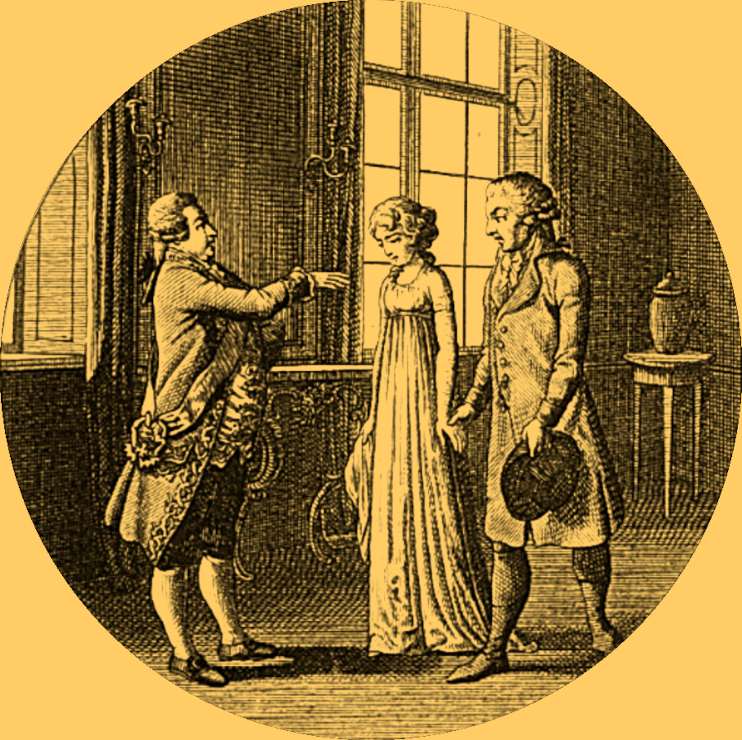

Finally, on 3 June 1792: “Today the wedding of young H. Dieterich and Mamsel Michälis. . . . The weddings guests pass by, we conduct our cannonade [Lichtenberg’s attempts to detonate fireworks] and they all come up!!!”
(Taschenbuch auf das Jahr 1805 für edle Weiber und Mädchen, Inhaltsverzeichnis deutscher Almanache, Theodor Springmann Stiftung):

Luise Wiedemann, née Michaelis, discusses this episode in her Erinnerungen, in her biography of Lotte, p. 89. Back.
[2] See Christian Gottlob Heyne to Georg Forster in a letter on 17 February 1792 (Albert Leitzmann, “Aus Heynes Briefen an seine Tochter Therese und seine Schwiegersöhne Forster und Huber,” Archiv für das Studium der neueren Sprachen 121 [1908], 10) (Caroline returned to Göttingen from Marburg after her father’s death in August 1791 and was about to depart for Mainz):
M[adam]e Böhmer will likely finally get serious about departing. She, too, is a woman without a heart, nothing but a pathetic head, full of vanity and deceitfulness; and her sister’s [Lotte’s] depravity certainly has a solid enough foundation in her temperament.
Caroline invoked the notion of “depravity” earlier in her assessment of Lotte’s character, associating that element, moreover, with the works of Rétif de la Bretonne; see Caroline’s undated letter to Lotte in 1786 (letter 72), note 3, with cross-references. Back.
[2a] Berlinischer Damen Kalender auf das Jahr 1799; Inhaltsverzeichnis deutscher Almanache, Theodor Springmann Stiftung:

[3] Caroline could have received such information from Therese Forster in Mainz; see notes to Therese Forster’s letter to Samuel Thomas von Sömmerring on 9 October 1790 (letter 98a) with supplementary appendix 98a.1 concerning August von Kotzebue and Lotte Michaelis in Mainz, and August Kotzebue’s letter to an unidentified student in Göttingen on 22 October 1781 (letter 25a). Back.
[4] Erich Schmidt (1913), 1:215, was unsure of this name. Albert Leitzmann, “Aus Karolinens Lebenskreisen,” 128, suggests the name “Föltersohm” should read Fölkersahm, a family of Courland nobility. Luise Wiedemann also mentions him in her memoirs, p. 66. The reference is indeed to Georg Friedrich von Fölkersahm, who studied in Göttingen 1786–89, where he was acquainted with Wilhelm Schlegel and seems to have also been an admirer of Dorothea Schlözer (see also Allgemeines Schriftsteller- und Gelehrten Lexikon der Provinzen Livland, Esthland und Kurland, ed. Johann Friedrich von Recke, vol. 1: A–F [Mitau 1827], 588). Back.
[5] Concerning Carl Friedrich August Grosse, see Caroline to Friedrich Ludwig Wilhelm Meyer on 12 August 1792 (letter 114) and especially the extensive sections on Grosse in Luise Wiedemann’s Erinnerungen, in her autobiographical section, p. 86f. et passim. — Concerning Caroline’s apprehension about Grosse and the Michaelis family, see supplementary appendix 114.1. Back.
[6] The infamous “Swabian maid,” Elise Bürger, née Hahn, Gottfried August Bürger’s third wife, developed an extensive but disreputable social circle in the Dieterich house; the demoiselles Michaelis (Lotte and Luise) participated as well, and not merely on the theater evenings, when, for example, Luise would recite a prologue (Gottfried August Bürger, “Prolog,” published later in the Göttinger Musenalmanach [1797], 188); indeed, their involvement was so extensive that Bürger accused them of bearing part of the blame for his wife’s ruin.
Young Philipp Michaelis, moreover, is said to have been Elise Bürger’s “first paramour” (documentation in Strodtmann, 4:144–47, 161–62, 186–87 et passim [abridged]; also [unabridged] in Karl Reinhard, Gottfried August Bürger’s Ehestands-Geschichte: Geschichte der dritten Ehe Gottfried August Bürger’s: Eine Sammlung von Acten-Stücken [Berlin, Leipzig 1812], 64–75; 127–29; 228–30; although Erich Schmidt [1913], 1:690, also adduces Strodtmann, 4:182, that page contains no mention of the Michaelis family; moreover, 4:157, which Schmidt also adduces, is now included in the notes to Caroline’s letter to Friedrich Ludwig Wilhelm Meyer on 6 December 1791 [letter 111]) (frontispiece to Carl Friedrich August Frh. von Lütgendorf, Karl von Dahlfeld der Jüngling, oder: der junge Herr und sein Hofmeister als Nebenbuhler [Munich, Leipzig 1788])::
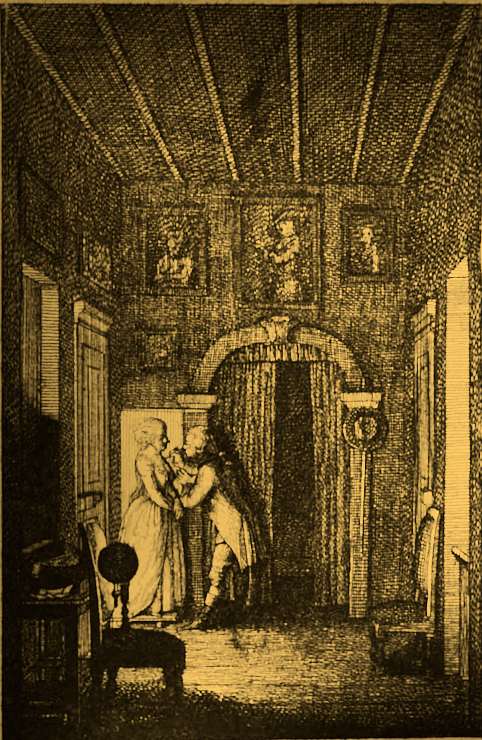
For documentation of the events involving Elise Bürger and the Michaelis family from Strodtmann and Gottfried August Bürger’s Ehestands-Geschichte, see supplementary appendix 102.1. Back.
[7] Caroline and Philipp had known Baldinger from both Göttingen, where from 1773 he was a professor of medicine and clinic director, and Marburg, where from 1785 he was a faculty member. See the biograms of Baldinger and Lisette Drebing concerning their relationship and why Caroline expresses herself as she does here; Baldinger had, moreover, married Lisette Drebing precisely two weeks earlier, on 8 June 1791 (not 1787 as in NDB). Back.
[8] Although one can only speculate concerning the incident involving Madame Handel to which Caroline alludes, her next remarks do suggest that all was not entirely well on the Marburg domestic front (frontispiece to August Heinrich Julius Lafontaine, Kleine Romane und moralische Erzählungen, vol. 8 [Berlin 1801]):
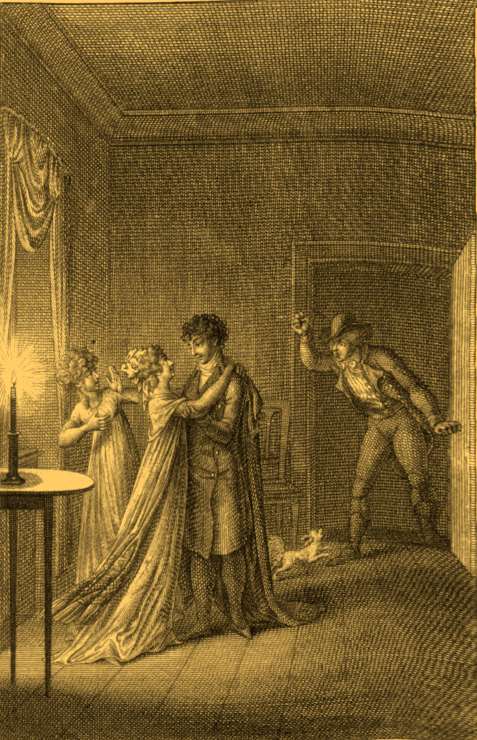
“Nebel” is presumably the medical student Conrad David Nebel (dates unknown), who earned his doctorate in Marburg in 1791 with a dissertation on Hippocrates. The identities of Mademoiselle Wiederhold, Herr Schulz, and Herr von Berger are uncertain, though a certain Herr Lt. Johann Henrich (or Heinrich) Wiederhold, Hofrath, was Marburg town mayor in 1776, 1786, 1790, 1792, 1799, and 1803, and the reference may well be to his daughter. Back.
[9] Illustrations: (1) frontispiece to E.R. Graf von Vargas, Novellen, vol. 2 (Berlin 1792); (2) frontispiece to Moritz Augustvon Thümmel, Reise in die mittäglichen Provinzen von Frankreich im Jahr 1785 bis 1786, vol. 9 (Leipzig 1810):
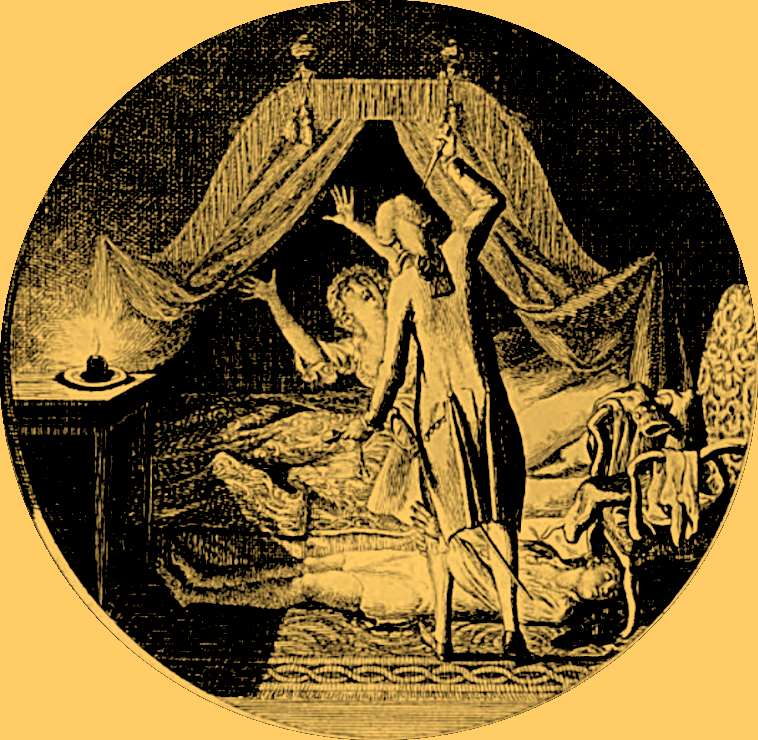
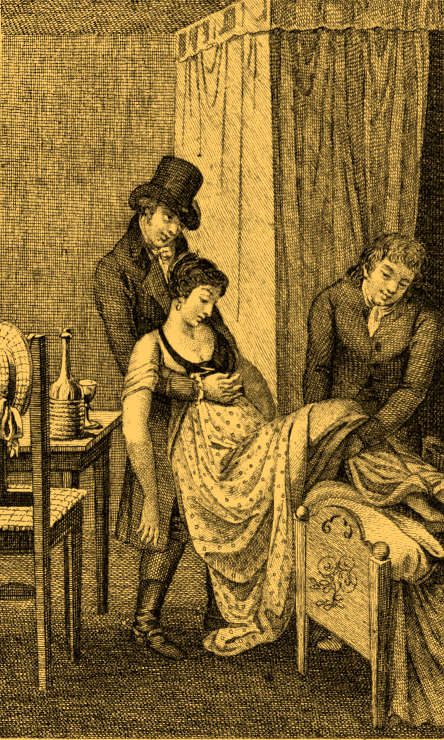
[10] Popular literature of the time attests no dearth of such dramatic and emotional romantic scenes filled with passion (title vignette to Christian August Pescheck, Liebe und Ehe in der Narrenkappe und im Philosophenmantel [Breslau 1786]):

(Göttinger Taschenkalender für das Jahr 1799, Inhaltsverzeichnis deutscher Almanache, Theodor Springmann Stiftung):
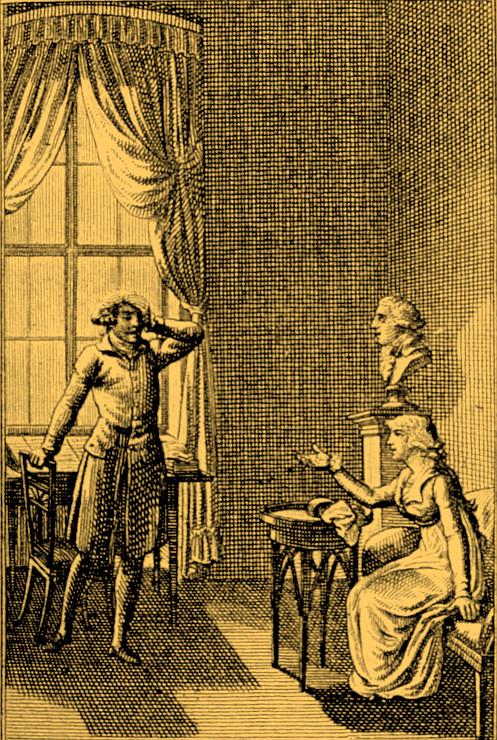
(Daniel Nikolaus Chodowiecki, “Ah, cruel one — someone else? where is he? who is he?”, Herzog August Bibliothek; Museums./Signatur Uh 4° 47 [269]):
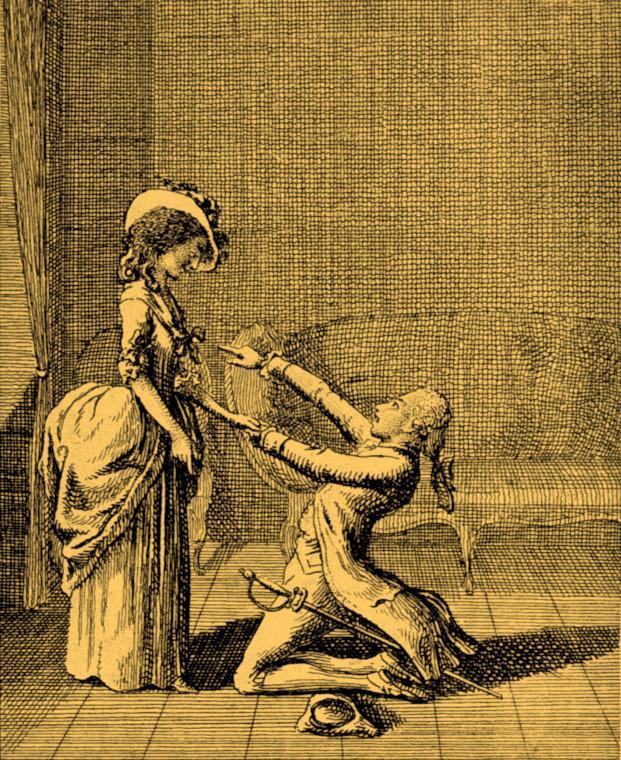
(Chodowiecki, “My dear Lindorff — in the name of heaven, calm yourself!” [1784], Herzog Anton Ulrich-Museum, Museums./Signatur DChodowiecki AB 3.705):

Translation © 2011 Doug Stott