
• 107. Caroline to Luise Gotter in Gotha: Göttingen, 31 October 1791
Göttingen, 31 October [17]91
|232| Fortunate for me that I fell into all of your hands, where the zeal and enthusiasm of friendship erred not even a single step beyond the boundaries of what is graciously appropriate — had Grandison and Miss Byron had to deal with this matter [1] — they could not have been more considerate of the most delicate emotions of the two parties —
I recognize Gotter — but my recognition of him was accompanied by new discoveries — and even were I not compelled to thank him once again for having given me the pleasure of admiring this particular aspect of him as well, I would nonetheless still have to say — that it has nonetheless brought me a feeling of profound obligation. His comportment is so rare — even among people of good sense and understanding — and yet delicacy is the mark of understanding! And here it is worth twice as much to me because it is almost more unpardonable to raise hopes one then does not fulfill than to intimate prematurely the fulfillment of |233| precisely such hopes — can you understand what I am saying?
My dear Louise — your simple, straightforward wisdom already anticipated it — nor does the tone of your last missive contain any more element of tense anticipation — hence you will not really be taken aback if I confess to you that I cannot. [2]
I feel as if I must apologize to you as if I had committed some act of foolishness, even though my own, resolute conviction is that I have acted on the basis of the most sober, reasonable considerations. Each of us, after all, has personal reasoning of this sort, and such can be reproached as rapturous enthusiasm only if a person undertakes a certain course without first considering all the consequences and then collapses, discouraged and exhausted, under their weight.
I have vividly considered the former and have no need to fear the latter, not even should things happen I did not foresee. And would I not be able to anticipate such things even less were I to follow your charming plan rather than pursue the simple path I have set before myself? I am quite ambitious in wanting to be of use — but that which is more useful is also always that which is happy — and I am doubtless happier the freer I feel I am — and all the more bound to the duties appropriate to my strengths the more I act from my own volition.
Hence do not condemn me for frustrating the hand of providence — for I am nonetheless pious enough to believe that such providence does nothing without a purpose. Hence neither let us regret the brief dream — it is unlikely the result of all this for him will be pain — and he has thus wholly, completely spared us the pain of separation — such is what my own destiny has demonstrated to me from every quarter. And having thus resolved, I find even more reasons militating against the opposite course of action, one with regard to which I deceived myself at the beginning because I wanted to be able to give my consent — my discussions and deliberations lasted several days —
I honestly did consider everything as impartially |234| as is possible for mortals — again, having thus resolved, the actual decision was made by the secret inclinations of my heart — and in that case I am not acting wrongly, since then I can never have cause to reproach myself. You will not be able to refrain from remarking that Tatter influenced my choice — were I to say no, you would still believe your own opinion, and so why should I start a heated argument on behalf of the cold objectivity of my own reflections? I will, however, give this wonderful person his full due by pointing out how I would have enjoyed his full concurrence even had I chosen differently. [3]
And now Gotter will bring the matter to an end, letting him know in a way enabling him to receive the news in the most indifferent manner possible, namely, that I simply cannot — whether he tells him that he in fact is really losing nothing in losing me — or that I love another and that thus both duty and conscience prohibit me — though not a word of this is true — from marrying this upright man. I will write to dear Mother Schläger later this week — today I only have time for this one letter. [4]
The brothers-in-law in Mühlhausen have no need of a wife, for they can all kiss their comely sister-in-law [5] — is Wilhelmine already there again? Please comfort her as well during the next few days. Louise’s high spirits have sunk now that Gotter is no longer making any impromptus for her, and along with them the beautiful promises — I myself have not yet heard anything more about it.
Adieu, my dear; you know what I feel for you in my heart without my having to write or say it — give my regards to the children and to your dear aunt, and write me soon — indeed, very soon.
C. B.
Notes
[1] Miss Byron in English in original. Sir Charles Grandison and Harriet Byron, principle characters in Samuel Richardson’s novel The History of Sir Charles Grandison (London 1753–54) (Isaac Taylor [1778]; British Museum; repr. in Sir Charles Grandison, Illustrated Gleanings from the Classics 1 [London 1912]):

For Thomas Stothard’s complete illustrations to The History of Sir Charles Grandison, click on the following gallery:

Richardson had styled Grandison as a counterbalance to the less honorable and less virtuous characters in his previous novels Pamela, or Virtue Rewarded, 2 vols. (London 1741 [1740]) and Clarissa, or The History of a Young Lady, 8 vols. (London 1748–49) (Caroline’s father had translated the latter novel in 1748; see Caroline’s letter to Lotte Michaelis on 28 March 1787 [letter 77], note 1).
Click on the following image to open a gallery of Daniel Nikolaus Chodowiecki’s illustrations to the German and French translations by Ludwig Theobul Kosegarten, Clarissa. Neuverdeutscht und Ihro Majestät der Königin von Grosbrittanien zugeeignet, 8 vols. (Leipzig 1790–93) and M. Le Tourneur, Clarisse Harlowe, 14 vols. (Geneva, Paris 1785–87), a novel that functions almost as a locus classicus for the various “crises faced by pretty girls” when Caroline, her sisters, and her friends were young women:
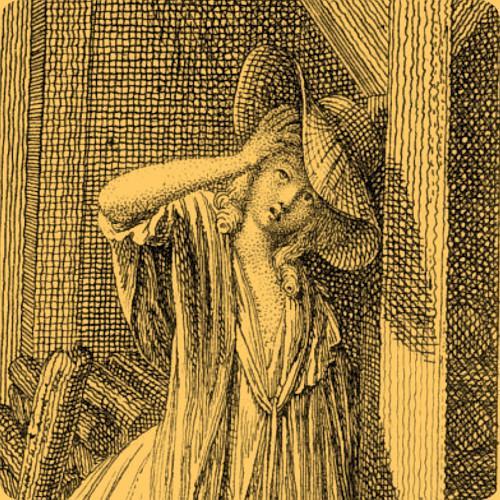
At issue in this letter is the attempt by Luise and Friedrich Wilhelm Gotter to play the matchmaker between Caroline and Josias Friedrich Löffler (this issue is addressed in letters 105–10); here Caroline is referring to Gotter’s letter to her on 27 October 1791 (letter 105) and to the (lost) “missive” Luise Gotter seems to have written her in a similar vein. Back.
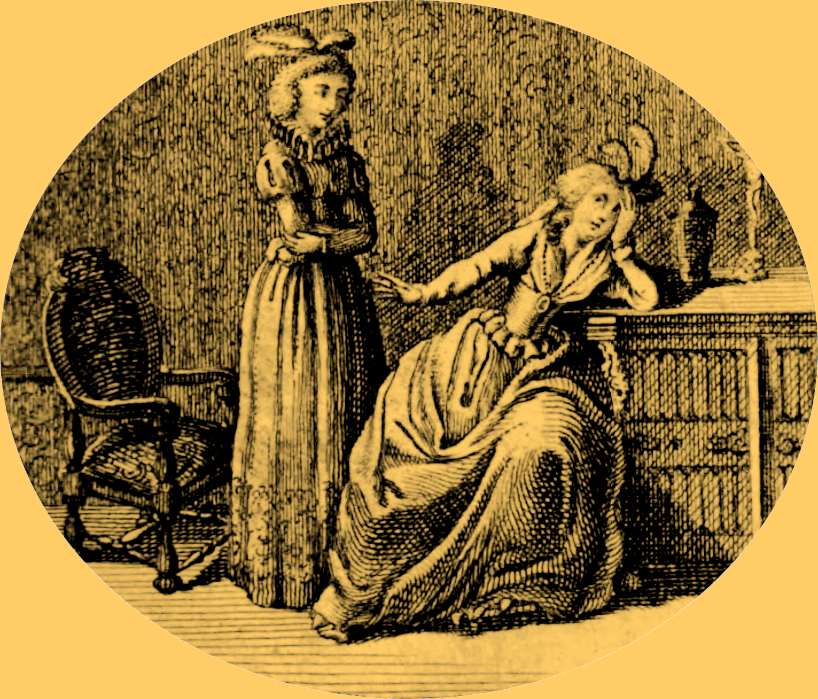
[2] Title vignette to Johann Friedrich Ernst Albrecht, Die Familie Eboli: Dramatisch bearbeitet vom Verfasser der Lauretta Pisana, vol. 3 (Dresden, Leipzig 1792):
[3] Luise Wiedemann, née Michaelis, Erinnerungen, mentions Tatter in this context as well in her biography of Caroline, p. 79. Back.
[4] See Caroline’s letter to Luise Gotter on 17 June 1783 (letter 37) concerning Christoph Friedrich Bretzner’s popular play about a matchmaker, “love after the current fashion,” Liebe nach der Mode, oder: Der Eheprocurator. Ein Lustspiel in fünf Akten (Leipzig 1781). Click on the image below to open a gallery of twelve illustrations to the play by Daniel Nikolaus Chodowiecki in the Lauenburg Genealogischer Kalender auf das Jahr 1785:

[5] Uncertain allusion; Mühlhausen is located in Thuringia about 60 km southeast of Göttingen, between Göttingen and Gotha (Post Karte Durch ganz Deutschland, ed. J. Walch [Augsburg 1795]):

Translation © 2011 Doug Stott