
107a. Gottfried August Bürger to Wilhelm Schlegel in Amsterdam: Göttingen, 31 October 1791 [*]
G[öttingen], 31 October 1791
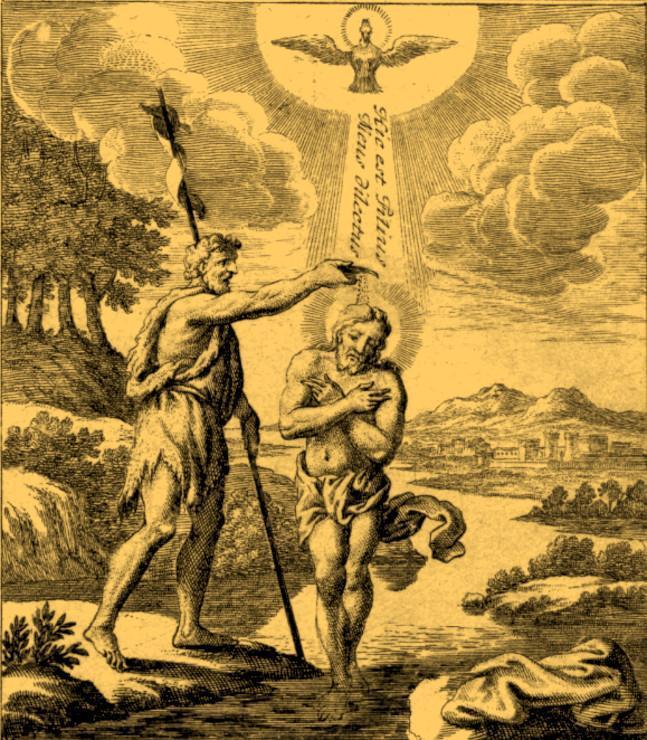
It is sinful, my son, I myself must confess: most grievously sinful that I have not yet written a single word to you. Because Madam Böhmer said as much yesterday evening as well, namely, precisely that it was most grievously sinful, then grievously true must it surely also be. I even dreamt about this lofty sinfulness last night, and because this morning that same lofty sinfulness seemed just as grievously sinful when I was awake, I immediately sat down to make this confession and, after said cleansing from sin, to have my spirit hover above you like that certain holy one vel quasi [1] and call out to you: you are still my beloved son with whom I am well pleased. [2] . . .
You doubtless have long been aware that Madam Böhmer has been here since the death of her father. [3] A few days ago she was in Gotha with Luise and is still quite raving about the merry days she spent there with the belletristians. Gotter has prepared a straightaway splendid free adaptation of Shakespeare’s Tempest with the title Die Zauberinsel, which the ladies cannot extol highly enough. Mozart is composing the music. [4] This development has effectively blown the dust off our own Midsummer Night’s Dream once again, and Madam Böhmer and I have resolved together to see what this fellow is up to without further ado. [5] . . .
Stay well, my son, and please do not requite equal with equal as regards my own failure to write. For you know too well that amid all my Bürgerisms I am still heartily fond of you. Once during a walk we took together, Madam B[öhmer] read aloud to me quite a bit from one of your letters in which you spoke about all the things worth seeing in Amsterdam. Quite well written, I should say.
Vale faveque tuo [6]
GAB
Notes
[*] Source: Strodtmann, 4:134–37. Back.
[1] Latin, in the sense “as it were.” Back.
[2] Mt. 3:16–17 (NRSV): “And when Jesus had been baptized, just as he came up from the water, suddenly the heavens were opened to him and he saw the Spirit of God descending like a dove and alighting on him. And a voice from heaven said, ‘This is my Son, the Beloved, with whom I am well pleased'” (Christoph Weigel, Historia von Iesu Christi unsers Heylandes Geburt, Lebenswandel, Wunderwercken, Gleichnußreden, Leiden, Sterben, Auferstehen und Himmelfahrt: Zur Einpflanßung von Jugend auf, und state Unterhaltung Gottseelige betrachtungen auß denen heyligen Evangelisten Mattheo, Marco, Luca, und Johanne, vorgebildet [Augsburg 1695]):
[3] Johann David Michaelis had died on 22 August 1791.
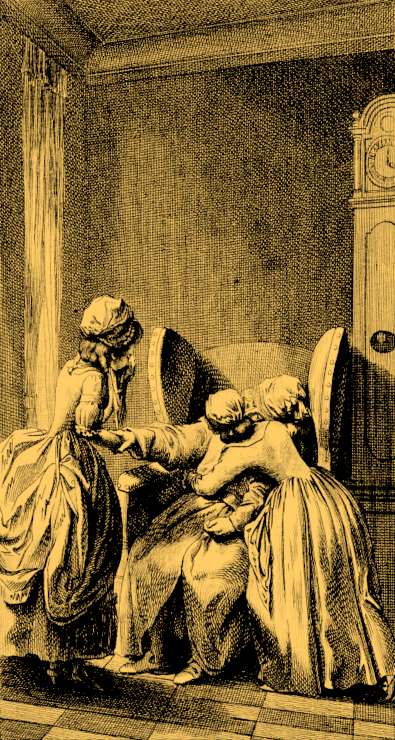
Luise Wiedemann, in her Erinnerungen, mentions that Caroline returned from Marburg to Göttingen to be with her father before he died; see her biography of Caroline, p. 79. Here two daughters similarly attend to their dying father (Daniel Nikolaus Chodowiecki, Töchter beweinen den sterbenden Vater [ca. 1762–1803]; Herzog Anton Ulrich-Museum; Museums./Signatur CGGeyser WB 3.4):
Marburg is located ca. 115 km southwest of Göttingen (Post Karte Durch ganz Deutschland, ed. J. Walch [Augsburg 1795]):

[4] Gotter, initially together with Friedrich Hildebrand von Einsiedel, had transformed Shakespeare’s play into a singspiel, though with the title Die Geisterinsel: Ein Singspiel in drei Akten rather than Die Zauberinsel. Although Einsiedel mentions this piece in a letter to Gotter on 7 April 1791, it was published only posthumously in Schiller’s periodical Die Horen, vol. 11, no. 8 (1797), 1–26; no. 9 (1797), 1–78; then reprinted in 1802 in Friedrich Wilhelm Gotter. Literarischer Nachlass von Friedrich Wilhelm Gotter. Mit des Verfassers Biographie und einem Bildnisse, ed. Friedrich von Schlichtegroll (Gotha 1802). Rudolf Schlösser, Friedrich Wilhelm Gotter, 296–301, here 297, remarks:
Instead of the old type of modest singspiel, however, the Geisterinsel is an opera in the grand style with three lengthy acts, richly elaborate musical passages, an extended finale, and, at least for that earlier sensibility, an unprecedented attention to set decorations and effects.
The piece was clearly influenced by Mozart’s Magic Flute, though the latter was not performed until 30 September 1791; Mozart did not, however, compose the music to Gotter’s piece (concerning the piece’s complicated musical history, see supplementary appendix 107a.1). Although Schiller did indeed publish it in Die Horen, he did not have a particularly high opinion of it. In this regard and in general regarding the equally complicated fate of Die Geisterinsel otherwise, see esp. Caroline’s letters to Luise Gotter in March 1797 (letter 181). Back.
[5] Caroline mentions Bürger’s interest in the project in her letter to Gotter on 13 November 1791 (letter 110). Back.
[6] Latin, “Stay well and remain kindly disposed toward your . . . ” Back.
Translation © 2011 Doug Stott