
II.
Mainz. Gotha. Braunschweig.
1792–1796
Erich Schmidt’s Introduction to Caroline’s Time in Mainz [1]
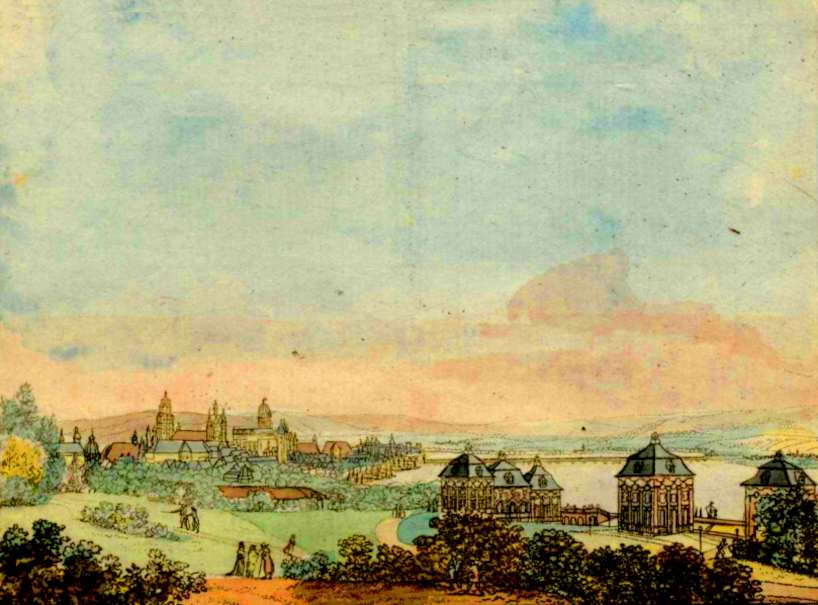
|692| Caroline moved to Mainz in February 1792. The marriage between Georg and Therese Forster had from the very outset been unstable, not least because Therese entered into it without any real affection for Forster in any case; moreover, even as a fiancée, in the spring of 1785 she developed an ardent, cautiously reciprocated passion for Friedrich Ludwig Wilhelm Meyer, a passion rekindled during a visit to Göttingen in 1787 and which for all practical purposes Forster himself facilitated.
Despite his considerable intellectual gifts, Forster, for whom his father-in-law Christian Gottlob Heyne had always had “an inexpressible love,” utterly lacked any understanding of human beings in general and of women in particular; he was a soft, yielding enthusiast, managed his finances poorly, was unconcerned with satisfying Therese’s rich, more lofty interests precisely when they were living in the wasteland that was Vilnius at the time, [1a] and with his sensual nature was oblivious to the fact that his wife found him physically repulsive.
Serving as the senior librarian at the university in Mainz since the spring of 1788, he followed the revolutionary developments in France with an increasingly resolute republican bias in which he was “goaded on” neither by Therese, who quickly curbed her own enthusiasm on behalf of freedom, nor by Caroline, whose corresponding enthusiasm lasted somewhat longer.
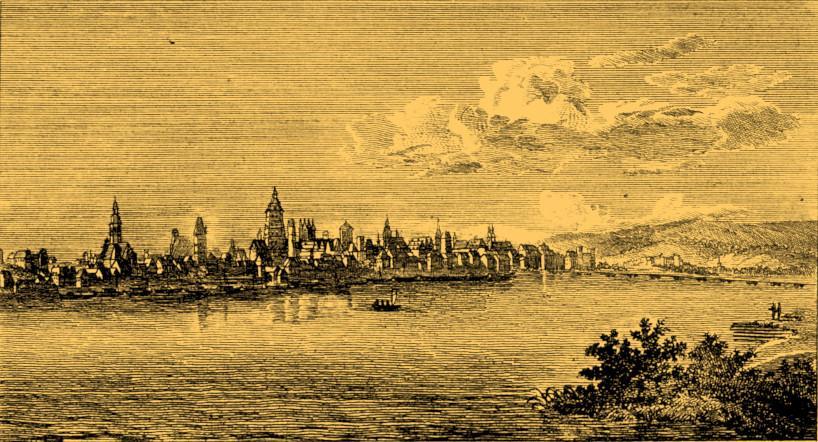
The French army took Mainz on 21 October 1792.
Although he was not an instigator like Caroline’s brother-in-law Georg Wilhelm Böhmer, who functioned as interpreter and secretary for General Adam Philippe de Custine, Forster nonetheless did join the revolutionary “club” on 5 November 1792 — the “Society of the Friends of Freedom and Equality” — even delivering a speech on 15 November confident of victory concerning the abiding membership of Mainz in the new France, whereupon he became vice president of the provisional general administration. He took part in planting the “freedom tree” [see below] and even considered regicide to be justified as required by the moment.
Frankfurt was occupied by the Prussians on 2 December 1792, and on 7 December Therese hastened initially |693| to Strasbourg with her children, [1b] since now Mainz itself was threatened and she, unequivocally estranged from her husband, was following the advice of her new lover, Ludwig Ferdinand Huber, who had been a family friend and since December 1790 also lived with the family. Huber, an embassy secretary, managed to rescue the Saxon archives by taking them to Frankfurt.
He also finally ended his engagement to the older, physically deformed Dora Stock, which had dragged on for some time, and in August 1792 her brother-in-law, his friend Christian Gottfried Körner, reminded him of his obligation; eventually a break in the two men’s relationship came about, at first rather mildly, then with an element of increasing brusqueness also shared by Schiller and accompanied by the false allegation that Therese Forster already had a child by Huber. [1c]
Attempts were made to get the weak Forster to release Therese from their marriage; Caroline stood by and consoled Forster — who still loved the unfaithful Therese — though not in any sort of erotic relationship. Forster left for Paris on 25 March 1793 as a deputy from Mainz, meeting one last time with Therese and Huber, who were biding their time near Pontarlier in France. [1d] Amid the considerable confusion of the times and despite considerable disappointment, he remained committed to the republican cause of seeing the German Rhineland united with France. He died [in Paris], exhausted, on 10 January 1794, of a severe case of gout. Thus the tragic end of this famous natural scientist who had once sailed round the world, a multifaceted and skilled prose author whom Friedrich Schlegel celebrated as a “social writer.”
Caroline alludes only equivocally to her own participation in the political aberrations in Mainz. [2] In Mainz itself, she made the acquaintance not only of the professor and physician Georg Christian Gottlieb Wedekind, but also his mother, the widow of the Göttingen theologian Rudolf Wedekind, and his sister, Meta Sophie Dorothea Forkel.
Meta, who was married at an extremely early age to the university music director Johann Nikolaus Forkel, had acquired a questionable reputation at home because of various love escapades, something Gottfried August Bürger, among others, attested in a rather crude caricature after his own dalliances with her [see below]. She fled Göttingen in 1788, rehabilitating herself after her divorce, which was not effected until 1794, after marrying the Königsberg native Johann Heinrich Liebeskind, who in 1797 became a government administrator in Ansbach.
Georg Forster discusses her past quite gently, complimenting her insofar as “her resource is her work” and even adding a good word on her behalf to his father-in-law, Christian Gottlob Heyne: “The poor woman comported herself extraordinarily well during her stay here and was very often a visitor in my own house. She is doubtless infinitely more to be lamented than condemned.” He promoted her many and various translations from English and French; she had already published an epistolary novel of her own, Maria. Eine Geschichte in Briefen, |694| 2 vols. (Leipzig 1784) (originally published anonymously). Justus Erich Bollmann also vigorously defends her in September 1791. [3] By contrast, Friedrich Ludwig Wilhelm Meyer, in a letter to Bürger in 1789, only has frivolous remarks concerning the “dirty Furciferaria“: “that she loved and enjoyed several men at once harmonizes quite well with my own principles.” [4]
It was with this housemate, who had such an ill reputation in Göttingen itself, and with the elderly Madam Wedekind that Caroline, who herself was trying to get to Gotha and Göttingen by way of Mannheim, tried on 30 March 1793 to escape Mainz, which had already been surrounded. [5] And even according to the portrayal given by her adversary Samuel Thomas von Sömmerring, who at the time was in fact helpful to Caroline, she would indeed have reached her goal quite easily had she not given a provocative response when stopped by the Prussians in Oppenheim, whereupon she was escorted from Hattersheim to Frankfurt, where the women were again given the opportunity to escape. [6] Therese Forster maintained later [as Therese Huber] that in order to show off, Caroline had addressed officers along the way and even made several visits to people in Frankfurt. Sömmering writes: [7]
I am really quite sorry that the oh-so-clever Göttingen ladies were unwilling to follow my earnest advice and leave immediately after the hearing, their names being simply too detested here, humiliating attestations of which, after all, they themselves certainly experienced insofar as they could hardly find lodging and even the waiter declined to serve them coffee.
On 8 April 1793, in a carriage, the three women along with little Auguste and the compromised Madam von Esebeck [8] joined the procession of imprisoned Clubbists from Mainz, Worms, and Bingen and were transported to the fortress Königstein, whose ruins, remnants from the Napoleonic wars, one now sees above the beautiful city in the Taunus region. [9] They had not exploited the free day-and-a-half and were now incarcerated without further investigation to appease the rage of the people and to repay the French for similar actions.
Beginning in June, however, they were held merely in house arrest in nearby Kronberg. [10] Sömmerring reports on 13 April 1793: “Hofrath Böhmer from Werstatt has intervened on behalf of the Göttingen dames at Königstein to the extent that they now have a tolerable room.” [11] Madam Forkel’s sister-in-law, Madam Wedekind, was also brought to this prison on 15 June. Christian Gottlob Heyne distorts the facts when he writes to Therese at the time that Caroline “is also doing time up on Königstein and has even drawn other, innocent people into her own unfortunate fate, including poor Madam Forkel, Madam Wedekind, and her mother.” [12]
|695| Caroline was in a most horrible situation; soon sensing that she was pregnant, she knew her entire existence would be ruined were a lengthy period of imprisonment to bring that fact to light. Moreover, she would also end up losing Auguste! [13] This mature woman had given herself to a young Frenchman. We know from Georg Forster’s letters to Therese that during the previous winter there was lively socializing with the National Convention deputies [14] and military heads, especially with General d’Oyré of the engineering corps, whom Goethe too, extolled and who had assumed the high command after Custine’s withdrawal toward Landau. [15]
According to Forster, he was “a handsome, tall, older man with beautiful, intelligent eyes and benevolent features. He reads English”; “we have spent many evenings with the maréchal de camp, Doyré, an extremely cultivated, knowledgeable man, almost sixty years old . . . His entire comportment is quite refined, unforced, at once both open and firm, and his manner of evaluating things quite liberal even though an aristocratic element does peek through.” His adjutant — according to more specific notes by Arthur Maxime Chuquet — was his sister’s son, Jean-Baptiste Dubois de Crancé, a lieutenant in the 91st Regiment (and also the nephew of the influential member of the National Assembly of the same name). [16]
Born on 12 December 1773 in Sedan, he advanced rapidly in his military career but was killed in action as colonel of the 91st Mounted Riflemen crossing the Rhine on 25 April 1800. So it was this youth of nineteen who became Caroline’s lover during the reckless hours of a ball night in Mainz, a night that now had to be atoned. [17] On 17/25 July 1803, Therese Huber wrote from Stuttgart to her daughter Therese Forster, who, frankly, was still a child: [18]
After hardly any time at all in that prison, one so grievous to all these unfortunate ones bearing the title of Jacobin who had lost their human rights, Caroline sensed that she was with child — there was never any doubt that it was anyone other than a certain young French officer, Crancé . . . she at least maintains that this young man of 18 years was the father of her child. [19] But what a situation! In a state prison, surrounded by military personnel, exposed to daily interrogations by a commission composed of citizens of Mainz who earlier were our neighbors . . . moreover, in addition to the shame and misery, to be personally hated and despised by the companions whom she alone had involved in this abyss of misfortune.
Therese also claimed that Caroline had declined General d’Oyré’s |696| offer of marriage with his nephew after the birth of the child, but that she did allegedly receive a not inconsiderable pension.
Miraculously, the relationship and its consequences remained a secret. Not even the coarse pamphlet published anonymously in 1793 by someone in Frankfurt bearing the subtitle Die Weiber decken einander die Schanden auf, which otherwise seems to have so much inside information and which puts the “citoyenne Böhmer” (Caroline) at the very top of the dramatis personae as “a widow who promises much and delivers little,” seems to know nothing of this incident, whereas, e.g., Therese and Ludwig Ferdinand Huber spread all sorts of gossip about it. [20]
Feverish attempts were made from various quarters to find a way out, attempts directed toward Georg Ludwig Böhmer, Karl Theodor von Dalberg, and the former prince elector, as shown by the letters themselves and the material in the appendix [letters incorporated into the letters proper in this present edition] — but in vain. Caroline’s brother Philipp, however, who had hastened from Italy to Kronberg, arriving on 17 June 1793, did manage to intervene effectively, doing so with the help of Sophie Bethmann according to the account Sömmering gives (along with that of Therese Huber, who was probably dependent on him for her own information) after Friedrich Wilhelm II had already brusquely rejected any intervention from the Hannoverian ministry. [21]
Caroline was freed soon thereafter despite Goethe’s assertion to Friedrich Heinrich Jacobi on 7 July 1793, that “it will be difficult to do anything for the prisoners, who have been handed over to and whose fate has been left to the discretion of the prince elector.” Caroline was released on 11 July 1793 following the royal decree of 4 July — though not yet Madam Forkel — departing then on 13 July. It was now that Wilhelm Schlegel dramatically proved his worth as her rescuer and knight.
He forgot how he had been pushed aside in Göttingen in favor of the egoist Georg Tatter and how during a visit in Marburg he had not received the desired answer from Caroline to his proposal of establishing a more intimate relationship; he who in spite of everything had considered moving to Mainz himself in December 1791, [22] now merely wanted to help.
In the same letter of 17/25 July 1803, [23] Therese described how Caroline had related to Huber her letters from that period to Schlegel in Amsterdam, with the request either for deliverance before the sixth month of pregnancy or for poison, “to avoid shame by choosing death. Those letters are remarkable — everything they contain in the way of beauty, courage — one forgets the character of the person and sees only the beautiful style, the beautiful sentiments.”
Notes
[1] (1) Mainz illustration from 1795 essentially as Caroline experienced it (Kalender für Deutsche: Auf das Jahr 1795; Inhaltsverzeichnis deutscher Almanache, Theodor Springmann Stiftung).
(2) A similar view ca. 1806, from E. Klebe, Reise auf dem Rhein, durch die Teutschen Rheinländer und durch die französischen Departements des Donnersbergs, des Rheins und der Mosel, etc (Frankfurt 1806), plate preceding p. 41.
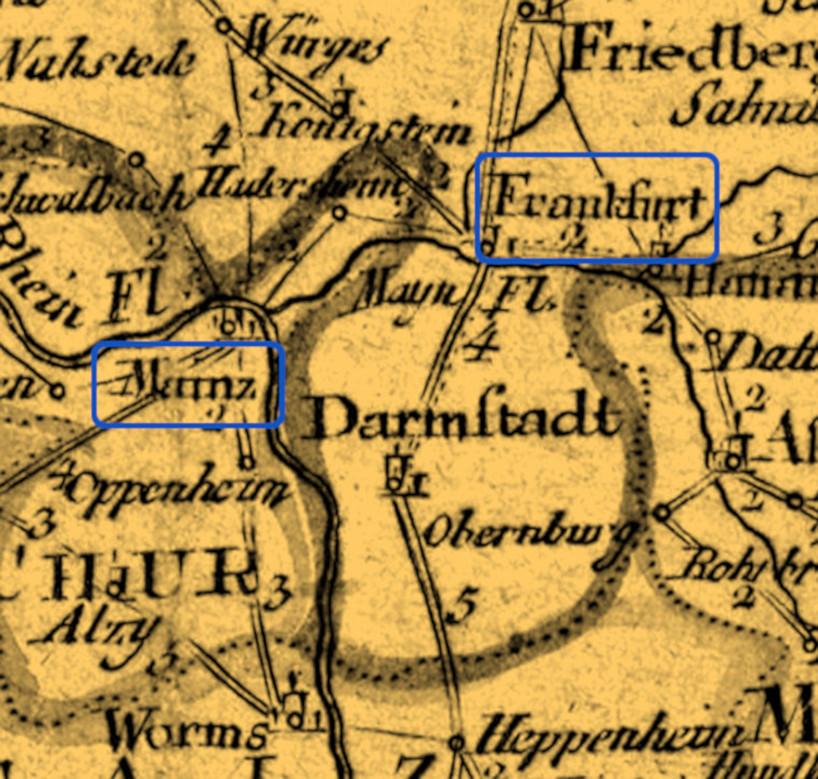
Mainz is located on the Rhine River at its confluence with the Main River, 30 km east of Frankfurt (Post Karte Durch ganz Deutschland, ed. J. Walch [Augsburg 1795]; illustration: Balthasar Frederic Leizel, Prospect von der Churfürstl. Residenz-Stadt Maijnz zwischen Rhein und Mayn von Bingen aufwärts anzusehen [ca. 1780]:

By early December 1791, Caroline had made up her mind to move to Mainz (see her letter to Friedrich Ludwig Wilhelm Meyer on 6 December 1791 [letter 111]). In a letter to his father-in-law, Christian Gottlob Heyne, on 10 January 1792, Georg Forster indicated that he and Therese were expecting Caroline to be traveling to Mainz at the end of January and were anticipating that she would be having additional personal belongings sent along in a separate transport, that is, presumably for a lengthier stay (Albert Leitzmann, “Ungedruckte Briefe Georg Forsters IV,3,” Archiv für das Studium der neueren Sprachen un Litteraturen 48 [1894], no. 93: 23–68, here 49).
In what follows, Erich Schmidt (1913), 1:692–96, provides what he calls “only a few brief comments and bits of information concerning Caroline.” The footnotes for this section are my own, following the lead of Schmidt’s cross references and the occasional need for clarity.
Schmidt (1913), 1:692, also supplies the following bibliography for the events in Mainz (the epistolary editions have been superceded):
(1) Forster’s correspondence as variously revised and augmented by Albert Leitzmann in Ludwig Herrig’s Archiv für das Studium der Neueren Sprachen und Litteraturen (Braunschweig 1890–94) 89 (1892), 15–32 (and subsequent).
(2) Ludwig Geiger on Therese Huber: Therese Huber. 1764 bis 1829. Leben und Briefe einer deutschen Frau (Stuttgart 1901); idem, Dichter und Frauen. Abhandlungen und Mitteilungen. Neue Sammlung (Berlin 1899); reviewed by Jakob Minor in Zeitschrift für die österreichischen Gymnasien 53 (1902), 40–49.
(3) Jakob Minor also reviews the anonymous play Die Mainzer Klubbisten zu Königstein. Ein tragic-komisches Schauspiel in einem Aufzuge. 1793, Deutsche Litteratur-Pasquille, ed. Franz Blei, vol. IV (Leipzig 1907), in Euphorion 15 (1908), 259–66 (see supplementary appendix Mainz Clubbists for the texts of both the play and the review).
(4) The various satires on this episode in Mainz history as enumerated in Goedeke 5:551 include Die Mainzer Klubbisten zu Königstein (see above) as well as an excerpt and synopsis of this latter play in Karl Cäsar von Leonhard, Aus unserer Zeit in meinem Leben, 2 vols. (Stuttgart 1854), 1:65–69.
(5) Rudolph Wagner, Samuel Thomas von Sömmerring’s Leben und Verkehr mit seinen Zeitgenossen (Leipzig 1844).
(6) The best French specialist, Arthur Maxime Chuquet, “Le révolutionnaire George Forster,” Études d’histoire, 2 vols., 1:147–288 (Paris n.d. [1903]), including a bibliography of earlier secondary literature concerning the Mainz Clubbists. Back.
[1a] In what at the time was the Grand Duchy of Lithuania, over 1000 km east of Göttingen and over 400 km east of Danzig, here with Danzig on the left, Königsberg at center, Vilnius (also “Vilna,” “Wilna”) on the right (Thomas Kitchin, A new map of the Northern States containing the Kingdoms of Sweden, Denmark, and Norway [London 1790]):

[1b] Strasbourg is located approx. 160 km upstream (i.e., south) of Mainz on the Rhine River (map: Post Karte Durch ganz Deutschland, ed. J. Walch [Augsburg 1795]; illustrations: [a] William Tombleson, Ober Rhein, vol. 2 [London 1834], plate preceding p. 63; [b] Strasbourg town gate [“Hospital Gate”] from G. C. T. Bartley, The Rhine: From Its Source to the Sea [London 1903], 81):


[1c] See esp. Therese Forster’s letter to Christian Gottlob Heyne on 22 March 1793 (letter 121a), note 16. Back.
[1d] Pontarlier is located approx. 240 km southwest of Strasbourg (Post Karte Durch ganz Deutschland, ed. J. Walch [Augsburg 1795]):

[2] Concerning her lost letters from this period, see Friedrich Schlegel to Wilhelm Schlegel on 23 October 1793 (letter 135e): “she gave me the letters she wrote from Mainz to Louise in Hamburg and to her mother.” Walzel, 127n1, identifies Louise as Caroline’s sister Louise Wiedemann (concerning Louise’s stay in Hamburg in 1792, see her autobiography, Erinnerungen, pp. 31–32), also mentioning that no letters to her mother were known except the one on 30 July 1791 (letter 104); Walzel then references Waitz (1871), 1:vii, fn1, where Waitz writes: “Luise Wiedemann wrote to Schelling in February 1817 and on 16 March 1818 that Caroline had asked her to send back the letters she had written Luise from Mainz and Königstein, assuring Louise that she would return them to her — something, however, she never did.” On 24 November 1793 (letter 136b), Friedrich writes to Wilhelm that “among a great many other letters, she also gave me yours to her in Mainz to read.” Back.
[3] Bollmann writes from Karlsruhe to his father on 6 September and 26 October 1791 (Friedrich Kapp, Justus Erich Bollmann. Ein Lebensbild aus zwei Welttheilen [Berlin 1880], 22, 24):
On the whole I am otherwise living here quite contented . . . My preferred social contacts are those in the Forster house. This Forster fellow is the same who sailed around the world with [James] Cook. His spouse is a daughter of Herr Hofrath Heyne in Göttingen. There is also another lady here from Göttingen who visits the house daily. I spend almost every evening with this family, where several very bright and interesting people are free to come and go as they please. . . .
These three [Georg and Therese Forster, Ludwig Ferdinand Huber] and a certain Madam Forkel from Göttingen, a woman about whom I would prefer to say nothing except that she is esteemed everywhere except Göttingen, where several malicious people have become her bitter enemies; she is judged with extraordinary inaccuracy because no one really can judge her who does not have a precise acquaintance with her past — she is a woman whom those other three dearly love and whose preeminent talent consists in an remarkable adroitness in dealing with others. So, these were the people in whose company I spent each evening. We would gather at 7:00 around a tea machine after finishing our work, quite in the English fashion, and would remain together until after 9:00. Back.
[4] Strodtmann, 3:225. Gottfried August Bürger published the following, insulting poem about his affair with Meta Forkel (“Fulvia” in the following lines), one whose references everyone in Göttingen would have recognized (Gottfried August Bürger, Bürgers Gedichte, ed. Arnold E. Berger [Leipzig, Vienna 1800], 365, no. 256; orig. Germ. title “Ebendeswegen”):
For Just That Reason
Fulvia, in town and country known,
Ingeniously does me accuse of disgrace, dishonor,
Wenching, and adultery in surfeit,
Noting, moreover, how oft I did burn out.
And yet — once when indeed she did o'ertake her goal
And, one might say, steal me off to tête-à-tête,
— Note bene having twenty times
Stolen up to me as puppies do
And futilely with her pleas me entreat,
Did I behave so mannerly indeed
That not e'en her mind did I touch.
Bürger also seems to have coined the nickname Furciferaria (deriving from Latin furca, “two-pronged fork”) by Latinizing the name “Forkel” in the sense of “fork.” In ancient Rome the term furcifer referred to slaves who were punished by having a fork-shaped (V-shaped) device fitted around their necks, their two hands then being attached to the ends. Bürger may also be equivocally alluding to her genitalia (Monika Siegel, “Ich hatte einen Hang zur Schwärmerey,” 84n31).
In his extended letter to Elise Hahn’s mother in February 1792 recounting Elise’s various marital infidelities, Bürger goes to considerable trouble to excuse his own previous affair with Meta (Strodtmann, 4:168n23; Gottfried August Bürger’s Ehestands-Geschichte: Geschichte der dritten Ehe Gottfried August Bürger’s: Eine Sammlung von Acten-Stücken [Berlin, Leipzig 1812], 153–54n* [Bürger’s own footnote]):
As you doubtless know, I had not forgotten my own former libertine escapades, though it was both impossible and truly superfluous to adduce every single fact in my written confession in question. But it was with loving frankness that I revealed to her [Elise Bürger] in person whatever occurred to me on this or that occasion. Everything I and my friend Doctor A[lthof] were able to reveal about the alleged unpleasant discoveries she [Elise Bürger] made consists in a single, earlier, intimate relationship with a shady, disreputable married woman [i.e., Meta Forkel] here [in Göttingen] whose company, however, I wholly renounced almost four years ago after becoming convinced she was in fact a dissolute woman capable of carrying on a half dozen love intrigues at the same time.
Friedrich Ludwig Wilhelm Meyer writes to Bürger on 14 April 1789 from London (Strodtmann, 3:225):
As far as Furciferaria is concerned — whom I admittedly do not really like; she has always seemed too dirty to me [in the sense of housework, as he indicates in a later paragraph] and never knew how to dress — I nonetheless cannot really share your opinion. That she loved and enjoyed several men at once quite harmonizes with my own principles; I do the same thing as well as I am able and know how, and I confess I find such pleasurable contentment in it that, since I have learned about this [concerning her], I have even developed a certain esteem for her. Back.
[5] The route from Mainz to Gotha and Göttingen by way of Mannheim: Mannheim is located 70 km south of Frankfurt at the confluence of the Rhine and Neckar rivers. Caroline and her traveling companions presumably took the longer, out-of-the-way route south to Mannheim to avoid Prussian troops directly opposite Mainz; the postal route would then lead directly north to Frankfurt and thence 170 km northeast to Gotha. —
Here also are the other locales mentioned in the following discussion, namely, Gotha, Oppenheim (ca. 18 km almost due south of Mainz on the same [west] side of the Rhine River), and Hattersheim (Hadersheim on the map; ca. 17 km northeast of Mainz on the north side of the Main River) (Post Karte Durch ganz Deutschland, ed. J. Walch [Augsburg 1795]):


[6] Samuel Thomas von Sömmerring mentions these events and circumstances in his letter to Christian Gottlob Heyne on 6 April 1793 (letter 121d). Back.
[7] Samuel Thomas von Sömmerring to Christian Gottlob Heyne from Frankfurt on 6 April 1793 (letter 121d). Back.
[8] Not identified, though she is included among the characters of the satirical play The Mainz Clubbists in Königstein as “Citizen Madam Essbeck, formerly of the nobility, now Club lector.” Back.
[9] Ca. 25 km northeast of Mainz and 15 km northwest of Frankfurt, here along with Kronberg mentioned next and Hattersheim (Hadersheim), where Caroline and Auguste would be taken after Caroline was detained and before Königstein (Bibliographisches Institut von Leipzig, Umgebung von Frankfurt [1894]):

[10] Ca. 3 km due east of Königstein and just outside Frankfurt (see note 9 above); Caroline spells it Kronenberg. Back.
[11] To Christian Gottlob Heyne, Forster’s Briefwechsel mit Sömmerring, 620; Hofrath Böhmer from Werstatt is not otherwise identified. Back.
[12] Ludwig Geiger, “Aus Therese Hubers Herzensleben,” Westermanns Illustrierte Deutsche Monatshefte 94, no. 563 (August 1903), 681. Back.
[13] Chuquet, “Le révolutionnaire George Forster,” Études d’histoire, 229, suggests Caroline may have feared having Auguste taken from her by her in-laws, the Böhmers. Back.
[14] Presumably the représentants en mission, commissioners sent out to cooperate with local Jacobin clubs and revolutionary committees to suppress counterrevolutionary movements. The National Convention itself, the longest lived of the revolutionary assemblies, was in power in France between 21 September 1792 and October 1795. Back.
[15] Weimarer Ausgabe 33:305; Campaign in France in the Year 1792, trans. Robert Farie (London 1849), 335: “He was a tall, well-formed, slender man, of middle age, very natural in his bearing and deportment.” — Landau in der Pfalz, since 1709 part of France, is located ca. 95 km south of Mainz (Post Karte Durch ganz Deutschland, ed. J. Walch [Augsburg 1795]):

[16] Chuquet, “Le révolutionnaire George Forster,” Études d’histoire, 229. Back.
[17] The first illustration below depicts the processional through the streets of Mainz on 3 November 1792 preceding the initial planting of the “freedom tree; note the women and other citizens viewing from house windows much as doubtless Caroline and Auguste also did (anonymous late-eighteenth-century engraving):

The second illustration depicts the planting of the second “freedom tree” on 13 January 1793 (Gespräch eines Juden zu Lassel bey Maynz mit einem eingebildeten Freyheits-Mann über den Freyheitsbaum im Jänner 1793; Herzog August Bibliothek; Signatur Graph. C: 152) and (sidebar) a color illustration of the tree (Revolutions-Almanach von 1794; Inhaltsverzeichnis deutscher Almanache, Theodor Springmann Stiftung):

The “ball of freedom and equality”: The third illustration is the only known illustration of a “ball of freedom and equality,” which in this case was intended as a celebration for all the residents of Mainz after the planting of that tree (Nürnberg, Germanisches Nationalmuseum, Graphische Sammlung, Inventar-Nr. HB 28023; same illustration also in Paul Schreckenbach, Der Zusammenbruch Preußens im Jahre 1806 [Jena 1906], 74):

Several features suggest the illustration was intended as a satire: The women are wearing sashes with slogans, the men (some of whom are obviously French soldiers) cocardes in their hats. A French general, perhaps Custine himself, is directing the musicians. The dance involves some risqué embracing by couples (including, to the left, a couple in the shadows not dancing), one woman has already lost a shoe, and two drunken men have collapsed on the floor. Such balls regularly concluded freedom celebrations during the French Revolution and often included the carmagnole.
The birthday of Caroline’s son, Wilhelm Julius Krantz (in reality: Böhmer), on 3 November 1793 dates the “ball night” to approximately 3 February 1793; see, however, Caroline’s curious remark (with its accompanying note) in her letter to Friedrich Schlegel on 13 October 1793 (letter 135cd). Back.
[18] Therese Huber to Therese Forster on 17–25 July 1803, Geiger, Dichter und Frauen 2:89; Therese Huber Briefe, 422 (letter 380b in present edition). Back.
[19] See also Therese Huber to Therese Forster on 3 September 1803; Geiger, Dichter und Frauen, 2:95; Therese Huber Briefe, 428 [letter 380h]: “Madam Liebeskind . . . recalled an orgy in Mainz where Caroline had danced the Carmagnole with the French, the same evening that preceded the night when, according to her admission, Crancé brought about an event that was quite important for his honor.” The Carmagnole was a song created and made popular during the French Revolution based on a dance of the same name; it originated in August 1792 and was sung as a rallying cry or as entertainment among groups of pro-revolutionaries; see the supplementary appendix La Carmagnole. Back.
[20] Reprinted as Die Mainzer Klubbisten zu Königstein, oder Die Weiber decken einander die Schanden auf, issue 4 of Deutsche Litteratur-Pasquille, ed. Dr. Franz Blei (Leipzig 1907). Translated in full in this edition along with Jakob Minor’s review in Euphorion 15 (1908), 259–66, supplementary appendix Mainz Clubbists. Back.
[21] As a native of Göttingen, Caroline was a subject of the Electorate of Hannover. See the chapter on Lower Saxony in the supplementary appendix on Germany in the late eighteenth century, esp. the section on the elector of Hannover. &mdash
Concerning Sophie Bethmann’s mediation, see Luise Wiedemann’s Erinnerungen, specifically her chapter on Caroline, p. 81. Back.
[22] See Friedrich to Wilhelm Schlegel on 5 December 1791 (Walzel, 29; KFSA 23:33 [letter 110a]); and in January 1792 (Walzel, 31–32; KFSA 23:38 [letter 111a]). Back.
[23] Ludwig Geiger, Dichter und Frauen, 2:90; Therese Huber Briefe, 422–23 (letter 380b). Back.
Translation © 2011 Doug Stott