
• 246. Caroline to Luise Gotter in Gotha: Jena, 5 October 1799
Jena, 5 October 1799
|559| My dear, best, ever beloved friend — and such you are even were I forced to be silent for years. |560| And I have indeed had to be, as Madam Seidler can tell you, for she quite knows how things have been with me. [1]
Although I have experienced a thousand joys from it all, I have had not a single moment of peace and quiet for fully three months now. [2] It has also genuinely taken its toll on me, and as soon as our friends left, medication had to step in the breach, and I have become thoroughly soured on it all. As soon as I saw your handwriting, I quietly laid the letter aside and was thoroughly depressed, since I had wanted to write you, wanted with all my power, and yet could not.
Indeed, since I received your letter another week has passed during which the entire house has been rearranged from top to bottom, an enormous load of wash done, curtains hung until I almost passed out. [3] And I really do miss Auguste’s help now as well; as you probably know, she is in Dessau with our good friends, the Tischbeins, though her heart has remained here with her mother. The Tischbeins themselves share her longing for Jena, where things went just delightfully during their stay. What convivial, merry, musical days we all had! I also had the great joy of seeing to it that my mother’s stay here was quite pleasant. [4]
First Tieck from Berlin (an extremely charming young man) and Hardenberg came; they stayed with us for two weeks. [5]
Then the Braunchschweig contingent arrived, including my mother, sister, brother-in-law, one child, and a maidservant. Luise’s child is an angel; never has such a loveable, impertinent look of curiosity been seen on a child’s face. Luise herself, though, is not as radiant and healthy as earlier; the two children have taken a lot out of her, particularly the pain caused by the one, which in its own turn makes her excessively anxious about the other. [6]
A week later Madam Tischbein arrived with a little boy a couple of years old and similarly with a maidservant. Her two daughters were staying in Weimar with the Bertuchs and |561| only occasionally came over to Jena until the Braunchschweig contingent left, [7] then they, too, stayed with me. I tried to arrange it such that everything went smoothly. Of course, the three young girls, Caroline, Betty, and Auguste, made a frightful noise, and their room was quite ill kept, but what bliss being able to watch these cheerful creatures!
Betty is a jewel who inevitably delights everyone; nor is it merely her magnificent musical talent and the completely original cast of her entire disposition. There is also such goodness and naturalness in all that she does that one cannot but envy her mother for having such a child. Caroline’s voice has developed considerable power; [7a] we had a couple of concerts that were simply splendid and during which she and Betty sang arias, Auguste duets and trios with them, and finally their mother chorales with her two daughters.
How I wished that everyone I hold dear might have taken part, that I might have been able to whisk all of you over here, magically, if but for a short time. Surely you can see how enthusiastic even I myself was with it all. [8]
It has been three weeks now since these guests, too, left us. [9] At that time, I had 15–18 guests each day for the midday meal, but since my cook is good and I attentive, everything went excellently. [10] To our great delight, my brother-in-law also arrived unexpectedly from Berlin. Auguste, prompted by friendship and by her love of music, went along back to Dessau.
As things would have it, though, there was no sign of emptiness here and certainly no end to the parade of guests. The day after tomorrow, for example, I am expecting a sister-in-law from Göttingen, the Hoppenstedts. You will probably hear about them in Gotha. If I am not mistaken, their company will include a daughter of Madam Glockenbringk.
A woman from Berlin, moreover, will be moving into the parlor downstairs, one of Mendelsohn’s daughters, a very decent woman whose arrival I am expecting any day now [11] and who |562| will also be eating with us. Tiek from Berlin will also be moving to Jena for the winter with his wife, and they, too, want to take their meals with us. One part of my previous company did, however, depart today amid mutual laments of woe, namely, Paulus.
So, there you have a rather dry outline of my busy life. And now let us speak about other business. Iffland simply has not gotten in contact with us at all, though I will immediately and urgently admonish him with regard to his promise to you, a promise he may well disregard but will surely not break. [12] On 10 October Schlegel’s Hamlet will be performed in Berlin. Although we were supposed to be going, it simply became too much for me for every conceivable reason. [13]
Now I have a proposal for you regarding Auguste. I cannot bring myself to have her confirmed here, that is, to have her take the required instruction for it here. [14] The pastors here are such that a child of Auguste’s reflective nature would inevitably often simply feel insulted, and this brief torment, too, I would like to spare her.
Hence my idea was to entrust her to you and Löffler for that time. I would very much like for you to speak to Löffler about it. I know not what your living arrangements are or whether Löffler himself even does this sort of thing now. Although I seem to recall that if she is living with you she would have to be confirmed by the senior court pastor, perhaps it could be arranged such that one could say she were with your parents. Or perhaps this is not even something non-residents have to observe.
In any case, please write and let me know whether this plan might be implemented. I am interested only in the simplest instruction that might be completely finished in 6 weeks, and if Herr Löffler is otherwise inclined to entertain my wishes, I am certainly willing to |563| come to an understanding with him in this regard. Please let me know, the sooner the better. What has Löffler been doing? Do you see him occasionally? [15]
Madam Seidler has had to tell me everything she heard about Gotha. I asked often about our dear Cécile and heard basically the same thing you yourself have written to me. May I soon be able to embrace her and know that she is healthy and recovered! [16] If the plan with Auguste turns out to be possible, I will be seeing all of you in the spring.
Regards to my dear Minchen. Her longing did not, however, bring her to Jena after all; she seems to be captivated by her circle of friends in Gotha. How nice it would have been had she been able to live with us during this recent period and participate in all our activities and traverse the countryside with us — for let me tell you, we have left not a single castle in a 3-mile radius untouched. [17] . . .
Let me entreat you, my dear, to pay a special visit to Madam Schläger to tell her bit about how I am doing — I cannot write more this time. Is she doing tolerably well? Tell her we are doing exceptionally well, that we are living amid wonderful conviviality, and that the spring will surely occasion journeys again. [Errand requests.]
Please remember me to your housemates. Let me embrace the children to my heart with all my former love just as I do you. Forgive my silence and continue to love
Your Caroline
Notes
[1] Presumably Elisabeth Sophie Seidler, two of whose sisters were married and living in Gotha (Christiane and Anna Caroline). She would in any case be sending her daughter Louise Seidler to Gotha to Luise Gotter’s mother’s boarding school in early 1800 because of the death of Louise’s grandmother in 1799, Marie Elisabeth, née; Pyrner, with whom Louise had lived in Jena since she was five years old (Erinnerungen der Malerin Louise Seidler, ed. Hermann Uhde, new edition [Berlin 1922], 9, 13). Back.
[2] Although Caroline enumerates all the guests and activities that had (and continue) to occupy her in Jena during this period, she similarly bemoaned the toll it was taking on her in the initial paragraph of her earlier letter to Auguste on 30 September 1799 (letter 245), with note 1. Back.
[3] Among other things, Caroline was preparing for the arrival of Dorothea Veit the following day, who would be moving into the house at Leutragasse 5 with her son, Philipp Veit. She generally enumerates the same domestic activities in the previously mentioned letter to Auguste on 30 September 1799 (letter 245), where she also mentions that the physician treating her was Justus Christian Loder. Back.
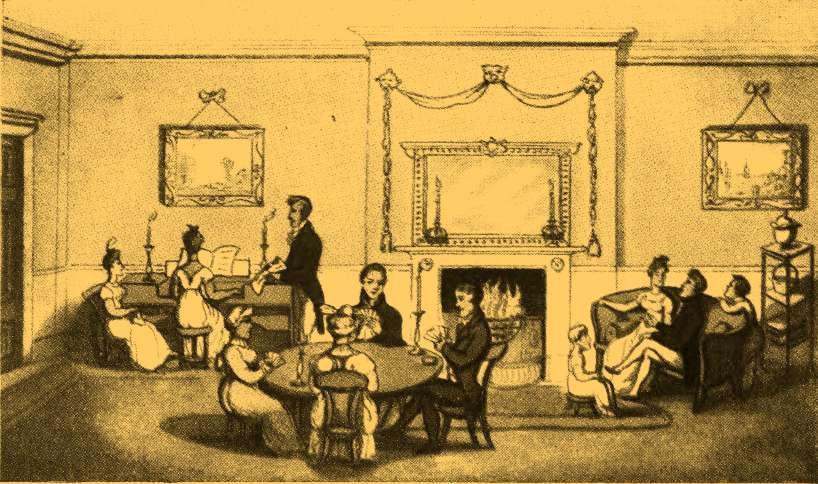
[4] Caroline’s mother had come for a visit along with Caroline’s other relatives from Braunschweig, after which the Tischbein daughters then came over from Weimar to join their mother; both daughters were musically inclined (illustration by T. Rowlandson, in Alfred Burton, The adventures of Johnny Newcome in the Navy; a poem, in four cantos orig. pub. date 1818 [London 1904], illustration following p. 180):
See also below. Back.
[5] Ludwig Tieck and Friedrich von Hardenberg had both arrived in mid-July; concerning their visit, see Wilhelm Schlegel’s letter to Goethe on 19 July 1799 (letter 242a) with note 3 (with a reference to supplementary appendix 242a.2). Back.
[6] Concerning the early death of Luise’s first child, see the account in her memoirs. Back.
[7] Caroline Wilken, née Tischbein speaks about her and her sister’s visit with the Bertuch family in Weimar in her memoirs, remarking that “to be honest, I believe the Bertuchs [in Weimar] were not particularly sad to be rid of their little guests; nor, however, was I myself sad, and was happy to be leaving a household where I encountered more prose than my own personality could bear.” Back.
[7a] The Schlegels were acquainted with the daughters from having visited the Tischbeins earlier; see supplementary appendix 181c.1. Back.
[8] “Fühlst Du vieleicht [sic], was dem Entfernten fehle,” Almanach der Musen und Grazien, ed. F. W. A. Schmidt (1802) (Inhaltsverzeichnis deutscher Almanache, Theodor Springmann Stiftung):

See esp. Caroline Wilken’s, née Tischbein, memoirs of the Schlegels in Jena. Back.
[9] Likely on 14 September 1799; concerning the chronological questions involved in the Tischbeins’ departure with Auguste, see the editorial note to Caroline’s letter to Auguste on 16 September 1799 (letter 244). Back.
[10] Although the following illustration depicts a wedding-reception dinner gone slightly awry, its element of convivial chaos likely similarly resembles the midday meal at the Schlegels’ during this period (Berlinischer Damen-Kalender auf das Gemein-Jahr 1805):

Caroline’s estimated number of “15–18 guests” derived not least from the unusually large number of out-of-town guests. That said, the common midday meal at the Schlegels was nonetheless a fixture during most of this period. Caroline had, however, remarked earlier in her letter to Luise Gotter on 6 June 1799 (letter 239) that “I do have a very good cook” (J. E. Gailer, Neuer Orbis Pictus für die Jugend oder Schauplatz der Natur, der Kunst und des Menschenlebens, 5th ed. (Reutlingen 1842), plate 123):

Such crowded meals, however, were quite in contrast to later, after so many of the professors had left for positions elsewhere and Jena itself, along with the university, had become considerably quieter. See H. E. G. Paulus’s later remarks on that development.
See similarly Lorenz Oken’s letter to Schelling on 3 September 1808; at the time, Oken was teaching in Jena (Alexander Ecker, Lorenz Oken. Eine biographische Skizze. Durch erläuternde Zusätze und Mittheilungen aus Oken’s Briefwechsel vermehrt [Stuttgart 1880], 202–3; translation from Lorenz Oken. A biographical Sketch. With explanatory notes, selections from Oken’s correspondence, and a portrait of the professor, trans. Alfred Tulk [London 1883], 117–18; translation altered):
In other respects I am very comfortable in my surroundings, though I suffer somewhat from my sedentary habits. My circle of acquaintances consists of Frommann, Seebeck, Knebel, and the privy-councillor Stark [whose daughter Oken eventually married]. I meet young Voigt in the botanical garden, and at times Dr. Majer.
Yet I have no one, alas! with whom I can go about as a comrade; so that I go out walking very seldom, lecture up to five o’clock, and then, all my acquaintances are flown. I have, too, nobody with whom I can converse concerning my own discipline; in short, there is no longer any scholarly intercourse here, as it may have been in your time. I eat my meals at home, and there is not a single social [i.e., common] table to be met with.
Oken wrote similarly to Schelling on 3 February 1809 (Eine biographische Skizze, 206; A biographical Sketch, 123, translation altered):
The Jena residents are a crabbed lot of pedants. Just imagine, I have sent all through the town to find some one who would go with me to Weimar; but not a soul goes to the redoute. It is just the same with the theater. Frommanns, Seebeck, Luden, Gries, and myself are the only ones in Weimar who occasionally give any sign of being alive. Madame Schopenhauer’s “teas” are very charming. Back.
[11] As mentioned above, Dorothea Veit would arrive with her son Philipp Veit the next day, 6 October 1799. Back.
[12] At issue is Iffland’s promise to acquire and perform some of Friedrich Wilhelm Gotter’s posthumous theater pieces; see Caroline’s letter to Luise Gotter on 2 May 1798 (letter 200), with note 4; to Luise Gotter in June/early July 1798 (202), with note 1; and on 24 October 1798 (letter 206), with note 10. Back.
[13] Concerning the background to the performance of Hamlet in Berlin on 15 October 1799, see Ella Horn’s essay. Back.
[14] Caroline has already brought up this topic in her letter to Auguste herself on 30 September 1799 (letter 245). Caroline’s plan is to have her take such instruction in Gotha (Post Karte Durch ganz Deutschland, ed. J. Walch [Augsburg 1795]):

[15] As it turned out, Auguste took confirmation instruction in Jena during the winter of 1799–1800 after all with Christian Oemler (see Caroline’s letter to Auguste on 30 September 1799 [letter 245], with note 18); her companion during this instruction was Louise Seidler, who recounts their amusing experiences in her memoirs (for which see Caroline’s letter to Auguste on 28 October 1799 [letter 252], in which Caroline resolves to have Auguste confirmed in Jena after all). Back.
[16] Cäcilie Gotter had apparently been ill enough to be visiting a mineral springs spa, something Caroline mentions in her letter to Auguste on 30 September 1799 (letter 245). Back.
[17] An intriguing statement insofar as Jena offered several such excursion destinations; regrettably, Caroline regrettably says nothing more about these excursions. See in any case Friedrich Schlegel and Dorothea Veit’s letter to Wilhelm Schlegel on 25 August 1800 (letter 266b), esp. with notes 2 and 2a. Back.
Translation © 2013 Doug Stott