
• 202. Caroline to Luise Gotter in Gotha: Dresden, late June/early July 1798
[Dresden, late June/early July 1798]
|452| My dearest Louise, we are really quite worried that something may have happened to you, and I particularly long to hear something about Cecile’s health.
Der schöne Geist had not yet arrived in Berlin, otherwise Iffland would have told my husband. What is the reason? [1] The Geisterinsel will be performed in Berlin according to Reichard’s composition on the day of tribute, 6 July. [2] Schlegel was at the rehearsal and found the music quite radiant and romantic. [3] Fleischmann cannot complain, since they did at least buy his music in B[erlin]. [4]
Schlegel and Iffland have grand plans together; Hamlet is to be given in its entirety in Schlegel’s translation — if this comes about around Michaelmas, then we will surely be returning by way of Berlin. [5]
Our little friend was very pleased with things there and was himself pleasing to a great many people — You would not believe how he was fêted by men, even by ministers, by women, even actresses. He also left behind a splendid poem of tribute [6] and several tender sighs to Iffland and the Diaboline Unzeline. I will send them to you by the by. [7]
Please give my warmest regards to Mother Schlegel [Schläger], and Wilhelmine. You can imagine how my time is enormously tight just now. Moreover I am also drinking Egerbrunnen and am not permitted to sit much. [8]
Madam Iffland must be an extraordinarily good woman, as Schlegel, too, has confirmed for me after seeing her almost daily for 5 weeks. [9]
Our address is to Madame S[chlegel] in care of Court Secretary Ernst. The post office will know the rest. Our house is a delectable place. Schlegel also brought his brother Friedrich along. [10] |453| Hardenberg, the favorite of us all, and visits us often.
Stay well, and write soon.
Notes
[1] At issue are Friedrich Wilhelm Gotter’s posthumous theater pieces. Concerning the disposition and fate of these pieces, see Caroline’s letter to Luise Gotter in March 1797 (letter 181) with note 2 and esp. also supplementary appendix 181.1 and supplementary appendix 107a.1. Back.
[2] The official “homage” to Friedrich Wilhelm III in the White Hall of the Berlin Castle took place on 6 July 1798. Back.
[3] Wilhelm recounts having attended this rehearsal in his letter to Gottlieb Hufeland on 1 July 1798 (letter 201d); indeed, he uses Caroline’s precise wording in describing the music. Back.
[4] Concerning Friedrich Fleischmann’s role in the history of the composition of the music for Gotter’s Die Geisterinsel, see supplementary appendix 107a.1. Back.
[5] Friedrich wrote to Schleiermacher later (mid-August 1798) (Aus Schleiermacher’s Leben 3:89; KFSA 24:163; KGA V/2:393): “Things do not yet seem to be settled with regard to Hamlet, and thus also not with Wilhelm coming to Berlin” (Friedrich repeats essentially the same message in several other letters during this period as well).
See in general Ella Horn concerning the background to the premiere of Hamlet in Berlin. As it turned out, Caroline, Auguste, and Wilhelm did not return to Jena by way of Berlin (Post Karte Durch ganz Deutschland, ed. J. Walch [Augsburg 1795]):

[6] “Am Tage der Huldigung. Berlin 6. Juli 1798,” Jahrbücher der preussischen Monarchie unter der Regierung Friedrich Wilhelms des Dritten (1798) 2 (May, June, July, August) 266–68 (Sämmtliche Werke 1:160–61). See the translation of Wilhelm’s poem of homage to Friedrich Wilhelm III. Back.
[7] For the text of Wilhelm’s various poems to Friederike Unzelmann, see section VII of the supplementary appendix Friederike Unzelmann.
Over the course of the next several years, Wilhelm’s intimate relationship with Friederike Unzelmann, though not just with her, became a source of varying degrees of irritation for Caroline (Göttinger Taschen Calender Für das Iahr 1796; Inhaltsverzeichnis deutscher Almanache, Theodor Springmann Stiftung):

That said, Caroline never really viewed Friederike Unzelmann as a serious rival for Wilhelm’s affections, and in any case later remarks unequivocally in a letter to Julie Gotter on 18 February 1803 (letter 375) that her and Wilhelm’s marriage was “an alliance that the two of us otherwise never viewed as being anything but completely free.” See on the other hand the supplementary appendix on Caroline’s Rival: Elisa van Nuys. Back.
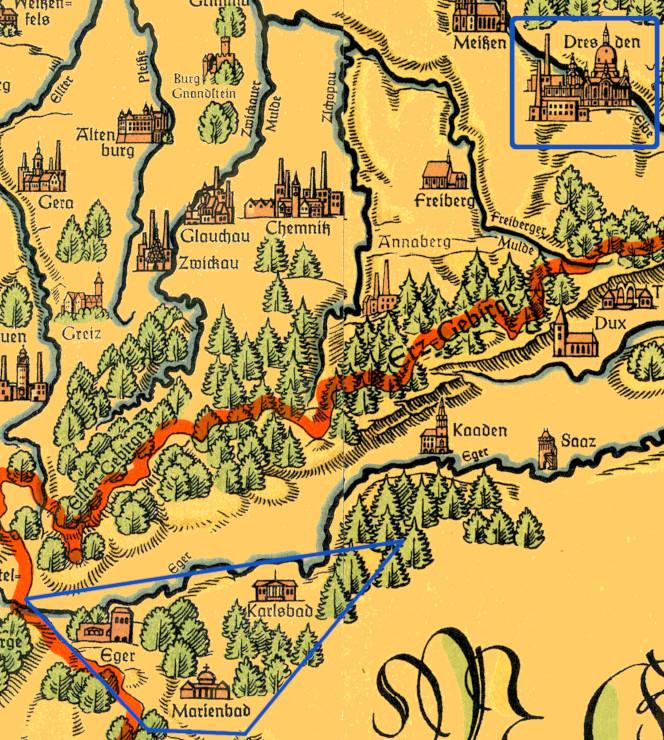
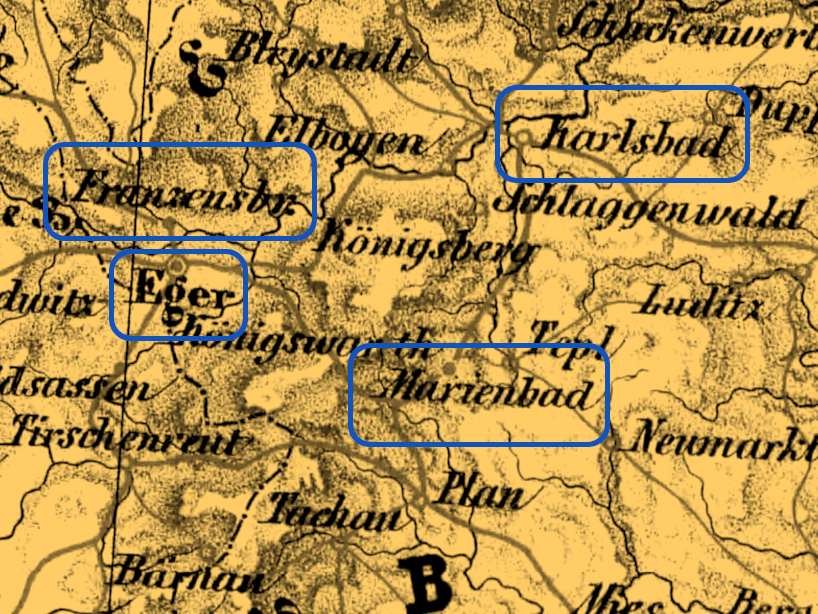
[8] Egerbrunnen, later Franzensquelle or Franzensbrunnen, a mineral spring in what was eventually known as Franzensbad in western Bohemia (modern Františkovy Làzně, Czech Republic, just north of Eger; ca. 150 km southwest of Dresden), a famous spa where mineral-spring cures were first introduced in Germany in the sixteenth century.
The area is known as the “mineral-springs spa triangle” because of the proximity of Franzensbad (and Eger), Marienbad, and Karlsbad (first map: Rudolf Koch and Fritz Kredel, Deutschland und angrenzende Gebiete [Leipzig 1937]; second map: Generalkarte von Europa, ed. Joseph Scheda [Vienna 1845–47]; David Rumsey Map Collection, David Rumsey Map Center, Stanford Libraries; abbreviated as Franzensbr[unnen]):
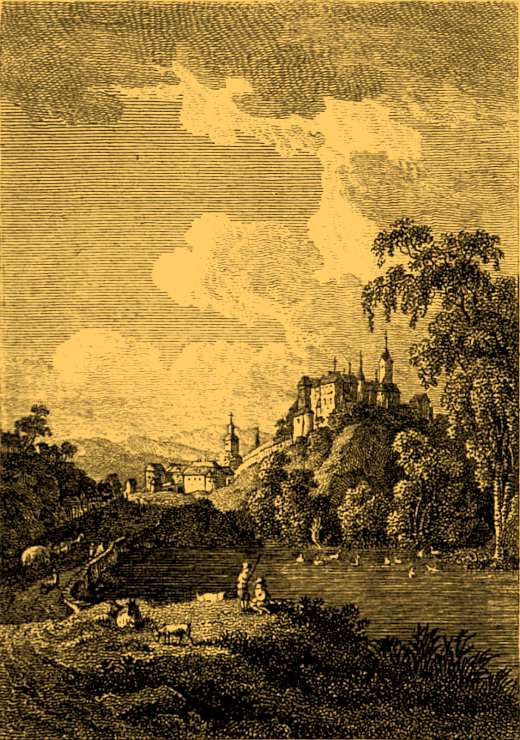
Here Eger in 1810 (Taschenbuch zum geselligen Vergnügen [1810]):
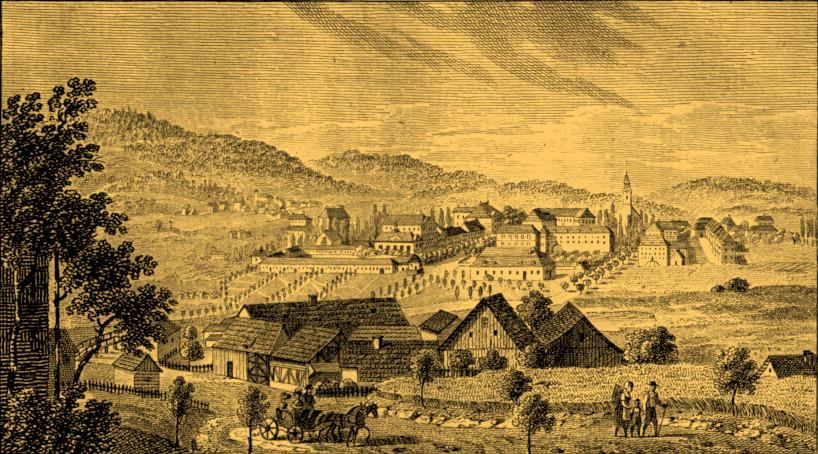
Here Franzensbad in 1822 (Emil Osann and Johann Bartholomäus Trommsdorff, Die Mineralquellen zu Kaiser-Franzensbad bei Eger. Historisch-medicinisch dargest. [Berlin 1822], plates following p. 18, 22):
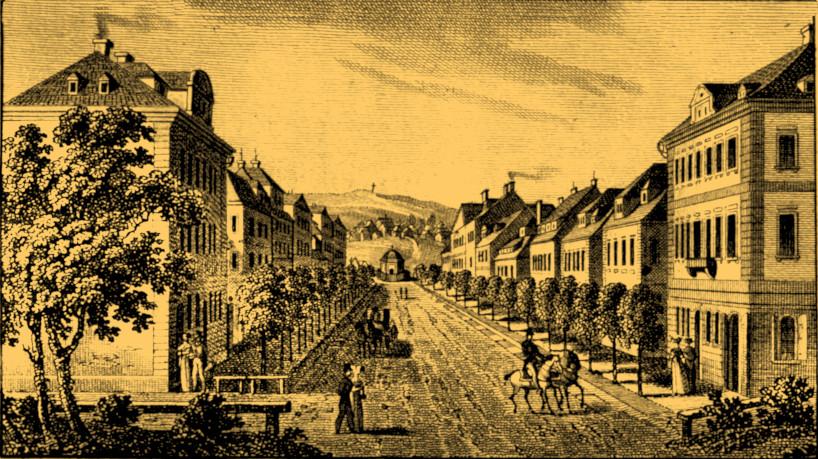
The name of the spring doubles as the name of the water; see Augustus Bozzi Granville, The Spas of Germany, 2 vols. (London 1837), 149–50 (illustration of the mineral spring: frontispiece to Lorenz Koestler von Strohmmberg A Treatise on Eger-Franzensbad Its Mineral Waters and Its Cron-salt-moor, 9th ed. [Prague 1858]):
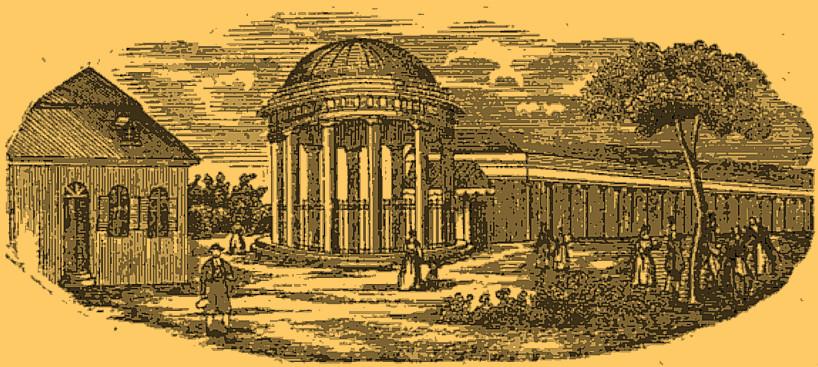
Its temperature, which has never been known to vary, either in summer or during the severest winter, is 53° Fahrenheit. As I stood watching the spring its surface appeared to be in a continual commotion; numberless bubbles of gas ascending from the bottom through the water, and bursting when they reached the surface.
On dipping my glass into the water I found it of the purest limpidity, pervaded in all directions by small gas-bubbles, many of which adhered to the glass. Exposed to the air for some hours, in an open vessel, it loses its transparency, becomes turbid, and, at the end of five or six days, it deposits the yellow carbonate of iron.
The presence of this mineral in the spring may be detected by the après-gout of the water, which, though piquant, pleasant, and refreshing when first tasted, leaves afterwards a ferruginous indication on the tongue. Mixed with sugar, or with a little wine and sugar, it forms a most agreeable beverage, and effervesces like champagne mousseux.
The quantity of carbonic acid gas in the water is equal to one hundred and fifty-four cubic inches for every hundred cubic inches of the water. Except those of Geilnau and Pyrmont, no mineral spring, among those frequented in Germany contains so much free gas as the Franzensquelle. The predominant saline ingredient is the sulphate of soda, or Glauber salt, of which there are twenty-five grains in sixteen ounces of the water, with nearly eight and a half grains of muriate of soda, or common salt, and the same quantity of bicarbonate of soda.
Here the main street ca. 1837 (ibid., 149); the writer Franz Kafka would vacation here with his family during the first part of the twentieth century:
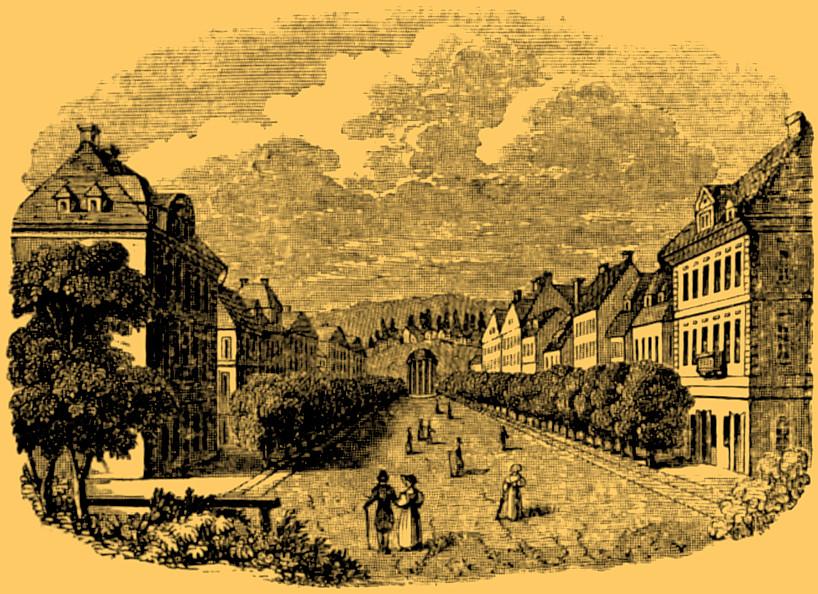
[9] The relationship between the Ifflands and Schlegels became increasingly tense over the coming months; see the supplementary appendix on the background to the premiere of Hamlet mentioned in note 5 above and esp. Luise Iffland’s letter to Caroline on 8 September 1798 (letter 202i), in the latter also a catty allusion to Wilhelm’s relationship with Friederike Unzelmann. Back.
[10] See Friedrich to Schleiermacher in August 1798 from Dresden (Aus Schleiermacher’s Leben 3:87; KFSA 24:161; KGA V/2:385): “I am once again harmonizing excellently with Caroline. Her sensibility for love has reestablished our mutual relationship to the extent it is both good and beautiful.” Concerning their tense relationship, see Friedrich’s letter to Wilhelm from Berlin on 6 March 1798 (letter 198). Back.
Translation © 2012 Doug Stott