
• 245. Caroline to Auguste in Dessau: Jena, 30 September 1799 [*]
[Jena] 30 September [17]99
|556| You sweetheart! How perfectly delighted I was to get your letter, and yet your poor, wicked mother is only today getting around to answering! You would not believe how busy I have been during the past week, and sick as well, since all my walking and running about, which I used to like to do so much, has finally come home to roost. [1] |557| Dear Loder had to prescribe something for me.
But now the entire house has been cleaned and redecorated. I had an enormous load of wash to do, and had to hang about 20 curtains. The new sofa has also been arranged, and everything looks very nice indeed; our small parlor with the Fromman’s little sofa is especially attractive. Friedrich is living for you like the most favorably apanaged prince. [2]
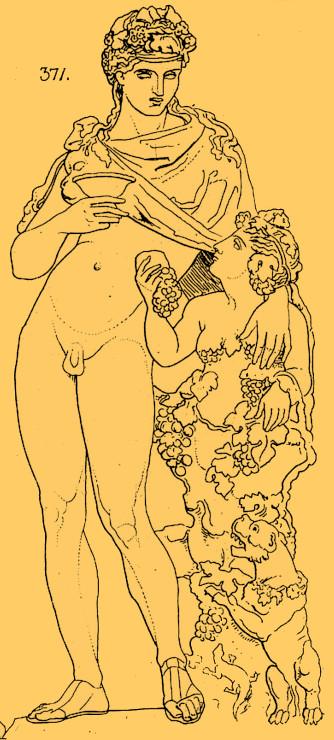
This evening we 3 will be having dinner at Schelling’s so we can help him initiate his new nest. [3] He is pleased that you have appointed him Bacchus by calling him the Giver of Wine; soon he may also be called the Giver of Joy, for he is gentle and amiable and jocular, and he wanted me to tell you he would prefer it if upon your return you did not act like a coy little half-mamsell toward him. [3a]
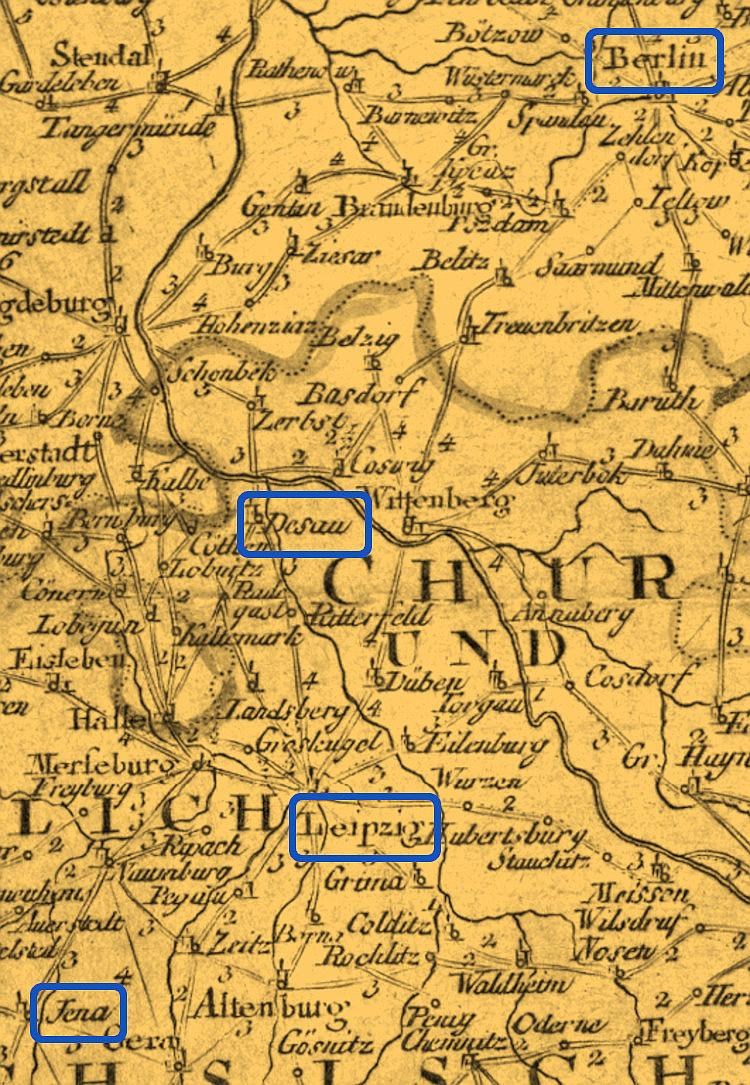
Wilhelm composes a poem each morning. [4] Friedrich spends every day doing nothing — except waiting for Madam Veit, who will not be coming by way of Dessau. [5] We were planning to pick her up in Leipzig the day before yesterday, Friedrich and I, when we suddenly got new instructions yet again, though she will surely be coming next week.
Hardenberg arrived suddenly the day before yesterday but only stayed until yesterday after the meal, which was fine, since this time I truly could not stand him; he said some really tasteless things to me and seems disposed in a way suggesting that — I would bet on it — he prefers Madam Tiek to me. [6] Only imagine, child! we do not yet know when they will be coming, though probably soon. [7] —
We have taken some immoderately long walks recently, from 2:00 to 7:00 is the usual im-moderation. Wilhelm claims he will not be going out with us anymore, insisting he will otherwise end up walking his legs off; and since he had to walk back and forth with Goethe all of last week, every morning from 10:00 to 1:00, it is probably reasonable for him to rest now during the afternoons, flat on his back. Goethe went through all his poems with him, that is, through all of Goethe’s own poems, of which a new volume |558| is being published, and was remarkably gracious to him. [8]
Griesette had reason to be unhappy a week ago, since Schiller invited him for the same evening that Goethe and Schelling were there and yet he was already at the Frommans’ with us, where the evening really did turn out rather dismal. But yesterday he had reason to be happy after all, since he was invited again and effectivement did go. [9] He comes by here almost every day for lunch, though I must remark that considerably more goes into his mouth than comes out.
Corona showed up again, and now 2 elderly demoiselles are suffering from ennuy. [10] Although the saying is that deux afflictions mises ensemble font une consolation, [11] two ennuys certainly never manage to add up to one amusement.
The Loders are gone. He is still here and is completely obsessed with Poland. [12] A gleaming neck buckle is his latest aquisition. This morning he gave a dejeuner in the museum — Schlegel also attended — in honor of several Portuguese, the former envoy Aranjo, and the Jewish banquier Cappeadoce from Amsterdam along with his wife, [13] whom Madam Tischbein might know. [14]
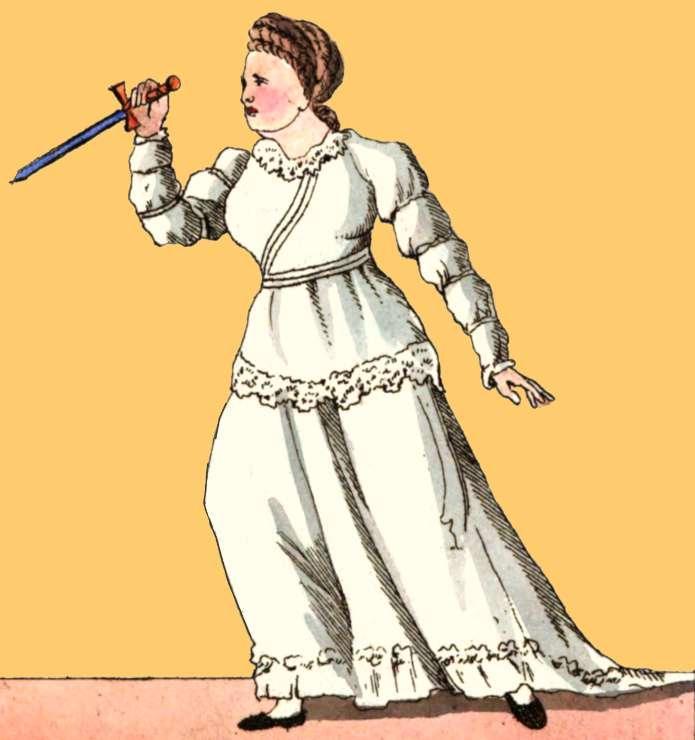
Is Kotzebue’s Johanna von Montfaucon not being performed there just now? [15] It is supposed to be a very nice production. Only make sure you practice your music as much as possible and keep your département cleaned up; see to it that you are neat and tidy.
Very soon you will have to occupy yourself with another bit of business, dear child, for I solemnly promised Grandmother that you would be confirmed at Easter. When she wrote me about it, I sensed an element of worry that we do want to spare her. [16] She tells me that on the last day, [17] she asked you whether you were receiving any instruction.
How is it that you said nothing to me of this? I explained to her how loathsome and useless such inferior instruction in religion from a student would inevitably be for a bright child like you. You yourself, however, realize that I cannot have you confirmed here under Oemler, [18] |559| since you would surely perish in the process. It must take place in Gotha under Löffler, and I have already made some queries along that line. Everything can be done in 6 weeks. Madam Gotter also wrote me. Cäcilie has used the mineral springs and baths and continues to improve, albeit very slowly.
I am unable to write to our dear, dear Madam Tischbein today; tell her that first we read her husband’s letter with joy and then burned it with fire; a thousand kisses to the children.
Lehmann should not put the news of Madam de Nuys to music; it is not worthy of being composed. This is one of the many stupid legends that circulated about her in Dresden and Leipzig. In Hamburg and Bremen, where she used to live, Madam de Nuys is a woman who for many years — more than she would probably prefer — has been known wholly as Madam Nuys. The Frommans also know her as such. Prince August’s wife was lady Auguste Murray. She lives in England and has a son by him. [19]
The gherkins arrived, and Friedrich is talking of nothing but his gherkins, also taking a great many out for himself; eventually he will doubtless write a letter of thanks. Schelling wants you to tell Madam Tischbein that it is a small thing to have Goethe call her pleasant company. [20] Schelling, too, has extremely pleasant memories of her.
Adieu, let me squeeze you to my heart until you are black and blue. Madam Hufeland will surely be bringing you along with her. [21]
Notes
[*] Concerning Auguste’s trip to Dessau with the Tischbein family, see Caroline’s letter to her on 16 September (letter 244) with the editorial note. Back.
[1] Caroline was, among other things, preparing and apparently rearranging the house at Leutragasse 5 for the arrival of Dorothea Veit.
As evident in her letter to Luise Gotter on 5 October 1799 (letter 246), the Schlegels had a plethora of visitors between August and October 1799, including Ludwig Tieck and Friedrich von Hardenberg beginning in mid-July for two weeks, then immediately thereafter Caroline’s relatives from Braunschweig (see below), whose arrival was followed a week later by Sophie Tischbein and, after the Braunschweig relatives’ departure, her two daughters, Caroline and Betty, the arrival of Friedrich Schlegel on ca. 2 September, then also — at least for the midday meal — the arrival of Johann Diederich Gries on 3 September, along with her usual midday table guests, including Schelling and the Pauluses.
As similarly evident in her letter to Luise Gotter, Caroline was expecting additional guests (on which see letter 246). And all this quite apart from the anticipation of the arrival, as mentioned above, of Dorothea Veit on 6 October (i.e., the following day), who would, like Friedrich, be moving in with them at the house, and the Tieck family on 17 October, though they would reside elsewhere (see supplementary appendix 241.1, note 10. Back.
[2] Unclear allusion; perhaps Friedrich had taken (i.e., been “endowed” with) Auguste’s earlier room? Back.
[3] “We three” meaning Caroline, Friedrich, and Wilhelm Schlegel. — Concerning Schelling’s initial place of residence in Jena, see Friedrich, Wilhelm, and Caroline’s letter to Friedrich Immanuel Niethammer on 6 July 1798 (letter 202a), note 7.
Peer Kösling, Die Frühromantiker in Jena, 42–43, points out that the anticipated arrival of Schelling’s brother in Jena to study medicine (see Schelling’s letter to his parents on 29 December 1798 [letter 213a]; his brother did indeed begin his studies in Jena during the winter semester 1799–1800) prompted Schelling to move into a larger apartment, namely, the one in the Asverus house next door to the Hotel zum Bären on Lutherplatz, which Caroline mentions later when she herself was considering renting an apartment there (see her letter to Wilhelm on 10 December 1801 [letter 335]). Here the house in an illustration on a painted teacup (to the right of the hotel; Städtische Museen Jena, Stadtmuseum):

[3a] Here a young Bacchus/Dionysos alongside Ampelos, his lover and personification of the grape vine (here almost completely transformed into a vine), along with the god’s panther at lower right and lizard crawling up the vine (Carl Ottfried Müller and Carl Osterley, Denkmäler der alten Kunst, 3rd ed., ed. Friedrich Wieseler [Göttingen 1877], vol. 2, plate xxxii, no.371):
Caroline’s quip about the “coy little half-mamsell” recurs later; in the meantime, see esp. the scene from Goethe’s play Stella in which Cäcilie’s daughter Lucie exhibits something of such a personality, which Caroline earlier refers to as “Lucianity” (letter 240). Back.
[4] Wilhelm was preparing for the publication of a collection of his poems with Johann Friedrich Cotta in Tübingen. See Ludwig Ferdinand Huber’s letter to Wilhelm on 17 August 1799 (letter 243c), esp. with note 2. On 6 October 1799, Wilhelm would deliver some materials to Goethe for assessment; see his letter to Goethe on 1 September 1799 (letter 243d), note 4. Back.
[5] Dorothea Veit arrived from Berlin with Philipp Veit on 6 October 1799, as Caroline points out in her next sentence, by way of the more direct route through Leipzig (Post Karte Durch ganz Deutschland, ed. J. Walch [Augsburg 1795]):
[6] Dorothea Veit similarly reports to Sophie Bernhardi on 7 October 1799 (letter 247b) that during this visit to Jena (28–29 September), Hardenberg had said that “she [Amalie Tieck] was the most charming and attractive woman he had ever seen!” (Daniel Nikolaus Chodowiecki, Die sonderbare Art Schwiegermutter zu gewinnen [1780]; Herzog August Bibliothek; Museums./Signatur Chodowiecki Sammlung [4-255]):

[7] Ludwig, Amalie, and Dorothea Tieck arrived in Jena on 17 October 1799. Back.
[8] Concerning Wilhelm’s assistance to Goethe in preparing the latter’s Neue Schriften, vol. 7 (Berlin 1800), specifically with respect to the poems, see supplementary appendix 245.1 (Goettinger Taschen Calendar für das Jahr 1791; Inhaltsverzeichnis deutscher Almanache, Theodor Springmann Stiftung):

[9] This evening is noted in the biography of Johann Diederich Gries (Aus dem Leben J. D. Gries, 37); see also Caroline’s letter to Auguste on 16 September 1799 (letter 244), note 11.
Goethe notes in his diary (Weimarer Ausgabe 3:2:260) that Schelling was already at Schiller’s when he, Goethe, arrived on the evening of 20 September; Goethe also saw Schelling the evening of the 22 September, possibly with Schiller as well. Back.
[10] Unclear reference; Corona Schröter? Ennuy (modern spelling: ennui), Fr., “boredom; nuisance, vexation.” Back.
[11] Fr., “two afflictions put together make one consolation,” i.e., “misery loves company.” Back.
[12] The Balt Justus Christian Loder, born in Riga, Latvia, who lived in Russia after being in Jena, Halle, and elsewhere, was supposed to be moving to Poland. Back.
[13] In his diary entry for this same day, 30 September 1799 (Weimarer Ausgabe 3:2:262), Goethe similarly uses the spelling Aranjo, and similarly notes the company of “Herr and Mad. Cappadoce.” The reference is to Antonia di Araujo, former Portuguese envoy in Paris who was destined for the same post in Berlin, also a poet whom Klopstock highly recommended to Herder in July 1797. See Aus Herders Nachlass. Ungedruckte Briefe von Herder und dessen Gattin, Goethe, Schiller, Klopstock, Lenz, Jean Paul, Claudius, Lavater, Jacobi und andern bedeutenden Zeitgenossen, 2 vols., ed. Heinrich Düntzer and Ferdinand Gottfried von Herder (Frankfurt 1856–57), 1:206–7 (Klopstock writes from Hamburg to Herder on 14 July 1799):
An extremely worthy man will soon visit you, namely, Herr von Aranjo, former Portuguese envoy in Paris, the same one whom the French Fünfleute [“five people,” i.e., the five-member Directoire exécutif de la République française in Paris] (I am loathe to say “men”) imprisoned in the Temple, thereby certainly not erecting any temple of honor. I will say nothing more of Aranjo, for you yourself will soon see that he deserves your acquaintance. He loves our language and has just begun to learn it.
Please acquaint him with your assessment of my odes [Herder had reviewed the 1798 edition of Klopstock’s odes in the Erfurtische Nachrichten von gelehrten Sachen], and tell him that I am proud of your intelligent and enthusiastic judgment. The latter is in fact an explicit condition I am imposing on you if you intend to speak about your own judgment. I warned Aranjo about you, for if he stays too long with you he will return to us too late. — . . .
Have Aranjo tell you how the good widow Sieveking and the good daughter of my blessed late Madam Büsch celebrated my birthday. We were quite jolly, and I think I can boast of having been the most jolly of all. Perhaps Madam Cappadoce herself can relate to you how . . . sang my “Im Fühlingsschatten fand ich sie” [Klopstock’s Lied “Das Rosenband”] for her. . . p.s. Aranjo’s friend and secretary is also an excellent man with considerable taste. Please acquaint Böttiger with them both.
Klopstock then writes again from Hamburg on 20 July 1799 (1:208), possibly explaining why the envoy is not attested in Weimar and Jena until late September:
Aranjo, about whom I recently spoke with you, will now in all likelihood not come see you so soon after all, for he must first recover from an illness before he can travel. Back.
[14] The Tischbeins lived in Amsterdam 1792–November 1794, where they were also acquainted with Wilhelm Schlegel. The banker Cappadeadoce (or Cappadoce) is otherwise unidentified. Back.
[15] Johanna von Montfaucon. Romantisches Gemälde aus dem 14. Jahrhundert in 5 Akten (Leipzig 1800), August von Kotzebue’s most successful tragedy (frontispieces to [in order] August von Kotzebue, Theater von Kotzebue, vol. 12 [Prague 1818]; Neue Schauspiele, vol. 4 [Leipzig 1800]; color illustration of the title character played by Friderike Kroseck, speaking the lines, “Death? — Revenge?”, unpaginated illustration from Brünner Theater-Taschenbuch auf das Jahr 1814):

[16] Auguste would be confirmed in December 1799 in Jena together with Louise Seidler (see Caroline’s letter to Auguste on 28 October 1799 [letter 252]) (Thomas Stothard, Confirmation [1792]; Herzog August Bibliothek; Museums./Signatur FBartolozzi V 3.223):

Caroline’s mother was apparently subject to depression quite apart from confirmation worries. Back.
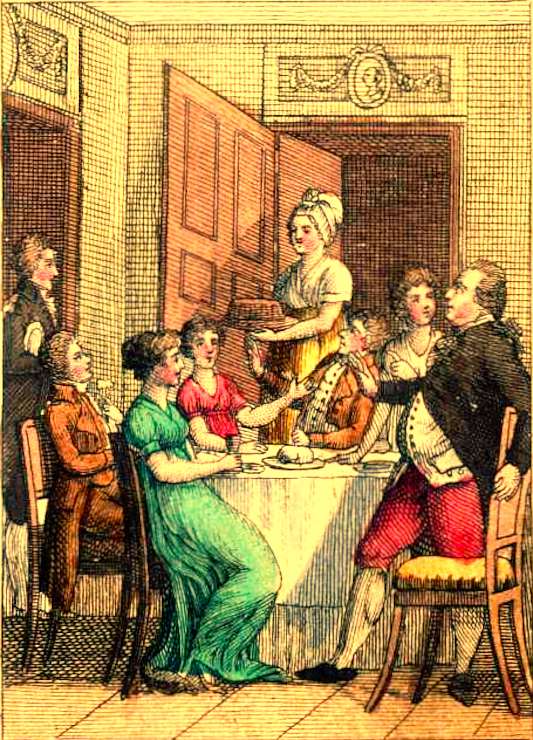
[17] In August of 1799, Luise Wiedemann, her husband and daughter, a maidservant, and her and Caroline’s mother came from Braunschweig to visit the Schlegels in Jena. See Luise’s account of this visit in her memoirs (Der neuesten Moden Almanach auf das Jahr 1808 [Vienna]; Inhaltsverzeichnis deutscher Almanache, Theodor Springmann Stiftung):
[18] Christian Wilhelm Oemler, superintendent in Jena, was already more than seventy years old. Back.
[19] Minna van Nuys had apparently been confused with the morganatic spouse of Augustus Frederick, Duke of Sussex. Concerning his marriage with Lady Augusta Murray, see Luise Wiedemann’s memoirs, note 33. Caroline is referring to Minna van Nuys’s earlier name without the aristocratic de, von, van etc. Back.
[20] See Caroline to Auguste on 16 September 1799 (letter 244), where in the editorial note Erich Schmidt references Goethe’s opinion of Sophie Tischbein from 1797. Back.
[21] That is, back to Jena; Auguste would not return to Jena, however, until 26 November 1799. Back.
Translation © 2013 Doug Stott