
• 244. Caroline to Auguste in Dessau: Jena, Monday, 16 September 1799 [*]
[Jena] Monday [16 September 1799]
|555| If only I knew how you were doing, my little lamb, but the driver has still not returned. If only you arrived in Dieskau early enough! [1] And I wonder how you behaved during lunch today at the chancellery table? [2] When you receive this, you will already be in Dessau, so write soon.
Yesterday morning was terrible, it rained the entire morning. Not knowing what else to do for consolation, I bought myself a big bouquet of flowers and put them round about me — they were my children, their fragrance exquisitely charming — but they could not sing. [3a]
The midday went crazily enough; out of sheer desperation we drank a great deal of wine, they remained for a long while, and then |556| I sat down to write a letter to Mumu in Hannover.
In the evening I had tea with the two brothers. [3] Today Friedrich’s room was completely finished, and he has already spread out all his things in it. Wilhelm’s room and chamber have also been cleaned, and tonight I will be sleeping upstairs again. [4]
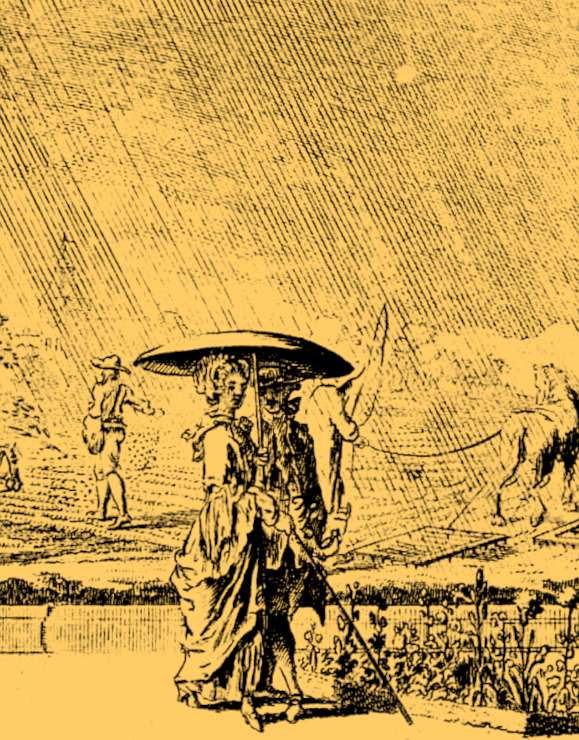
I spent the night before in your nest, and in bed read Les voeux téméraires by Madame Genlis, vows that strive ever so hard to be quite virtuous and witty. [5] I must herewith report to you that I got very wet today while taking a walk, a condition in which neither wit nor virtue are of much help. [6]
The Russian emperor is coming to Vienna. [7] Goethe arrived here today. I do believe the old gentleman expressly waited until all of you were gone.
The newspaper woman gave birth to an unkepunz yesterday evening, of the male sex. [8]
My dear girl, may you do very well indeed there, and though I do not doubt you will, I nonetheless want to know about it every single minute. I embrace all your friends there. Here are a few personal effects that were left behind; I am enclosing the franges for Betty. [9] The enclosure from Tischbein came today; if he has painted something beautiful, do write and let me know. Paul and Peter send their regards. [10] Adieu, dear, dear soul. Still no Gries. [11]
Notes
[*] Dating: Erich Schmidt dates the letter to “[21 September 1799],” albeit without adducing reasons, though see below. Albert Leitzmann, however, “Aus Karolinens Lebenskreisen,” 128, remarks that
“Monday [21 September 1799]” should be corrected to 16 September; the 21st was a Saturday rather than a Monday [in 1799], and the remark that “Goethe arrived here today” removes any doubt from this date (see Goethe’s diaries, Weimarer Ausgabe 3:2:259) [for 16 September: “After dinner to Jena. Evening with Herr Hofrath Schiller“].
The chronological problem is that according to Adolf Stoll, Der Maler Joh. Friedrich August Tischbein und seine Familie: Ein Lebensbild nach den Aufzeichnungen seiner Tochter Caroline (Stuttart 1923), 103, Sophie Tischbein and her daughters — and Auguste — allegedly left Jena on 20 September 1799, which explains Erich Schmidt’s dating and renders Leitzmann’s impossible. It might be kept in mind that Caroline is writing at least a day and possibly two after Auguste’s departure, since she reports the previous day’s weather to Auguste in this letter, suggesting Auguste was not there to experience it herself.
Goethe’s diary, moreover, may be incorrect (Weimarer Ausgabe 3:2:259), according to which he traveled over to Jena on the evening of Monday, 16 September 1799 (“evening” could loosely refer to late afternoon). If it is correct, however, it means the Tischbeins and Auguste left Jena not on 20 September as maintained by Adolf Stoll, but on Saturday, 14 September, or Sunday, 15 September (Caroline quips later in this letter that she believes Goethe expressly waited until they had left).
Caroline herself resolves this chronology. In her letter to Luise Gotter on (Saturday) 5 October 1799 (letter 246), she remarks that “it has been three weeks now since these guests, too, left us.” Three weeks prior to Saturday, 5 October, would indeed be the weekend of Saturday and Sunday, 14 and 15 October. Leitzmann’s dating is correct, and because Caroline seems to be writing at least a day, possibly two after Auguste’s departure, the group seems to have left on Saturday, 14 September 1799.
In any event, Auguste was on her way to visit the Tischbeins, who lived in Dessau from 1795 to 1800; Caroline’s letter to Luise Gotter (letter 246) recounts the Tischbeins’ preceding visit to Weimar and Jena. See also Wilhelm Schlegel’s letter to Minna van Nuys (letter 243e), note 24. Auguste would not return to Jena until 26 November 1799.
Erich Schmidt, (1913), 1:741, points out that Goethe praised Sophie Tischbein but found her husband unsympathetic (Gespräche, ed. Woldemar von Biedermann, vol. 10: Nachträge 1755–1832 [Leipzig 1896], 28):
1797, between 2 and 6 January
During one of his [Prince Leopold von Anhalt-Dessau] visits [at the home of Friedrich August Tischbein], he also brought Goethe along — who had come to Dessau for a short time — even though the prince knew of his disinclination toward the father [Tischbein]. But the prince had mentioned that Goethe, despite his stubbornness, should visit the father. Goethe was quite delighted with the mother and even mentioned later that Madam Tischbein was an extremely pleasant person to be around.
Schmidt also points out that the Tischbein couple had two daughters, both of whom were talented singers: Caroline (who later married the historian Friedrich Wilken), born 1783, was also a talented painter; and Betty (who later married Christian Gottfried Körner’s friend Wilhelm Kunze), born 1787.
Adolf Stoll published Caroline Tischbein’s memoirs as “Autobiographische Aufzeichnungen von Karoline Wilken,” Jahresbericht des Kgl. Friedrichs-Gymnasiums zu Cassel 1894/95, p. 93ff.; reprinted in Der Geschichtschreiber Friedrich Wilken. Mit einem Anhang, enthaltend Aufzeichnungen von Karoline Wilken, geb. Tischbein, über ihren Vater Johann Friedrich August Tischbein und ihr eigenes Jugendleben (Cassel 1896), 254–338; later reprinted yet again, albeit thoroughly annotated as the basis for a Tischbein family biography, in Adolf Stoll, Der Maler Joh. Friedrich August Tischbein und seine Familie: Ein Lebensbild nach den Aufzeichnungen seiner Tochter Caroline (Stuttart 1923). For the text of the section of Caroline Tischbein’s memoirs that deal with her stay in Jena with the Schlegels, see the supplementary appendix Caroline Wilken’s memoirs.
Erich Schmidt assesses these memoirs as a lively enough account but with errors as well as a striking antipathy toward Caroline, whom Caroline Tischbein also, quite incredibly, accuses of tolerating terrible disorder in her household and of serving bad food. Caroline Tischbein also alleges that her father referred to Caroline as a “brilliant witch,” and that Caroline was only too happy to take whatever he dished out to her. Back.
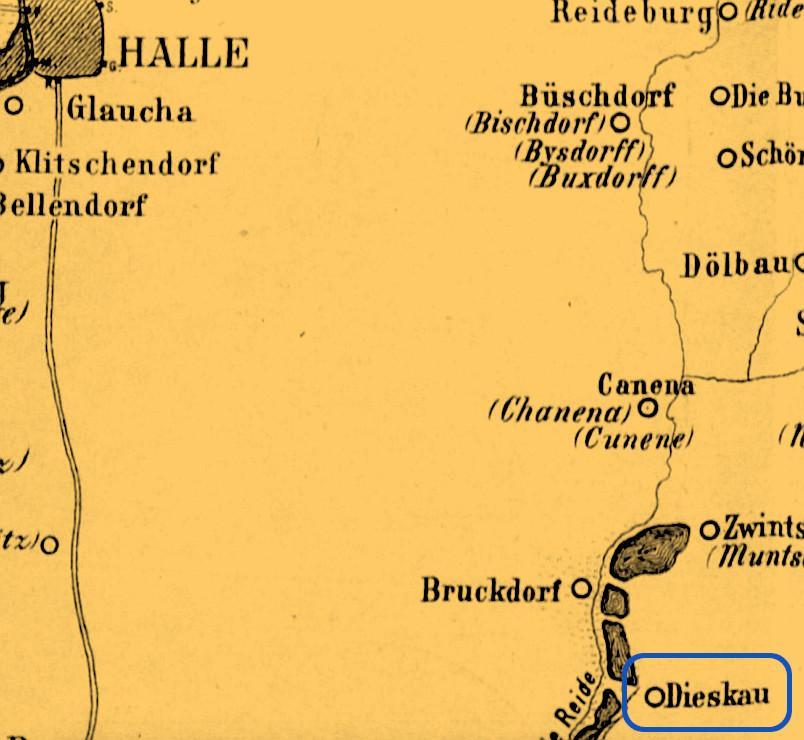
[1] Dieskau is located 8 km southeast of Halle, which in its own turn is located ca. 70 km northeast of Jena, and Dessau another 40 km northeast of Halle (Dessau in an engraving by Matthäus Merian; first map: Rudolf Koch and Fritz Kredel, Deutschland und angrenzende Gebiete [Leipzig 1937]; second map: Dr. Hertzberg, Plan der Umgegend von Halle an der Saale im Mittelalter, gez. von Paul Schwarz [Halle 1888]):


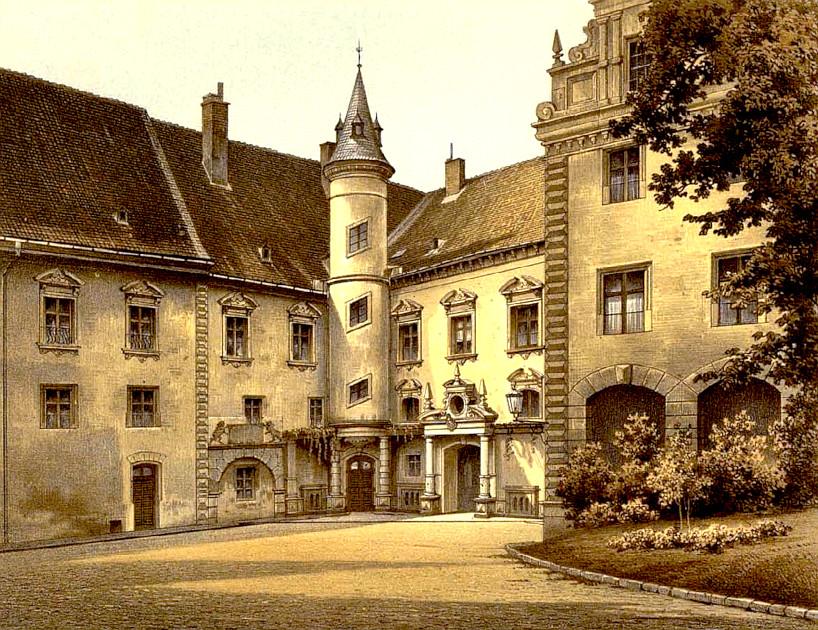
It seems likely (see note 2 below) that Sophie Tischbein, her children, and Auguste dined at midday during a stopover at Chateau Dieskau on 16 September 1799, perhaps by way of an otherwise unknown acquaintance between Johann Friedrich August Tischbein and the current owner, the former chancellor of the university in Halle Carl Christoph von Hoffmann. It is of some interest that on 3 July 1799, just over two months earlier, Friedrich Wilhelm III and his wife, Queen Luise of Prussia, had visited the chateau during their trip through the duchy of Magdeburg (see Caroline’s letter to Johann Diederich Gries on 6 June 1799 [letter 240], with note 1), where they planted what became known as the “King’s Oak.” Here the chateau courtyard ca. 1870 in a photo by Theodor Albert (Collection Alexander Duncker, Zentral- und Landesbibliothek Berlin):
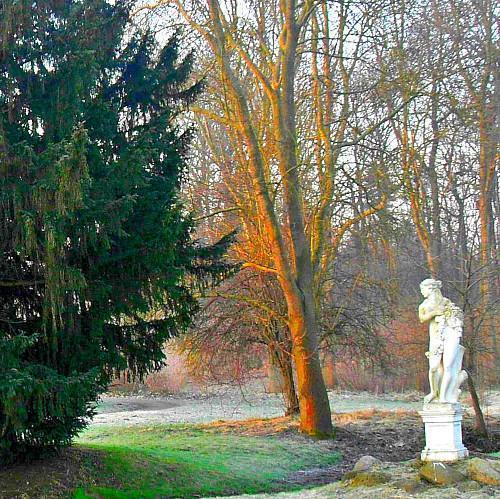
For several haunting winter views of the chateau and its grounds today, click on the gallery below:
[2] Although Erich Schmidt, (1913), 1:742, maintains (albeit without adducing documentation) that this meal took place at the house of August Hermann Niemeyer in Halle, whom Caroline and Wilhelm had met in Braunschweig in the autumn of 1795 (see her letter to Luise Gotter from that autumn [letter 156]) but who did not become chancellor until 1808, it seems more likely, given the explicit reference to Dieskau above and to the “chancellery table” here, that the meal was with the former chancellor Carl Christoph von Hoffmann in Dieskau itself. Back.
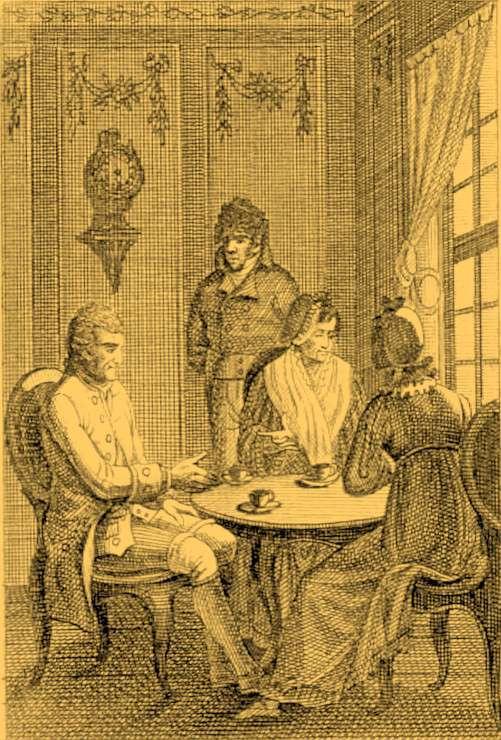
[3] Wilhelm and Friedrich Schlegel (Genealogischer Kalender auf das Jahr 1810; Inhaltsverzeichnis deutscher Almanache, Theodor Springmann Stiftung:
[3a] All three Tischbeins — Sophie, Betty, and Caroline — were musically inclined, as was Auguste, and had engaged in duets and other musical entertainment while visiting the Schlegels in Jena. See esp. Caroline’s letter to Luise Gotter on 5 October 1799 (letter 246). Back.
[4] Shortly after her arrival on 6 October 1799, Dorothea Veit describes the living arrangements in the building at Leutragasse 5 as follows in a letter to Schleiermacher on 11 October 1799 (letter 247c):
we live in a kind of rear edifice, all the windows look out onto the courtyard. I myself live downstairs, one flight up Caroline, then Wilhelm, and finally, in the uppermost story, Friedrich. Back.
[5] Les voeux téméraires ou l’enthousiasme, 3 vols. (Hamburg 1798) (Eng. Rash Vows: or, The Effects of Enthusiasm. A novel, 3 vols. [London 1799]). Madame de Genlis, who lived in Germany from 1794 to 1799 in Berlin and Hamburg as an émigrée countess and prolific “governess“-author, was always coolly assessed by Wilhelm Schlegel; see his review of Les voeux téméraires ou l’enthousiasme in Athenaeum (1799) 322–24 (this issue of Athenaeum had just appeared in August):
After reading Madam de Genlis’ novel Les voeux téméraires in a single sitting, with all its artificiality and affected virtues and delicatesses, one finds oneself heartily yearning for a bit of natural earthiness and harshness, just as after recovering from a sickness during which one has been condemned to eat rag soup one yearns for a bit of sourness. —
Concerning “rag soup,” see Adelung 2:885: In the life of the common people in Upper Saxony, a soup consisting of water or meat bouillon to which, when boiling, one adds beaten eggs, which then break up in the broth and become “ragged.”
Wilhelm continues in the review:
Quite apart from the boredom resulting from its utter lack of wit, the book is, however, neither as good nor as bad as it has been judged. Considerable imagination, but without any real blossom and without freshness, as if cultivated entirely in a greenhouse; considerable knowledge of her world, bon ton, gallantry, but also cinched and in a hooped skirt.
The characters are always described first and then must fit themselves into this prescribed mold like examples of a mathematical principle. The heroine, a consummate English woman as portrayed by a Frenchwoman’s exaggerating imagination, flees all human society for several years, and yet things are artificially arranged such that she is constantly seen and observed, being perpetually and invisibly accompanied by one of her secret admirers, who even observes her most secret movements at night in her chamber.
Of course, the chamber is situated too high for anyone to see in directly from outside, but the lover, who neither sleeps nor eats for years on end, that he may skulk about the castle in ever new disguises, can at least see the shadow of her figure and her long hair on the ceiling, thereby learning that she is restlessly pacing to and fro. She is discovered and observed during even the most solitary walks. —
This vanity is portrayed with the most devoted reverence, and the veil of the most exuberant prudery hung over it. And what pretensions with respect to the men! It is naive to admit such a thing as if it were so very virtuous. Although in some scenes the portrayal is of enchanting liveliness, rivers of tears soak the entire book in an extremely sad fashion.
Everything in the book is artificial in the fine Parisian fashion: field and forest, river and bridge, peasant and peasant wedding, indeed even the cows of these peasants and all of nature itself. In this sick-room atmosphere, love is almost afraid to breathe, and the book is never so bold as that it risk speaking about love.
Its moral purpose is, by the way, clear enough, namely, that it is quite dangerous for a man to become a member of the Knights of St. John — because of the chastity vow; and that a widow must be mindful of writing on the public monument of her deceased husband in golden letters that she will never seek to become the wife of another, since neither can be sure they will not someday regret it. Back.
[6] Kupfersammlung zu J[ohann] B[ernhard] Basedows Elementarwerke für die Jugend und ihre Freunde: Erste Lieferung in 53 Tafeln. Zweyte Lieferung in 47 Tafeln von L bis XCVI (Leipzig, Dessau, Berlin 1774), plate XVI a:
[7] In connection with the Italian and Swiss campaigns in the War of the Second Coalition (see also Friedrich Schlegel’s letter to Caroline in late April 1799 [letter 236], note 7), André Masséna’s defeat of Alexander Korsakov on 26 September 1799 at Zürich, and the forced retreat of another Russian army from Switzerland, decimated by starvation and low supplies, along with a lack of cooperation between the Russians and their Austrian allies and contradictory goals in the Italian campaign — all this left Paul I enraged at the Austrians, whom he and his generals blamed for the Russian disasters. The eventual result was the withdrawal of Russia from its alliance with Austria in the War of the Second Coalition. Paul does not, however, seem to have journeyed to Vienna. Back.
[8] Frontispiece to Christian Friedrich Sintenis, Stunden für die Ewigkeit gelebt: Vom Verfasser von Hallo’s glücklichen Abend (Frankfurt, Leipzig 1792):
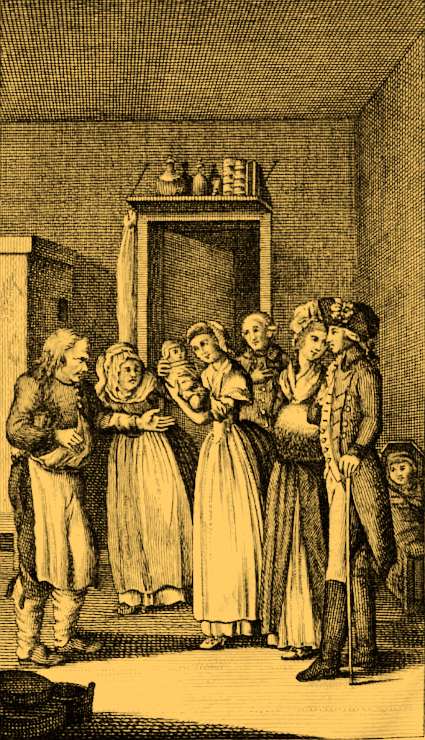
The newspaper woman is unidentified and not mentioned elsewhere in extant letters. Back.
[9] Fr., “fringes.” Back.
[10] Presumably Wilhelm and Friedrich. Back.
[11] Another chronological problem arises here, since Johann Diederich Gries had been in Jena since 3 September 1799 and had already made the acquaintance of the Tischbein family. Caroline is likely simply referring simply to a specific scheduled visit by Gries. See in any case Aus dem Leben J. D. Gries 36–37 (illustration: Heinrich Schneider, Die Burschenschaft Germania zu Jena [Jena 1897], 9):
A summons to Jena, however, always exerted such magical power on our Gries that he was simply unable to resist, and indeed, he had hardly returned to his legal studies [in Göttingen, where he was trying to complete his law degree; see the editorial note to Wilhelm’s letter to Gries on 10 May 1799 (letter 236c)] when he was joyously received in Jena on 3 September [1799] by his brother and his other friends.
He immediately hastened over to the Schlegels, who were especially delighted at his unexpected appearance; he now also met Friedrich Schlegel there, who had recently arrived from Berlin, as well as the Tischbein family from Dessau; their daughters and Auguste Böhmer accompanied him to the Loders, and he was everywhere accorded a triumphant welcome.
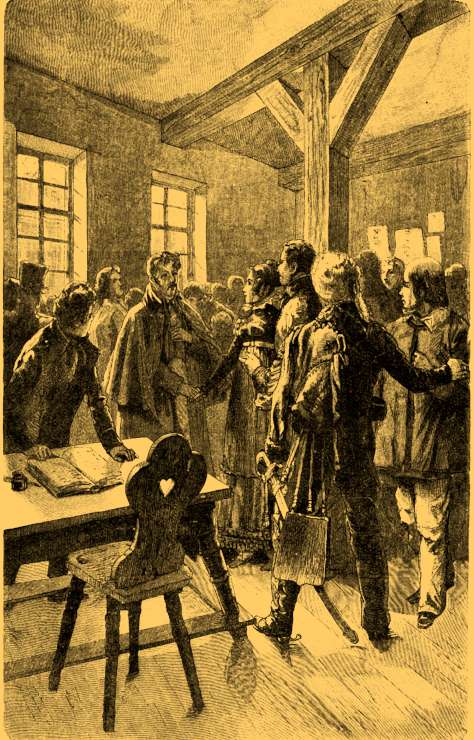
How salutary was such a reception after his cold, barren life in Göttingen, where even his joy in music found so little nourishment; here in these circles, however, and particularly through the presence of the Tischbein daughters, that joy was reawakened, providing him with extraordinarily enjoyable evenings. . . .
[Gries was an accomplished pianist (illustrations: [1] Almanach und Taschenbuch zum geselligen Vergnügen für 1798; Inhaltsverzeichnis deutscher Almanache, Theodor Springmann Stiftung); [2] T. Rowlandson, in Alfred Burton, The adventures of Johnny Newcome in the Navy; a poem, in four cantos orig. pub. date 1818 [London 1904], illustration following p. 180)]:
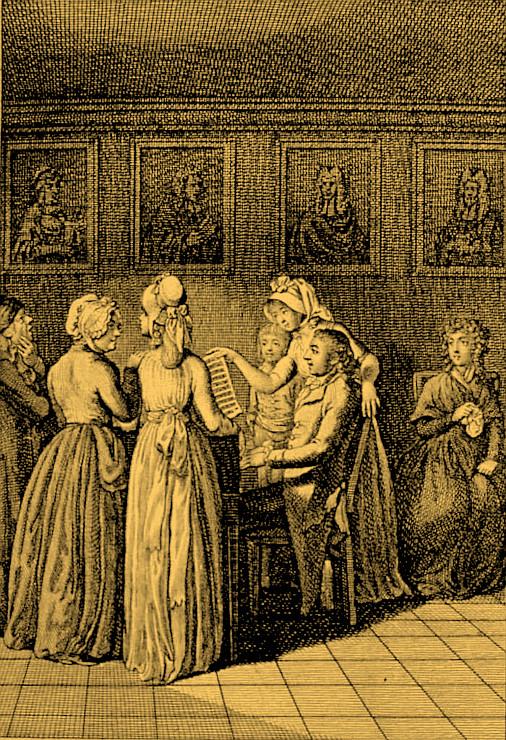
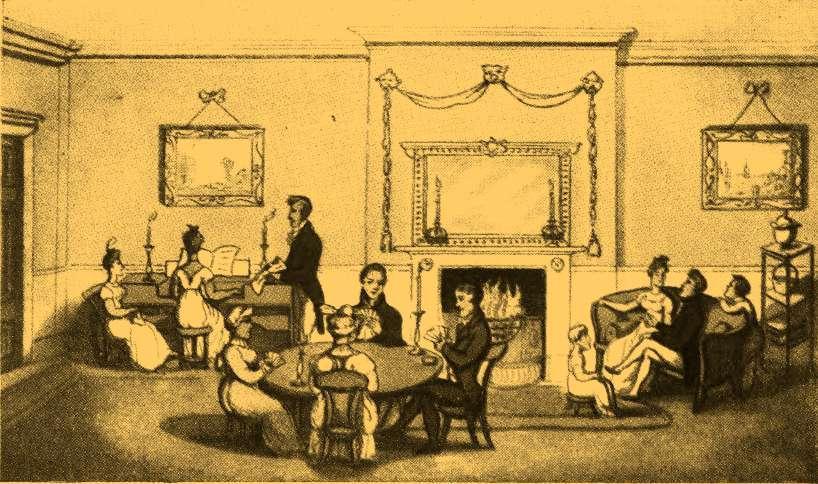
This time he also spent some very profitable time with Schiller, and the final evening before his departure the additional company of Goethe and Schelling there was particularly interesting [29 September 1799, as attested in Goethe’s diary, Weimarer Ausgabe 3:2:262]; the afternoon of the next day, when he had to depart for the città dolente [the “sad town,” i.e., Göttingen], he was loathe to leave his mealtime seat at the Schlegels. Back.
Translation © 2013 Doug Stott