
245a. Wilhelm Schlegel to August Ferdinand Bernhardi in Berlin: Jena, 30 September 1799 [*]
Jena, 30 September 1799
You have probably been informed [1] that some time ago I spoke with the editors of the Allgemeine Literatur-Zeitung on the subject of your request, and that they would be quite keen on acquiring a critic such as you in what is unfortunately an area quite poorly represented at present. You no doubt have not yet received an invitation, since initially they had no address for you, and now Schütz is here alone and is extremely distracted and getting little done.
In the larger sense, the correspondence of this journal is conducted quite ill, and if one is to establish a relationship with them of the sort I have enjoyed for some time now, the most efficient way is admittedly to be in Jena itself. I am always quite willing to deliver your requests in person and to write to you with the response immediately. Perhaps you can speak with Hufeland on his return trip from Danzig. [2]
I have agreed to review a great many pieces that I cannot yet really see my way clear to take care of, several among which I would be glad to pass on to someone else, pieces you would perhaps not be entirely disinclined to take. I did not immediately suggest you as someone to review either Athenaeum or my brother’s works, since I did not want the editors to get the impression that your entire participation in the A.L.Z. was merely at our prompting; they assured me, moreover, that the review of Athenaeum was already well under way — though I cannot so easily imagine just how and with whom [3] — and that the book Das Studium der Griechischen Poesie had allegedly also already been assigned a reviewer.
My brother’s piece Geschichte der griechischen Poesie, however, will reliably fall to you should you want it. They themselves own that they are in a bit of an awkward position, having several people already decline it, hence they would have no excuse if an acknowledged, solid philologist were to offer his services.
I am indeed unsure whether I should grant the A.L.Z. your keen judgment and wit. As happy as I am whenever any sort of fright is visited on inferior writers, the A.L.Z. actually sooner deserves to perish under the weight of its own tediousness and boredom. On the other hand, your company would give me reason to begin contributing more again, since heaven knows how often I have been ashamed of the reviews that stand cheek-by-jowl with my own there. [4]
Above all, however, do not let this distract you from our Athenaeum. . . .
You had given us some cause to anticipate perhaps an essay on Herder’s Metakritik — though now I fear that perhaps the remarks I sent to Berlin concerning certain Weimarian considerations that ought to be kept in mind may have frightened you off. Hence let me explain.
Herder’s attack on the critical philosophy is so comprehensive, and presents such an appearance of thoroughness, and the stature of the author so great, that I think one cannot really dispense with it through a simple flight of fancy. Hence in order not to hinder truly serious annihilation, one would have to repress all sarcasm save for that emerging quite naturally from the course of refutation itself. —
For the same reason, I already have convinced my brother to put off for now such a flight of fancy against the splendid triple alliance of Herder, Jean Paul, and Wieland, [5] nor can we likely use yours either, which Schleiermacher sent to us, because in part it appears to be mocking the spirituality of said gentleman, and one might too easily be inclined in Weimar to accuse us of wanting to ridicule not only the inferior writers, but also their bishops in this territory. Your idea itself, by the way, is quite delightful, and I would be inconsolable were it to be denied to the world. Might you not have it published as an announcement of a piece by a bookseller in the Intelligenzblat of the A.L.Z.? That would be the most effective way of getting it disseminated. [6]
If, however, on closer acquaintance you find it too uncomfortable and repugnant to get involved with this journal, one that for me truly has acquired a kind of cattish odor, then simply tell us straightforwardly, and we will see what we might otherwise do for it. It is truly harsh having to expend so much intellect, emotion, and time on such a thing.
One more request before I close. Hamlet will, I understand, now be performed in Berlin. It is very important to me that this first (and hence for just that reason bold and meritorious) attempt to bring Shakespeare to our stage in his true form not go without some reaction. Hence if you publish an announcement of it in the Archiv der Zeit, [7] I would be much obliged if you could do it in such way that the actors not be scared off, and if you could also gently point out what perhaps does not yet come across quite the way it should. [8]
Had I myself come to Berlin, I would add something about the performance to the special printing of Hamlet. As it is, however, I was only able to say something about the theatrical presentation of Shakespeare in general. [9] In my translations, I am just now coming to the Henrys, and would very much like to see them actually staged and to see Iffland play Falstaff. [10]
Stay well and remember us fondly.
Your,
A. W. Schlegel
Notes
[*] Source: Körner, (1930), 97–99. — Wilhelm’s quarrel with the Allgemeine Literatur-Zeitung — a journal that, as Wilhelm says in this letter, had “acquired a kind of cattish odor” for him — would intensify over the next month and ultimately end with a complete break. Despite what Wilhelm says in this letter about having agreed to various reviews that were still outstanding, his last review had already appeared in the journal, namely, of Don Quixote, translated by Ludwig Tieck as Leben und Thaten des scharfsinnigen Edlen Don Quixote von la Mancha, 4 vols. (Unger: Berlin 1799–1801); volume 1 (1799), reviewed by Wilhelm in the Allgemeine Literatur-Zeitung (1799) 230 (Saturday, 20 July 1799) 177–83. Back.
[1] Wilhelm had asked Schleiermacher to alert Bernhardi that he, Wilhelm, would be writing him in regard to the Allgemeine Literatur-Zeitung. In the same letter of 23 September 1799 (Aus Schleiermacher’s Leben 3:122–23), he urgently asks Schleiermacher to “take on our orphaned Athenaeum out of fatherly interest,” since Friedrich Schlegel had moved to Jena. Back.
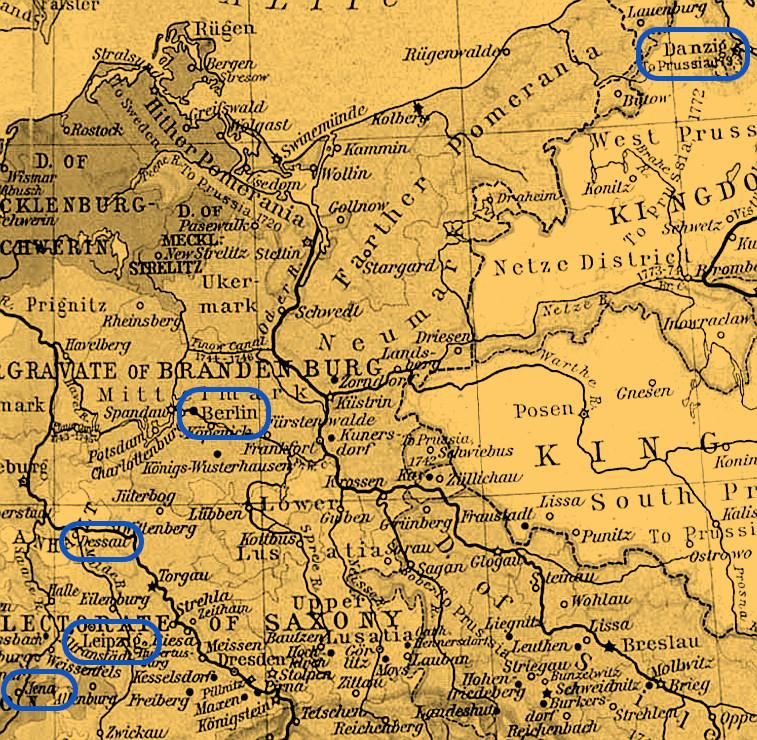
[2] The other editor, Gottlieb Hufeland, would be coming through Berlin at the end of October on his return trip from a visit to his hometown of Danzig (Caroline mentions the trip in her letters to Auguste on 30 September, 14 October, and 21 October 1799 [letters 245, 248, 250], though Erich Schmidt, (1913) 2:693 (personal index compiled by Reinhard Buchwald), incorrectly associates these passages with the physician Christoph Wilhelm Hufeland (W. R. Shepherd, Historical Map of Central Europe about 1786 [1926]):
[3] See Gottlieb Hufeland’s letter to Wilhelm on 2 May 1799 (letter 236a) concerning possible reviewers for Athenaeum (point 4 in Hufeland’s letter) and — as Wilhelm mentions next — for Friedrich’s works (point 3 in Hufeland’s letter, which mentions having already had people decline offers to do the reviews).
In the meantime, Ludwig Ferdinand Huber had been assigned and was working on reviews of both Athenaeum and Friedrich’s novel Lucinde, which would appear in Allgemeine Literatur-Zeitung (1799) 372 (Thursday, 21 November 1799) 473–77 and Allgemeine Literatur-Zeitung (1800) 130 (Wednesday, 7 May 1800) 297–300. For the complete texts of these reviews, see supplementary appendices 256.1 and 256.2.
Caroline responds to Huber personally concerning the reviews in her letters to him on 22 and 24–27 November 1799 (letter 256, 257). Concerning the dispute, see in general Garlieb Merkel on C. G. Schütz, the Allgemeine Literatur-Zeitung, and Wilhelm Schlegel; also Wilhelm Dilthey on the break between the Romantics and the Allgemeine Literatur-Zeitung (supplementary appendix 258a.1). Back.
[4] See the similar wording in Wilhelm’s “farewell” missive (dated 30 October 1799) to the Intelligenzblatt of the Allgemeine Literatur-Zeitung (1799) 145 (Wednesday, 13 November 1799) 1179 (here letter/document 255a), where he speaks of “the increasing proliferation of empty reviews whose company has already often enough made me ashamed.” Back.
[5] Josef Körner found Friedrich’s idea on a manuscript preserved in Schleiermacher’s literary estate in Berlin (Körner, [1930], 2:39):
Although Herr Generalsuperintendent Herder has hitherto more or less “philosophized,” and with considerable humanity, he has finally wearied of such and has now courageously resolved to philosophize in all seriousness in community with Wieland, Böttiger, and Jean Paul, in fact: contra the mighty Kant, or actually alongside him and off into space, or even more precisely: beneath him and away.
As Körner points out (ibid., 2:39–40), the early Romantics were especially ungrateful to Herder of all people, since they in fact owed the most to him. That said, Wilhelm seems to have remained loyal to him the longest, even in his — Wilhelm’s — later years.
The personal relationship between Wilhelm and Herder, however, was harmed by material that appeared in Athenaeum and by the Romantics’ excessive veneration of Goethe, with whom Herder and his wife were no longer on such good terms. On the other hand, Herder’s intimate relationship with one of their most resolute oppontents, Garlieb Merkel (who appears later in these letters), did little to remedy the situation.
The two parties, however, said very little publicly. Wilhelm remained utterly silent about Herder later in his Berlin Vorlesungen über schöne Literatur und Kunst and Herder refrained from publicizing his own indignation over the performance of Wilhelm’s play Ion: ein Schauspiel (1802; see volume 2 of this edition). Back.
[6] Bernhardi contributed a sharp review of Johann Gottfried Herder’s Verstand und Erfahrung. Eine Metakritik zur Kritik der reinen Vernunft (Leipzig 1799), in Athenaeum (1800) 268–83. Back.
[7] I.e., in the Berlinisches Archiv der Zeit und ihres Geschmacks; Bernhardi does not seem to have carried out Wilhelm’s request for a review. Back.
[8] Hamlet would finally be performed in Berlin on 15 October 1799, though the performance was not a success. See Ella Horn’s essay on the background to the premiere of Hamlet in Berlin. Back.
[9] Wilhelm’s translation of Hamlet had appeared in volume three (1798) of his edition of Shakespeare (along with The Tempest). The rare special edition to which he is referring (Josef Körner had a copy in his personal library) is Shakespeare’s Hamlet, trans. August Wilhelm Schlegel (Berlin: Unger 1800), 238 pages with an eight-page preface beginning with the words:
The occasion for having this particular play, from among the translation of the collected dramatic works of the poet, presented in an additional, special printing was the hitherto merely fortuitously delayed prospect of seeing it performed on one of the premier stages of Germany under the keen guidance of an artist wholly permeated by the grand meaning of this piece. Back.
[10] Volume 6 (1800) of Wilhelm’s translation of Shakespeare included Henry IV, parts 1 and 2 (translated as König Heinrich der vierte: Erster Theil, König Heinrich der vierte: Zweyter Theil), in which the character of Falstaff plays a notable role; neither was performed in Berlin until (respectively) 1817 and 1820 (C. Schäffer and C. Hartmann, Die Königlichen Theater in Berlin: Statistischer Rückblick auf die künstlerische Thätigkeit und die Personal-Verhältnisse während des Zeitraums vom 5. December 1786 bis 31. December 1885 [Berlin 1886], 41).
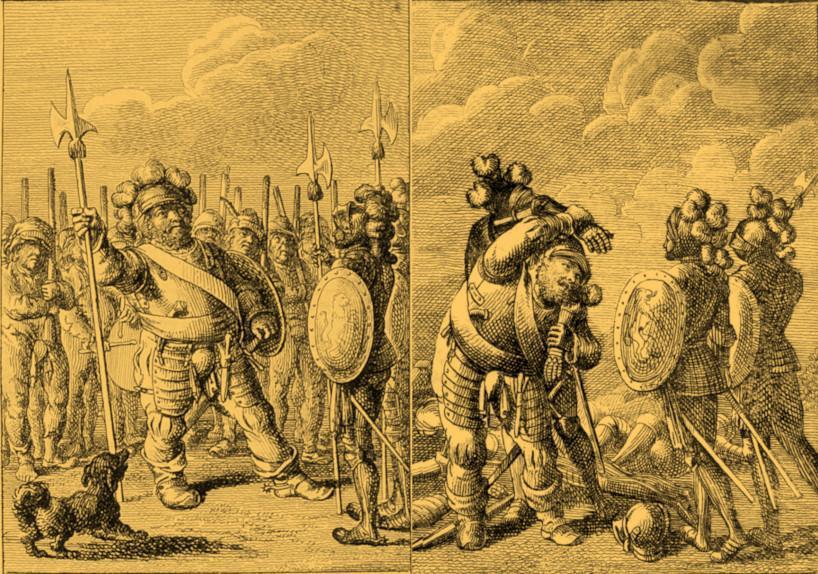
In any event, Wilhelm’s choice for Iffland to play the role of Falstaff was no accident. Iffland, a superior actor in any case, was also known for his corpulence; here two illustrations (together) of Falstaff for Johann Joachim Eschenburg’s translation of Henry IV by Daniel Nikolaus Chodowiecki (Herzog Anton Ulrich-Museum; Museums./Signatur DChodowiecki AB 3.642,) and (bottom) two illustrations by F. Catel of Iffland in the role of Franz Moor in two famous scenes in Schiller’s play Die Räuber. Ein Schauspiel (Frankfurt, Leipzig 1781) (Gustav Könnecke, Bilderatlas zur Geschichte der deutschen Nationallitteratur, 2nd ed. [Marburg 1895], 345):

Translation © 2013 Doug Stott