
242a. Wilhelm Schlegel to Goethe in Weimar: Jena, 19 July 1799 [*]
Jena, 19 July 1799
Please accept my sincere gratitude for the new issue of Propyläen. What a grand celebration it was for us; we especially and eagerly fell upon the correspondence of the art collector and his family, and I am equally eager to speak with you about it in person. [1]
Although we flattered ourselves that you would be spending considerable time in Jena this summer, we now hear that you will yet be spending several more weeks in Weimar. [2] I am all the more sorry because my two friends Hardenberg and Tieck have been with me here since the day before yesterday. [3] You are already acquainted with the former, and I was hoping to introduce you to the latter. We have planned to travel over to Weimar on Sunday, hence should you not have time to see us perhaps on Sunday morning, or will not be in Weimar in any case that day, I would be greatly obliged if you could inform me of such in a few lines. [4]
My kind regards to Herr Professor Meyer, whom I also hope to find in good health.
AWSchlegel
Notes
[*] Source: Körner-Wieneke 86–87. Back.
[1] Goethe had sent Wilhelm the fourth issue of his periodical Propyläen (1799) on 13 July 1799, which contained his art novella “Der Sammler und die Seinigen” (“The art collector and his family”; issue 4 = vol. 2, no. 2, 26–122); see especially supplementary appendix 242a.1, which provides an overview and key passages from this essay.
In it, Goethe presents, in epistolary form, what is essentially a treatise on what might be called the various modes of perception of art; although he also speaks about the artist, the primary focus is on how different people react to the works of art before them, in this case primarily paintings. Translated by Samuel Gray Ward as “The Collector and His Friends,” Essays on Art (Boston 1845), 42–117.
It is no accident that the Schlegel household — certainly including Caroline — were so taken by this piece, since they themselves had just published a piece similarly exploring different perceptions of paintings in the Dresden gallery, namely, “Die Gemählde. Ein Gespräch von W.,” in Athenaeum (1799) 39–151, which had appeared in early March. Back.
[2] According to his diaries, Goethe moved into his garden house in Weimar on 31 July 1799, here in an illustration by Rudolf Ridel, in Wilhelm Bode, Damals in Weimar (Jena 1912), 56:
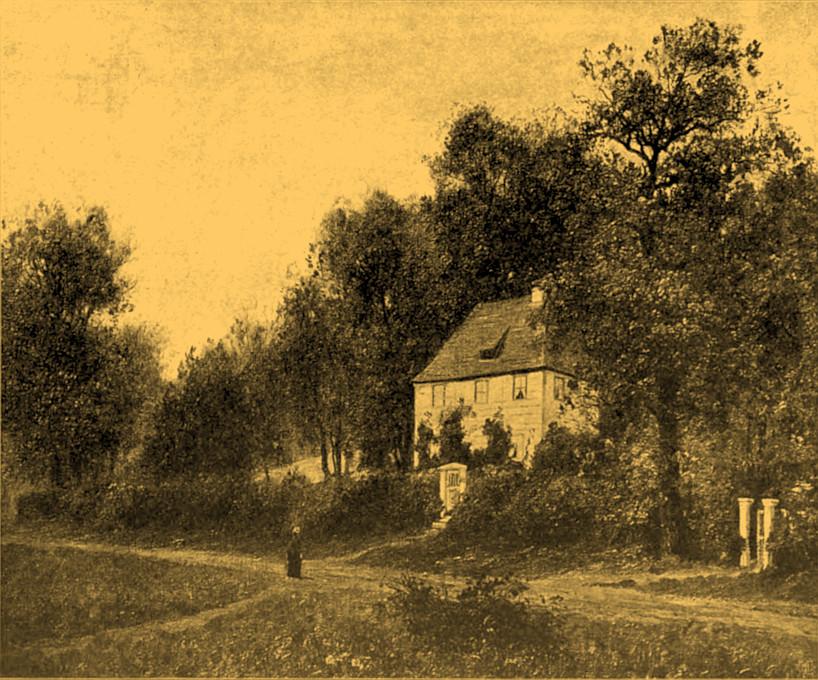
He did not return to his house on the Frauenplan until 15 September 1799 (Weimarer Ausgabe 3:2:256, 258; illustration of his Weimar house on an early postcard: “Vor dem Goethehaus zu Weimars klassischer Zeit”):

[3] Concerning the initial meeting between Ludwig Tieck and Friedrich von Hardenberg, who had hitherto not been personally acquainted, see Rudolf Haym’s portrayal in Die romantische Schule (supplementary appendix 242a.2). Back.
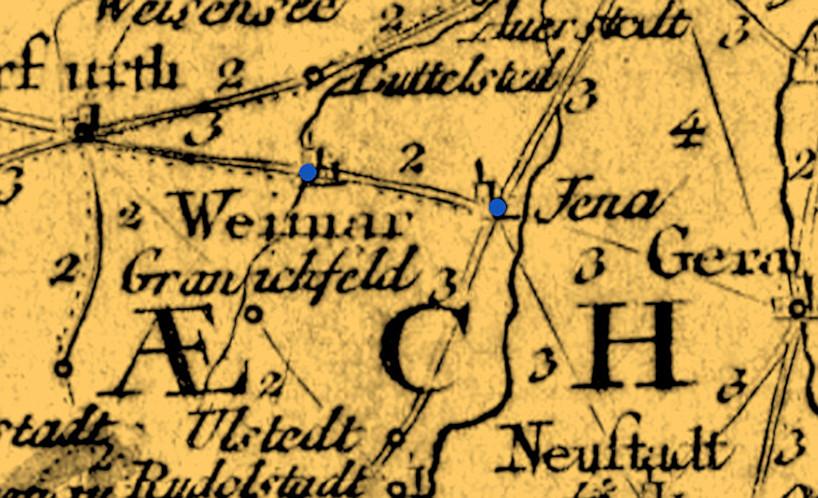
[4] Wilhelm, Tieck, and Hardenberg dined with Goethe on Sunday, 21 July 1799 (Post Karte Durch ganz Deutschland, ed. J. Walch [Augsburg 1795]):
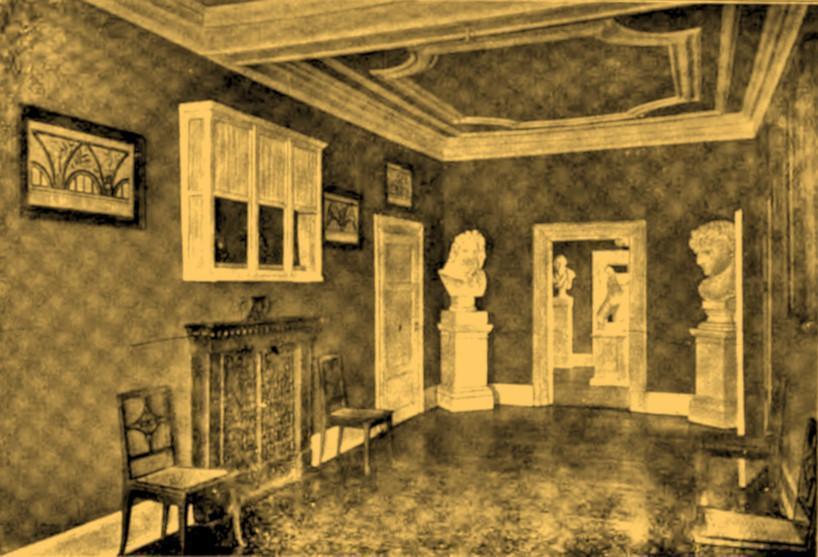
Goethe generally dined with his guests in what is known as the “Yellow Room,” so named after the color of its walls (illustration from Franz Neubert, Goethe und sein Kreis, 2nd ed. [Leipzig 1922], 182:
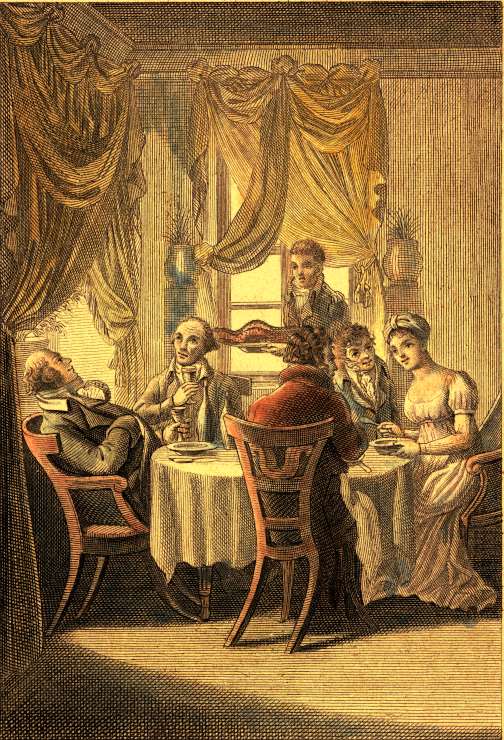
Goethe recounted the visit to Schiller in a letter on 24 July 1799 (Correspondence between Schiller and Goethe, 2:246–47): “Tieck came with Hardenberg and Schlegel to dinner; to judge from a first appearance, he seems very pleasant. He spoke little, but well, and has, in fact, made a very good impression here” (representative illustration: Der Freund des schönen Geschlechts: ein angenehm und nützlicher Taschenkalender für das Jahr 1808):
Translation © 2013 Doug Stott