
• 252. Caroline to Auguste in Dessau: Jena, Monday, 28 October 1799
[Jena] Monday, 28 October [1799]
|571| My dear child, now that I know I will not be getting you back again right away, a feeling of longing is also beginning to creep into my soul. |572| The Hufelands returned yesterday, [1] and since there was simply no way you could have come with them in any case, you can no longer blame me after all for allowing you to languish there so far away from us, nor, indeed, can I blame myself for it now. [2]
Fate! Fate! my angel, and the quite ordinary fact — that particular quite ordinary fact — that we cannot fly — enfin [3] everything just as in Wallenstein, the stars, the horses’ hoof beats, etc. [4] But the time will come, and you shall celebrate a wonderful Christmas here.
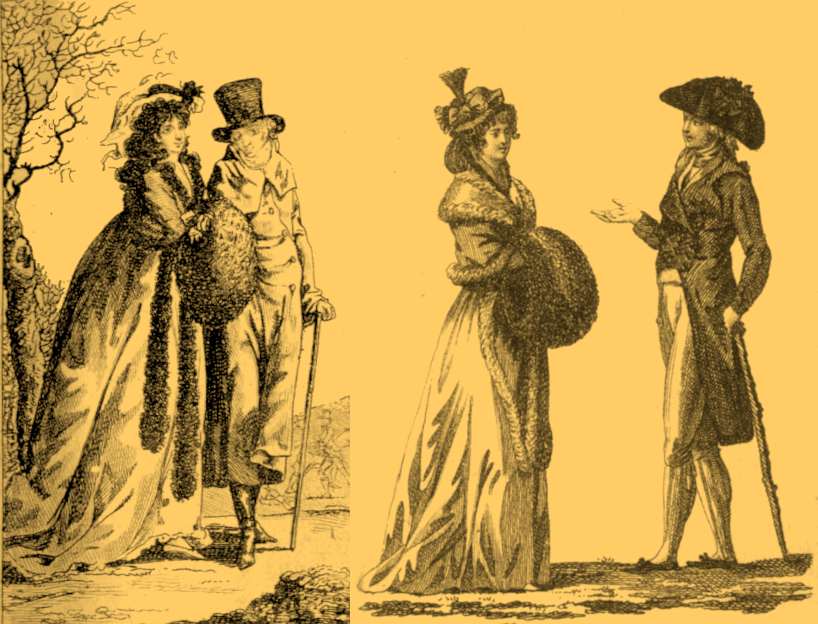
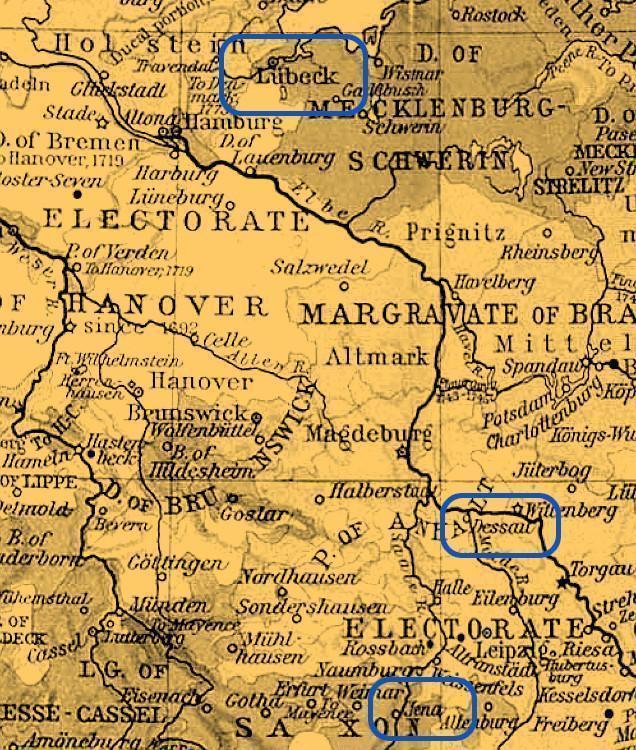
That business with the cough is indeed bad. But play as much as possible and open up your ears so you can really hear what the others are playing and singing that you may begin developing an internal understanding of music. Do not let a single operetta go by without listening to it. I will pay whatever it costs. I will send your muff with Madam Frommann’s sister Madam Bohn, who will be traveling back by way of Dessau. [5] Madam Fromman’s aunt, Madam Hanbury, is also here with a great many children; [6] in short, a veritable Hamburgerie has been set up in their house.
Hofrath Hufeland has returned along with his wife and children. [7] How beggarly and shabby all that is.
Buonaparte is in Paris. [8] O child, only think, everything is going well again. The Russians have been driven out of Switzerland — the Russians and the English must shamefully capitulate in Holland, the French are penetrating into Swabia. [9] And now Buonaparte is coming as well. You should rejoice as well, otherwise I will think that all you are doing is dilly-dallying around without ever having a single intelligent thought.
Madam Tiek basically displeases me after all, it is merely that I do not want it to start showing. [9a] He himself is quite amusing, and we spend quite a bit of time together.
But you simply would not believe the things this bunch comes up with. I will send you a sonnet about Herr Merkel, who in Berlin was gossiping about how the duke allegedly had the Schlegels reprimanded because of Athenaeum |573| etc. [10] So Wilhelm and Tiek sat down yesterday evening and presented him with a despicable sonnet. What a celebration it was to watch their brown eyes flashing sparks across the room and with what cheerful boisterousness this wholly justified malice was perpetrated! Madam Veit and I were almost rolling on the floor with laughter. [11] Madam Veit can really laugh, something that will commend her to you most excellently. Herr Merkel the Monster is done for. He will never recover from this. [11a]
This will, of course, prompt a murderous outcry from every quarter. [12] Schütz and Wilhelm have exchanged charming billets, [13] Schelling is attacking the Allgemeine Literatur Zeitung with full force. [14] But these quarrels do not concern you, whereas the Russians and Buonaparte do considerably. . . .
If only Tischbein would come much earlier, as early as November, and go ahead and finish your portrait. [15]
Madam Schiller has been so sick in childbed with nervous fever that the physician has already given up on her. [16]
Grandmother wrote again. I am determined now to have you confirmed here with Luise Seidler. [17]
So, you are getting fat, my slender child! What an ugly thought! Now I must leave you there so you can pine until you are gaunt again. . . .
Schelling’s brother is big and strong and speaks with a thick and broad Swabian accent. Although he resembles his brother in certain ways, his countenance has none of the inspired defiance. He is not taking his meals with us, and Schelling’s opinion is that things should not go so excessively well quite so quickly for such a rascal. . . .
If I wrote and told you that Charlotte’s child was mortally ill, let me relate to you now that it is doing better again. [18]
I will write our dear Madam Tischbein next time; today it is impossible.
Notes
[1] Josef Körner, Krisenjahre, 3:64, corrects Erich Schmidt’s incorrect identification, (1913), 1:693, of “Hufeland” here as Christoph Wilhelm Hufeland; see Caroline’s letter to Auguste on 17 October 1799 (letter 249), note 3. Back.
[2] The possibility that Auguste might return from Dessau with the Hufelands has been a topic of Caroline’s letters to her for the past several letters. As it turned out, Auguste would not return to Jena until 26 November 1799 with Wilhelm Schlegel (Rudolf Koch and Fritz Kredel, Deutschland und angrenzende Gebiete [Leipzig 1937]):

[3] Fr., here: “in a word, in short.” Back.
[4] An allusion to Wallenstein’s essentially obsessive and ultimately fatal obsession with astrology and presumably to Thekla’s reaction to the news of Max Piccolomini’s death under the hooves of the enemy’s horses during battle (for the text describing his death, see supplementary appendix 236c.1). Thekla reacts to the horrible news in a monologue in the final scene to act 4 (translation from The Death of Wallenstein, in Schiller’s Works, vol. 2, trans. J. G. Fischer [Philadelphia 1883]; illustration of Thekla initially receiving the news of Max Piccolomini’s death: ibid., 240):
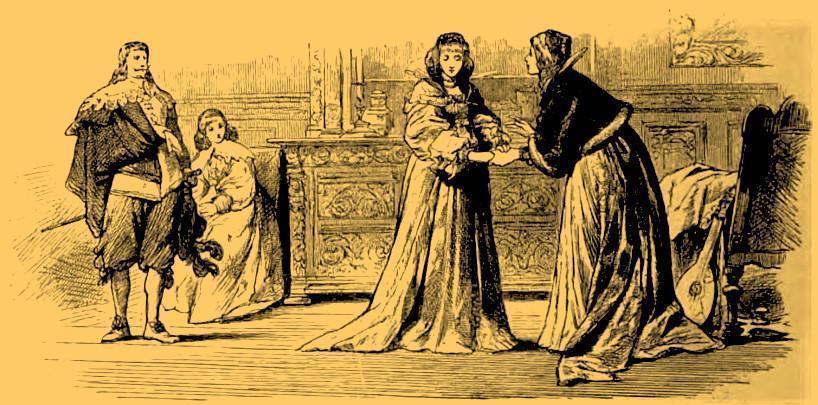
Thekla His spirit ’tis that calls me: ’tis the troop
Of his true followers, who offer’d up
Themselves to avenge his death: and they accuse me
Of an ignoble loitering — they would not
Forsake their leader even in his death — they died for him
And shall I live?
For me, too, was that laurel-garland twined
That decks his bier. Life is an empty casket:
I throw it from me. O! my only hope; —
To die beneath the hoofs of trampling steeds —
That is the lot of heroes upon earth! [Exit.](The Curtain drops.) Back.
[5] Here contemporary muffs in fashion plates from 1798, 1796, 1795 ([1] Der Zauber des Orpheus für Freunde der Musik und Dichtkunst: Ein Almanach für 1798; [2] Toiletten Kalender für Frauenzimmer 1796; [3] Toiletten Kalender für Frauenzimmer 1795; all: Inhaltsverzeichnis deutscher Almanache, Theodor Springmann Stiftung):

Madam Bohn would presumably be traveling to her home in Lübeck (W. R. Shepherd, Historical Map of Central Europe about 1786 [1926]):
[6] Caroline Hanbury had four daughters. Back.
[7] The Hufelands had three children: Mathilde, Therese, and Siegmund (Adolph). Back.
[8] After learning of France’s defeats in the War of the Second Coalition, Napoleon left Egypt on his own initiative, i.e., without orders, on 24 August 1799, landing at Fréjus, on the French coast, on 8 October 1799, and proceeding to Paris. Although French fortunes had improved, the country itself was bankrupt and the Directory unpopular. He was approached by one of the directors to support a coup to overthrow the constitutional government. On 9 November (18 Brumaire by the French Republican Calendar), the Directory was effectively dissolved in its move to Chateau Saint-Cloud (Napoleon at St. Cloud, Taschenbuch für die neuste Geschichte [1801]; Inhaltsverzeichnis deutscher Almanache, Theodor Springmann Stiftung):
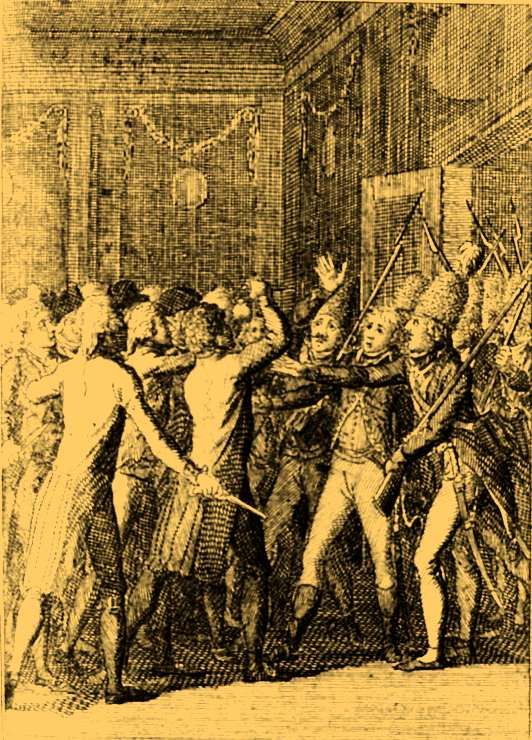
In the aftermath Napoleon was named one of the provisional consuls and then succeeded in having himself elected First Consul and virtual dictator. Back.
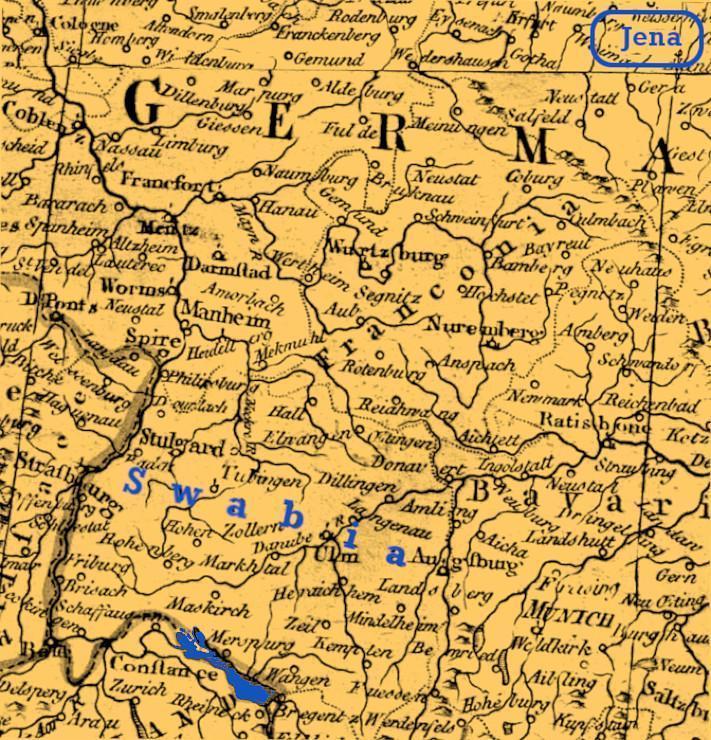
[9] Concerning these events, see Caroline’s letter to Auguste on 16 September 1799 (letter 244), note 7 (with cross reference to letter 236). — The Russians had been driven out of Switzerland by the French, the British forced to surrender all the prisoners they had taken in their failed Holland campaign in exchange for unobstructed evacuation, having failed to cooperate with the Russians effectively. Indeed, the Russians withdrew from the coalition entirely.
Jean-Baptist Jourdan had orders to advance into southwest Germany to the west of Lake Constance in what is now Baden-Württemberg, broadly Swabia (Thomas Kitchin, (Composite of) Europe divided into its empires, kingdoms, states, republics, &c [1787])
[9a] Caroline had articulated her initially reserved (and slightly critical) opinion of Amalie Tieck in her letter to Auguste on 21 October 1799 (letter 250). Back.
[10] Concerning this gossip, see Fichte to Schelling (not Schelling to Fichte as in Schmidt, [1913], 1:749) on 22 October 1799 (letter 251a). Back.
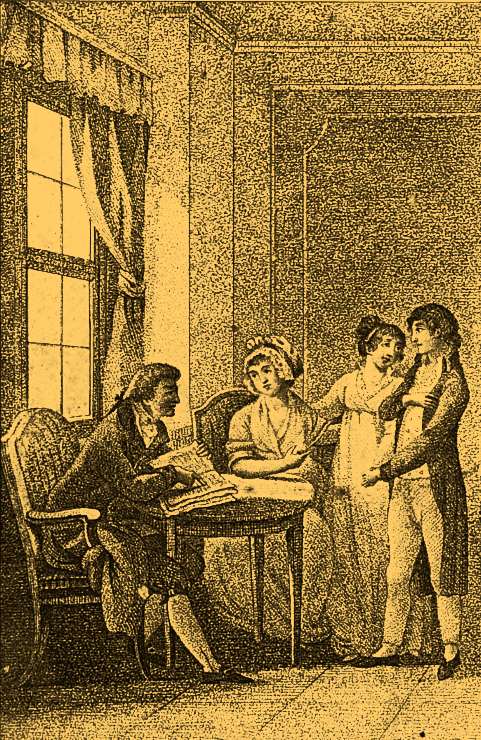
[11] Frontispiece to August Lafontaine, Rudolph und Julie,, vol. 1 (Halle 1801):
[11a] Garlieb Merkel remained a resolute literary adversary of the Jena Romantics even after the group’s dispersal from Jena. Back.
[12] Concerning this entire episode and its aftermath, see supplementary appendix 252.1. Back.
[13] On 20–21 October 1799 (letters 249b, c, d), leading to Wilhelm’s departure as a contributor from the Allgemeine Literatur-Zeitung. Back.
[14] Schelling’s quarrels initially concerned what in his opinion were inferior reviews of his publications. This quarrel is documented in subsequent letters (see his missive to the Intelligenzblatt of the Allgemeine Literatur-Zeitung on 2 November 1799 [letter/document 252d]). Back.
[15] Tischbein seems to have been in Dresden rather than Dessau with his family. Back.
[16] See Schiller’s missives to Goethe during this period (Correspondence between Schiller and Goethe 2:282ff):
22 October 1799: The recovery of my little wife is proceeding somewhat slowly, but she has been spared all bad after-effects, and the little one is growing daily.
(R. J. Steidele, Lehrbuch der Hebammenkunst [Vienna 1791]):
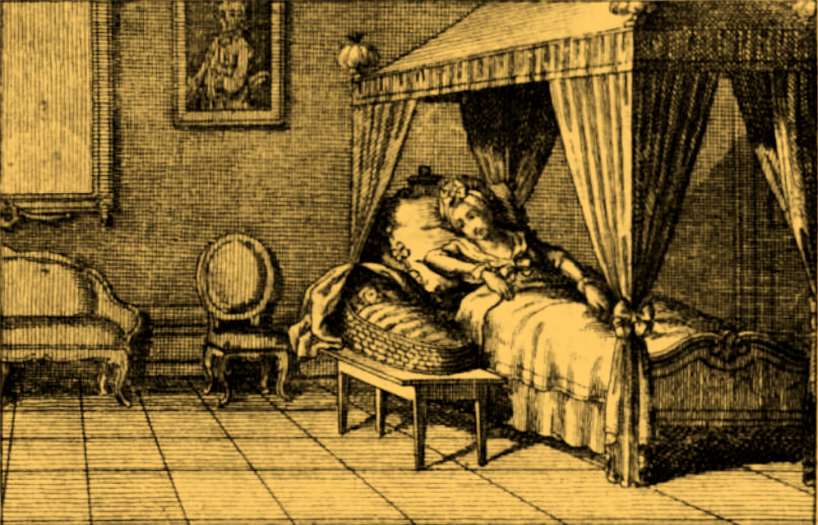
25 October: Since the evening on which I last wrote to you, the state of things here has been very sad. That same night my wife got worse, and her trouble has now taken the form of regular nervous fever, which causes us great anxiety. She has, it is true, a good deal of strength considering the suffering she has gone through, but she has been delirious for three days, has not had any sleep during all this time, and is often in a very high fever. We are still in great anxiety, although Starke still holds out great hopes of her recovery. . . . Her ravings pierce my very heart, and keep me in a perpetual state of uneasiness.
28 October: I have only a few minutes to tell you that since yesterday evening we have been less anxious, that a tolerably good night was passed, and the ravings no longer so distressing, although my poor dear wife is still in a state of delirium. The rash has come out and her strength is still good. Starke is hopeful, and thinks that an improvement may probably set in on Thursday.
30 October: I take this opportunity, which has just offered itself, of sending a letter to Weimar, so as to let you know that, in Starke’s opinion, my wife is now out of danger; the fever has almost entirely disappeared, but, unfortunately, consciousness has not yet returned; in fact, violent attacks of derangement of the mind are of frequent occurrence.
1 November: The one-and-twentieth day of the illness is now past, the fever is very much less and is often quite gone, but consciousness has not yet returned; in fact, it seems as if the whole mischief has settled in the head, and it often takes the form of regular phrenetic attacks. We are, therefore, no longer anxious about the life of my dear wife, but cannot help fearing that her head may suffer.
4 November: Things are, unfortunately, exactly in the same state with my wife as they were three days ago, and it cannot be said what the end of it may be. Since the day before yesterday she has not uttered a syllable, although several circumstances would lead one to suppose that she recognises us, and she returns the signs of affection we show her. . . . An obstinate dullness, indifference and absence of mind, are the symptoms which distress and make us most anxious. . . . opium, musk, hyoscyamus, china [quinine], camphor, oxide of zinc, vesication, sinapisine, cold ammonia-compresses on her head, strong oils for embrocation, have all been tried in turn, and today another trial with belladonna is to be made.
8 November: The day before yesterday, on my return home, I found my wife just as I had left her. Yesterday was a good day and promising in many ways; but last night the restlessness returned accompanied by great distress of mind, and her recovery seems again to be very far off.
19 November: Last night was a tolerably good one, but throughout today my poor wife has again been very much troubled with her imagination, and made us very unhappy.
4 December (from Weimar): . . . my wife, who is staying with Madam von Stein, had a good night after the troubles of the previous day, without a trace of her old attacks. The beginning, therefore, has been fortunate, and I hope the best for the future.
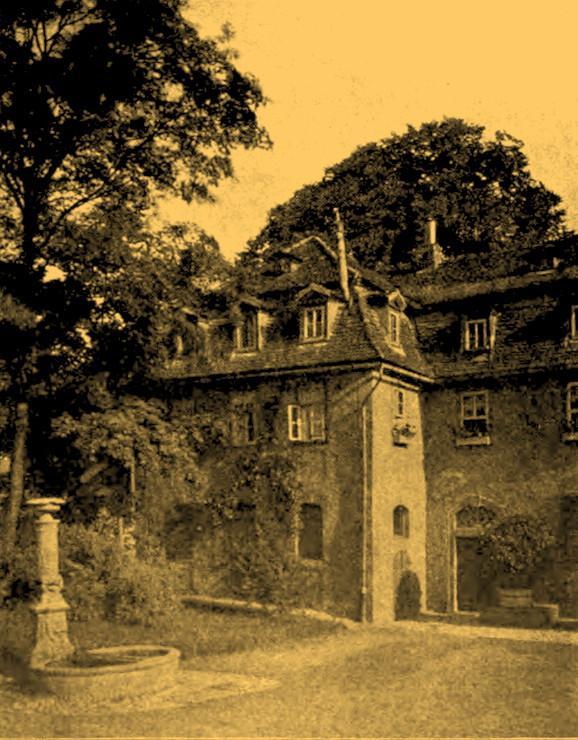
Here the house of Frau von Stein in Weimar, where she resided from 1776 to 1827 (illustration from Wilhelm Bode, Damals in Weimar [Weimar 1912], 34):
7 December (from Weimar): My wife has kept steadily well during the last five days, without the slightest trace of her previous condition. God grant that things may remain in this good state. Back.
[17] Caroline mentions this issue of confirmation in her letters to Auguste on 30 September and 5 October 1799 (letters 245, 246), as does Friedrich Schlegel in his letter to her after 17 October 1799 (letter 249a).
Louise Seidler fondly recalled being confirmed together with “charming Auguste.”
Erinnerungen und Leben der Malerin Louise Seidler. Aus handschriftlichem Nachlass zusammengestellt und bearbeitet von Hermann Uhde, ed. Hermann Uhde (Berlin 1874; 2nd ed. 1875), 11–12; new edition Erinnerungen der Malerin Louise Seidler, (Berlin 1922), 13–14 (Thomas Stothard, Confirmation [1792]; Herzog August Bibliothek; Museums./Signatur FBartolozzi V 3.223):

Her [Luise’s grandmother’s] death [on 2 November 1799] introduced a change in the plans that had been made for my life insofar as at the urging of my aunt Dorette I was to be sent to the boarding school of Madam Stieler in Gotha (wife [correct: mother] of the famous cartographer), which had an excellent reputation, to prepare me to be a governess.
Hence in the winter of 1799–1800 I was given instruction in Christianity and then, not yet fourteen years old, confirmed, in fact together with charming Auguste Böhmer, whose early death in Bocklet (12 July 1800), brought about when she had to care for her sick mother, was so touchingly lamented in a series of sonnets by her stepfather, A. W. Schlegel [Todtenopfer für Augusta Böhmer, Sämmtliche Werke 1:127–40; translated in the supplementary appendix Wilhelm Schlegel: Todtenopfer], also made the philosopher Schelling, at the time a professor in Jena, into the subject of malicious gossip as a result of foolish rumors concerning an opium cure he had used on her.
I do, by the way, well remember a tragicomic event from the time when I was confirmed. The residence of the venerable superintendent who was to prepare us for the holy sacrament was located directly across from the former town moat [Graben], where the dear street urchins were wont to engage in their cheerful games. Especially during the winter, when parts of the moat were frozen solid, there was no end to the sliding.
Here an illustration of the promenade along the former moat along the town walls in Jena ca. 1791; the Powder Tower stands at right (Jena und Weimar von alter zu neuer Zeit [Jena 1908], following p. 64) and an otherwise unidentified skating opportunity of the sort Luise here mentions (Taschenbuch für das Jahr 1811 [Frankfurt], vignette for the month of January) along with the same kind of embarrassing of slip (Gottlieb Böttger der Ältere, Schlittschulaufende Jungen [1804]; Herzog August Bibliothek; Museums./Signatur Graph. A1: 244):


It was with secret envy that I watched all this fun that my grandmother had hitherto strictly forbidden me; I would have given my very life to try out my skill on the smooth ice. But I was just too ashamed — until one day Auguste Böhmer, to whom I had confided both my profound longing and my reservations, facilely dispensed with the latter through one joke or other.
So I tried my hand at what I had never before dared to do, and rushed out to the slippery iceway; unfortunately, unpracticed as I indeed was, I fell flat onto the ice, tall and gangly, with my Bible, hymnal, and catechism books flying everywhere. When I finally scrambled back onto my feet, blushed with embarrassment, I saw to my horror the grave teacher standing at his window, in rapt astonishment, both hands clasped over his head.
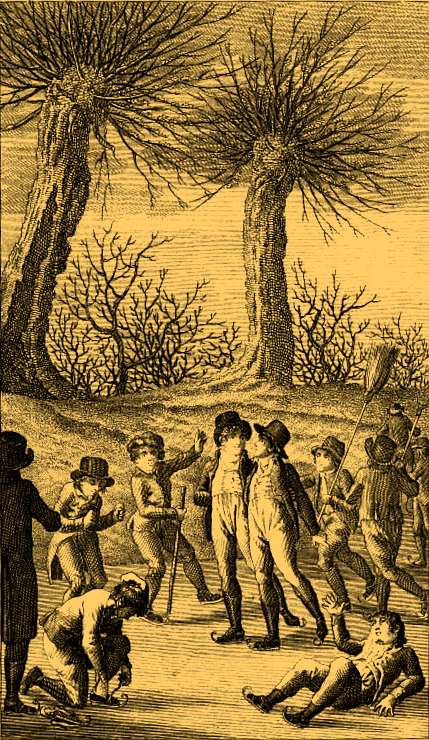
For a town plan showing the intact town walls and Graben from an earlier period, see Dorothea’s letter to Wilhelm on 23 September 1800 (letter 268a), note 1.
During the autumn of 1799, Auguste developed a not entirely neurotic anxiety at the prospect of traditional confirmation and catechism instruction. Caroline had written her back on 30 September 1799 (letter 245): “you yourself, however, realize that I cannot have you confirmed here under [pastor Christian] Oemler [born 1728], since you would surely perish in the process”; and she herself then writes to Cäcilie Gotter on 6 November 1799 (letter 254): “I am now also to be confirmed at Easter, and you cannot imagine how much I fear it!” Concerning this anxiety, click on the gallery below:

Louise Seidler resurfaces in 1817 in Munich as an intimate friend of Pauline Schelling, née Gotter. Back.
[18] Caroline had mentioned Auguste Ernst’s illness in her letter to Auguste on 21 October 1799 (letter 250). Back.
Translation © 2013 Doug Stott