
• 143. Caroline to Friedrich Ludwig Wilhelm Meyer in Berlin: Gotha, 16 March 1794
Gotha, 16 March [17]94
|330| My poor friend, from very the beginning of your letter, I could already read what was at its end; it seemed to me that here and there I could even hear you crying “Woe!” Read this only if you are experiencing no pains, otherwise you will not be able to avoid others than merely the ones podagra is causing you. I at least believe it will be thus — though perhaps here, too, I am excessively questioning my own heart. This much is certain, however, there is nothing more uncomfortable than taking a sympathetic interest in me — and yet —
though fate hate me ever so much,
will now you blindly recite its maxims? [1]
Can you forgive me for boundless misfortune? You have a much too sanguine understanding of my situation and are wholly unfamiliar with the way things are here. I, too, was unfamiliar with it, else would I have spared myself this entire sojourn even though it has not been entirely unfruitful — for if my friends had not seen me, they, too, doubtless gradually would have come to think the same of me as does the world at large.
I must absolutely recognize that nothing can change in this regard. What a weave of abominations has entangled me — and the guilt I genuinely have |331| merely serves to elicit belief in additional guilt I never could have incurred. And yet not even this really had to be thus —
I would in any case gain nothing over a universal sort of “system” that has already been stubbornly followed several times in the past. That is to say, the office of “judge” has always been exercised quite stringently here. You remember Auguste Schneider — she was shunned and condemned despite the otherwise so customary policy that should have spared her. Once she was dead, however, how gladly would they have summoned her forth from her quiet grave because her very existence had made the regent more human. [2]
There are several other examples of this sort in which virtue has been most strikingly avenged. I am not speaking out of bitterness, my dear Meyer; it seems to me that I would not be prejudiced even against that sort of uncompassionate virtue despite you yourself believing that we all cling to prejudices. —
All of them have raised their threatening hand against me — what I did is worthy of condemnation before everyone — whereas what I did not do, and yet which, had I done it, would indeed be worthy of condemnation before me myself, is taken to be true about me because the most unfortunate chain of events makes it seem probable. [3] It is, moreover, now politic not to think well of me. The words I wrote you and that I now find repeated in one of your letters — namely, that my existence in Germany is over, that I have been disgracefully handed over to a spiteful public [4] — they are true — and virtually everything has come true that I foresaw when I was considering whether it would be better to live or to die. [5] —
That I am still alive — is precious to me — for you know what it is that binds me — love and kindness cannot die within my heart, and thus neither can joy. It is simply that I should not have settled again among acquaintances — why should I allow myself to be thus tormented? My imagination will not persist in occupying itself with the opinion I have in so unconcerned a fashion put behind me as long as I am able to escape its immediate effects.
|332| You seem not to be overlooking, my good Meyer, how much one must know about me with certainty — consider the people whose company I had to keep in Königstein, consider the entirety of their low, base nature. Consider how early I was already being denigrated by people in Frankfurt, long before I even left Mainz — would you yourself not lose faith?
Consider then with regard to certain people how much Therese was always opposed to me — (the entire scope of which I have only now become aware) — with what — how should I describe it? was it art? — every fortuitous circumstance was in her favor — with what success she was always, wherever she could but manage it, able to cast the most disadvantageous light on me — in a word, I am lost from every possible quarter — socially dead with regard to my status as a citizen despite the noble conduct of my friends. —
You are imagining that I was wrong not to pay a visit to certain people — but I could not pay such visits. From the very moment the news got out that I was coming, people were extraordinarily careful never even to mention my name, and those two most notably. [6] I was firmly resolved not to go to anyone — though I admittedly did not at all expect people to avoid me so trenchantly, for I was too persuaded that I did not merit such to begin with.
In the meantime — before you wrote me, I had already sent the enclosure [7] to Amalie through (the chanoinesse, daughter of Madam S.), Louise Schläger (the only person who knows about every event, whose heart feels and thus does not reject me). Here you also have the response, [8] concerning whose explanation I must add that — precisely because Louise related to me that Amalie’s own negative judgment toward me in fact derives from Therese — I told her in so many words about the considerable extent to which Therese had acknowledged to me her own culpability in this matter — concluding thus: “It would be base to try to bring about a general change of opinion in the matter — and such change is |333| not essential to my own peace of mind in any case — but I would like the opportunity to explain certain things to you.”
My dear friend, I hope you have the patience to read this — I admit I cannot spare you such if you are to be properly informed in the event you might be of service to me or if you have heard it differently than it is in reality. —
If with regard to Therese I made mistakes, it was that I was not just toward myself. And who knows that better than you? Indeed, at this very moment I am — blind, or perhaps — fair-minded enough to view your remarks as too harsh. Concerning Amalie’s response I have nothing more to say.
I have resolved to wait and persevere, but only until I have found a secure place, though such will admittedly probably not be Berlin. Nor will the consideration of earning a living influence me in my choice. I want to forget and be forgotten. Had I but a small hut in some amiable locale — I would be quite capable of living alone with my children [9] — here, deep in my breast, dwells a peace no fate has been able to destroy. Occasionally, when in my lonely room with Auguste I have forgotten myself, busily occupied with some activity or the other, and then become aware again of the kind of world that surrounds me, I wonder — “Are you really the person who people feel is no longer capable of even a single worthy feeling — you? before whom the pure now shudder? [10] Were you not created instead for the most tranquil domestic happiness, had fate but allowed it? — And you can still enjoy it — for it is from despair itself that you have often wrested the most serene hours of tranquility.”
You can sense, my friend, that I am not despairing — no possible human power can ever make me be less good than I am. Although the path I take will — perhaps never silence the slander, it will — and this I can promise myself and every person who loves me — never justify it.
|334| There is one thing I have done to help me narrow down my choices — I wrote to Meiners and his wife — they are familiar with Germany and with German-speaking Switzerland — they have a good overall view of my situation and will, I hope, be willing to advise me. —
What do you mean by “good reputation”? Am I to save what cannot be saved in any case, and in the process lose what is more precious still? Should I expose myself to influences that, regardless of how steadfast I might be, will invariably disturb my tranquility — undermine my health and make even more difficult the good things that I am still able to do? I have still been able to make my poor Gustel happy — she often sees my bitter tears, tears that flow only when I communicate to someone in conversation or writing — but then she also sees me smile again. Someday, as a warning to her, she will remember those tears — and the smile, that she might still love the mother who transgressed against her, and might yet bless her sorrowful memory.
True, you need what I am telling you here as little as you do anything else someone might relate to you — but I do need it, even though I am not as certain of you as I am of myself. Indeed, how exceedingly rarely have I experienced any relief that I did not derive solely from within my own heart — it would not surprise me if you, too, who know all about the blind rage of chance, nevertheless fell prey to it and became its tool in wounding me yet once more from a perspective with regard to which I am not entirely without feeling.
Indeed! Misfortune itself can force into parting company even those who might have been siblings in misfortune — Remain my friend as long as you can. — Do not let it vex you when I contradict you — I, too, am tolerant of your, let us say: less gentle manner of contradiction. How can you believe Forster would ever have become a man? And men who are not men bring about the misfortune of even the most excellent woman. In that sense, Forster himself |335| promoted Therese’s misdeeds. You may recall the reason for my downfall, a reason about which I have still not told you enough [11] — but why linger in the past?
I have not yet read what you wrote for Göschen; [12] one is in a rather wretched situation here as far as reading material is concerned. You are familiar with Gotter’s inactivity — I am not very keen on getting in touch with Ettinger, and the rest of the gentlemen, Herr Schaz, your adversary, etc., are not part of my circle of acquaintances. [13] Gotter himself has not yet managed to read “Die Erlösung,” [14] despite the fact that he is eager to get hold of everything that comes from you — father and children still have friends [15] — among ourselves, we speak about you with a measure of love that you perhaps no longer even know how to accept into your heart. You do realize that someone has found allegory in Homer, so why might I not find it in your fairy tale, about which I have a more positive opinion than I am really inclined to express just now.
Dieterich came here to select a wife for himself, and he found one in Mademoiselle Friedheim. [16] Hofrath Michaelis in Marburg is marrying a certain Fräulein von Malsburg — who has been his lady friend for 6 years. [17] —
You will answer me when you are healthy again and would like to gladden my day. Please keep the enclosures in your archive.
We send our regards.
Notes
[1] Caroline slightly (albeit deftly, given her circumstances) alters verses from Meyer’s poem “Bey Uebersendung eines Bildes der Maria von Moulines. Den. 25 November,” Spiele des Witzes und der Phantasie (Berlin 1793), 33–34 (not 54, as in Schmidt [1913], 704), whose initial three stanzas read as follows:
In the snow-covered field did I find her
sadly astray, her on whom from a full cup
the goddess did pour love, grief and torment;
seven summers already have passed
since joy did depart her cheeks,
and peace her breast.

For a false delusion did deceive her,
alas! she did believe herself deceived by him
to whom her affections did incline;
he is faithless! speak her tears,
speaks her pale, deathly quiet yearning,
every other image has she banned.

Fallen, the forest's leaves all,
harsh and merciless, the weather,
and Maria without even a hut's shelter;
you shall not go pale in poverty,
though fate hate you unjustly,
never will I blindly recite its maxims. Back.
[2] Allegedly the mistress of Duke Ernst II von Saxony-Gotha-Altenburg, Auguste Schneider died of consumption on 23 February 1785. H. A. O. Reichard, Selbstbiographie, 156, portrays the relationship as having been considerably more platonic than it apparently was (see below), though according to Wilhelm von Humboldt’s account of a conversation with Therese Forster on 8 October 1788, even Therese herself insisted it was not what most people thought (Wilhelm von Humboldt, Gesammelte Schriften, ed. Königlich preussische Akademie der Wissenschaften, Abteilung 3, Wilhelm von Humboldts Tagebücher, ed. Albert Leitzmann, vol. 14, Tagebücher I: 1788–1798 [Berlin 1916], 44–45):
I spent a bit of time alone with Therese. She spoke to me about one of her former lady friends, a certain Mademoiselle Schneider in Gotha. Because the duke loved her and visited her daily, the whole town viewed her as his mistress. But the girl never gave herself to the prince. A young man wanted to marry her, and she was genuinely fond of him. Alas, a bit of coquettishness that — as Therese put it — perhaps merits pardon given so much beauty, caused her to keep the young man at arm’s length rather than agreeing immediately to marry him. When the prince fell in love with her, she had, however, already resolved to do so.
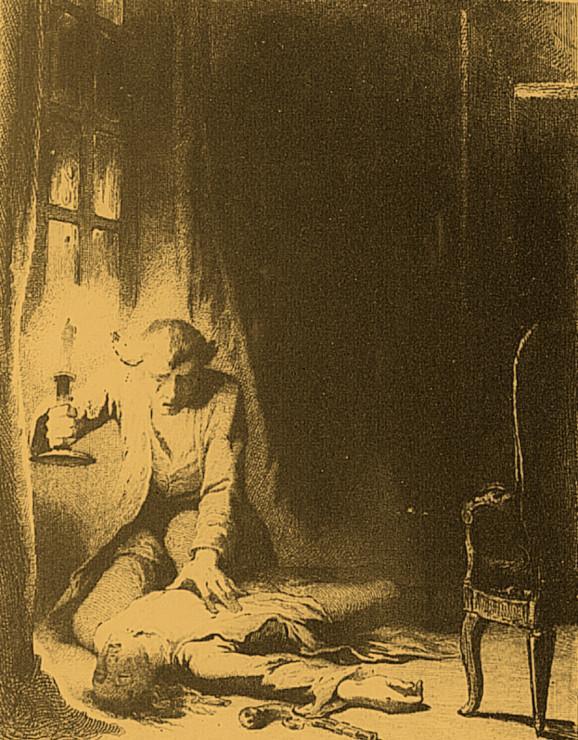
But the same evening she intended to tell him, company prevented her from doing so, and the next morning the young man shot himself to death.
The classic pistol-suicide scene from the period was from Goethe‘s Die Leiden des jungen Werthers (Leipzig 1774) (Tony Johannot, [Illustrations de Werther [Paris 1845]; Bibliothèque nationale de France):
She did genuinely love the duke. This and the fact that she nonetheless resisted his amorous advances so assaulted her heart that she came down with consumption and died a few months later. Therese, who was her close friend, ignored all the prejudices and all the gossip, journeyed to where she was, and remained at her side the entire time she was sick, even up to her death.
Therese told me that this experience was extremely useful to her, having taught here something she was able to use quite often later, namely, patience. We spoke at considerable length about the unfortunate girl. Therese said she could not comprehend how a person could love as did that girl and yet not surrender wholly to one’s feelings, how she could be viewed by the town gossip as a mistress and yet still not give herself to her lover. For after all, love consists precisely in such complete yielding, complete surrendering.
In any event, both H. A. O. Reichard’s, wife, Amalie Reichard, née Seidler, and Therese Forster were close to Auguste Schneider, with Therese’s reputation understandably at risk, as Humboldt quite rightly points out, because of that association. Goethe also mentions Auguste Schneider in letters to Charlotte von Stein. Concerning Reichard’s comments in his autobiography as well as Therese Forster’s extensive accounts and Goethe’s own comments, see supplementary appendix 143.1. Back.
[3] Almanac de Goettingue pour l’anneé 1786; Inhaltsverzeichnis deutscher Almanache, Theodor Springmann Stiftung:

Although trying to reconstruct Caroline’s line of thinking here is risky, it seems to be some version of the following: “What I did is worthy of condemnation before everyone” may refer to her pregnancy, about which, however, no one in Gotha knew. “What I did not do, and yet which, had I done it, would indeed be worthy of condemnation before me myself, is taken to be true about me because the most unfortunate chain of events makes it seem probable” may refer to the insinuation and even published accounts viewing her as having had an affair with Georg Forster in Mainz, which people in Gotha and elsewhere seem almost universally to have assumed. Back.
[4] Caroline to Meyer on 15 June 1793 (letter 129). Back.
[5] See Caroline to Meyer on 30 July 1793 (letter 132). Back.
[6] Presumably the “the two sisters Gelbke and Grabstich” mentioned in Caroline’s letters to Meyer on 10 May 1794 and 30–31 August 1794 (letters 144, 147) and again in her letter to Franz Oberthür on 21 September 1794 (letter 148) (Leipziger Taschenbuch für Frauenzimmer zum Nutzen und Vergnügen auf das Jahr 1798; Inhaltsverzeichnis deutscher Almanache, Theodor Springmann Stiftung):

[7] Presumably Caroline’s letter to Amalie Reichard at the end of February 1794 (letter 141), a copy of which in someone’s handwriting other than Caroline’s is included among her letters in the Biblioteka Jagiellońska in Krakau, Poland, letters consisting primarily of those she wrote to Meyer himself. Back.
[8] Presumably from Amalie Reichard, though no longer extant. It is uncertain in which missive Caroline’s next citation (“It would be base to try to bring about a general change of opinion in the matter etc.”) was written. Back.
[9] Here Caroline is still clearly anticipating eventually getting Julius from his foster parents in Lucka to join her and Auguste. Back.
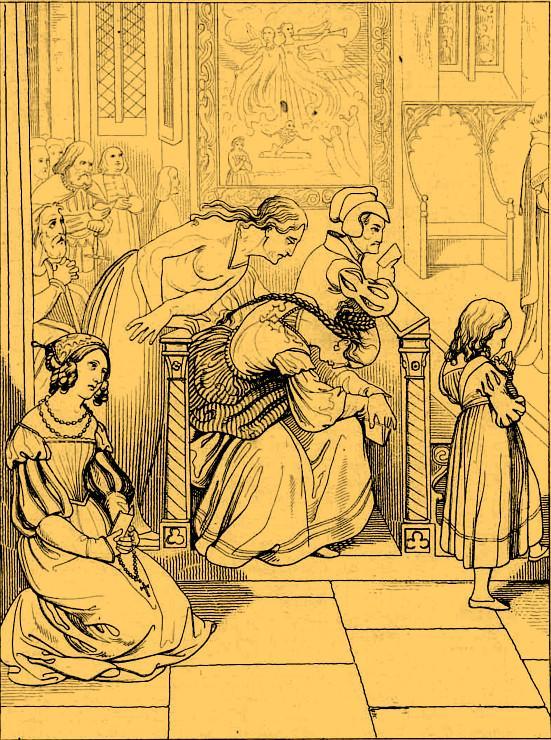
[10] Albert Leitzmann, “Aus Karolinens Lebenskreisen,” 127–28, points out that Caroline’s turn of phrase here evokes lines spoken by the character of the Evil Spirit to Gretchen in Goethe’s Faust, part 1, in the scene “Cathedral,” lines 3828–3832. After the Evil Spirit speaks these words while leaning over Gretchen from behind, Gretchen faints (translation: Faust. A Tragedy, trans. Bayard Taylor [Boston, New York 1870], 177; illustration: Julius Nisle, Göthe-Gallerie: Stahlstiche zu Göthe’s Meisterwerken, vol. 4 [Stuttgart n.d.], plate 22):
Hide thyself! Sin and Shame
Stay never hidden.
Air? Light?
Woe to thee!

They turn their faces,
The glorified, from Thee:
The pure, their hands to offer,
Shuddering, refuse thee!
Woe!
[11] Possibly an allusion to Caroline’s vague and incomplete explanations concerning her disappointment in Georg Ernst Tatter in her letter to Meyer on 15 June 1793 (letter 129): “My patience began to be exhausted [in Mainz], my heart regained its freedom, and in this position, without an aim in life, it seemed to me that I could do no better than to alleviate a friend’s sufferings and — find diversion for my thoughts.” Or is she referencing the circumstances of her pregnancy before leaving Mainz? Back.
[12] Uncertain publication reference. Back.
[13] Georg Gottlieb Schatz, the prolific writer of reviews, was by far not the enemy of Meyer alone, but of a host of other writers as well (Goethe and Schiller’s Xenien also deride Schatz). Friedrich Jacobs includes the following remarks in his extensive characterization of Schatz in his Personalien (Leipzig 1840), 335–47, here 341–42:
He had already insulted several writers with his derogatory assessments, and an even greater number, with whose works he was perhaps not even familiar, believed he had insulted them. That he was dealing with the testy nation of poets made things even worse; and that he was so adroit wielding the rapier of wit made him detested especially among those already painfully aware of their own literary shortcomings — sunt quos hoc genus minime juvet, utpote plures culpari dignos [Horace: “There are some who are by no means pleased with this sort of writing, as being for the most part worthy of censure themselves”; The Works of Horace with English Notes, ed. A. J. Macleane and Reginald Chase, 11th ed. (Boston 1878), 416].
Hence his own collection of poems had hardly appeared [Bluhmen auf den Altar der Grazien (Leipzig 1787)] when people began exacting their own revenge on him. Every epigram was exhaustively interpreted, and, since there is no dearth of fools, it came as no surprise that the poet’s originals were everywhere found out. The insulted authors and their friends wrote bitter, derisive reviews; the leading journals were silent; the author’s work gave him untold vexation, and very, very little joy.
Schatz himself superficially poked fun at Meyer’s Spiele des Witzes und der Phantasie (Berlin 1793) in the Neue allgemeine deutsche Bibliothek, vol. 6, no. 1 (1793), 140–42 (under the pseudonym Ea), praising only the admittedly quite comely volume design along with Wilhelm Schlegel’s poem “Bakchidion,” which was also printed there, but otherwise finding only mediocre material in it (for text of review, see supplementary appendix 143.2).
In a letter to Meyer on 14 September 1795, Schiller alludes to this situation in advising Meyer not to be “led astray by the pathetic fuss of literary reviewers” (Schillers Briefe, ed. Fritz Jonas IV [Stuttgart 1894], 266). Back.
[14] Caroline mentions this piece in her letter to Meyer on 20 February 1794 (letter 140), with note 14. Back.
[15] That is, still have friends in Gotha despite Caroline’s presence in their home. Back.
[16] Concerning Heinrich Dieterich (Lotte Michaelis’s husband and widower) and Janette Fridheim, see Luise Wiedemann’s account in her Erinnerungen, p. 32 and p. 90. Back.
[17] That is, since approximately 1788; Fritz Michaelis had first come to Marburg in 1786 after being appointed professor of medicine in December 1785. Back.
Translation © 2011 Doug Stott