
255b. Dorothea Veit to Schleiermacher in Berlin: Jena, 15 November 1799 [*]
Jena, 15 November 1799
My dear friend, it is not at all right that you so rarely write. Hardenberg is here for a few days. [1] You have to see him in person, for even if you read 30 books by him, you will not understand him as well as if you have tea with him but once. I am speaking solely of his appearance, since I myself have not yet really entered into conversation with him, though I think he is the one avoiding it; he is so in Tiek, with Tiek, for Tiek that he simply has no room for anything else.
Enfin . . . he has not yet really impressed me. But he looks like a ghost-seer, [2] and has a quite unique personality quite to himself, that much cannot be denied. Christianity is à l’ordre du jour here; [3] all these gentlemen are a bit daft. Tiek is driven by religion the way Schiller is driven by fate; [4] Hardenberg believes Tiek shares his opinions wholly and completely, but I would wager, say what you will, that they understand neither themselves nor each other.
But now only listen!
Yesterday afternoon I was in Paradies (that is what they called a certain promenade here) with the Schlegels, Caroline, Schelling, Hardenberg, and one of his brothers, a certain Lieutenant Hardenberg, [5] and who should suddenly appear coming down the hill? none other than his old Divine Excellency, Goethe himself. He sees the large company and veers a bit to the side, we make a deft maneuver, half of our party withdraws, and the Schlegels walk directly toward him with me. [6]
Wilhelm is leading me. Friedrich and the lieutenant bring up the rear. Wilhelm introduces me to him, he pays me a very nice compliment, turns completely around with us and retraces his steps and goes back up the hill once more with us, and is cordial and charming and all at ease and quite attentive toward your most obedient lady servant.
At first I was hesitant to say anything, but since he and Wilhelm could not really get any conversation going, I thought to myself, well, the devil take modesty, if he is bored then I have irrevocably lost my opportunity! so I immediately asked him something, about the rushing currents in the Saale River, he responded with an explanation, and thus we continued on in a lively manner.
I kept looking at him and thinking of all his poems; he most resembles Wilhelm Meister now. [7] You would not have been able to keep from laughing yourself silly had you seen how I felt walking there between Goethe and Friedrich. I earlier withstood the trial by water of low spirits; will I now also be able to withstand the trial by fire of high spirits? [8] —
He also greeted Friedrich with a very distinguished countenance, and that made me very happy indeed. [9]
My dear Schleiermacher, please be so good and tell Madam Bernhardi that Caroline has sent her manuscript to Becker and at the same time also written down her address, so he will arrange everything further with her directly. [10] I will write her again very soon about the fairy tales. [11] Please beg her pardon for my not having done so until now, I have much to do and am unable to make use of my mornings because of these eternal headaches; only if I stay very quiet during the morning do they pass. But then time becomes scarce, as has money — — please let her know, my good friend.
Imagine my uncontrollable delight, I composed a very nice Lied for my novel, everyone is quite pleased with it. [12]
Will you not write me and take care of my requests? do you hate me? Give my regards to Jette, this letter is intended for her as well. Only call it a letter even though it does not deserve the name, I simply have no time, I swear to you
Dorothea
Notes
[*] Sources: Aus Schleiermacher’s Leben 3:132–33 (incomplete); Briefe von Dorothea Schlegel an Friedrich Schleiermacher 21–22; KGA V/3 237–38; KFSA 25:22–23. Back.
[1] Friedrich von Hardenberg was in Jena between 11 and 15 November 1799. Back.
[2] Enfin, Fr., here: “in a word, in short.”
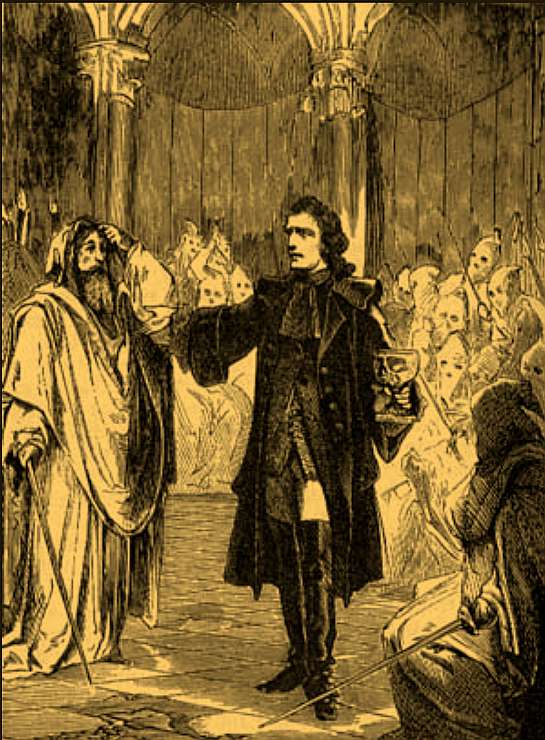
Here a late-19th-century illustration of the possible inspiration for the mysterious character in Schiller’s Der Geisterseher: Eine Geschichte aus den Memoires des Grafen von O** (Leipzig 1789), Giuseppe Balsamo, also known as Cagliostro (Alexandre Dumas, Memoiren eines Arztes, Erste Abteilung, Joseph Balsamo [Wien/Pest/Leipzig ca. 1900], 13):
The notion of the possibility of such communication with the dead had become increasingly popular (Ebenezer Sibly, A New and Complete Illustration of the Celestial Science of Astrology; Or, The Art of Foretelling Future Events and Contingencies, 2 vols., 12th [sic] ed., [London 1822], plate following p. 1106):
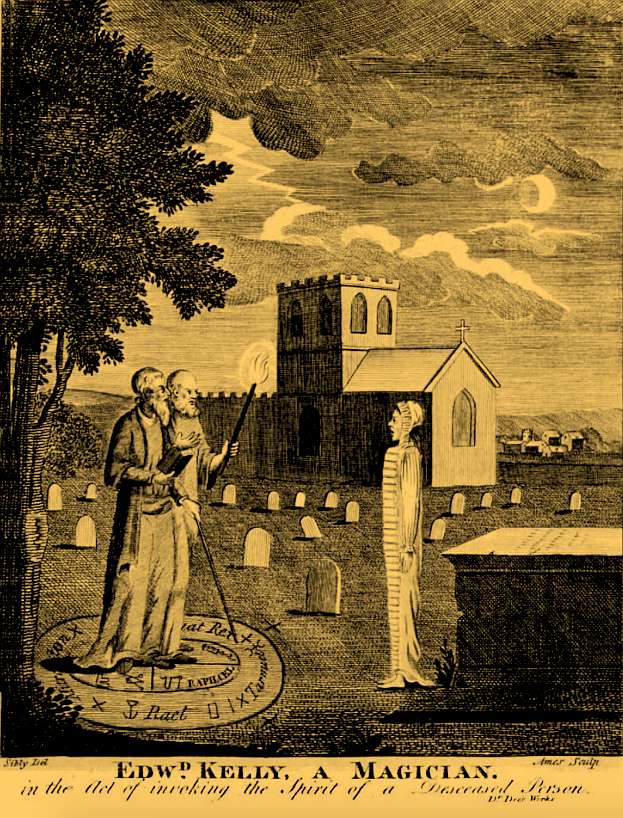
Concerning Hardenberg’s earlier essentially mystic experience at the grave of his deceased fiancée Sophie von Kühn, see esp. Friedrich’s letter to him on 5 May 1797 (letter 181f), note 3.
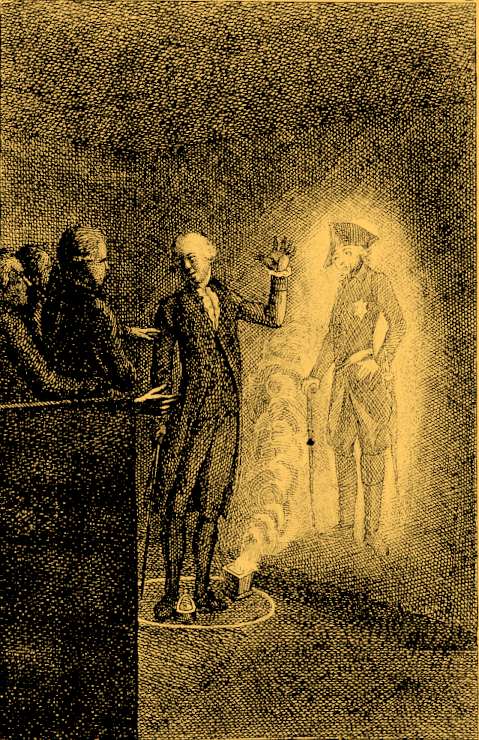
That said, Dorothea’s application of the expression “ghost-seer” to Hardenberg is not necessarily a compliment, for the notion of actual contact with the dead — mystical or otherwise — was by no means widely accepted by the general disposition of the late Enlightenment in Germany; here an illustration in a periodical for “enlighteners and non-enlighteners” (“Der Geisterbeschwörer,” Taschenbuch für Aufklärer und Nichtaufklärer auf das Jahr 1791):
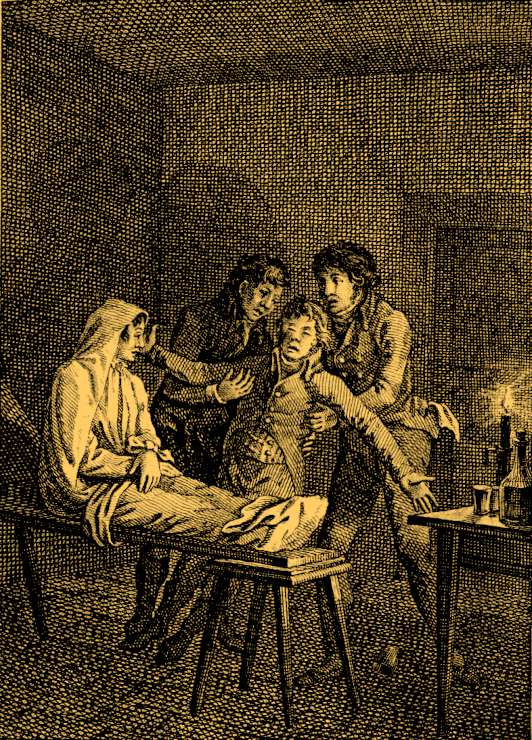
Indeed, young people were warned against such practices in various periodicals, as is the case with the following illustration of an “ill-considered practical joke” (Taschenbuch für die Deutsche Jugend auf das Jahr 1804; Inhaltsverzeichnis deutscher Almanache, Theodor Springmann Stiftung):
[3] Fr., “on the order of the day, on the current agenda.” Back.
[4] An allusion to the “Horseman’s Song” at the conclusion to Schiller’s Wallensteins Lager (from Wallenstein), published first in Schiller’s Musen-Almanach für das Jahr 1798, 137–40; Eng. Wallenstein’s Camp, trans. Theodor Wirgman (London 1871), 101–3 (illustration: Schiller’s Works , ed. J. G. Fischer, vol. 2 [Philadelphia 1883], 119):
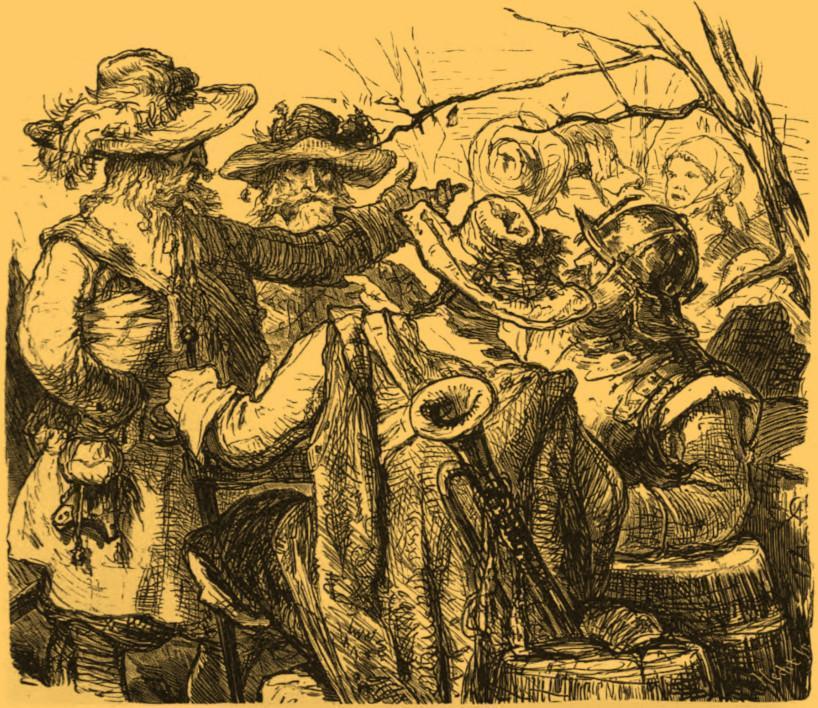
Second Cuirassier. Why drowns the maid with tears her mirth
And pines away? — Pray let him go!
Fix’d quarters he has not on earth,
Wherefore true love he ne’er can know.
Fate drives him on in rapid pace;
Rest he ne’er finds in any place.Chorus. Fate drives him on in rapid pace;
Rest he n’er finds in any place.First Chasseur. Then saddle, Comrades! quick your steeds!
Uplift to combat bold your breast!
Youth champs and mid-life foams for deeds;
Quick — ere the mind spirts out its zest.
If you won’t stake your life anon,
Ne’er will a life for you be won!Chorus. If you won’t stake your life anon,
Ne’er will a life for you be won! Back.
[5] Possibly Karl von Hardenberg (Gerhard Schulz, Novalis in Selbstzeugnissen und Bilddokumenten [Reinbeck 1969], 122), but more likely, given the title and impersonal description, Anton Georg von Hardenberg, from February 1797 a cadet in Weissensee near Grüningen, who could have been a lieutenant in 1799 (KFSA 25:388fn6). That said, Gotthold Klee, “Ein Brief Ludwig Tiecks aus Jena vom 6. Dezember 1799,” Euphorion, Drittes Ergänzungsheft (1897), 211–15, here 212, identifies him as Karl von Hardenberg. Back.
[6] According to his diary, Goethe was in Jena from 10 November till 8 December 1799 (Weimarer Ausgabe 3:2:269–74); his diary for 14 November 1799 (ibid., 270) notes: “Went for a walk about midday. The weather was again quite beautiful.” It does not mention this meeting, though it does note that he met with Wilhelm Schlegel the following day (illustration: title vignette to Christian Friedrich Sintenis, Flemmings Geschichte: Ein Denkmal des Glaubens an Gott und Unsterblichkeit, vol. 1 [Leipzig 1789]):

In any event, the Paradies green space was above all a locale for just such recreational walks and encounters, one for which Dorothea had been hoping since her arrival ([1] Henry Mayhew, German Life and Manners as Seen in Saxony at the Present Day, 2 vols. [London 1864], 2:166; [2] Leipziger Taschenbuch für Frauenzimmer zum Nutzen und Vergnügen auf das Jahr 1808):


[7] Illustration of Wilhelm Meister from Goethe-Galerie. Charaktere aus Goethe’s Werken. Gezeichnet von Friedrich Pecht und Arthur von Ramberg [Leipzig 1864]):
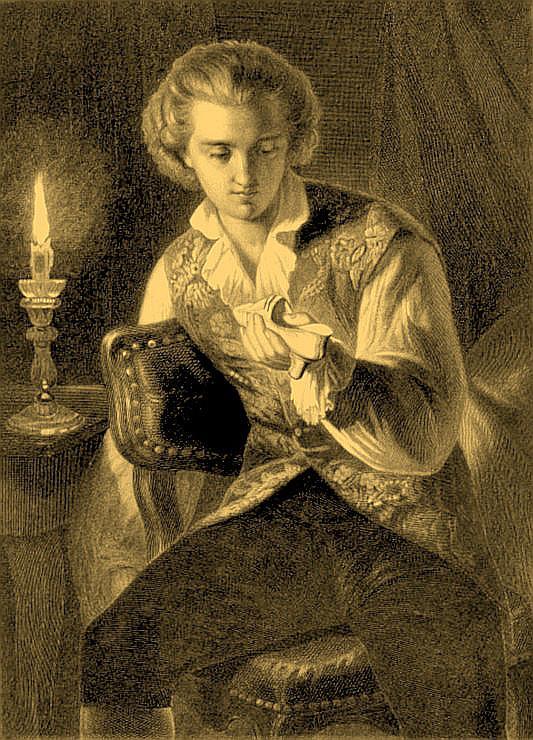
Here Goethe in 1800 by Friedrich Bury:

[8] The “trial by water of low spirits” was Dorothea’s disappointment at not yet having encountered Goethe in Jena; see her letter to Schleiermacher on 28 October 1799 (letter 252a) with note 17. The “trial by fire of high spirits” is now this actual encounter with him.
The allusion is presumably otherwise to Mozart’s opera Die Zauberflöte (premiered in 1791 in Vienna); see Il flauto magico (The Magic Flute): An Opera in Two Acts, The Opera Libretto (New York 1858), 19–21 (scene 12):
[A tremendous mountain; at the foot, a deep cavern, with an iron grating in its recesses; flames arise, which mount to the top, whence liquid masses of lava are seen to descend. On one side, a pyramid with an inscription; two men appear covered with black armor, who read the inscription to Tamino. After Pamina.]
Men. He who pursues this path with dangers full,
Becometh pure by fire, water, earth, and air.
If he can o’ercome the terrors of death,
From out of earth he rises unto Heaven.
Thus purified, he will then be able
To devote himself to Isis’ mysteries.Tamino. Acts becoming man, no fear of death
Will hinder me from consummating.
Open, then, the portals of terror,
With joy I’ll dare the bold career.Pamina. May heaven have compassion and guard thy steps.
[The gate opposite to that whence Tamino came out, opens; Pamina enters, and they rush into each other’s embrace.]
[Together:]
Pamina. {Dearest Tamino.
Tamino. Dearest Pamina. Oh what happiness is this.}
Tamino. But here terror dwells. [To Pamina.] Here death each instant threatens.
Pamina. I will be your faithful companion wherever you go. I will lead my love; and love in return will lead me. [Takes him by the hand.]
Love will deck thy thorny way,
And the path with roses strew;
Thy flute enchanting sounds obey,
These each danger shall subdue.
When fashion'd in an omen'd hour
From aged laurel by my sire,
How did the heavens with tempests lower,
What lightnings glared and spectres dire.
Then prove its power: though rough the way;
Be bold, advance, and banish fear.
All four. Let wisdom, joined with valor, sway;
Who knows to die, shall conquer here.[The two armed men retire, and shut the grating, on the other side of which Tamino is seen to pass, sounding his flute, and followed by Pamina, through the midst of the fire.]
[Together:]
Tamino, Pamina.
The raging flames Have passed away, And lick the feet In harmless play; But still the roar Of waves we hear; Dark is the sky, No shores appear.[The mountain changes into another, from the summit of which a torrent precipitates itself Pamina and Tamino descend the mountain, and on searching the plain, they both courageously endeavor to stem the torrent. Tamino sounds his flute as they proceed; the waters cover them, but Tamino still continues to sound his flute. At last they proceed so far that they can no longer resist the force of the torrent, which bears them away, and they are seen no more. When they are thought to be drowned, the mountain divides, and in its centre discovers a temple, where Tamino and Pamina are seen in the act of returning thanks.]
Tamino. At length the dangerous
Wave is past,
And heaven in mercy
Smiles at last.[The gate of the Temple opens; Tamino and Pamina are still seen on their knees.]
A Chorus of Priests from within.
No more, no more.
The trial's won:
Lo! virtue crowns
Her favorite son.
Now close the rites,
The pomp prepare,
To triumph lead
The noble pair. [Exeunt.] Back.
[9] Daniel Nikolaus Chodowiecki, Die Freundschaft (1793) (Herzog Anton Ulrich-Museum; Museums./Signatur DChodowiecki AB 3.968):
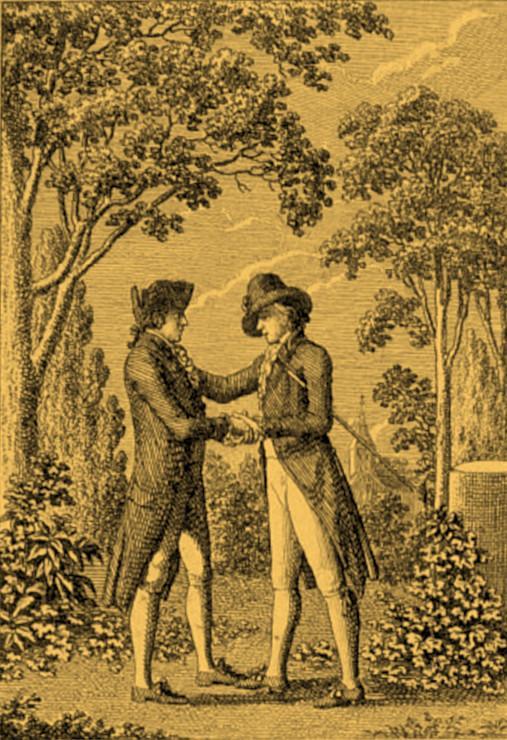
[10] At issue is the attempt to sell the manuscript of Sophie Bernhardi’s novel Julie Saint Albain to Wilhelm Gottlieb Becker. See Caroline’s letter to Wilhelm Gottlieb Becker on 23 September 1799 (letter 244a) and Dorothea’s to Sophie Bernhardi on 4 November 1799 (letter 253a). Back.
[11] See again Dorothea’s letter to Sophie Bernhardi on 4 November 1799 (letter 253a), with note 2. It is unknown but unlikely that Becker actually published the first fairy tale (“Die Quelle der Liebe”) of the collection (KFSA 25:386fn3, 388fn13); in any event, this collection plays a role in Wilhelm Schlegel’s correspondence with Sophie in 1801. Back.
[12] Dorothea’s novel Florentin. Ein Roman herausgegeben von Friedrich Schlegel, vol. 1 (Lübeck 1801) (vol. 2 never appeared); the novel contains several art songs, or lieder. Back.
Translation © 2013 Doug Stott