
• 172. Caroline to Luise Gotter in Gotha: Jena, 22? October 1796
[Jena, 22? October 1796] Saturday morning
|401| I just received your letter, dear Louise, and was myself just now about to send you the Allmanach by way of the newspaper courier, since your sister will not be leaving until Tuesday. [1] Although I do indeed want to go ahead and take care of it, I am horrified when I think of the commentary, which will turn into a quite extensive written task. Although much will probably be self-explanatory, other things I myself cannot really explain because Schiller is observing an inviolable |402| silence, confirming or denying only this or that detail. Nonetheless, let me have at it as briefly as possible. [2]
P. 201 [nos. 9–12] I do not understand except for what can be given a general interpretation; such I will mark with †.
Pp. 202 and 203 Hermes [13]
For Daughters of Noble Birth.
To daughters of noble birth can we commend this work,
That they might quickly be promoted to daughters of pleasure.
Some general persons. The Antiquarian Stollberg.
The Antiquarian.
What the Christian eye beholds, I espy in marble:
Zeus and all his kind fretting and fearing death.
H. S. Heinrich Stilling.
H. S.
Never have I put much stock in sentimentalists, who,
Given the opportunity, turn into poor company.
The Prophet Lavater.
The Prophet.
A pity that nature created but one of you,
For the ingredients sufficed for a man of dignity and a rogue.
204. Lavater [21, 22],
The Amalgamation.
Though nature mixes everything so uniquely and intensely, yet here
Alas, are noble-mindedness and impishness a bit too close.
Noble Material.
Your muse extolls how God had mercy on humans,
But that he found them pathetic: is that poesy?
Stollberg [23]
Belshazzar: a Drama.
King Belshazzar revels and feasts in act 1, the king
In the second, the prince on up till the end.
Hermes [24].
Certain Heroes in Novels.
Without taking anything away from the pedant, you,
Dear artist without equal, created the perfect dandy.
So also 205 [25], the last two [27, 28] Baron von Racknitz.
The Newest School.
Earlier one had taste. Now there are “tastes,”
But do tell, where is these tastes’ taste?
To Germans Keen on Building.
You learn to decorate rooms Kamchatkanly,
Though much among you is already sufficiently Kamchatkan.
206 [29–32] general persons. 207, 208 [33–41] Manso.
33. Manso on the Graces.
Though witches, indeed, be invoked through inferior aphorisms,
Grace does enter only at the summons of grace itself.34. Tasso’s Jerusalem by the same.
An asphalt swamp does yet here mark the spot
Where once Jerusalem stood that Torquato sang for us.35. The Art of Love.
You even need art in order to love? Unhappy Manso,
that nature otherwise did nothing, absolutely nothing for you!36. The Breslau Schoolmaster.
In boring verses and fatuous thoughts
A preceptor teaches us here how to please and how to seduce.37. Amor as Teaching Colleague.
The most terrifying of all terrifying things?
A pedant itching to be loose and easy.
209 is self-explanatory, as also 210 and 11 [41–50].
N. O. P. †. The last one [52] Stollberg.
The Commissar of the Last Judgment.
To Calabria he travels, to inspect the arsenal
Where the artillery for the Last Judgment is being forged.
212 [54] Jacob in Halle.
J–b.
Steep indeed, the path to truth, and slippery,
And yet we prefer not to ascend it on asses.
214 To Kant [63] is aimed at Stollberg etc.
To Kant.
So you think the tone of the new prophets is genteel? Quite so,
Philosophized with gentility means conceived as a commoner.
Then [64] Plattner “Ernst by name.”
The Temporary Philosopher.
A merry doctor, Ernest in name only, explicates
A comical philosophy, and in an airy hall.
216 Sign of Aries [69], our good little Jacobs.
Sign of Ares the Ram.
You encounter first the ram, the leader of the sheep,
From the Dykian corral it defiantly leaps.
Taurus [70] Jacob in Halle.
Sign of Taurus.
You are quickly received by his namesake; with dull horns,
If you yield not, are you then rammed by the Halle ox.
Charioteer [71] Becker.
Sign of the Charioteer.
Soon indeed the Empire’s worthy in-law bursts in G**,
And though he takes you not along, he does pass by.
Gemini [72] the Stollbergs.
Sign of Gemini.
If you come upon the Gemini, speak but: Praise be to J—
C—! “Eternally” will you hear as response.
[Great] Bear [73], Die allgemeine deutsche Bibliothek published in Kiel.
Sign of the Great Bear.
Quite close does the bear at K** reach out its leaden claws
Toward you, and yet catches but the flies in your clothes.
Cancer [74] Rammler.
Sign of Cancer.
Avoid me, Cancer in B***, for many a lyrical blossom,
Swelling in lush growth, has the scythe severed.
Leo [75] Voss.
Sign of Leo.
Henceforth beware of the hearty Eutinian lion,
Lest with Greek tooth he wound your feet.
Virgo [76] Wieland.
Sign of Virgo.
Bow, as is seemly, before the dainty virgin of Weimar,
And though she pout — who would not forgive the graces their moods?
Raven [77] Schlichtegroll.
Sign of the Raven.
Take care with the raven that cackles behind you,
For this necrological animal is after cadavers alone.
Berenice’s Hair [78] Salzburgische Zeitung
Locks of Berenice.
See to it that in S***, too, you escape the crude fists
That stroke Berenice’s hair with zealous comb.
Scorpio [80] Reichard[t] in Giebichenstein.
Sign of Scorpio.
But now a malicious insect comes from G – b – n,
With flattery does it approach, hasten lest it sting.
Ophiuchus †.
Goose [83] the Leipzig and Gotha critics
The Goose.
Just let the goose in L***g and G***a cackle on,
It bites no one, and merely offends the ear.
Capricorn [84] Nicolai.
Sign of Capricorn.
On occasion, do bump the old Berlin ibex,
For that vexes it, and provides laughter for all.
Pegasus [85] Eschenburg.
Pegasus.
But if in B**** you see the Gradus ad Parnassum, politely
Request permission to choose your own paths.
|403| Aquarius [86] Adelung. [3]
Aquarius.
Otherwise stay clear of the Dr***r Aquarius,
Lest he pour out upon you the entire Elbe River.
Eridanus [87] Campe.
Eridanus.
On the shores of Eridanus am I haunted by the fearful washerwoman
Who cleanses the German language with lye and sand.
The rivers are easy to interpret: The Danube in Bavaria, in Austria, etc.
The one about the Spree [River] is splendid.
The Spree River.
Once I received language from Rammler and material from my Caesar,
But I overstuffed my mouth and have since been silent.
P. bei N. [109] Pegni[t]z [River] at Nürnberg
P** at N***.
Long ago did I become a hypochondriac,
And since then flow only because it has — always been thus.
P. 227 Dialogues from the Greek [116], Stollberg.
Dialogs of the Greek.
For the edification of devout souls did F*** S***,
Count and poet, translates these into German.
Charis [119] is referring not to Ramdohr’s newly acquired nobility, but to the casual manner in which he treats the fine arts, and his noble bearing while so doing.
Charis.
Be this the wife of the artist Vulcan? She speaks about the trade
As befits the commoner’s noble half.
229 Ding dong [122] Heydenreich.
Ding dong.
In the art of poetry did he heartlessly ring out with words;
In philosophy he continues on sanctimoniously in the same way.
230 The pair of brothers [125] the Stollbergs
The Brothers.
As centaurs did they once traverse poetic forests,
How swiftly did the wild family convert.
233 Frivolous curiosity [138] refers to the many queries concerning the continuation of the Geisterseher [4]
Frivolous Curiosity.
It was worth the trouble to trouble the Delphic god
To tell you, my friend, just who the Armenian was.
Collection of examples [139] Eschenburg.
Collection of Examples.
Not merely a collection of examples, no, himself a warning example
Of how never to collect for good taste.
Now comes Nicolai and Reichard[t]. What lies between is self-explanatory. 2 [151, 152] refer to Campe.
Society of Friends of Language.
Oh, what self-esteem! How carefully you brush the clothes
Of our authors, and who can avoid the clinging feathers?
The Pedant is cute.
The Purist.
Ingenious you are, cleansing the language of foreign words,
So tell us, good friend, how to translate “pedant” into German.
239 [161–76] here Göthe appears with natural history and optics. Because I have heard him speak a great deal about this, I understand most of them, though to others they will not seem as funny as to those who have heard him speak these epigrams aloud; for you see, he does not really compose his epigrams on paper: they slip out and escape him.
167. Who would believe?
Newton erred, indeed doubly and triply, and how?
It has long been in print, but no one reads it.
170. Example.
I already saw a will-o-the-wisp vanish: you, phlogiston! And soon,
Oh Newtonian specter, will you follow your brother.
245, 46, 47, 48, 49, 50 [184–206] again Nicolai.
251 [208ff.] Reichard[t] the musical director, similarly also 252 and, excepting one [218], then 253, 254, 255, 256 finally [230ff.] Cramer.
In 260–64 [nos. 245–263] you will be able to guess everything.
265 [264] Jacobs will have to tell you about Wolf in Halle.
Leonhard * * [266] Meister.
170. Herr Leonhard **.
Though I read your name in twenty publications, yet
Is it precisely your name, my friend, that is missing in all.
267 [273] Madam B. and her sisters. Madam Brun etc. [5]
|404| B. [275] Baggesen.
170. B**.
Were nature and genius venerated by all people,
Then what, Phantast, would be left for you as a reading public?
269 [280] As a birthday gift. Wieland.
170. For Your Birthday.
May your own life’s thread spin forth as do the sentences
In your prose, in which, unfortunately, Lachesis sleeps.
274 [302ff.] most recent sample of criticism Friz Schlegel. The reference is to a review of the previous Allmanach in the journal Deutschland [see letter 167, note 5], extends to the Jeremiads in the Reichsanzeiger [by Rudolf Zacharias Becker mentioned above], which really are enormously funny.
The two fevers [320] and several of the following ones are again referring to Fr. Schlegel.
302. Most recent samples of criticism.
You lack very little indeed to be called a “master” according to my own concepts,
Providing, of course, I forget how daft are your fantasizations.303. A second.
Your feelings are charming and delicate, your expression cultivated,
But a single thing would I reproach: that you are frosty of heart — and dull.320. Our two fevers.
Hardly has the cold fever of Gallomania subsided
Than a heated one breaks out in Grecomania.330. Swift writers.
What they yesterday learned, would they teach us already today,
Ach! what a short intestine these gentlemen have!331. Sunday’s children.
The master works for years and is never satisfied,
While this ingenious generation receives it . . . in their dreams!
Much is still rather obscure in the underworld. Achilles [338] is allegedly Lessing. The aged Peleus [343] Gleim. Ajax [345] Bürger. Then it gets more serious in three epigrams [347–49], all of which have aroused the highest degree of displeasure, and not just for me! [6] Then Louis 16. [350]. Joseph II [351]. 288 [356] Lessing once again. The Stollbergs [357]. Rammler [359] etc.
290 are the rhapsodies [366] and the following again in the most charming fashion — also the philosophers Reinhold, Fichte, Kant etc.
Someone in the Crowd.
Cogito ergo sum. I think, therefore I am,
If the first be true, the second is sure.
The Ego.
If I think, I am! Doubtless! But who always thinks?
Often I was, and yet was thinking absolutely nothing!
A second someone.
Because there are things, there is a thing of things,
And in the thing of things we all swim just as we are.
A third someone.
I assert exactly the opposite. There is no thing except me!
Everything else arises in me like a bubble.
A fourth someone.
I acknowledge two things: the world and the soul,
Neither knows of the other, and yet the two are one.
A fifth someone.
I know nothing of the “thing.” And nothing of the soul,
Both merely “appear,” and yet are not mere “appearance.”
A sixth someone.
I am I, I posit myself and posit myself myself.
As non-posited, well, I posit a non-self as well.
A seventh someone.
Representation at least “is”; something represented thus “is,”
Something representing as well, so altogether: three!
The Ego.
But with all this I will get no one’s attention,
I need an eclectic statement, and one that posits.
An eighth someone.
Nothing more is available in theory,
But the practical statement stands: You can, for you ought!
The Ego.
Ah, just as I thought. Have you no reasonable response,
You swiftly push it onto a person’s conscience.
Not a single soul knows yet who Hercules [390] is supposed to be, [7] though I am quite sure that the following, general satire is among the best things here [412].
When vice vomits, virtue sits down at the table. That must be Ifland’s poor sinners after life.
He.
The poet is the innkeeper and the final act the bill.
When vice vomits, virtue sits down at the table.
But now I cannot go any further, I have to pack hastily and close. . . .
You can give the Allmanach to Dorette again, and please do be careful with it. [8]
Notes
[1] The reference is to Schiller’s Musen-Almanach für das Jahr 1797, which Caroline has discussed in her letters to Luise Gotter on 4 September, 3 October, and 15–16 October 1796 (letters 169, 170, 171).

The reference will be more specifically to Schiller and Goethe’s satirical epigram collection, the Xenien. — Luise Gotter’s sister is not otherwise identified, though she is also mentioned at the beginning of Caroline’s letter to Luise Gotter on 4 September 1796 (letter 169). Assuming this letter was indeed written on Saturday, 22 October 1796, the following Tuesday would have been 25 October. Back.
[2] Because a complete discussion of all the xenia Caroline mentions here would involve a lengthy introduction and considerable historical background on individual figures, references to the targets of those xenia mentioned here along with translations of several key xenia will have to suffice, albeit enough to provide readers with a sense for what so captivated and at times incensed Caroline and her contemporaries. Readers may keep in mind that Caroline provided Luise Gotter only with the key to several xenia, not the verses themselves as is now the case in this letter.
The Xenien generated vehement indignation and debate at the time of a sort that is perhaps difficult to understand today; numerous responses were published quite apart from discussions in letters such as Caroline’s own, as well as satirical illustrations such as the following (illustration from Franz Neubert, Goethe und sein Kreis, 2nd ed. [Leipzig 1922], 120; “Heavens! What rabble comes hither? Halt, ye passengers! No one passes by me without first having shown his passport!”):

This illustration depicts a procession of burlesque figures trying unsuccessfully to enter the town gates of Jena. The Harlequin figure at the front carries a banner announcing the gang of Schiller and Comp[any] following behind, with Goethe and Schiller themselves at center (Goethe holding the Thierkreis banner [animal kingdom] and Schiller the bottle and whip) while their followers try to “overturn” the column representing “Propriety, Morality, Justice.”
Another illustration from 1797 portrays Schiller physically striking Friedrich Nicolai after having already dispensed with Johann Gottfried Herder. The goddess Minerva presides, who guides men through the perils of war. Not insignificantly (given the questions concerning the authorship of some of the more trenchant and cutting Xenien), Goethe keeps his distance in the background at left (Otto Güntter, Friedrich Schiller: Sein Leben und seine Dichtungen [Leipzig 1925], 83):
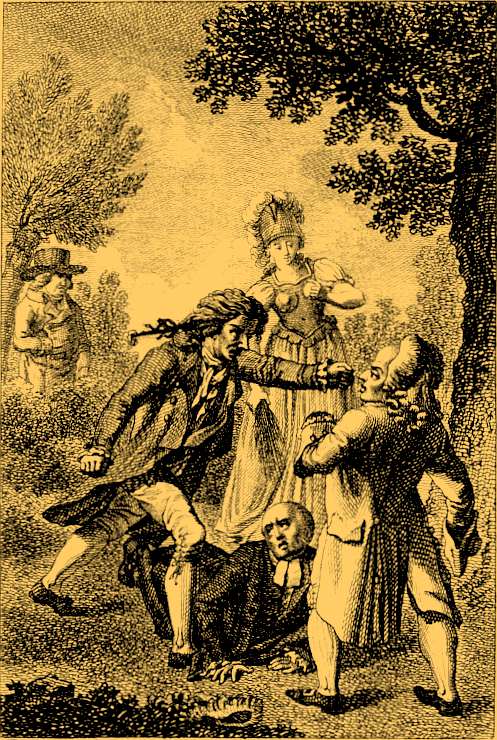
The Musen-Almanach für das Jahr 1797 contained 414 xenia proper, then 124 of what were known as “tame” pieces called tabulae votivae arranged in 103 tabulae, then also 18 and 19 in two other groupings. Moreover, some xenia were not yet published at all. That is, the number of actual pieces was not yet entirely clear.
Erich Schmidt’s exhaustive collection and interpretation, Xenien 1796. nach den Handschriften des Goethe- und Schiller-Archivs, ed. Erich Schmidt and Bernhard Suphan, Schriften der Goethe-Gesellschaft 8 (1893), contains some 926 pieces along with a detailed history of the collection, but with different numbering than the original. Here Caroline lists the original pagination, while Erich Schmidt adds the original epigram number in brackets. The Xenien concluded the Musen-Almanach on pp. 197–302.
In his annotation to this letter, Erich Schmidt (1913), 1:715, remarks the following concerning Caroline’s brief interpretations here:
One can easily orient oneself to Caroline’s key by referring to sequences in more recent publications of the Xenien. Her interpretations are for the most part correct; the only incorrect ones are, e.g., 229 and several things involving the underworld cycle. It is odd that precisely she did not figure out that “Hercules” [no. 390 in original] was referring to Shakespeare. She quite readily interprets “Madam B. and her sisters” [no. 273 in original] as referring to Friederike Brun; in any event both internal and external considerations make it impossible to interpret the distich as referring to Caroline herself. [See Schmidt’s interpretation below.] Of course, she could only find the vexatious epigrams referring to Georg Forster (and Therese Forster) to be extremely repugnant.
It is not entirely clear to which xenion Schmidt is referring as “229” above, since Caroline did indeed get Heydenreich correct as the target of no. 122 on that page (even according to Schmidt himself, ibid., 205, no. 794 in Schmidt’s numbering there); she similarly correctly identifies Reichardt in the series including no. 229.
The “vexatious epigrams” 347, 348, and 349 presumably refer to Georg Forster and his initial enthusiasm for the French Revolution, along with Therese Forster’s role in his demise. See below. Back.
[3] Incorrectly numbered as “85” in Schmidt (1913), 1:403. Back.
[4] Schiller’s fragmentary novel Der Geisterseher: Eine Geschichte aus den Memoires des Grafen von O**, published in instalments in Die Thalia (January 1787–May 1789), and as a book (Leipzig 1789; also 1792; 1793; 1797) (here the frontispiece to the first edition):

It was translated early by D. Bolleau as The Ghost-Seer; or Apparitionist: An Interesting Fragment, Found among the Papers of Count O***** (London 1795) (frontispieces to [1] the 1793 German edition and [2] “The Ghost-Seer; or, Apparitionist,” in The Works of Frederick Schiller: Early Dramas [New York 1895]):


Schiller’s piece along with early Gothic novels such as Horace Walpole’s The Castle of Otranto exerted considerable influence on the development of literature in Germany that dealt with the darker, unexplained side of nature and natural phenomena (frontispieces to the German editions of 1797 and 1792):

Dorothea Veit, moreover, compared Friedrich von Hardenberg’s external appearance, doubtless in allusion to Schiller’s Geisterseher, as that of a “ghost-seer” (see her letter to Schleiermacher on 15 November 1799 [letter 255b]).
Concerning Schiller’s tale, one of whose characters (the mysterious Armenian) was allegedly based on the historical figure Cagliostro, see Agnes Genevieve Murphy, “Banditry, Chivalry, and Terror in German Fiction 1790–1830,” PhD dissertation, University of Chicago (1935), 33–34:
Schiller first used the figure of Cagliostro in a novel, Der Geisterseher (1789). The ghostseer, a mysterious person guised as an Armenian, continually thrusts himself into the path of a German prince visiting in Venice. He alarms the prince by making prophecies which are fulfilled. At a seance, the ghost-seer appears as a Russian officer.
This seance is obviously modeled upon those held by Cagliostro. The guests are seated in a mystic circle around an altar adorned with a skull, a crucifix, and a Bible. The spiritualist’s costume is most peculiar and is covered with magic symbols. As soon as the magician falls into a trance, everyone in the circle feels an electric shock. Thunder is heard, the light is extinguished, and the spirit of the prince’s dearest friend appears. This spirit answers the prince’s questions and then disappears. When the magician awakens from the trance, the Russian tells him that never again will he be allowed to summon spirits.
Immediately, soldiers break down the door, arrest the spiritualist, and investigate the house. They find complicated apparatus used to create the ghostly apparitions [pp. 78–79: “In this vault they found an electrical machine, a clock, and a little silver bell, which, as well as the electrical machine, had a communication with the altar and the crucifix that was fastened upon it. . . . In this hole . . . was fixed a magic lantern, from which the figure of the Ghost had been reflected on the opposite wall”].
(Heinrich Heidegger, Der vernünftige Dorfpfarrer: Geschichte wie sie ist, und wie sie durchgehends seyn sollte: Lesebuch für Landgeistliche und Bauern [Zurich 1791], following p. 84):

The prince questions the magician about the Russian and hears strange tales. This mysterious person is said to be immortal; he neither eats nor sleeps, always disappears for one hour at midnight, and is supposed to be able to summon spirits. The Armenian-Russian is in reality an officer of the Inquisition and uses all sorts of mysterious methods to induce the prince to join the Catholic Church. Eventually, he is successful.
Here two later, 19th-century illustrations of the figure of Giuseppe Balsamo, also known as Cagliostro (Alexandre Dumas, Mémoires d’un médecin: Joseph Balsamo, vol. 1 [Paris 1860], frontispiece and plate following p. 72):

[5] Concerning this epigram and its interpretation, see Erich Schmidt, Xenien 1796. nach den Handschriften des Goethe- und Schiller-Archivs, ed. Erich Schmidt and Bernhard Suphan, Schriften der Goethe-Gesellschaft 8 (1893) 95, 206–8 (supplementary appendix 172.1). Back.
[6] Concerning 347, 348, and 349 (in the original Musen-Almanach on pp. 285–86): In the Aeneid, book 6, Plegyas, having desecrated the temple of Apollo in Delphi, sits tormented in the underworld, warning others not to despise the justice of the Gods (“While Phlegyas’ there ‘mid fiercest torments cries, / No temple violate, no god despise”; The Aeneid of Virgil, trans. J. M. King, 2. vols. [London 1847], 1:247). Some interpretations (e.g., that of Schmidt himself, Xenien 1796, 215) understand this epigram as being directed at Georg Forster and Caroline rather than Therese Forster (or even at Friedrich Schlegel and Caroline; see Robert E. Richards, The Romantic Conception of Life [Chicago 2002], 51).
347. Phlegyasque miserrimus omnes admonet.
[“The unfortunate Phlegyas warns everyone.”]
Oh, but what a fool am I! A raging fool! And raging anyone
Who, following woman’s advice, plants the freedom tree.
Whether the reference is to Therese or Caroline herself, Caroline would be displeased in any case because of her fondness for Forster. The following verses are generally also understood as referring to Forster, and one can easily understand Caroline’s displeasure here as well:
348. The tricolored Cockade.
Who is the raging one who roars through Hell
And with grim fist dishevels his cockade?
Erich Schmidt, Xenien 1796, 215, suggests that 348 may be referring to Klopstock’s initial enthusiasm for the French Revolution and later remorse, though Schmidt is still unsure, suggesting instead that the xenion may “hover” between the two men. The final xenion in the series then reads:
349. Agamemnon.
Citizen Odysseus! How fortunate you! Modest is your spouse,
Knits socks for you instead of pinning the tricolors on you!
Here, quite apart from who Odysseus may be (Schmidt thinks it Klopstock), Agamemnon is Forster, who was destroyed by a woman just as was Agamemon by Clytemnestra and now envies those with appropriately domestic spouses. If such be the correct interpretation, then the woman in no. 347 is likely not Caroline, but rather Forster’s own wife, Therese. Back.
[7] As Erich Schmidt point out (see note 2 above), “Hercules” is referring to Shakespeare:
390. Hercules.
Finally do I catch sight of mighty Hercules! His
Translation! Unfortunately, he himself was nowhere to be seen. Back.
[8] Concerning the identify of Dorette, see Caroline’s letter to Luise Gotter on 4 September 1796 (letter 169) with note 2. Back.
Translation © 2012 Doug Stott