
252a. Dorothea Veit to Schleiermacher in Berlin: Jena, 28 October 1799 [*]
[Jena] 28 October 1799
Friedrich is sitting here in my room trying to take the pulse of a book in English that Wilhelm intends to propose to a bookseller as a translation project; I would then do the translation, that is, if the book is good. [1] But the fellow is making such bored faces during this examination that I fear the whole thing, again, will come to nothing; poor Friedrich, everything gets pushed onto him! I can tell from here that he is extremely bored with it, even though he is sitting at least ten paces from me; so I really do not want to suggest to him that he write you himself in such a mood.
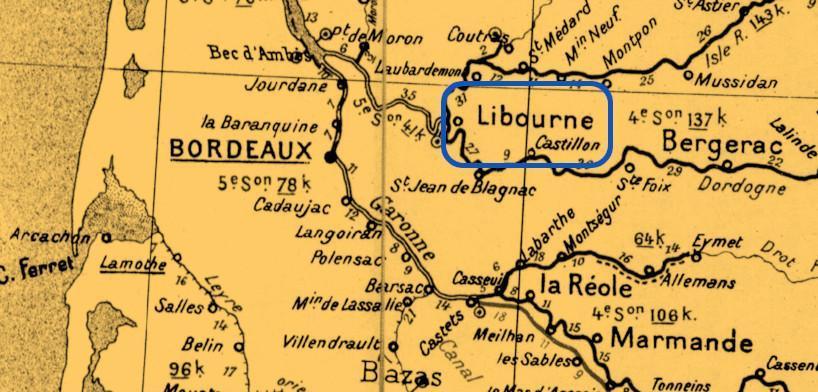
To all his sufferings yet another has been added as well, namely, that one cannot get any reasonable wine here, the customary is the Graves des Graves, otherwise there simply is no other here. [1a] I spoke with Madam Hufeland yesterday, [2] who told me that Madam Herz is still wearing a bandage on her hand. [3] I do hope that everything has mended by now. Give her my profuse and warmest regards, I will write and thank her myself for her letter on the next postal day. —
What a nice letter you wrote me, my dear Schleyer; once, when I was visiting you one morning while Friedrich was in Dresden, [4] you were just so extraordinarily kind, and this letter seemed just the same to me. My dear friend! Please do be good to Friedrich, for no one is as tormented as he, with things not working out. I cannot talk much about it nor do I really know what is going to happen. —
Just now he says he is working on the 2nd part of Lucinde, but he is not as free and cheerful as he should be. [5] It is simply horrible that all these worries thwart his work instead of spurring him on. And even more horrible that all the things he finished in so short a period are not earning enough for him to be able to take a break and get things organized again. And horrible that he is supposed to live from art works that are paid like the work of some tradesman.
In spite of all that, though, I am nonetheless quite hopeful that if we can but help him through a few more years things will surely get better. The sun seems to be shining on the world once again, the good people are victorious again! [6] I am always dreaming that Friedrich will someday take up a different carriere than the one he has now. If fate chooses to give us a state, he, too, will no doubt become a citizen. [7] But soon, please soon, dear heaven, before it is too late for us! —
What in the world do you think about Buonaparte? [8] — can one really mistrust the good fortune of a truly great man? —
Schelling? I do not really know much about him yet; he does not say much. His external appearance, however, is just as one would expect: powerful through and through, defiant, rough, and noble. Really, he should be a French general instead; he does not seem quite suited for the university lectern, and even less, I think, for the literary world.
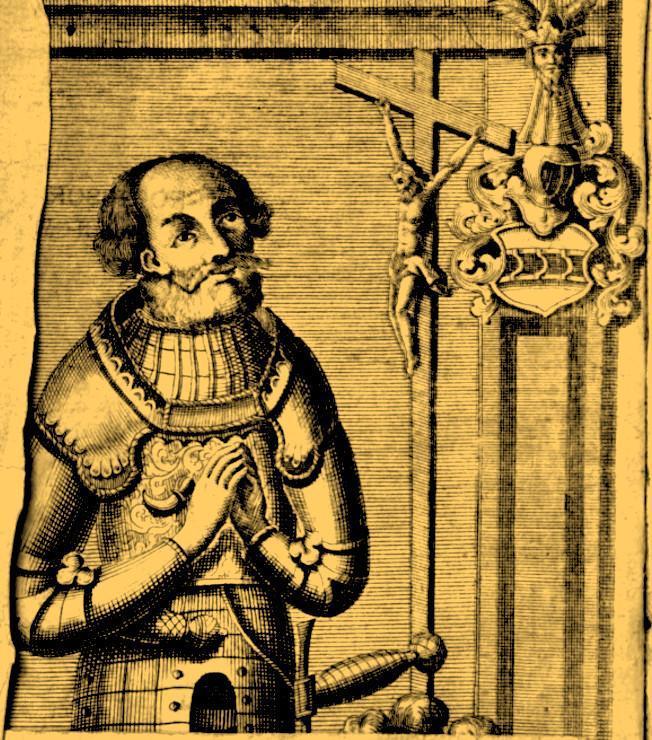
In general, my opinion now is that all you revolutionaries need to fight with body and blood first, and then you might be in a position to retire and write, just as Götz von Berlichingen wrote his own life story. [9] That is also why I am so fond of Benvenuto Cellini. [10] Someday I would also like to read something by Luther, I am suspecting he must greatly resemble those two.
And so also should it be with all of you. For as it is, your personalities, your desires — all that accords with the literary path and criticism and all that stuff the way a giant fits into a child’s bed. I see quite clearly now that those who are sitting at the rudder are polite, cold, malleable simpletons who cannot use any of you for the tiny machines they have set up for their feeble hands. They bend way over when passing through the tiny door, and all of you want to enter standing upright; no wonder you hit your heads.
The quarrel with the Literatur-Zeitung has now been initiated, and something will probably be appearing publicly soon. [11] Wilhelm is a worthy warrior; but it pains me that he must squander so much wit and energy on these wretched creatures.
You will very soon receive a splendid sonnet, the fruit of a magnificent hour by Wilhelm and Tieck [12] (though Tieck’s participation is to remain a secret). I was really thinking about how you should have been here if only to see their effervescence and sparks, you no doubt would have been as entertained as I! [13]
Tieck is in every sense a quite good fellow; he comes across quite properly and seems to be in just the right place, whereas Madam Tieck severely stands out in contrast. One simply puts up with her for the sake of her husband, who really must have resolved to be quite charming here, something at which he is indeed succeeding. Indeed, my dear friend! You yourself should come here. Whenever things get so lively with all the wit and philosophy and art discussions and a general demolition of enemies, I really do think quite vividly of you. You would certainly enjoy it all, and would hardly find time for your mystical ball-throwing after dinner and for those dangerous equilibristic chair-turnings; [14] for say what you will, all that was nothing but mere distractions when they tended to go on a bit too long. —
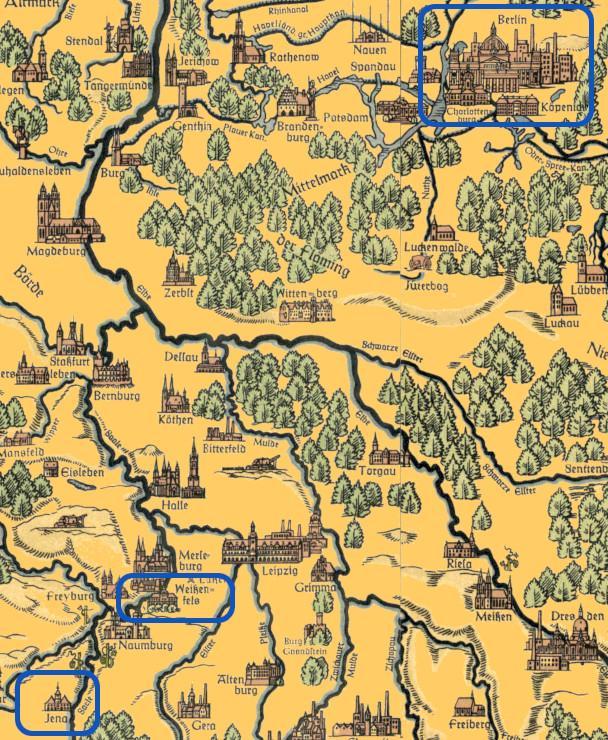
It was quite right of me, just as I had anticipated, not to seek out Hardenberg. [15] A new acquaintance, and certainly one that interesting, always causes me a bit of embarrassment that only afterward gradually and gently disperses; but such takes time, and time is precisely what I did not have. Had I been able to make his acquaintance without him having to make mine, it would have been fine. Then one also needs a bit of — self-awareness — if I may call it that, to summon someone up to have a look at him. Only beautiful women possess such noble audacity, or only they should have it. He is certain to visit here again this winter. [16]
What is true is that he has recently assumed an extremely peculiar disposition. And according to what they say about him here, it is indeed something wondrous! E.g. he is utterly and crazily and madly in love with Tieck, maintaining that the latter is a completely different poet than Goethe, and that sort of thing (“and that sort of thing” is one of Schelling’s expressions). But no one can console me for the fact that I have not seen the pope. [17]
Wilhelm is an excellent person, and I wish Friedrich could always be around him. His energy and constant activity really do extend into the grandiose!
Caroline is charming, and remains so despite my closer acquaintance with her. It is only a great shame that she does not apply her rare talent for art, and really, seriously develop that talent. As it is, however, “beauteous femininity” occupies all her time and all her thoughts. Basically I do not really believe she is all that enamored of the life that is her lot here. Her wish is probably instead to traverse some brilliant path. She is cordial and animated, but never content, never cheerful. One can also often discern in her personality that she is distracted, and noticeably absent or distant — — in a word, I do not believe she is happy. —
I could not write anything about Auguste, since she was not here on my arrival; she is in Dessau, with the Tischbeins. [18]
My dear Schleyermacher, if you see Mademoiselle Levin, give her my kindest regards, I will be writing her as soon as I find the time, in the meantime I would ask that she go ahead and write to me without waiting for my letter. She should and really must compose for us an authoritative opinion on Hamlet. [19] Each person must do what he can, and one expects that of her. —
And also if you see Rose, give her my regards, and ask her why she has not delivered my letters and requests in Leipzig, and why she has not answered me. —
One more thing. Mlle. Levin should write me something about our summer plan. [20] If you chance to see Madam Bernhardi, tell her I will take care of everything and also write her soon. [21] —
I am suffering often from headaches, my dear friend, and have even had to endure a couple of sick days. Quinine and valerian count for absolutely nothing here, though Hufeland maintains the contrary. Now I would like to ask you to request a prescription from Doctor Bing in my name, and to send to me here, well packaged and protected against wetness, a really large amount of good quinine mixed with the appropriate amount of valerian. And also several ounces of valerian without quinine. I also use that often in desperate situations. [22] Does Doctor Bing still have a fever? —
Do go ahead and pass this letter along to Jonas, [23] dear Schleyermacher; only imagine, I have not received a single syllable from the boy, nor any other news from him either, if only he is not sick! Philipp is already practically at home here, and is also quite diligent.
Friedrich sends his warm regards; because he had intended to write you, you will for just that reason presumably not receive any letter from him today. The Lord keep you. Yours,
D[orothea] V[eit]
You will probably have to do something about the spoons soon so that others can eat soup with them. Surely you understand? [24]
Notes
[*] Sources: Aus Schleiermacher’s Leben 3:128–30; Briefe von Dorothea Schlegel an Friedrich Schleiermacher 16–20; KGA V/3:222–26; KFSA 25:17–19. Back.
[1] Dorothea had written to Schleiermacher on 11 October 1799 (letter 247), shortly after her arrival:
Nor is there much hope of finding translation work for me. Wilhelm, who will be traveling to Leipzig next week, intends to try to find something, and Caroline, too, will do her best; but they have not been particularly encouraging; they say this is just not the right time for it, and that there are already so many others who monopolize these projects. Back.
[1a] Concerning Graves wines (from the Bordeaux region of France), see Gottfried Christian Bohns Waarenlager, oder Wörterbuch der Produkten- und Waarenkunde, Der wohlerfahrene Kaufmann 2: A–L (Hamburg 1805), 723–24:
Graves wine is an excellent type of red and white French wine from Gnienne; it is frequently exported to Holland , Bremen, Hamburg, Lübeck, and in general to the north. It is quite tolerable to one’s general health, not particularly intoxicating, and otherwise of varying quality, which is also why its prices vary greatly. The white varieties can be drunk even during their first year, the reds only later, and are generally substituted for Medoc. In general, Graves wine is usually sold in barrels.
See also the following German assessment from 1810, Philipp Andreas Nemnich, Original-Beiträge zur eigentlichen Kenntniss von Frankreich (Tübingen 1810), 159–60:
The red Graves wines, like the white wines of the same name, grow in more or less rocky soil. The have little or no fermentative features, but considerable aroma (bouquet). They are subdivided into four qualities, whose prices vary between 350 and 150 livres. The most excellent is the Haut-Brion. The Graves also include the beautiful St. Emillion, along the Dordogne River near Libourne; such is exported largely to the north. Otherwise Graves-wines are exported almost everywhere because they maintain their high quality even on long sea journeys.
(La France fluviale et maritime [Paris 1925]; Bibliothèque nationale de France, département Cartes et plans):
[2] Hermann Patsch, KFSA, 25:380, suggests the reference here is to Juliana Hufeland, wife of Christoph Wilhelm Hufeland, professor of medicine in Jena. Although the argument might be made that it is unlikely to have been Konradine Luise Hufeland, wife of Gottlieb Hufeland, since, as Dorothea mentions later in the letter, the Jena circle was becoming involved in a heated quarrel with the Allgemeine Literatur-Zeitung, of which Hufeland was co-editor, nonetheless, the latter Hufelands would indeed have had occasion to have contact with Henriette Herz in Berlin (as Dorothea goes on to mention) insofar as they had just returned from a trip to Danzig by way of Berlin and Dessau (see Caroline’s letter to Auguste on 6 October 1799 [letter 247], note 7). Back.
[3] Concerning Henriette Herz’s injured hand, see Dorothea’s letter to Schleiermacher on 11 October 1799 (letter 247c). Back.
[4] Friedrich had been in Dresden during the summer of 1798, when Wilhelm, Caroline, Auguste, and others were there as well. Back.
[5] Friedrich never published a second volume of his novel Lucinde; only fragments have been preserved. Back.
[6] In September 1799, the French army defeated the allied armies of Austria and Russia in Switzerland, prompting a turn in the Second War of Coalition. Caroline similarly extols these events in her letter to Auguste on 28 October 1799 (letter 252); see note 9 there and the cross references. Back.
[7] Dorothea is using these terms in the sense of French état and citoyen as used in connection with the French republic at the time. It is also worth noting that as a Prussian Jew, she was not a full citizen as would have been the case in France (KFSA 25:381fn17). Back.
[8] See Caroline’s letter to Auguste on 28 October 1799 (letter 252) with note 8. Back.
[9] A tall order for the Jena literary “revolutionaries.” The reference is, however, not to Goethe’s well-known play Götz von Berlichingen mit der eisernen Hand. Ein Schauspiel (n.p. 1773), but to the autobiography of the Franconian knight Gottfried von Berlichingen “with the Iron Hand,” Lebens-Beschreibung des Herrn Gözens von Berlichingen, zugenannt mit der Eisern Hand: Eines zu Zeiten Kaisers Maximilian I. und Caroli V. kühnen und tapfern Reichs-Cavaliers (Nürnberg 1731), which served as the source for Goethe’s play; here the frontispiece to that edition:
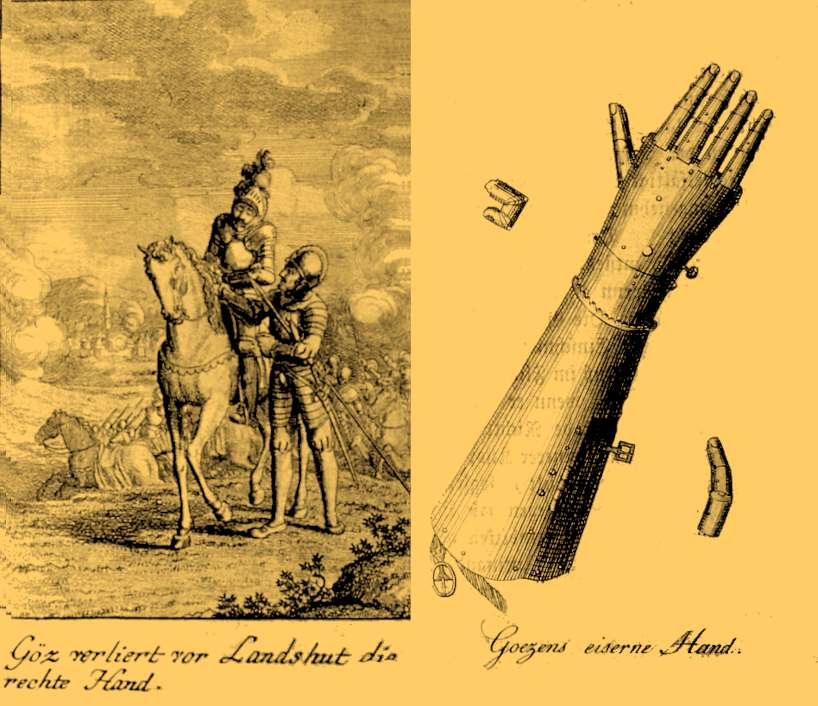
Götz’s escapades of fighting “with body and blood” were similarly recently (1793) the subject of and entire Almanach issue that included illustrations of the scene in battle (1504) in which he lost his hand, as well as of the “iron hand” itself, whose fingers could be bent at three joints each (the thumb at two joints) and which could be rotated on axis (Carl Lang, Ritter Göz von Berlichingen mit der eisernen Hand,, Historische Almanach für den deutschen Adel und für Freunde der Geschichte desselben. 1793; Inhaltsverzeichnis deutscher Almanache, Theodor Springmann Stiftung):
[10] Excerpts from Goethe’s translation of Benvenuto Cellini’s autobiography had been published as the article “Benvenuto Cellini” in Schiller’s periodical Die Horen (1796) nos. 4–7, 9–11; (1797) nos. 1–4, 6. Back.
[11] The dispute with the Allgemeine Literatur-Zeitung had in fact already begun, albeit not yet publicly (Daniel Nikolaus Chodowiecki, “Die Philosophen” [The philosophers], Illustrationen zu Erasmus’ Lob der Narrheit in sechs Abteilungen [1780]; Herzog Anton Ulrich-Museum; Museums./Signatur DChodowiecki WB 3.31):

Wilhelm had exchanged letters with Christian Gottfried Schütz on 20–21 October 1799 about an alleged satirical slight of Athenaeum in an amateur theater performance (letters 249b, 249c, 249d).
Schelling’s protest concerning the review of his Ideen zu einer Philosophie der Natur (1797) had already been composed on 6 October 1799 but would not be published until 2 November (letter/document 252e), while at the same time Wilhelm was writing to both editors of the Allgemeine Literatur-Zeitung concerning its failure to publish a review of Athenaeum despite repeated requests as well as concerning Ludwig Ferdinand Huber’s anonymous and favorable review there on 26 October 1799 of Friedrich Nicolai’s epistolary novel Vertraute Briefe von Adelheit B** an ihre Freundin Julie S** (Berlin, Stettin 1799), a novel trenchantly critical of the early Romantics and especially of Friedrich’s novel Lucinde. Even the “coquette” Caroline is lampooned in the novel.
See Wilhelm’s letter to Schütz ca. 30 October 1799 (letter 252b); Gottlieb Hufeland to Wilhelm on 3 November 1799 (letter 252f), and Wilhelm to Hufeland on 3 or 4 November 1799 (letter 252g). Back.
[12] For the text and background to the sonnet directed against Garlieb Merkel; see Caroline’s letter to Auguste on 28 October 1799 (letter 252) and supplementary appendix 252.1. Back.
[13] Caroline recounts the evening similarly in her letter to Auguste on 28 October 1799 (letter 252). Back.
[14] Uncertain but intriguing allusion; other editions of this letter say nothing about these activities. Back.
[15] Dorothea is referring to her stopover in Weissenfels, where Friedrich von Hardenberg was living at the time, during her journey from Berlin to Jena, and her decision not to seek him out for an initial acquaintance. See her letter to Schleiermacher on 11 October 1799 (letter 247c) (Rudolf Koch and Fritz Kredel, Deutschland und angrenzende Gebiete [Leipzig 1937]):
[16] Hardenberg would be in Jena on 11–15 November 1799. Back.
[17] The “pope” is Goethe; see Dorothea’s similar lament in her letter to Schleiermacher on 11 October 1799 (letter 247c). Her letter to him on 15 November 1799 (letter 255b), however, recounts her first meeting with Goethe. Back.
[18] Auguste did not return to Jena from Dessau with Wilhelm until 26 November 1799 (Rudolf Koch and Fritz Kredel, Deutschland und angrenzende Gebiete [Leipzig 1937]):

[19] Hamlet had been performed in Berlin in the translation of Wilhelm and Caroline on 15 October 1799; Friedrich Beschort performed the role of Hamlet, August Wilhelm Iffland that of Polonius, and Friederike Unzelmann that of Ophelia. The performance was not well-received (KFSA 25:382fn42). See esp. Ella Horn’s essay on the background to the premiere of Hamlet in Berlin along with the two reviews of the premiere (review 1 and review 2). Back.
[20] This summer plan likely involves Rahel’s anticipated visit to Jena, about which Dorothea speaks in her letters to Rahel in the spring and early summer 1800 (28 April and 2 June 1800, letters 259m, 260f). Back.
[21] Concerning efforts to place Sophie Bernhardi’s novel Julie Saint Albain — though such is likely not Dorothea’s reference here — see Caroline’s letter to Wilhelm Gottlieb Becker on 23 September 1799 (letter 244a). Back.
[22] Dorothea wrote to Karoline Paulus at about the same time (mid-October 1799; Briefe von Dorothea und Friedrich Schlegel an die Familie Paulus 111; KFSA 25:16): “Poor Dorothea is suffering from dizziness and migraines and yearns to get out into the open air, but instead must remain in the rear building of the Döderlein house.”
Concerning valerian, see Robert John Thornton, A Family Herbal: or Familiar Account of the Medical Properties of British and Foreign Plants, 2nd ed. (London 1814), 34–37:
Officinal Valerian, Valeriana officinalis, Wild valerian, Valeriana sylvestris
. . . Medicinal Use.
Wild Valerian is a medicine of great use in nervous disorders, and is particularly serviceable in epilepsies proceeding from a debility of the nervous system. Some recommend it as procuring sleep, particularly in fever, even when opium fails; but it is principally useful in affections of the hysterical kind. . . .
Cullen mentions that it is serviceable in hysteric and other spasmodic affections; and where it failed of producing any good, it arose from these disorders not being primary nervous affections, or from the badness of the drug. Haller mentions also his success in hysteria. . . .
As far as my practice has gone, I have found it successful in several cases of epilepsy, and a good nervous medicine and in phthisis pulmonalis (consumption) a tea made of it for breakfast has done considerable service. It merits yet a place in the Materia Medica, but what rank remains to be explored. The oil of Valerian deserves a trial in epilepsy, being said to have produced several extraordinary cures.
Preparations: . . .
Tincture Of Valerian. (Tinctura Valeriana.) Take of wild Valerian root, grossly powdered, four ounces; proof spirit, two pints: Digest with a gentle heat for eight days, and strain the tincture.
Volatile Tincture Of Valerian. (Tinctura Valerians Tolatilis.)
Take of wild Valerian root, four ounces; the compound spirit of ammonia, two pints: Digest for eight days, and strain the tincture. The dose is half a drachm to half an ounce three times a day in any convenient vehicle. In my formulae I am in the habit of ordering the powder, tincture, and compound tincture, in the same mixture, with the addition of the camphorated mixture.
See similarly and succinctly William Woodville, Medical Botany: Containing Systematic and General Descriptions with Plates of all the Medicinal Plants, indigenous and exotic, vol. 1, 2nd ed. (London 1810), 79:
The advantages said to be derived from this root in epilepsy caused it to be tried in several other complaints termed nervous, particularly those produced by increased mobility and irritability of the nervous system, in which it has been found highly serviceable.
Illustration from Sydenham Edwards, The Botanical Register: Consisting of Coloured Figures of Exotic Plants cultivated in British Gardens with their History and Mode of Treatment, vol. 2 (London 1816), no. 155:

[23] Dorothea’s eldest son had remained in Berlin with his father, Simon Veit. Back.
[24] Unclear private allusion. Back.
Translation © 2013 Doug Stott