
• 184c. Friedrich Schlegel to Auguste Böhmer in Jena: Berlin, August 1797 [*]
[Berlin, August 1797]
|615| I suspected you would think I pontificated and moralized too much in my last letter, something of which, as I well know, you are not particularly fond even though you do occasionally make one want to do precisely that. So I am quite pleased you took it as cordially as it was indeed intended; and |616| even more that you are so diligent and are learning Greek so well. If it pleases you, have your mother give you Xenophontis Cyropaedia from among my books, and keep it for yourself. [1] It is a light novel you will soon be able to read. It will probably be too ill bound for you; but if your mother ever has any money for me again, or receives any, as will likely never be the case, then you ought to have it nicely bound quite according to your own taste.
I do not have as much to tell you as you have to tell me, since you are not acquainted with the people and the locale here. But I have seen one of your lady acquaintances rather often — Madam Liebeskind. And she did indeed ask very assiduously about you, though she herself nonetheless seems a bit boring and worn out. She charged me with sending her regards to your mother, and as I was departing she especially impressed upon me that I was to report that her husband is now a administrative Rath in Ansbach service. They will soon be going there and will perhaps be traveling through Jena. She may very well believe that that is something quite special. And frankly, if her Liebeskind were not an administrative Rath, he would be absolutely nothing. [2]
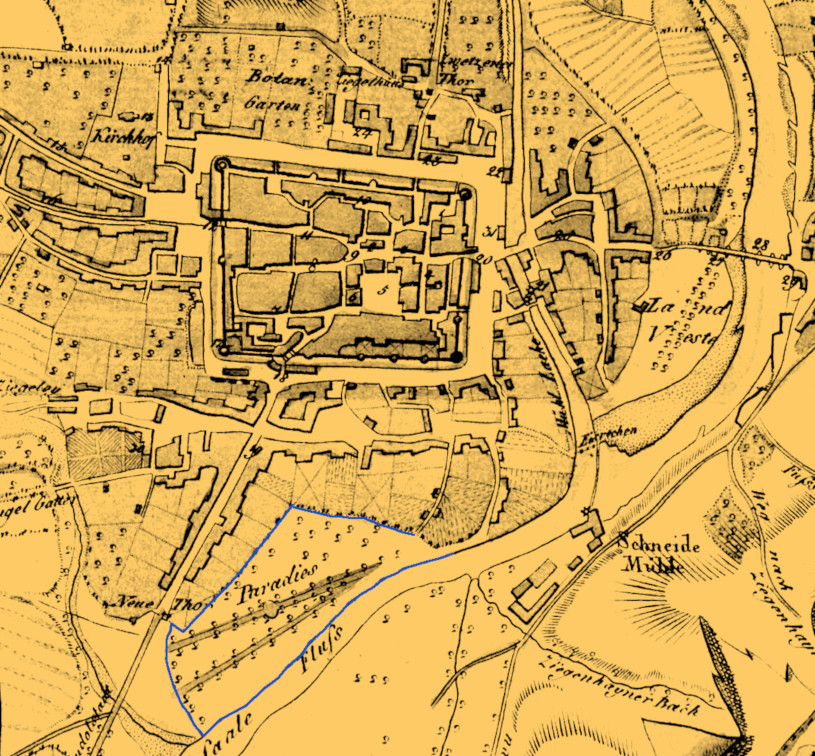
You wrote me a great deal about rocks, Rau Valleys, and clear brooks. [3] There is nothing at all like that here. Instead we have dust clouds, marble palaces made of sandstone, long, broad streets, and filthy water. I almost prefer your little Paradies [4] to the gargantuan Tiergarten, [5] where one can so easily get lost in all the dark paths. Where there is no dust, however, it is very beautiful indeed, and except for the view admittedly immeasurably more beautiful and better than Paradies.
I saw Madam Liebeskind primarily at the house of one of my acquaintances, Madam Herz, who still pleases me most among all the women I know here. She lives about as far from me as the Driessnitz is located from Jena, though here that is viewed as still being quite close. Her husband lives much farther from her.
You have no need to envy me my access to the theater, dear child, though I would certainly be glad to let you go instead. I am only rarely able to go, and it costs a half Thaler each time. Moreover, I am often already engaged or have something else to do precisely when I would most like to go; other times the plays are simply bad. I have seen Fleck only in an insignificant role of an insignificant Mark Brandenburg birthday-celebration play by the insignificant Rambach. — In that very play, Madam Unzelmann died so charmingly that I could have kissed her right there. The stupid playwright has the charming, diminutive lady spend a quarter hour dying, and then has her lie around for an entire act as a corpse en parade onstage. Is that not an abomination? [6]
The thing about being “pleasing” in Berlin will probably be bearable. I probably must endure it. I am already constantly thinking about how all of you will be coming here next spring, going to Pilnitz, [7] and about how I will then follow you there in the autumn and then come to Jena and again live with you all. — And then you will also read |617| Greek with me again even though I may well not have as much patience with your flightiness as does Wilhelm.
Do be diligent in writing me, and please do not reckon such tiny notes as counting for an entire Sunday letter. I remain tremendously fond of you.
Your Friedrich S.
p.s. Please tell Niethammer I will be writing him on the next postal day and sending him first the Begriff der Philologie, on which I am diligently working. [8]
Give my regards to Fichte whenever you see him. And to little Eschen perhaps once a month.
Along with the 2nd issue of Lyceum, I will be sending Reichardt’s melody for the song in Shakespeare and the proofs of Romeo. [9]
I am quite happy that your mother finds F[ichte] charming. I will write her all the more the next time for having written only to her daughter today. — A tax collector (and sinner) inquired with great interest after your mother, the tax collectress. [10]
Madam Herz is indeed nothing more than an aging coquette who was once irrepressibly beautiful and still is, and who has a piquant and malicious side and a naive good nature; [11] but she is truly not guilty in connection with Jenisch’s impudent dullness. [12]
That bit for your mother.
Notes
[*] Source: Schmidt (1913), 1:615–17 (letter no. 4); Waitz (1871), 1:357–58; reprinted in KFSA 24:5–7 (with supplementary material and redating, albeit without explanation, to “mid-August”). Supplementary material from Otto Braun, “Friedrich Schlegel an Auguste Böhmer,” Das literarische Echo 19 (August 1917), 1375. — Concerning the textual history of Friedrich Schlegel’s letters to Auguste Böhmer, see supplementary appendix 181d.1. Back.
[1] Friedrich has obviously left books and such behind in Jena after moving to Berlin, suggesting that he may indeed not have been planning to stay away permanently.
Xenophon, Cyropaedia, an in part fictional biography of Cyrus the Great. Here a late eighteenth-century edition of the sort Friedrich might have owned; although such a text was a not inconsiderable reading task for twelve-year-old girl at the time, Friedrich remarkably seems not to consider it too formidable (Xenophontis Cyropaedia, e recensione Hutchinsoni cum selectis eivsdem notis. Accessit index graecitatis, ed. Thomas Hutchinson [Lipsiae (Leipzig) 1784]; title page and first full page of text):

[2] Meta Liebeskind — at the time Meta Forkel — lived with Caroline and Auguste during part of their sojourn in Mainz and was one of their party when they attempted to flee Mainz. She similarly shared their incarceration in Königstein.
Friedrich pokes a bit of fun at Meta Liebeskind and her husband by referring to the latter as “her Liebeskind,” literally liebes Kind, “her dear child.”
Jena lay directly on possible postal routes between Berlin and the principality of Ansbach, and Meta Liebeskind, her husband, and their children did visit Caroline in Jena during early to mid-September 1797 (W. R. Shepherd, Historical Map of Central Europe about 1786 [1926]):

[3] Germ. Rauhthal (today: Rautal; Friedrich uses the plural form): forested area north of Jena (Franz Ludwig Güssefeld, Topographische Charte der umliegenden Gegend Von Jena / nach eigenen Messungen und andern Origin. Zeichnungen [Jena 1800]; reprinted in August J. G. K. Batsch, Taschenbuch für topographische Excursionen in die umliegende Gegend von Jena [Weimar 1800]):

Here a waterfall scene in the Rauhthal ca. 1806 in an etching by Jacob Roux (Jacob Roux, Die Gegenden um Jena, no. 1 [Jena, Weimar 1806], plate 4):

Jena fraternities frequented the secluded groves and even had primitive dining facilities for members (Edmund Kelter, Jenaer Studentenleben zur Zeit des Renommisten von Zachariae, Supplement 5 to the Jahrbuch der Hamburgischen Wissenschaftlich Anstalten, no. xxv, 1907 [Hamburg 1908], 48):

[4] Concerning the Paradies greenspace along the River Saale in Jena, see also Caroline’s letter to Luise Gotter Jena 17–20 July 1796 (letter 166), note 2 (Franz Ludwig Güssefeld, Topographische Charte der umliegenden Gegend Von Jena / nach eigenen Messungen und andern Origin. Zeichnungen [Jena 1800]; reprinted in August J. G. K. Batsch, Taschenbuch für topographische Excursionen in die umliegende Gegend von Jena [Weimar 1800]):
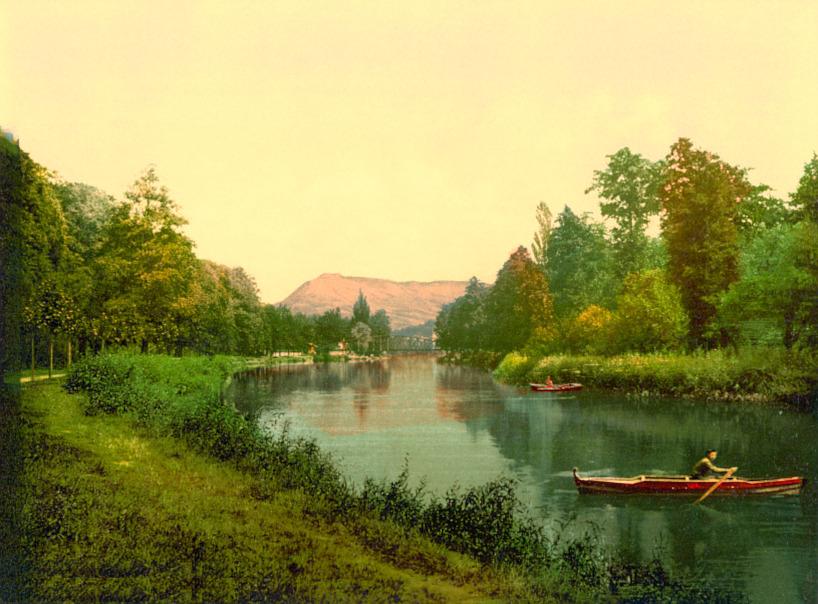
This area was a favorite among Jena residents for taking walks and otherwise relaxing, attested not least by the Romantics’ encounter with Goethe there as recounted later by Dorothea Veit in a letter to Schleiermacher on 15 November 1799 (letter 255b). Here the area between ca. 1890 and ca. 1900 (Library of Congress Prints and Photographs: lot 13411, no. 1104) and ca. 1864 (Henry Mayhew, German Life and Manners as Seen in Saxony at the Present Day, 2 vols. [London 1864], 2:166):

[5] Tiergarten: a large park in central Berlin; although it began as a hunting reserve for Brandenburg princes, in 1742 Friedrich II of Prussia instructed his architect to transform the park into a recreational park for Berlin residents, initially in a Baroque style. See also Friedrich’s letter to Auguste on 28 May 1798 (letter 200f), note 2. Back.
[6] En parade, Fr., “lying in state.”
Erich Schmidt, (1913), 1:761, maintains that the piece about which Friedrich here speaks is Friedrich Eberhard Rambach, Der grosse Churfürst vor Rathenau. Ein vaterländisches Schauspiel in vier Aufzügen (Berlin 1795, 1797).
Rambach’s long-winded (4 acts, 76 scenes) and complicated play (30 characters) was dedicated to Friedrich Wilhelm II, and one of the characters is Friedrich Wilhelm of Brandenburg, known as the Great Elector.
But an insuperable chronological problem arises insofar as Rambach’s play is listed as having been performed first on 25 September 1795 and for the last (and altogether seventh) time on 7 January 1796 (C. Scharffer and C. Hartmann, Die Königlichen Theater in Berlin. Statistischer Rückblick . . . vom 5. December 1786 bis 31. December 1885 [Berlin 1886], 38), something also confirmed by a review in the Neue allgemeine deutsche Bibliothek 31 (1797) no. 1, issue 3, Intelligenzblatt 21:163–65, here 163. That is, either the statistics for the Berlin theater are incorrect or Friedrich is referring to a different piece. An additional factor militating against this piece is that no female character dies in it, much less remains on stage as a corpse for an entire act. Although the character of Louise is wounded in the hand when she tries to break up a duel, she does not die (frontispiece to August Lafontaine, Karl oder welch ein Herz [Vienna, Prague 1809]):

Friedrich is referring instead to Rambach’s Otto mit dem Pfeile, Markgraf von Brandenburg: Ein vaterländisches Schauspiel in fünf Aufzügen (Berlin 1797), part of Rambach’s series of patriotic pieces playing on Prussian history, of which Der grosse Churfürst vor Rathenau was the initial installment. And indeed, not only does the wording of the full title of Otto mit dem Pfeile accord better with Friedrich’s reference (Mark Brandenburg), but the play was also performed twice in Berlin, namely, on 3 and 4 August 1797, which perfectly accords with Schmidt’s dating of Friedrich’s letter (Die Königlichen Theater in Berlin, 66).
In this latter play, moreover, a female love-interest does indeed die and is even described — much as in Friedrich’s remarks — as “a dying beloved” who “for a not inconsiderable time must spook around like a ghost quite in the literal sense of the word” (Neue allgemeine deutsche Bibliothek, 165). This character, Mathilde, who has been held captive by the archbishop and has become mentally unstable and melancholic, is so moved by her reunion in the dungeon with her former fiancé, Otto’s son Hermann, that she dies. The scene takes place approximately midway through act 4:
Marie. (Cries out loud and tries to hide.) Herrmann!
Mathilde. (Rises from her bed.) Where! — Yes!
Herrmann. (Embraces her.) Mathilde!
Mathilde. (Clings to him.) Herrmann! — ‘Tis you — praise be to God!
Herrmann. (Stares at her.) Mathilde! Mathilde! my heart beats, ’tis you, and yet my eyes dare not believe my heart. — This is not my radiant girl, it is her corpse that now beckons me to the grave.
Mathilde. God is merciful. — Closes my eyes for me. — Then will I gladly die.
Herrmann. Die? — Reunion and then die?
Otto. Bless this hour, and pray for its end.
Herrmann. (Involuntarily extending his hand to him.) Friend! — Oh! I have no friend! — I want only to hold fast to this corpse; my world shall it be.
Mathilde. Soon, soon ‐ merciful God, please but preserve me from insanity.
Herrmann. Insanity?
Otto. The work of your friends. Günther —
Mathilde. Oh! —
Herrmann. Vengeance! Vengeance!
Mathilde. Protect me, Herrmann! — The evil adversary, — his outstretched claws. — (Softly.) Mercy, mercy! I did it while insane. — — (Sinking.) Oh! darkness, — darkness —
(She sinks back onto her bed.)
Herrmann. Mathilde! Mathilde!
Mathilde. (Listless, dying.) — Herrmann, — there. — Vengeance! — Your hand! — Farewell! — Herrmann! — Yours! — Yours! (She dies.)
Mathilde, now deceased, remains onstage for the rest of the scene, then reappears in act 8 on a bier surrounded by candles, where she remains for the rest of the play (through scene 14). Friedrich is quite accurately describing how the actress Friederike Unzelmann spends essentially the rest of the play en parade, lying in state and, as the reviewer from the Allgemeine deutsche Bibliothek describes it: “spooking around like a ghost”; the stage directions similarly refer to the bier as a Paradebett. The following illustration portrays Princess Charlotte Amalie of Denmark (1706–82), daughter of King Frederick IV of Denmark, lying in state in essentially the same setting with candles (Peter Horrebow, Paradebett der verstorbenen Prinzessin Charlotte Amalie [ca. 1782]; Kopenhagen Statens Museum for Kunst, Den Kongelige Kobberstiksamlung):

[7] Also “Pillnitz”: at the time a suburb of Dresden; Charlotte Ernst and her husband seem to have had a summer home there. Back.
[8] Unrealized project Friedrich was apparently planning to publish in Friedrich Immanuel Niethammer’s journal Philosophisches Journal einer Gesellschaft Teutscher Gelehrten (KFSA 24:316n12). Back.
[9] Johann Friedrich Reichardt composed the songs for Wilhelm’s translation of Shakespeare. — August Wilhelm Schlegel, Shakespeare’s Dramatische Werke übersetzt, vol. 1, Romeo und Julia, Ein Sommernachtstraum (Berlin 1797); this volume appeared several weeks before Friedrich’s arrival in Berlin. Reichardt edited the periodical Lyceum der schönen Künste, in which Friedrich in his own turn published several of his more important writings between 1796 and 1797. Back.
[10] Wordplay on the name of Johann Friedrich Zöllner (Germ, Zöllner, “tax collector”), high consistory official and apparently an earlier acquaintance of Caroline. See her letter to Luise Gotter on 20–21 August 1795 (letter 154) and KFSA 24:317n17, with an accompanying allusion to Matt. 11:19 (NRSV: “the Son of Man came eating and drinking, and they say, ‘Look, a glutton and a drunkard, a friend of tax collectors and sinners!'”) and Mark 2:16 (NRSV: “When the scribes of the Pharisees saw that he was eating with sinners and tax collectors . . .”) (Katalog der Wolfenbütteler Luther-Drucke 1513 bis 1546, no. H 314):

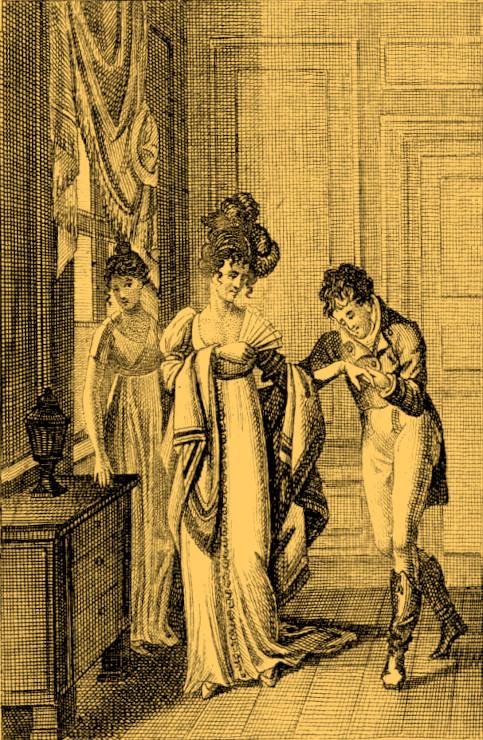
[11] The “aging coquette” was a popular topos ([1] Berlinischer Damen-Kalender auf das Gemein-Jahr 1809, Inhaltsverzeichnis deutscher Almanache, Theodor Springmann Stiftung; [2] Elisabeth Claire Tardieu and Pierre-Louis Dumesnil, La vieille coquette [Paris ca. 1751–73]; Herzog Anton Ulrich-Museum; Museums./Signatur Museumsnr. / Signatur ECTardieu AB 3.6):

[12] Daniel Jenisch, Ueber die hervorstechendsten Eigentümlichkeiten von Meisters Lehrjahren, oder über das, wodurch dieser Roman ein Werk von Goethes Hand ist. Ein moralischer Versuch (Berlin 1797), a criticism of Goethe’s novel Wilhelm Meister; Friedrich alludes to this critique later in his essay “Über Goethe’s Meister,” Athenaeum (1799) 323–54, here 349:
Probably the most unfruitful of all possible perspectives from which to view Wilhelm Meister would be for a single individual to rationalize about each of these persons solely from the perspective of his own peculiarity and from that perspective to cast moral judgment on them. Back.
Translation © 2012 Doug Stott