
• 184b. Friedrich Schlegel to Auguste Böhmer in Jena: Berlin, 25 July 1797 [*]
Berlin, 25 July [17]97 [1]
|614| Dear Auguste, notwithstanding your letter is as impertinent as it is short, I am greatly pleased with it because it does, after all, prove that the good child is in a cheerful mood even though she was certainly also capable of being quite ill-behaved.
But I am not happy, Auguste, for I cannot so quickly forget my friends, namely, your mother and Wilhelm and you, as easily as all of you seem to be able to forget me, you no less than your mother. Tell your mother I am quite angry with her for not having written me and am quite unhappy now. I often wish I could just push my entire life away from me with one big sigh.
Otherwise, however, I am not crediting your epistolary impertinence as a Sunday engagement, and am carefully keeping track. If you do want to write me, or want to send me some samples of your Greek splendors, and your mother does not have the opportunity, then simply write me unfranked, which will arrive just fine. That much I can still pay. But it must be a very nice amount indeed.
|615| So, now you have trumpeted all the way to Dresden that you “might perhaps one day be able to understand Greek“? If in fact you now do not learn it, however, then you can send out letters of bereavement to everyone telling them how it simply did not succeed. If you are very diligent, then in 8 to 10 years perhaps you will understand as much Greek as Madam von Humboldt. She, however, did not trumpet it to anyone, and instead kept it a secret. [2] And she was right in doing so, since the people who act and think the same way as everyone else always find the unusual to be ludicrous. No one need make anything of it, but why provide them the occasion? —
In addition, any reasonable person might easily also think that you are simply fishing for compliments by prattling on so grandly [3] about something that, even had it already happened, would still not really deserve all that much attention. I for my own part at least see nothing wondrous in everyone, young and old, girls and men, learning and doing as many good and beautiful things as they can. [4]
Please do not hold my modest warning against me, and please continue your fondness for me. Also write me soon again — and a lot.
If you do not understand something in my letter, then only say so, and I will try to explain myself more clearly.
Friedrich S.
[*] Source: Schmidt (1913), 1:614–15 (letter no. 3); Waitz (1871), 1:356–57; reprinted in KFSA 24:1 (with supplementary material). Supplementary material from Otto Braun, “Friedrich Schlegel an Auguste Böhmer,” Das literarische Echo 19 (August 1917), 1374–75. — Concerning the textual history of Friedrich Schlegel’s letters to Auguste Böhmer, see supplementary appendix 181d.1. Back.
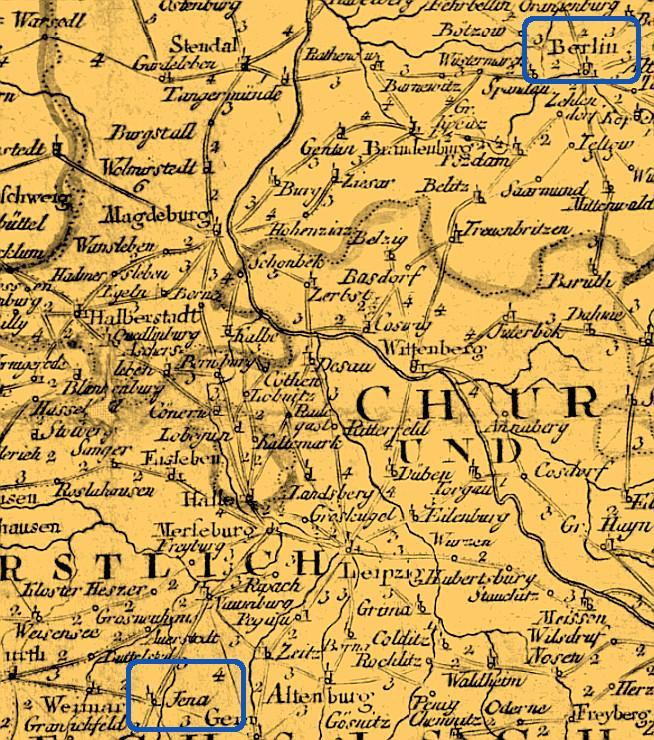
[1] Concerning Friedrich’s departure from Jena, see his letter to Auguste on 15 July 1797 (letter 184a) with note 1. He was now living in Berlin (Post Karte Durch ganz Deutschland, ed. J. Walch [Augsburg 1795]):
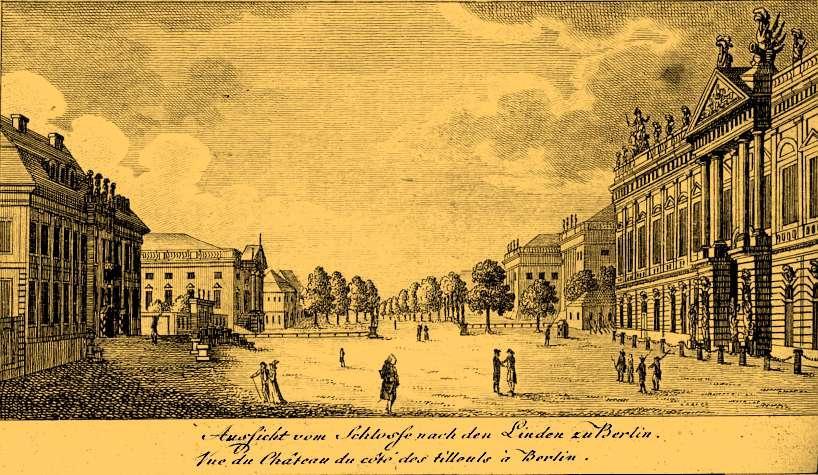
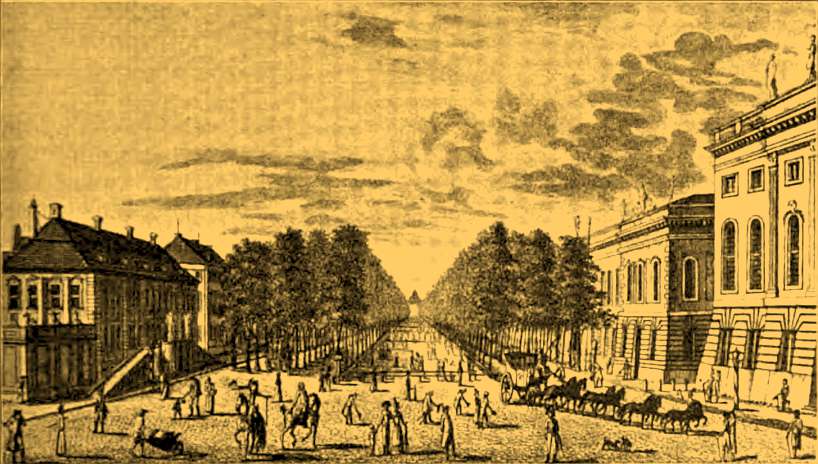
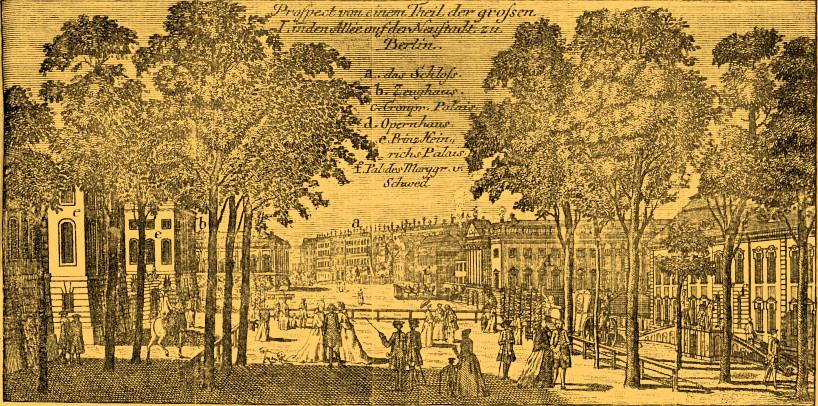
Here three contemporary views of the signature Berlin promenade Unter den Linden in the late 18th century ([1] Almanach zu Kenntniß der Preußischen Staaten für Reisende und Einheimische [1795]; Inhaltsverzeichnis deutscher Almanache, Theodor Springmann Stiftung; [2] Adolf Streckfuss and Leo Fernbach, 500 Jahre Berliner Geschichte: Vom Fischerdorf zur Weltstadt, Geschichte und Sage [Berlin 1900], 401; [3] Genealogischer Kalender auf das Gemeinjahr 1769, Inhaltsverzeichnis deutscher Almanache, Theodor Springmann Stiftung):
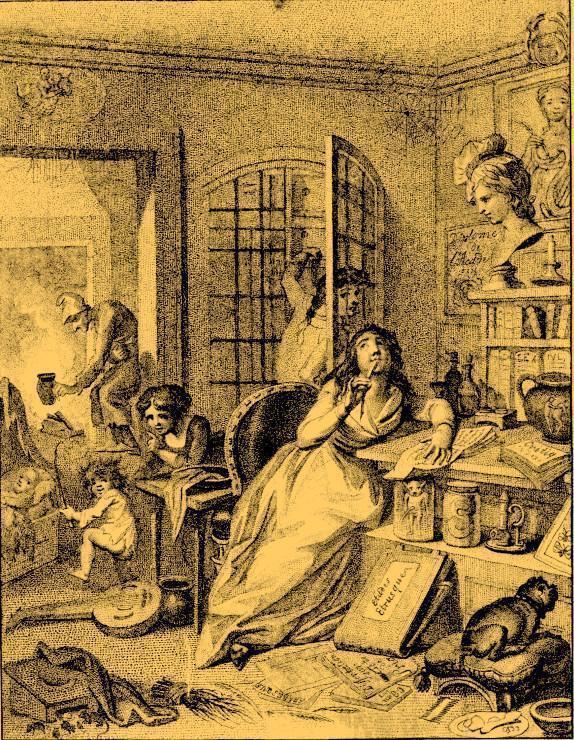
[2] A tongue-in-cheek remark, since had such genuinely been the case, Friedrich himself would not have known about it. That said, it may be noted that Auguste was but twelve years old: that such a girl was now starting to learn Greek was an exceptional situation in any case.
There was, moreover, still the prejudice that such “learned” or “scholarly women” (in the illustration below: “Etruscan studies”) inevitably neglected precisely their household and family, often with disastrous consequences (“Die gelehrte Frau,” Taschenbuch auf das Jahr 1803: Dem Edeln und Schönen der frohen Laune und der Philosophie des Lebens gewidmet [1803], plate 6; Inhaltsverzeichnis deutscher Almanache, Theodor Springmann Stiftung):
[3] Erich Schmidt (1913), 1:761, thought it helpful to point out to his readers the use of Germ. Brasch here (with a long a): Middle German, “prattle, blather.” Back.
[4] The sincerity of Friedrich’s remarks here is attested not least by his novel Lucinde, though also by his earlier essay “Über die Diotima.” Back.
Translation © 2012 Doug Stott