
• 184a. Friedrich Schlegel to Auguste Böhmer in Jena: Weissenfels, 15 July 1797 [*]
Weissenfels, 15 July [17]97
|612| Dearest Auguste, I was enormously pleased that you kept your word so nicely and on the very first |613| Sunday after my death wrote me a letter that was as funny as it was instructive, and even more pleased that at the end of the letter you yourself reveal that it was written not on Sunday at all, but — on Saturday. [1] May God grant that when you have lived yet another eleven [twelve] years in this world you will still be just as honestly dishonest.
Your letter is quite witty and bright; it even, moreover, contains some commas and periods, especially at the beginning, thought the latter occur somewhat less frequently. All of which surprised me not a little, indeed, most pleasantly. Although your Augean stables are not quite as free of errors as you yourself seem to believe, they did nonetheless quite amuse me. [2]
That I did not have any more patience with you than I did, my dear child, is because: (1) I was annoyed that I was to have you as a pupil for only such a short time more; (2) I wanted you to learn everything in that short time and to learn it all from me; (3) I have a choleric disposition; 4) I would have had no reason to be impatient at all had you learned everything as splendidly and as perfectly as you learned the sillyative mood in all conjugations and the superlative of the small, charming adjective φαυλος. [3]
In your strange or splendid story about the bug you surely forgot one important element. I think your mother probably scolded me not a little in this whole affair, as if I were really the bug that stung her, since she has from the outset considered me the father of all trouble and a liar.
You really should ask Wilhelm to be rather moderate with his praise of you, and you should think only of the Greek, not of the praise you are hoping to earn with it.
Also write and tell me whether you are still reading so much silly stuff, and what it is you are reading. I am absolutely serious. [4] But even if I otherwise tease you a bit, you must not be offended. It is only because I am so fond of you.
Do continue to write me so nicely; sit down on the new sofa in my name and be heartily embraced by
Your Φριζ [5]
Why are you always calling me “uncle”? — After all, you certainly have no respect for me. So it does me no good, it only reminds me how old I already must be if I am the |614| “uncle” of such a big girl who is already eleven [twelve] years old. And after all, I am not really old in any case, as your mother can also attest, even though since leaving Jena I have admittedly gotten a great many gray hairs, which do, however, look quite good on me.
I would prefer that you call me your “dear brother” or your “friend” or “Fritz.” I am well aware that a name often means more to you than the thing itself. The address is more important to you than the letter. The sugar more important to you than the coffee, and Sunday becomes genuinely Sunday for you only through coffee, which is an extremely φilistine way of θinking. You recount the compliments from the servants quite precisely, also everything all of you ate on the Driesnitz. [6] Everything else you forget.
Tell your mother she needs to keep an eye on Wilhelm and his Paulusean flirtation. [7]
Stay well, sweet child, and learn Greek.
Supplement. You little sulky thing you, must you immediately start threatening not to write me anymore if in respectable society I should make fun of your letter, which surely contains enough for two people to laugh themselves silly? [8] — And how can you think I would even do that in the first place, considering I am not at all the kind who exposes everything? —
But that does not make me any less fond of you, especially since you think it is dumb that I have died. For it is precisely because you and Fichte are carrying on so about it that I do firmly believe you two are not at all pleased that I have left.
Your Φριζ
Address: To my pupil Auguste in Jena
By express mail.
She has a yellow hat and yellow hair, dirty hands, but a pure heart. [9]
Notes
[*] Source: Schmidt (1913), 1:612–14 (letter no. 2); Waitz (1871), 1:355–56; reprinted in KFSA 23:375–76 (without supplementary material). Supplementary material from Otto Braun, “Friedrich Schlegel an Auguste Böhmer,” Das literarische Echo 19 (August 1917), 1374. — Concerning the textual history of Friedrich Schlegel’s letters to Auguste Böhmer, see supplementary appendix 181d.1. Back.
[1] “My death”: a euphemism for Friedrich’s departure from Jena. Friedrich had left abruptly sometime between ca. Thursday 15 and Thursday 22 June 1797; the Saturdays after those two Thursdays were 17 and 24 June 1797; unfortunately, Auguste’s letter is no longer extant. Friedrich had written to Friedrich von Hardenberg earlier on 8 June 1797 (KFSA 23:370; Novalis Schriften, 4:487):
In one, at most two weeks, I will be traveling to Berlin, where I will be living for the time being. Could we not yet see each other, my good friend? Write to me quickly in any case. I would be glad to delay my journey for a few days, or even longer, for your sake.
I have so much to tell you that I — cannot tell you. — So much has happened, and it has pleased fate yet again to entertain me with heavy artillery. For four and a half years I bore the weight of my debts with heroic courage. They have just been paid off, and I am breathing more easily, and now new torments commence against which no resignation is of any use, and which must be borne and overcome but can be so only in several years.
It seems Friedrich left Jena because of quarrels with, among others, Schiller and Karl Ludwig von Woltmann and after having been advised to do so by Goethe, though evidence is circumstantial (Goettinger Taschen Calender vom Jahr 1790; Inhaltsverzeichnis deutscher Almanache, Theodor Springmann Stiftung):
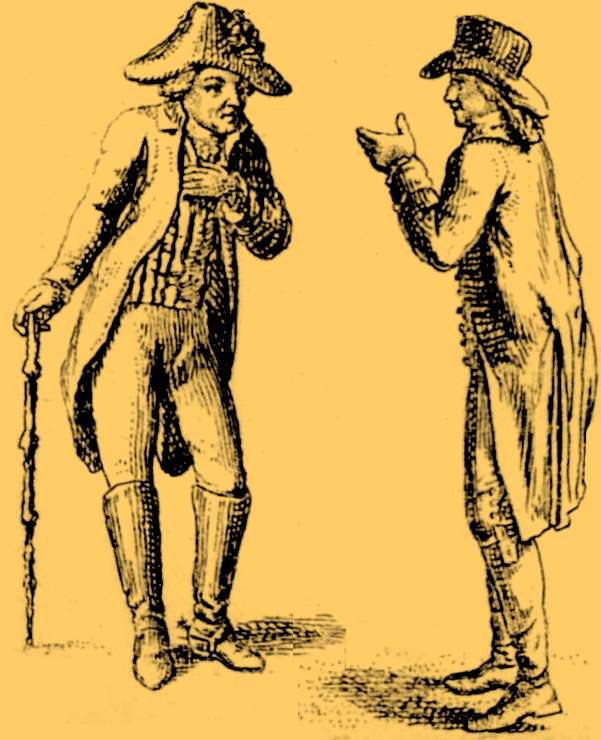
Concerning the break with Schiller and the reproach of Woltmann, see supplementary appendix 181g.1. Goethe may have advised Friedrich to leave Jena “for several years” (though Friedrich would be back much sooner), and Friedrich himself mentions Goethe in connection with his public quarrel with Woltmann in a letter to Hardenberg on 26 May 1797 (KFSA 23:369; Novalis Schriften, 4:486):
In the meantime, — I have also entered into a correspondence with him [Woltmann], initially privatim, and now publicly. You can read his initial insults and other crazy things in no. 65 of the Intelligenzblatt of the Allgemeine Literatur-Zeitung. My response is quite moderate. [See Wilhelm and Caroline’s letter to Schiller on 1 June 1797 with note 4] —
Almost everyone here is on my side, and certainly the best people. But a scoundrel can get by with quite a bit if he is already somebody, as people put it. They are intent on not publishing any denial and on not allowing even the most pathetic rogue to fall entirely into the dung heap, since they have, after all, already helped him become a Herr Professor.
What a miserable, lousy way of thinking, and even Goethe has fallen prey to it, who has, however, remained as cordial and respectful toward me as possible during this whole thing.
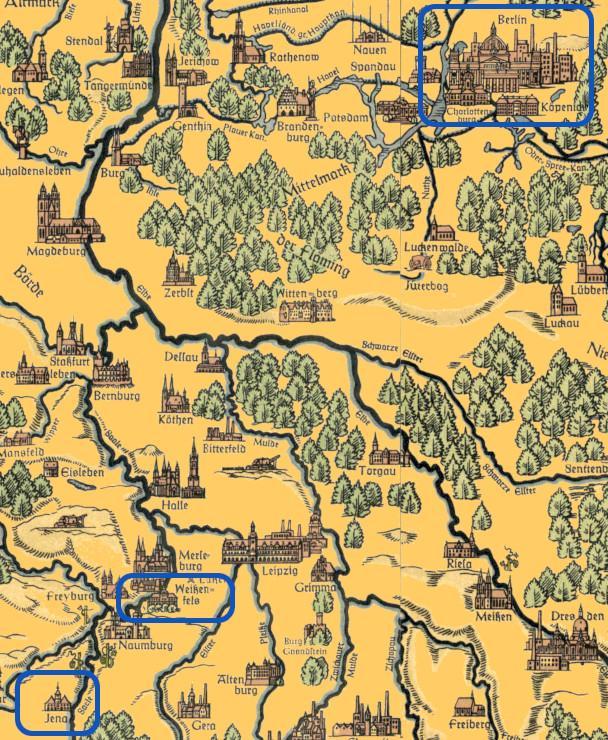
Friedrich is writing from Weissenfels, where he was visiting Hardenberg before continuing on to Berlin (Rudolf Koch and Fritz Kredel, Deutschland und angrenzende Gebiete [Leipzig 1937]):
[2] The fifth task of Heracles was to clean the Augean stables, which had not been cleaned in thirty years; he performed the task by rerouting two rivers. Back.
[3] Friedrich, who had been instructing Auguste in Greek, is engaging in jest (“sillyative” mood) and wordplay. The Greek adjective φαυλος encompasses a generally negative semantic spectrum, including “slight, trivial, paltry, common, of no account, vulgar, uneducated (as opposed to σοφοι), ugly, careless, etc.”; it also homophonically evokes Germ. faul, “rotten, bad; lazy, idle.” Back.
[4] Compare Dorothea Veit’s answer to this question in her letter to Schleiermacher on 15 May 1800 (letter 259s):
Wilhelm, however, is so blinded that he insists she has been brought up excellently, with an understanding of Goethe, Shakespeare, ancient poetry, his own poetry, and God knows what else! He simply does not see that this child, with the most intense carnal desires, checks out all the filthiest material from the lending library; he probably sees it but tells himself she does it perhaps out of a thirst for knowledge. Back.
[5] “Fritz” written in Greek characters. Back.
[6] Driesnitz (or Driessnitz, Triessnitz, Triesnitz), originally a rural area on the southern edge of the village of Winzerla, southwest of Jena proper, and in the eighteenth century a popular excursion locale for “academic Jena.” The locale, which at the time included a tavern and outdoor dining, will appear in later letters as well. Concerning its contemporary setting and activities, see supplementary appendix 184a.1. Back.
[7] Wilhelm carried on a flirtation with (according to Erich Schmidt [1913], 1:761: pretty) Karoline Paulus (Almanac de Poche pour l’Année 1756 [perhaps the French edition of the Genealogischer Schreib- und Postkalender (Berlin 1756)]; Inhaltsverzeichnis deutscher Almanache, Theodor Springmann Stiftung):
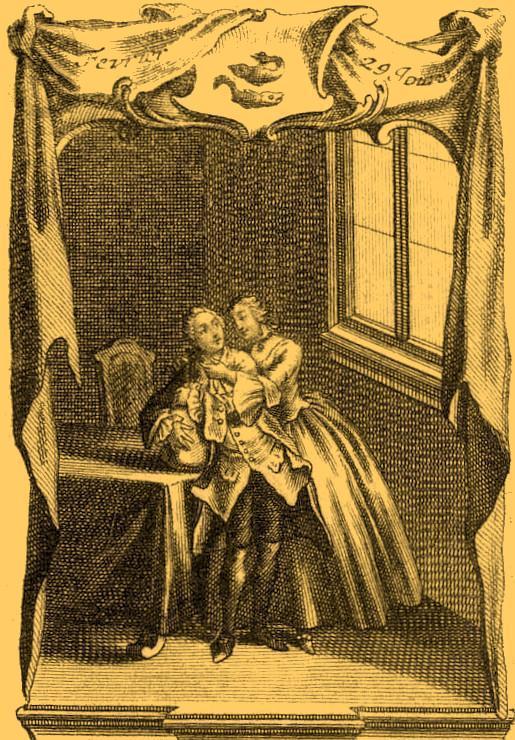
It was with her daughter, Sophie, that he entered into such an ill-fated marriage in 1818.
Wilhelm, however, was decidedly not the only person interested in Karoline Paulus, as becomes evident in subsequent letters. See the supplementary appendix on Karoline Paulus’s reputation. Back.
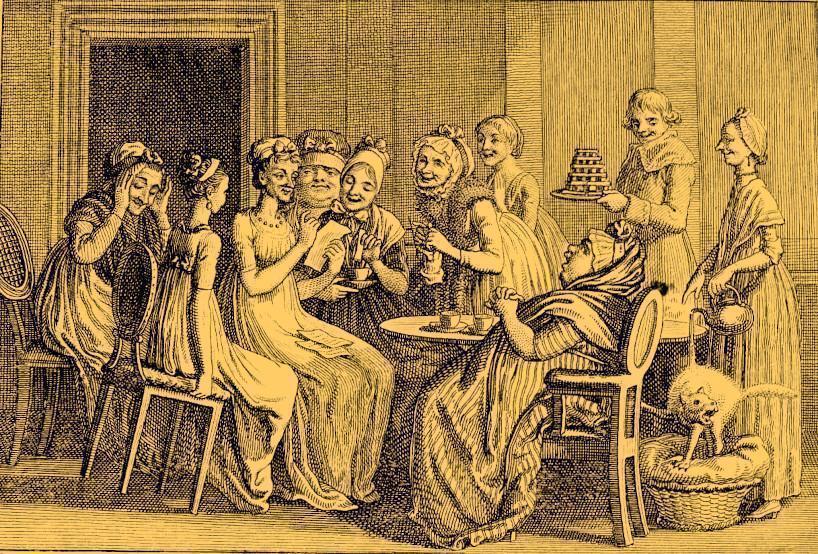
[8] “Ein Thé — medisant,” Taschenbuch auf das Jahr 1803: Dem Edeln und Schönen der frohen Laune und der Philosophie des Lebens gewidmet (1804), plate 5 (Inhaltsverzeichnis deutscher Almanache, Theodor Springmann Stiftung):
[9] See Ps. 24:3–4 (NRSV): “Who shall ascend the hill of the Lord? and who shall stand in his holy place? / Those who have clean hands and pure hearts.” See also Caroline’s letter to Friedrich Ludwig Wilhelm Meyer on 16 October 1792 (letter 117), note 20. Back.
Translation © 2012 Doug Stott