
• 181d. Friedrich Schlegel to Auguste Böhmer in Dresden: Jena, 28 April 1797 [*]
On Auguste’s Birthday [Jena, 28 April 1797]
Dearest Auguste,
Despite my being extremely angry with you the day before yesterday, since no letters arrived [1] — for even if the others have no time, you at least ought to write — nonetheless I cannot refrain from writing to you today. I was quite pleased with your contribution to the family letter. Especially the news about the horse. I suspect that your secret diary will contain many equally interesting bits of news. Had I gone along and you remained at home, the rascal would in any case have constantly reminded me of you. This rascal, as he insists, allegedly slew the Hussar such that he had to lie there for two days. I, however, believe he himself was a rascal. [?]
|611| Today you are exactly 12 years old, and from now on are never again permitted to sit on my lap. I do understand how difficult that will be for you, but since it is necessary, |612| and since your mother also wants it that way, you will not hold it against me for announcing it to you. — You will no doubt come back from Dresden as a real grownup. [2] I am particularly anticipating that you will have made great progress in idleness, something in which you already made such impressive progress here. [3] Or do you perhaps occasionally think about how diligent we intend to be when you are here again? But, then, you probably do not even think about here anymore. Louise asked about you but has firmly resolved not to write to you until you have first written to her. You are probably thinking the same thing. Now that is what I call a tender friendship!
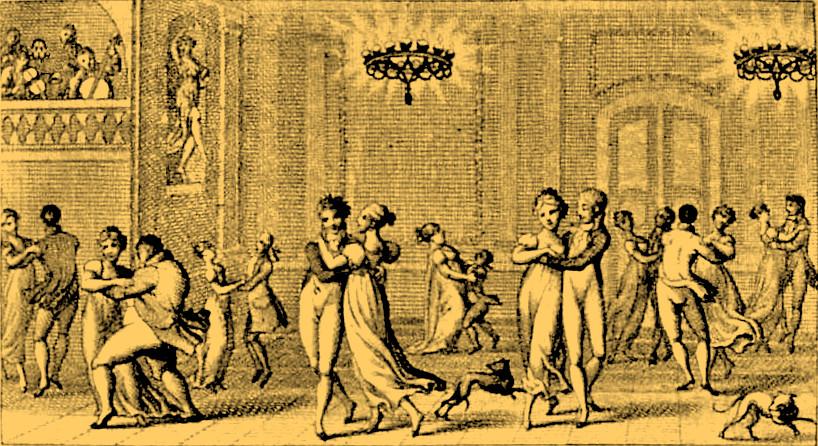
I am greatly looking forward to the diary you are preparing for me. Please properly describe especially what you think of all the people you meet. Write and tell me also whether you have made a good impression on the doctor’s wife. — Are the people in Dresden pulling your leg like here in Jena? — The two Kampenhausen gentlemen simply will not be deterred, insisting that this coming winter they will be dancing two dances with you at every ball. [4] I in my own turn gave them some reason to hope.
λευκωλενος Λωλωε also sends her regards. [5] For that is what we, Eschen and I, call her. Given your knowledge of the Greek language, you probably already know whom I mean. Madam Fichte also told me she was quite fond of you, that you were a schahrming child, almost as schahrming as Hartmann. [6] Of course, I immediately conceded that you are indeed a child. She also believes you are very well-behaved. The good, upright woman! I certainly corrected her in that opinion. The most boisterous, wildest hoydens, I said, are as quiet as a church mouse compared to you. My description of you made her hair stand on end. [7]
You need to tell your mother by and by that I am as fond of you as I am of her; and then also tell her that she best be on her guard, since I have decided that from the moment I no longer owe her money, I intend always to answer her absolutely truthfully whenever she asks me — and she cannot help but ask me — about certain things about which she does not have a completely clear conscience.
Tell your father he should also absolutely write a history. Tell him I recently happened to discover that all of nature is actually historical. If your mother perhaps also would like to know what kind of nature she has, just tell her: political-erotic, though the erotic probably predominates. I can already tell from looking at you that now you, too, want to know your nature. You, however, do not yet have any, my dear child. A person only develops one later. But it will probably be orchastic [orgiastic?].
The “Wicked Rogue,” as Hanna always refers to him, Traugott, has been bound to the bannister and chastised in an exemplary fashion. He squealed like ten pigs. Thus is vice punished. [8]
But now I will not be writing again until the Poesie is finished. [9] I wish the Poesie were hanging from the highest gallows. These dreadful Greeks!
Stay well, my little darling; and may Your Excellency remain most favorably disposed toward
Your most zealous servant,
Uncle Fritz.
Do you perhaps not understand this letter any better than earlier the letter from Aunt Louise, who prior to your birth could find not a single hour in which to write?
Give little Auguste a kiss in my name.
Have you already “seen” music again? [10]
Notes
[*] Source: Schmidt (1913), 1:611–12 (letter no. 1); Waitz (1871), 1:355; reprinted in KFSA 23:359–60 (without supplementary material). Supplementary material from Otto Braun, “Friedrich Schlegel an Auguste Böhmer,” Das literarische Echo 19 (August 1917), 1373–74. — Concerning the textual history of Friedrich Schlegel’s letters to Auguste Böhmer, see supplementary appendix 181d.1.
One curiosum that Erich Schmidt (1913), 1:761, adduces is that on 24 October 1796 (i.e., immediately after moving into the apartment at Leutragasse 5 in Jena), Auguste wrote from Jena to Cäcilie Gotter in Gotha: “Each morning I have a writing lesson from my father [i.e., her stepfather, Wilhelm Schlegel] . . . and three times a week an arithmetic lesson from my Uncle Fritz.”
Chronological note: A few days before this present letter was written, Caroline’s review of Friedrich Schulz appeared in the Allgemeine Literatur-Zeitung (1797) 130 (Tuesday, 25 April 1797), 217–24; 131 (Wednesday, 26 April 1797) 225–32. Back.
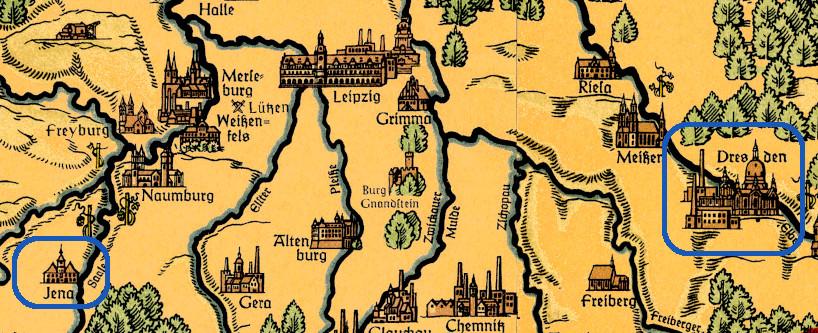
[1] Auguste, Wilhelm, and Caroline departed for Dresden on 10 April 1797, the Monday after Palm Sunday (see Wilhelm’s letter to Karl August Böttiger from Jena on 10 April 1797 [letter 181c]); 28 April 1797 was Auguste’s twelfth birthday (Rudolf Koch and Fritz Kredel, Deutschland und angrenzende Gebiete [Leipzig 1937]):
[2] Representative illustration from the Almanac de Goettingue pour l’anneé 1786 (Inhaltsverzeichnis deutscher Almanache, Theodor Springmann Stiftung):

[3] Less a random quip than it might seem. Friedrich later includes a chapter in his novel Lucinde. Ein Roman, part 1 (Berlin 1799) with the title “Idylle über den Müssiggang” (translated by Peter Firchow as “An Idyll of Idleness,” in Friedrich Schlegel’s Lucinde and the Fragments [Minneapolis 1971], 63–68), where Friedrich refers to idleness and leisure as a “godlike art.” The chapter is essentially a reflection on the passivity necessary for reflection and creation (Berlinischer Damen-Kalender auf das Jahr 1805; Inhaltsverzeichnis deutscher Almanache, Theodor Springmann Stiftung):
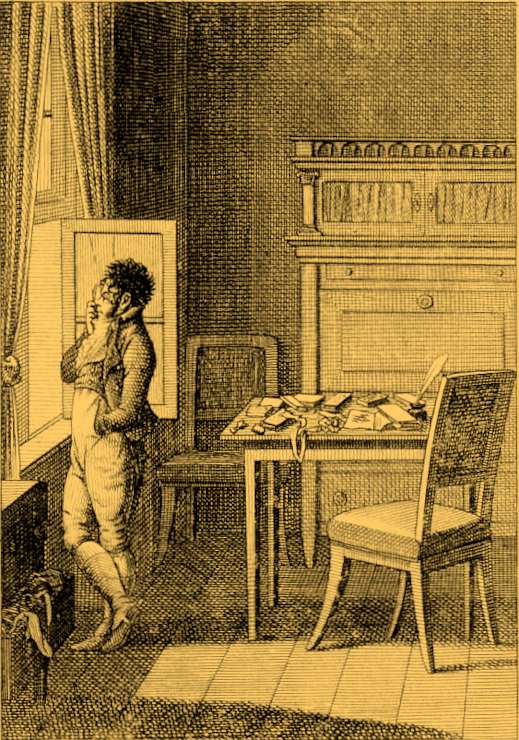
Reflection and creation, thus the reasoning, flourish only in idleness,
the life breath of innocence and inspiration . . . like a wise man of the East, I was completely sunk in a holy brooding and silent scrutiny of the eternal substances . . . Greatness in repose, the masters say, is the noblest subject of the fine arts. . . .
Why are the gods the gods, if not because they consciously and intentionally do nothing, because they understand this art and are masters of it? And how hard the poets and the wise men, and the saints strive to resemble the gods in this way too! . . .
What’s the point, then, of this unremitting aspiration and progress without reset and purpose? . . .
This empty, restless activity is nothing but a Nordic barbarity and so leads to nothing but boredom — our own and others! And what does it begin and end with but the antipathy toward the world that’s now so common? . . .
Only calmly and gently, in the sacred tranquility of true passivity, can one remember one’s whole ego and contemplate the world and life. How does any thinking and writing of poetry take place, if not by complete dedication and submission to some guardian genius? . . . the essence is thinking and imagining, and these are possible only in passivity. . . . Back.
[4] Taschenbuch für das Jahr 1814: Der Liebe und Freundschaft gewidmet (Frankfurt) (Inhaltsverzeichnis deutscher Almanache, Theodor Springmann Stiftung):

The Kampenhausens (or Campenhausens) are not otherwise identified. Possibly one of them was the Baron von Campenhausen from Latvia to whom the later Jena professor Johann Severin Vater (1771–1826) became a tutor/companion in 1795. Two Barons von Campenhausen (one a “junior”) from Courland are listed as full members of the Jena Society for Mineralogy in 1799 (Verzeichniss der Mitglieder der Societaet für die gesamte Mineralogie zu Iena [1799], 4). Back.
[5] Gk., λευκωλενος Λωλωε: “white-armed Lolo,” presumably an acquaintance named Charlotte, otherwise unidentified but perhaps also mentioned in Friedrich’s letter to Auguste in mid-September (letter 185a).
Albert Leitzmann, “Aus Karolinens Lebenskreisen,” 128, sees no reason not to identify this person as Charlotte Schiller. Militating against an identification with the “Charlotte” in the letter in mid-September, however, is that the latter behaves decidedly more like a younger woman (or girl) rather than as a married woman, and is, moreover, specifically described there as a “young girl.” Back.
[6] Schahrming (Germ. anmuthisch for anmutig): Friedrich is parodying Johanne Fichte’s Swiss accent. Back.
[7] Göttinger Taschen Calendar Für das Iahr 1795 (Inhaltsverzeichnis deutscher Almanache, Theodor Springmann Stiftung):

Friedrich uses the expression die ausgelaßensten wildesten Hummeln. Adelung s.v. Hummel, “a wild, fierce, unsociable person”; George J. Adler, A Dictionary of the German and English Language [New York 1856], s.v. hoiden, glossed there as “die wilde Hummel,”; also “tomboy,” “raw, wild, uncouth girl.” Back.
[8] Uncertain but curious reference to Johann Friedrich Traugott Fröbel, if indeed he be the reference here. Back.
[9] Friedrich’s Geschichte der Poesie der Griechen und Römer, I,1 (Berlin 1798); Jugendschriften 1:231–362. Back.
[10] An intriguing and not entirely unintelligible query given Schelling’s later explications concerning architecture as “frozen” or “rigid music.” See Karoline Paulus’s lampooning remarks in her novel Wilhelm Dümont: Ein einfacher Roman von Eleutherie Holberg (Lübeck 1803) in supplementary appendix 239.1, there also cross references to Schelling’s philosophy of art.
The puzzling elements in Friedrich’s query are, first, that Schelling would not arrive in Jena until the following year, 1798, and, second, that he would not deliver his lectures on the philosophy of art until after Auguste’s death in 1800. Back.
Translation © 2012 Doug Stott