
• 145. Caroline to Friedrich Ludwig Wilhelm Meyer in Berlin: Gotha, 7 June 1794
Gotha, 7 June 1794
|340| Here I am already writing again — for no other reason than that I have much to say to you. [1] I, too, am not personified justice, and least of all the justice bearing my name by way of Emperor Charles V, as I know from my father-in-law. [2]
On the other hand, all the passion inhering in this particular virtue rises up in me when it is a matter of tempering judgment. Shame on you for speaking to me thus about Therese, and know that this time your presuppositions are absolutely false. Therese is not in Paris, nor has Merlin ever seen her. M[erlin] knew Forster to be an honorable man and spoke up on his behalf when someone wrote to him through some |341| former citizen of Mainz — or perhaps even Huber himself. Huber wrote me in May from Neuchâtel, and Therese even earlier, soon after Forster’s death. [3]
It is not my intention to change your opinion, but neither should you in your own turn be abusive and slanderous. That is what is so ugly about all of you, that you can step all over what you once loved, or perhaps even venerated. You may very well be as justified as I in loathing Therese, and in having become indifferent toward her to the extent such is possible with someone one acknowledges as having such considerable talent for doing good — but you are not by a long shot justified in everything you ascribe to her, and the moment it involves such indecorous things, you should say nothing more to me about her.
I have not wanted to relate to you what I occasionally hear from these people, since it merely misleads you into fearing they are once again acquiring detrimental influence over me. Could I speak with you, my dear friend, you would see that I have discarded this particular, not inconsiderable personal weakness — but I cannot rid myself of the feeling that makes it impossible for me to replace it with hatred and bitterness. Therese has done me such infinite wrong, new traces of which I discover almost daily now, that it would be despicable for me to love her — nor would I even know how to begin — and just as little to believe that she were no longer capable of precisely those things for which she seems to have been born.
And now, out of revenge, I intend to relate to you something about one of your friends. He wrote a letter presenting himself in a way making me more willing to forgive him for having committed a murder than for having written this letter. Gotter sent Schröder his Muhmen and Die stolze Vasthi, asking 10 louis d’or for both. [4] Schröder sends them back, alleging that his public only likes a “few old farces” |342| that have already long been in his possession ready to be laughed at — and because that same public is allegedly unable to either feel or comprehend or understand any heroically comic play like this biblical sujet in Alexandrines. —
All that may well be true, except that a man like Schröder, who then immediately goes on to extol his own quiet domination of the public and actors, should certainly be in a position to teach the public how to feel, comprehend, and understand. But now comes this boastful affiche [5] concerning his own situation —
“I am living in a house in the most paradisiacal section of Hamburg, where I enjoy all the amenities high prosperity can provide — and I have every reason to believe these will even be multiplied after the peace — my house is the gathering place for the very best minds, both foreign and native” [6] —
— in brief, such that even the most uninformed could not but ask — “And you, for whom things are going so well, how can you be so intent on saving such a trifle and in so doing disappoint a friend who in the past has presumably done you favors enough? — but even more, how at the same time can you preen yourself so toward him? All puffed up and hardhearted?” — that is how he looks, and I would think that the role of Haman would fit him excellently. [7]
Gotter perceived it exactly this way. I am also sorry in a different respect, since Gotter could use the money. [8] Are you aware that for several years now he has suffered losses with Meyer in Lyon, at the very least the interest on the principal (or rather she has, since the money in fact belonged to her) and that these losses have severely pinched them? He has now sent the Muhmen to Engel. Could it be cast, it would doubtless be a success even though according to your description people only like plays by Kotzebue. Vasthi and Esther are to be published.
Nothing by Racine! [9] Instead, it was Goethe’s Shrovetide play that provided the initial idea. [10] It is a mixture of emotion and parody, characterization and theatrical pomp. Gotter himself calls it inspired. The verses are quite beautiful — though I assure you that after hearing Gotter read it aloud, I do not trust myself to give an assessment |343| of the whole. He is so adept at captivating the listener through the musicality and expressiveness of his declamation that, when he finishes, almost the only thing I end up repeating to myself are tones. —
The Geisterinsel has been in the hands of Freiherr von Dittersdorf in Silesia for two years now, yet without even a single answer to multiple letters. Herr von Einsiedel has just recommended a Viennese to Gotter, a completely new composer with whom Haydn is allegedly quite delighted. [11]
Alas, we have so many projects! All this will be well placed and paid, and in the autumn the Gotters will accompany me to — Dresden; the new opera and plays will be given in Weimar, in Leipzig, and in Dresden, and Gotter and I, each in our own way, will not be able to save ourselves from the sheer number of celebrities. That is why Louise would prefer not to go along, but we promised her she would find you there in Dresden. —
But seriously, my dear friend, you have mentioned Dresden, and I have been in negotiations in that regard for more than 6 weeks now. Your objection has no validity, since I know quite well how expensive Dresden is; this need not scare me away. I fear only that I may be too well known there, and I fear especially one house in particular — that of Körner. Do you know him? They judge and hate me just as they do Therese, and from their acquaintances in Leipzig they know more for certain than is good, since once I am there, the ladies will perhaps turn it into a meritorious undertaking to tell everyone about the particular element they do know for certain. [11a]
Although I have no desire to win them over, once I even come near the area it will not long remain unknown to them. (For my intention is to take up residence somewhere quite close by, out in the countryside.) I would have one female acquaintance there, namely, one of Schlegel’s sisters, who could never restrain herself from telling them. [12]
You are about to go to Dresden — you can perform a quite concrete service for me by doing some preliminary reconnaissance. You |344| wrote me about some acquaintances you have there — I now seem to recall that the Körners are among them — but tell me who the others are. Whenever it is easy for you to mention me in conversation among the K[örners], speak about me, tell them what you think — tell them you would like for me to reside in Dresden because there are so few ressources in Gotha for a person who cannot plunge into the entire breadth of the town’s social milieu — and then tell me how they react — namely, whether they react such that I would have to fear creating a stir that might degenerate into political unpleasantries, for you seem to be unfamiliar with just how strict they are in Saxony in this respect.
It would be quite appealing for me — the area there — after the shores of the Rhine the most beautiful in Germany, with the arts, galleries, libraries, and theater in the town itself! Except for the Körners, no one there knows of me. —
I cannot query Göschen further, who can do nothing more from the political side without damaging himself — and I do not need him with regard to anything else. Moreover, he is doubtless sick and tired of having to deal with me. He has already performed such enormous service for me that I will be profoundly grateful to him for the rest of my life. He has not been entirely discreet — this is no reason for me to become ungrateful, but, no, I do not want to involve him in my affairs anymore. —
If this does not succeed, I have resolved to leave Germany. None of the other suggestions help — for example, in all the places you mention, I can never do what I want to do and must do — namely, fetch my son in one or two years. It is not simply until peace has been attained that those particular locales on which you were otherwise probably counting will remain devastated by the war as far as I and others are concerned, on the Rhine and in the Palatinate. [13]
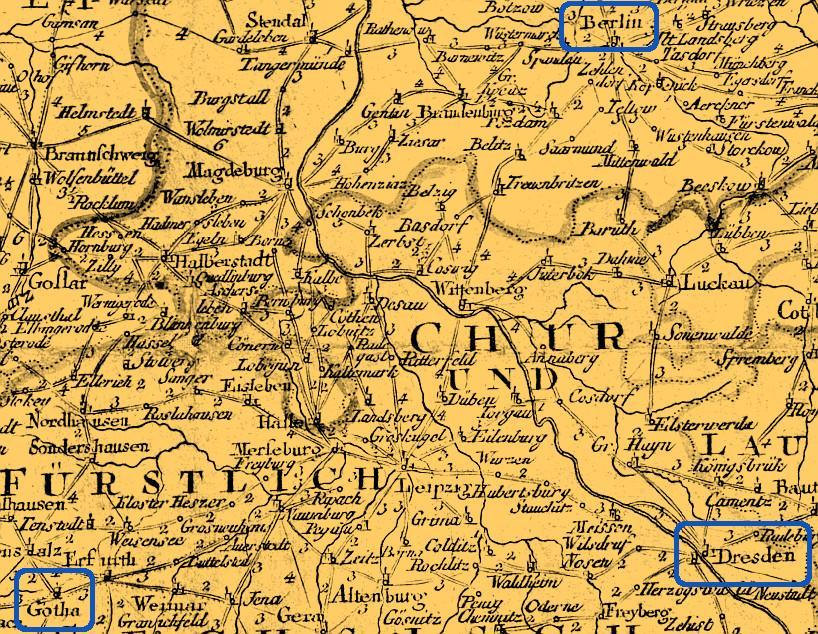
In a word, I am now quietly facing having to make a choice. If Dresden proves to be possible, then I will be glad — if it is not, then I will take my children — and then, farewell, dear friend — then you will be too late if you come looking for me here in October. Otherwise |345| we might be able to meet en route when you are on your way here from Berlin and I on mine from here to Dresden. [13a] —
I am glad I have come at least this far in making a decision. Please do your best in Dresden to gather together for me the last pieces of information affecting my decision. The younger Schlegel, who is also there now, you will probably not be wanting to look him up, or? Il m’a toujours paru que vous avés une dent contre les Schlegel. Pour moi — j’ai un tendre pour eux. Au moins je ne puis leur nier de l’influence sur mon sort, car si je ne vais pas a Dresde, j’irai en Hollande — et ceci c’est une chose si bien résolue, qu’il y auroit lieu à delibérer, si on ne devroit pas prendre d’abord ce parti, qui leveroit tout embarras et couperoit touts les noeuds de ma situation embrouillée. [14] You see, I am confessing to you in both German and French everything that burdens my soul — you wrap yourself in mystery. It is no different; you are a secret emissar — whom no person has sent and who goes to no person. —
Apropos, Gotter recently had tea with me, [15] and we spoke about Schatz’s review of your poems, [16] which does not, however, prevent me from being wondrously fond of these poems and from being attracted to something in them that presumably makes them unpalatable to others, namely, such treasures — we came upon the impromptu: la divinité qui s’amuse etc. [17] Gotter sat down in the window seat, mumbled a bit, then turned around and spoke the following:
The goddess who with but a single glance
Can from me the most secret secret steal,
I would not, were I Apollo, choose as muse;
As Thetis would I choose her, and the day would end.
A variant:
The goddess from whom I can as little
conceal my secret as withdraw my heart etc.
|346| And must you not grant that he has succeeded better than the diluted Anacreon [18] and my harsh friend, [19] who otherwise can indeed — may the “Schifferlied” bear witness — securely engage the magic of language? [20]
The thing with Bürger, — it is all simply so terrible [21] — I know about it from Dieterich. The finance councilors are disinclined to believe such things, since it inconveniences them. He has nothing to eat other than what his friends send to him, and is in the foulest of moods.
Stay well. If not sooner, then please write immediately from Dresden.
Notes
[1] Caroline writes this entire letter to Meyer using the familiar (Germ. du) rather than formal (Sie) form of address. Back.
[2] The Constitutio Criminalis Carolina (also known as the Carolina) was the first unified body of German criminal law, its aim being to unify the legal system of the Holy Roman Empire. The Carolina was accepted in 1530 at the Diet of Augsburg under the Holy Roman emperor Charles V and ratified two years later at the Diet in Regensburg. Although it did indeed largely succeed in unifying the imperial legal system, it also codified a definition of homosexuality and witchcraft as severe crimes, stipulated that those found guilty of witchcraft be executed by fire, and laid the basis for the use of obtaining confessions by torture. Caroline’s father-in-law, Georg Ludewig Böhmer, was a professor of law in Göttingen. Back.
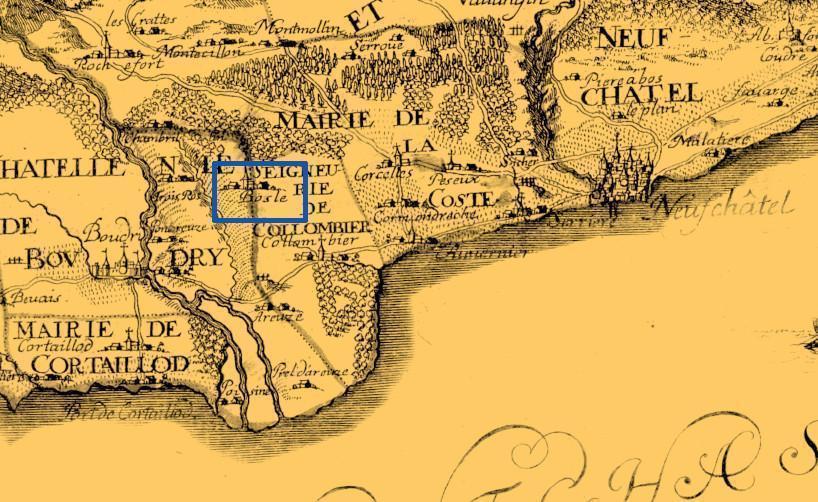
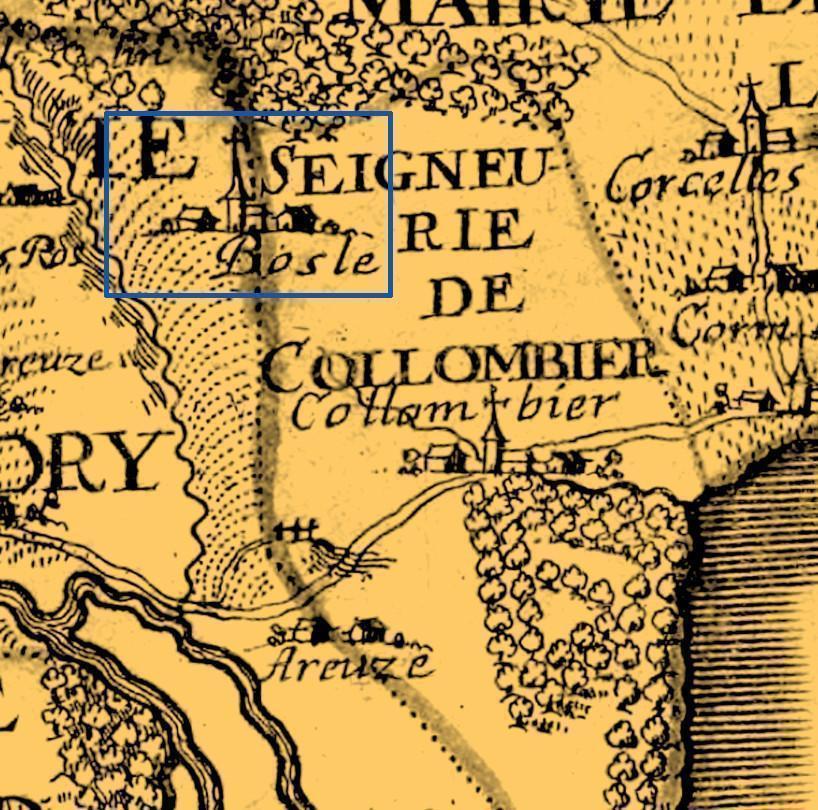
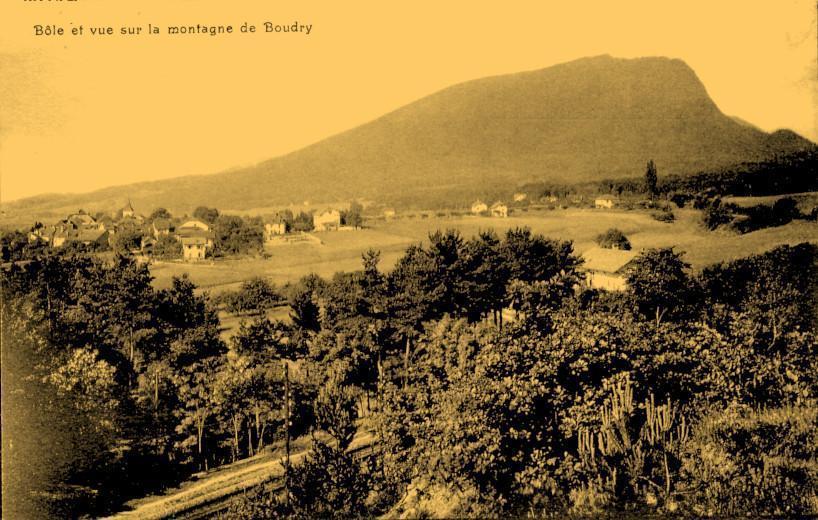
[3] Huber had married Therese Forster on 10 April 1794 (see Therese Forster’s letter to Caroline on 25 February 1794 [letter 142], note 10). Denied a residence permit in the town of Neuchâtel in mid-June 1794, they moved to Bôle, still in the vicinity of Neuchâtel, at the end of June; alternate names for the locale over its history include Boule, Bosle, and Bulla; here as “Bosle” (Dav. Fran. de Merveilleux, Carte géographique de la Souveraineté de Neuchâtel et Vallangin en Suisse [1694]; Bibliothèque nationale de France; photograph: early postcard):
The letter Therese wrote to Caroline shortly after Forster’s death on 10 January 1794 is presumably that of 25 February 1794 (letter 142). The letter from Huber seems not to have survived. Back.
[4] Concerning Gotter’s plays, see Caroline’s letters to Meyer on 24 October 1789 (letter 92), with note 8, and on 10 May 1794 (letter 144) with note 11. Back.
[5] Fr., “placard, play-bill, proclamation.” Back.
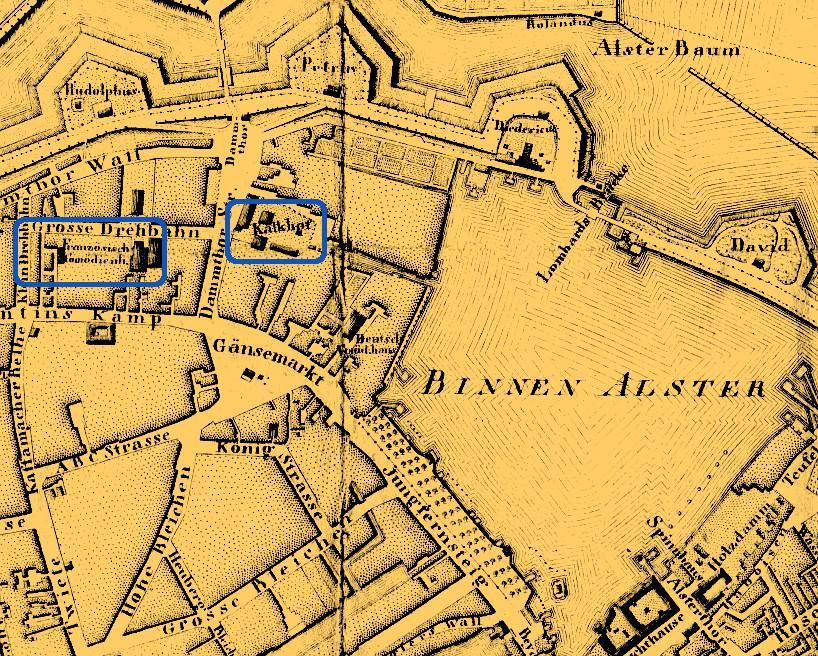
[6] Schröder lived in a tony section of Hamburg near the French theater; his address in 1792 was given as “bey den Kalkhof, an der Alster” (“at the Kalkhof, on the Alster”); Neues Hamburger und Altonaer Addreß-Buch auf das Jahr 1792 [Hamburg 1791], 234; map: P. G. Heinrich, Hamburg mit seinen nächsten Umgebungen im Jahre 1810):
Caroline alters the wording in Schröder’s (in Erich Schmidt’s opinion, [1913], 705: “arrogant”) letter from Hamburg of 20 May 1794, which was originally published in Schröder und Gotter. Eine Episode aus der deutschen Theatergeschichte. Briefe Friedrich Ludwig Schröders an Friedrich Wilhelm Gotter 1777 und 1778, ed. Berthold Litzmann (Hamburg, Leipzig 1887), 135–36:
As pleasant as it was for me to see your handwriting again after such a long time, my dear friend, it is equally unpleasant for me to have to tell you that neither piece is suitable for current taste in Hamburg. For some years now I have had no examples of baser comedic pieces that have enjoyed any success. People laugh, wrinkle their noses, and then like wildfire the murmering spreads, “Farce! Farce! — signaling utter condemnation. Older farces, performed 20 and more years ago, have been granted citizenship and are able to provide a certain measure of amusement when performed.
Vasthi — a heroic comedy — in rhymed verses — a biblical story! — who is to comprehend, feel, understand such a thing? Marketable pieces include operatic spectacles, plays intended half for laughing, half for weeping, occasionally also a Shakespearean piece, and older comedies. Nothing else sells.
I am pleased to hear you are doing well! I would like for you to be doing completely well. I am healthy and as happy as I can be given my temperament. My theater is the calmest of any nation. I am living in a house in a paradisiacal area, with all the conveniences prosperity can provide. It is not infrequently filled with the very best minds, both foreign and native. I myself rarely perform, and in all likelihood will never again take on a single new role. If this wretched war ends soon, I have every reason to believe that my prosperity will even be multiplied. My wife and Madam Stark send you their regards. I would be heartily glad to see you again sometime in Hamburg.
Your devoted,
Schröder
See also Rudolf Schlösser, “Schröder und Gotter,” Vierteljahrschrift für Litteraturgeschichte 6 (1893), 574–87, here 584, who cites Caroline’s passage here, then with respect to Caroline’s statement “Gotter sent Schröder his Muhmen and Die stolze Vasthi, asking 10 louis d’or for both” points out (fn25) how although three of Gotter’s plays were involved, Esther and the prologue Die stolze Vasthi could together count as a single play. Back.
[7] In her indignation, Caroline adduces the severe example of Haman, the archetypal villain both in Gotter’s play Vasthi and in the original biblical story in Esther, in which Esther foils his scheme, prompted by a perceived slight to Haman by Mordechai, to destroy the Jews (Esther 7 [NRSV]):
So the king [Ahasuerus] and Haman went in to feast with Queen Esther. On the second day, as they were drinking wine, the king again said to Esther, “What is your petition, Queen Esther? It shall be granted you. And what is your request? Even to the half of my kingdom, it shall be fulfilled.”
Then Queen Esther answered, “If I have won your favor, O king, and if it pleases the king, let my life be given me — that is my petition — and the lives of my people — that is my request. For we have been sold, I and my people, to be destroyed, to be killed, and to be annihilated. If we had been sold merely as slaves, men and women, I would have held my peace; but no enemy can compensate for this damage to the king.” Then King Ahasuerus said to Queen Esther, “Who is he, and where is he, who has presumed to do this?” Esther said, “A foe and enemy, this wicked Haman!”
Then Haman was terrified before the king and the queen. The king rose from the feast in wrath and went into the palace garden, but Haman stayed to beg his life from Queen Esther, for he saw that the king had determined to destroy him. When the king returned from the palace garden to the banquet hall, Haman had thrown himself on the couch where Esther was reclining; and the king said, “Will he even assault the queen in my presence, in my own house?” As the words left the mouth of the king, they covered Haman’s face.
Then Harbona, one of the eunuchs in attendance on the king, said, “Look, the very gallows that Haman has prepared for Mordecai, whose word saved the king, stands at Haman’s house, fifty cubits high.” And the king said, “Hang him on that.” 10 So they hanged Haman on the gallows that he had prepared for Mordecai
Here Esther (right) denounces Haman (center) to King Ahasuerus (left); gallows at back right (Christoph Weigel, Biblia Ectypa: Bildnussen auß Heiliger Schrifft dess Alt- und Neuen Testaments, in welchen Alle Geschichte und Erscheinungen deutlich und schrifftmäßig zu Gottes Ehre und Andächtiger Seelen erbaulicher beschauung vorgestellet werden [Augsburg 1695]):

Both Schlösser (“Schröder und Gotter,” 584n26) and Michael Bernays (“Caroline [1871, December],” in Schriften zur Kritik und Litteraturgeschichte, vol. 2 [Leipzig 1898], 283–311, here 311) also cogently point out that Waitz (1871), 1:147, seems to have misread “Haemon/Haimon” for what was in fact “Haman”; the Krakau manuscript seems to confirm the reading “Haman.” Back.
[8] Erich Schmidt (1913), 1:342, omitted the following sentence but did reference its content in his annotations 1:705. Thanks to Martin Reulecke for help in reading the Krakau manuscript. Back.
[9] Jean Racine, Esther (Paris 1689); see Wilhelm Schlegel’s review of Gotter’s Schauspiele (1: Die stolze Vasthi; 2: Esther; 3: Die Basen) (Leipzig: Göschen, 1795), in the Allgemeine Literatur-Zeitung (1796) 13 (Tuesday, 12 January 1796) 97–103 (Sämmtliche Werke 10:91–98) (supplementary appendix 144.1). Back.
[10] See supplementary appendix 144.1 (as in previous note above) and Caroline’s letter to Friedrich Ludwig Wilhelm Meyer on 24 October 1789 (letter 92) with note 8. Back.
[11] Erich Schmidt (1913), 1:705, remarks that music for the play Die Geisterinsel, in whose genesis Friedrich Hildebrand von Einsiedel had played a role, was supplied neither by Karl von Dittersdorf (see, e.g., Gottlieb Stephanie the Younger, Der Apotheker und der Doktor. Ein komisches Singspiel, comic opera in 2 acts, music by Karl Ditters von Dittersdorf [n.p. 1793], which premiered 11 July 1786 in Vienna) nor by any Austrian whom Joseph Haydn extolled. In his own turn, however, Albert Leitzmann, “Aus Karolinens Lebenskreisen” 128, considered it “possible that the reference is in fact to Beethoven,” whereas Rudolf Schlösser, Friedrich Wilhelm Gotter, 300, thought Mozart had been considered. Concerning the piece’s admittedly complicated musical history, see supplementary appendix 107a.1. On the publication of Die Geisterinsel, see also the notes to Caroline’s letter to Luise Gotter on March 1797 (letter 181). Back.
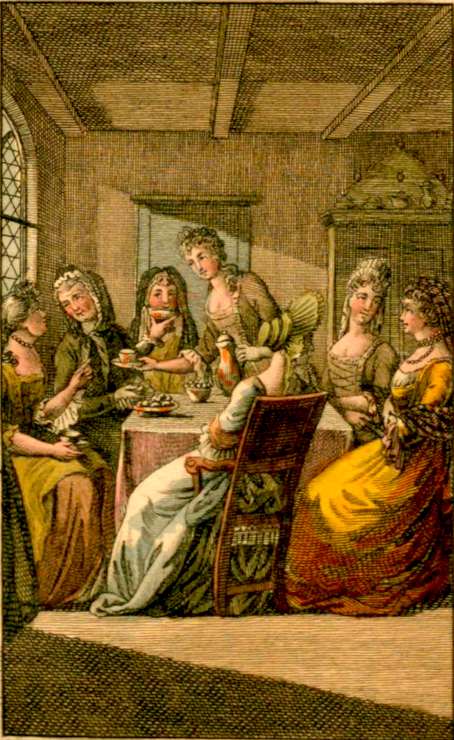
[11a] Presumably a reference to Caroline’s pregnancy, since at least some of these ladies had seen her during her stay at the home of Georg Joachim Göschen in Leipzig before she moved to Lucka (illustration: Der Freund des schönen Geschlechts: ein angenehm und nützlicher Taschenkalender für das Jahr 1808):
[12] Concerning Charlotte Ernst and her husband, see esp. Friedrich Schlegel’s letter to Wilhelm Schlegel on 9 May 1794 (letter 143d). Charlotte would prove to be considerably more accommodating than expected. Back.
[13] The War of the First Coalition.
Caroline’s enduring political problem in this context inside the Holy Roman Empire of the German Nation was her allegedly intimate association with the French occupying forces in Mainz, even as mistress to the commandant General Adam Philippe de Custine. Her enduring personal problems were her allegedly romantic association with the imperially proscribed Georg Forster (see also the play The Mainz Clubbists in Königstein) and the risk that her pregnancy and son by a French officer might become more widely known; hence also her uneasiness with the previously mentioned (note 11a above) gossip in Dresden. Back.
[13a] Post Karte Durch ganz Deutschland, ed. J. Walch (Augsburg 1795):
[14] French: “It has always seemed to me that you have a grudge against the Schlegels. As for me — I have a certain affection for them. At the very least, I cannot deny that they have exercised a measure of influence on my fate, since if I indeed do not go to Dresden, I will go to Holland — and this is something that is already so firmly resolved that there might well be cause to consider whether one should not indeed take this course first, which would remove all the embarrassing circumstances and sever all the knots of my confused situation.” Back.
[15] An indication perhaps that Caroline and Auguste were residing somewhere besides in the Gotters’ home. Back.
[16] For the text of that review, see supplementary appendix 143.2. Back.
[17] Allusion to Meyer’s adaptation (Spiele des Witzes und der Phantasie, 22) of a poem by the French poet Francis Marquis de St. Aulaire. The Duchess of Maine, having been charmed by St. Aulaire’s conversation and having called him Apollo, asked him then to tell her certain secret; St. Aulaire replies:
La divinité qui s'amuse
A me demander mon secret,
Si j'étais Apollon ne seroit point ma muse:
Elle seroit Thetis, & le jour finiroit.
Free translation (A New and General Biographical Dictionary, vol. 10 [London 1762], 488):
Were I Apollo, O divinest fair,
Who deign to ask the secret of a friend,
You should not be my muse; but I declare
You should be Thetis, and the day should end.
In his review, Georg Schatz cites Meyer’s adaptation of this epigram. Back.
[18] Georg Schatz? The reference to his being an “Anacreon” refers to a conscious imitation of a collection of Greek poetry known as the Anakreonteia, based on the poet Anacreon (ca. 550 B.C.), on the part of various other poets as well in Germany at the time, the Anakreontiker, composers of pseudo-Anacreontic poems on love, wine, nature, and friendship in a superficial but socially pleasing, convivial manner. Back.
[19] I.e., Meyer himself in his own version (“Frommer Wunsch” in Spiele des Witzes und der Phantasie, 22). Back.
[20] The “Schifferlied” from Meyer’s Spiele des Witzes und der Phantasie (Berlin 1793), 186–87, Meyer’s version of the oft-adapted Venetian La Biondina in Gondoletta (sample music treatment: La Biondina in Gondoletta, canzonetta veneziana [London 1805]):
Song of the Boatman
In the Venetian fashion
Cool did the night descend,
Breeze and wave do hardly breathe,
And the girl of my songs
Slumbers in her sweetest dream,
Inclined in the diminutive bark,
White hand 'neath her head:
"Would you," I ask, "yet wake with me?"
But gently the waters rock the boat,
And slumber overcomes.

Through clouds in muted distance,
Through lofty blue the moon now sojourns high,
And pale starlight
Reflects on hush'ed lake:
Like silken bosom veil
Her hair does cover the sleeping girl,
Yet now her vest more freely flutters,
And the most beautiful veil yields,
Which once was beauty's cover.

Ever greater now the power of desire,
Ever deeper my gaze profound;
Pure admiration of love
Alone restrained love's ardor:
To gaze upon her near, and nearer still
Did I quietly kneel before her,
Alas! I was quickly done for!
Did I but consider what I did not see,
Both gaze and sense departed from me.

Like a serpent through flowers
Did I move, nor did she know,
Now touching her cheek,
Now sheltering her breast:
Waking, sleeping,
My bliss lingered not long afar,
Yet doubt's chastisement did I escape:
When beautiful girls do sleep,
Devout love does gladly wake!

[21] After coming down with consumption, Gottfried August Bürger was no longer able to lecture in Göttingen and thus could also no longer collect lecture fees from students (he was an otherwise unsalaried professor), effectively cutting off his means of support. Although the university had agreed to a one-time payment of 50 Thaler, Bürger had largely been abandoned by his former friends and was living in dire straits. He would die on 8 June 1794, just a day after Caroline’s letter here (Genealogischer Calender auf das Jahr 1785 [Berlin]; Inhaltsverzeichnis deutscher Almanache, Theodor Springmann Stiftung):

Translation © 2011 Doug Stott