
• 94. Caroline to Lotte Michaelis in Göttingen: Marburg 1789
[Marburg 1789]
[Beginning of letter is missing.]
|188| . . . would have given . . . winter evening[s] after Tacitus.” With regard to the piece depicting Ulysses discovering Achilles among the women, [1] she [2] recalled that the king of Prussia owned this story in a group of statues. Then came a piece from an English ballade in which a girl with the most beautiful expression of pain is sitting between her father and mother, beneath which is written —
My Father urg’d me sear my Mother did nae speak
But she loockd in my face that my heart was like to break. [3]
Then the Death of Lord Robert Manners in the battle of April 12. She saw his monument. [4] Then we came to you — “What a dear creature,” she said — “She is the likeness of my sister” — “Of Lottchen?” And so I pointed out to her all the similarities.
On the subject of the Wegdwoods [5] she remarked that Goethe had his head engraved in a gem while in Italy, and that Merk had had an impression made of it and sent it to England, where one can now seal with Goethe’s head as well. [6] My embroidery pleased her greatly, and she wished me |189| luck with my talent.
After 8:00 she was reminded that she had to go. I promised to embroider her a head if, considering that she had already given Philipp Miss Lony, she would send me the Mannheimer Briefe, allegedly the best thing she has written. [7] That was the first time I mentioned any of her works. She agreed on the condition that I give her my opinion of Miss Lony — fortunately I had not read it yet, for surely I can come up with something that is true, something I can praise, which will doubtless, however, still not interest me. I had the right to be candid, she said with great delicacy. She asked me several times whether I was genuinely well disposed toward her — something she seemed to put some stock in.
I took my leave of her on Friday evening. There were some students there, theologians, bad company — La Roche [8] remarked to me: “There my mother sits, attracting them all to herself, and no one feels he is allowed to leave because each imagines he is in fact the favorite.” She will come again tomorrow and stay at least until Merk returns.
One more thing occurs to me: she was initially rather reticent about attacking Schiller — then someone told her that precisely because she attributes all these colossal ideas to him, she certainly could risk saying a great deal indeed. Is that not utterly the truth?
When she returns I will have to speak with her alone in order to discuss my Lotte with her more thoroughly. I understand you so completely, and what I understand best is that I would be too much for you. That is also why I cannot say much to you about yourself. After I have gaped at the enormity of your loss for a while — it vanishes for me — it is a simple human fate, one in which a person must not sink. [9] I raise myself up from the depths of your grief to the possibility that you can still enjoy much through the activity of your mind and your own capabilities.
Good for him that he was able to prompt at least one such thing in you: |190| the will to live — not for yourself, but for our parents; one must make as few people unhappy along with oneself as possible, and are they not already unhappy enough? Marianne knows everything, but you two do not speak of it, do you?
Marianne’s situation is very, very unpleasant indeed. [10] In the one case, she would not be able to endure it there; but is it even possible that such can come about? A visit, but by no means a stay. If only he does not establish himself in Mannheim, the most depraved city in Germany! Oh, if only Therese could overcome herself — I will hear nothing more of her if she does not, and yet what I do worship in her can never be completely destroyed. Her vices are that she overstrains her powers.
I have referred Tatter to this letter because you should have the whole story of Madam Roche. Please do not hold it against me that I bring the two of you together in this way. In return he will relate to you whatever he chooses.
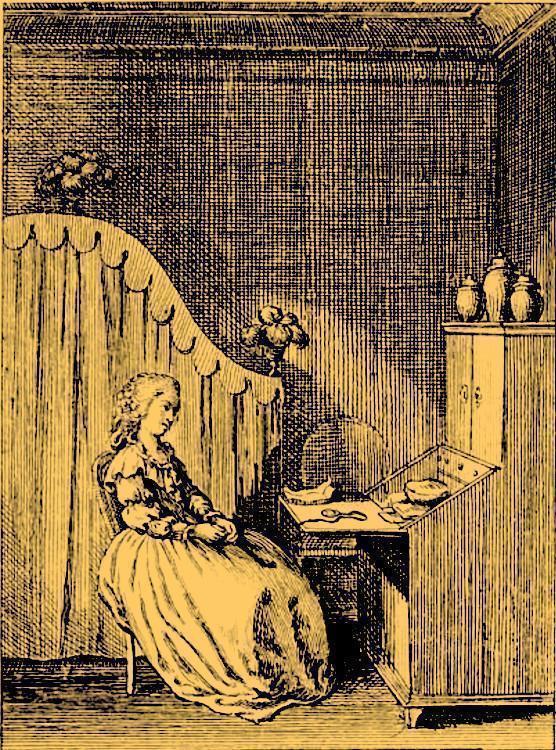
The Schulers just let me know that they have come. [11] I will probably visit the Kronenbergs this afternoon, for after a peaceful night I am feeling a bit better than yesterday, when I did not feel well at all. [11a] The night makes me think of the bedroom; La Roche could have seen it as well. In it are my own and my children’s beds and a night table, and all the silhouettes — surrounded by the shadow [silhouettes] of my loved ones — the silhouette of my father with the wreathe of wilted flowers hangs over my sofa, and Lotte at Werther’s grave, since it was not good enough to hang in the parlor. [12]
Le mal est fait, [13] for Schlegel has a letter since Tuesday — but I still would have committed the evil deed even had I read your warning. He wrote me three times, and how! Since on Thursday you had not yet learned anything about this |191| stroke of luck he had, I do hope he will go about it a bit more quietly now. I really had a good laugh about Jette [14] — Schlegel and I?! I laugh even as I write! No, that much is certain — nothing will ever come of us. But the notion “something must come of it quickly”? What a wretched idea, one only twisted Jette could come up with. To receive a letter from me through the mail: That is one triumph over the Royal British Postal Service and the well-established postman he will never have. And the content will have the gift of silencing him.
For heaven’s sake, Cepog [15] is not in love with Marianne, is he? I do not think I could imagine a more unbelievable one than Lotte. Give him and Launay [16] my regards if you otherwise have nothing to speak about, and to whoever asks, please respond that I am content here beyond all expectation. Let you not now put the question to me — and yet it is true — I now find that it was right for me to go, and living here is not at all unpleasant.
After Madam La Roche had tea with me, I went to Ockershausen with Philipp, where Madam von Malzburg gave a small souper for us and the Selchows from which we did not return until 12:00. [17] Madam Selchow has a certain measure of understanding; she sometimes says things that make good sense, but then she natters on and engages in irksome flattery — et elle n’a pas un brin d’âme. [18]
An obvious sympathy emerged between the gracious Fräulein and myself, for we both love genealogy and are constantly marrying off all the princes and princesses of the calendar to one another. [19] There is one candidate, the ami of the gracious house itself, a person of some understanding but insufferably conceited, around whom the conversation often revolves because he is a kind of string to which one ties flowers. [20]
Well, my dear Lotte, that is probably enough.
|192| If my parents concede, I can hardly doubt something will come of it. [21]
I do not want to make you weak, my dear, precious Lotte — it is a prejudice to imagine that sorrow and pain must hurt, must dissolve our very being and melt it amid tears. Weep, if you can, but do not let yourself want to weep. I must close now.
Notes
[1] See the British Museum’s Description of the Collection of Ancient Marbles in the British Museum with Engravings, part x [1845], 83 (illustration by Girard Audran, Ulisse découvre Achille [ca. 1660–1703]; Herzog Anton Ulrich-Museum, Signatur GAudran AB 2.6):
Thetis, knowing that her son Achilles, if sent to the Trojan war, was destined to be cut off in the flower of his youth, sent him disguised as a female to be a companion to the daughters of Lycomedes, among whom he went by the name of Pyrrha. The Greeks having been apprised by Calchas the priest of Apollo, that Troy could not be taken without the assistance of Achilles, dispatch Ulysses, Diomedes and Agyrtes to discover his retreat, and persuade him to join their united forces. Suspecting where he might probably be found, they sailed to Scyros in the character of merchants, having provided themselves with trinkets, implements of female industry and a few warlike instruments.
This stratagem suggested by Ulysses succeeded, for, when the daughters of Lycomedes and their companions saw the articles of merchandise, they each made choice of various ornaments of dress; Achilles on the contrary, fired at the sight of the armour, and forgetting that he had assumed the dress and manners of a female, with great eagerness seized upon a shield and spear, by which action he was discovered, and consequently obliged to join the Greeks in their war against Troy. This subject seems to have been a favourite one with the ancient artists, for many monuments are known on which the same scene is represented.

[2] Sophie von La Roche, a travel acquaintance of Elisa von der Recke. Back.
[3] Caroline’s lines in English in original. The anonymously published (Caroline mentions no author) Scots ballad, Auld Robin Gray, attributed to (and later claimed by) Lady Anne Barnard, née Lindsay, allegedly composed in 1772, published in 1776, tells the story of a woman’s sad marriage to an elderly man instead of to her beloved, who is thought to be dead but later turns up.
Caroline is referring to the touching illustration with the first two lines from stanza 6 that later accompanies the publication of the poem in Angelica’s Ladies Library, or, Parents and Guardians Present (London 1794), 167–68, illustration preceding 167; i.e., Caroline seems to have seen the illustration with its accompanying text prior to the publication in 1794:

The German version, “Das Lied von Martin Grau: Schottisch,” appeared in Friedrich Ludwig Wilhelm Meyer’s collection Spiele des Witzes und der Phantasie (Berlin 1793), 181–84. Vastly different English versions exist; here from English Poetry (1170–1892), ed. John Matthews Manly (London 1907), 309, which concurs with Caroline’s wording in stanza 6:
When the sheep are in the fauld, and the kye at hame,
And a' the warld to rest are gane,
The waes o' my heart fa' in showers frae my e'e,
While my gudeman lies sound by me.

Young Jamie lo'ed me weel, and sought me for his bride;
But saving a croun he had naething else beside;
To make the croun a pund, young Jamie gaid to sea;
And the croun and the pund were baith for me.

He hadna been awa' a week but only twa,
When my father brak his arm, and the cow was stown awa';
My mother she fell sick, — and my Jamie at the sea —
And auld Robin Gray came a-courtin' me.

My father couldna work, and my mother couldna spin;
I toil'd day and night, but their bread I couldna win;
Auld Rob maintain'd them baith, and wi' tears in his e'e
Said, "Jennie, for their sakes, O, marry me!"

My heart it said nay; I look'd for Jamie back;
But the wind it blew high, and the ship it was a wrack;
His ship it was a wrack — Why didna Jamie dee?
Or why do I live to cry, Wae's me!

My father urged me sair: my mother didna speak;
But she look'd in my face till my heart was like to break:
They gi'ed him my hand, tho' my heart was in the sea;
Sae auld Robin Gray he was gudeman to me.

I hadna been a wife a week but only four,
When mournfu' as I sat on the stane at the door,
I saw my Jamie's wraith, — for I couldna think it he,
Till he said, "I'm come hame to marry thee."

O sair, sair did we greet, and muckle did we say;
We took but ae kiss, and we tore ourselves away:
I wish that I were dead, but I'm no like to dee;
And why was I born to say, Wae's me

I gang like a ghaist, and I carena to spin;
I daurna think on Jamie, for that wad be a sin;
But I'll do my best a gude wife aye to be,
For auld Robin Gray he is kind unto me. Back.
[4] Captain Lord Robert Manners, an officer of the Royal Navy wounded at the Battle of the Saintes in the West Indies on 1 April 1782 and dying on 23 April 1782. Thomas Stothard painted the scene in 1786, “Death of Lord Robert Manners” (engraving: William Turner Davey):

Sophie von La Roche had seen his monument (still under construction; it would not be finished until 1793) in the north transept of Westminster Abbey during her trip to London in 1786. The monument was a collective piece by Joseph Nollekens commemorating Royal Navy captains William Bayne, William Blair, and Lord Robert Manners, all of whom were killed in 1782 (illustration from John Thomas Smith, Nollekens and His Times, 2 vols., 2nd ed. [London 1829], plate in vol. 1 following p. 370):

She mentions her visit in her travel diary, Tagebuch einer Reise durch Holland und England (Offenbach am Main 1786; 2nd ed. 1791) 452 (here: Sophie in London, 1786; being the diary of Sophie v. la Roche, translated by Clare Williams [London 1933]):
I also saw some busts of noble Englishmen: as, for instance, Savile, Mansfield, Spencer and others; then the superb monument which the Duke of Rutland is having erected at Westminster Abbey to his beloved brother Manners. . . . This monument is very large and very noble. A kind of hill by the seashore, on which Time is supporting a rostral column, and pendent from it the bust of Lord Manners, and, at the duke’s command, those of two other honest officers who served and died at his brother’s side; a sea-horse bears a Triton to the shore, who mournfully points to the likenesses; the spirit of fame hovers over the monument, laurel wreaths in hand. Back.
[5] Joseph Wedgwood and Thomas Bentley Company, famous London sellers of pottery and black porcelain. See Caroline’s letter to Luise Gotter on 1 (3?) September 1785 (letter 60), with note 6. Back.
[6] No such gem with Goethe’s head is known, nor anything about Johann Heinrich Merck’s part in the episode. Back.
[7] Sophie von La Roche, Geschichte von Miss Lony und der schöne Bund (Gotha 1789), essentially (Erich Schmidt [1913], 1:689), a derivative of Samuel Richardson’s Clarissa. Or the History of a Young Lady, 8 vols. (London 1748–49). Here the two engravings from the original edition:


Briefe über Mannheim (Zürich 1791), “the affected, disparaging woman’s hodgepodge expressing reservations against Schiller’s three early dramas” (Erich Schmidt [1913], 1:689, adducing pp. 144, 233 [letters 11 and 17] in the edition of 1791) (here the title page):

Here an excerpt from Mannheimer Briefe, 142–44; Laroche is relating what she said at a social gathering:
I know and appreciate Herr S[chiller] personally, but I would nonetheless tell him to his face, this excellent, intelligent man, that although I sincerely admire his natural talents and the wealth of mind he has acquired, I am not fond of the use he has made of these talents in his first three plays — as little as I would be fond of the owner of India’s richest diamond mine were he to use such riches merely to revive those older plays in which human beings fought with wild animals, or that I would like to hear the grand story in which, as is related, they might storm Olympus by piling rock upon rock with their enormous strength — but that it does indeed seem to me that in the Räuber, Fiesco — in Cabale und Liebe such an accumulation of heart-rending circumstances and passions could only be assembled through gigantic ideas. . . .
Herr S[chiller], as a sort of moral Hercules, may well accomplish as grand and useful things in the realm of science and the arts as that of the ancients, and his [periodical] Thalia [named after Thalia, the muse of comedy and merry or idyllic poetry] does indeed prove that he should be called Musagetes — [Apollo as the] Leader of the Muses — But what I was saying [at this social gathering] was actually merely what everyone tends to say to make up for a perceived slight.
See also her letter to Johann Georg Jacobi from Mannheim on 20 January 1785 (cited Schmidt [1913], 1:689): “I saw a performance of Schiller’s Cabale und Liebe; I personally find it to be quite abominable and consider it something only devils and insane people should perform in any case.”
Concerning the play, see Wilhelm Scherer, A History of German Literature from the Accession of Frederick the Great to the Death of Goethe, trans. Mrs. F. C. Conybeare (Oxford 1891), 118 (illustration of Secretary Wurm [“worm”], one of the play’s primary intrigants from Gotthelf Wilhelm Rupert Becker, Einige Charaktere aus den Darstellungen der churfürstlichen sächsischen Hofschauspielergesellschaft [Leipzig 1804]):

In Intrigue and Love the interest centres round a pair of lovers who are ruined by class-prejudice; it pictures the well-known misery of the smaller German states at that time, the Sultan-like prince, the all-powerful favorite, the miserable court, the scoundrelly minister and his rascally tools, the immorality of the nobles and their haughty scorn of the bourgeois class, the extortion practised towards the people, and shameful selling of soldiers to foreign rulers, the arbitrariness of justice — all features drawn from sad reality, which the poet could either observe in his own country or learn of from reliable sources. The obvious purpose of the play was to strengthen the hatred against oppressors and excite pity for the poor and innocent victims.
Click on the following image to open a gallery of Daniel Nikolaus Chodowiecki’s illustrations to Schiller’s Kabale und Liebe (generally translated as “Love and intrigue” or “Intrigue and love”):

[8] Besides Franz Wilhelm La Roche, a university friend of Philipp Michaelis, a stepson of Sophie von La Roche’s daughter, Maximiliane Brentano, also seems to have been there at that time. Back.
[9] The reference is to the painful end of Lotte’s relationship with Peter Heinrich Blankenhagen from Livonia, which Luise Wiedemann discusses in her Erinnerungen (see her biography of Lotte, p. 89), where she remarks that Blankenhagen
ardently loved Lotte and greatly respected her. There was no alliance or engagement, since couples did not always begin with such at that time, trying instead to get to know each other first. He wrote to her for a year, saying he intended to court her when he was back in Livonia. But then [the] letters came less frequently, and finally ceased. Lotte genuinely loved Blankenhagen and was totally destroyed.
(“Ah, how he would have loved me”; Daniel Nikolaus Chodowiecki, Wie er mich würde geliebt haben [1786]; Herzog Anton Ulrich-Museum; Museums./Signatur DChodowiecki AB 3.709):
[10] Uncertain reference. Back.
[11] The Marburg Schulers (along with the Marburg Hansteins) are unfortunately difficult to identify with certainty. The reference here seems to be to Carl von Schuler, son of Johann David Gotthardt von Schuler, both of whom are attested in Marburg during this period and the former of whom was later (1801) married to Sophia Caroline von Hanstein (born 1787), though she may have been his second wife (she was considerably younger); the Schulers (including his mother) later moved to Hildburghausen, as attested by Caroline in her letter from Munich to Luise Wiedemann on 31 January 1807 (letter 421). Back.
[11a] The Kronenbergs are unidentified. Back.
[12] The statement “La Roche could have seen it as well” along with the remark “After Madam La Roche had tea with me” indicate that Sophie von La Roche had had tea at Caroline’s apartment at Reitgasse 14.
Daniel Nikolaus Chodowiecki did an illustration of Werther’s bedroom in 1776 that likely resembled what Caroline is describing here as her and her children’s own, albeit without the nighttable. And, of course, Werther’s body rests in the curtained bed, the two pistols on the desktop and chair.
The room is typical enough, however, to illustrate Caroline’s living conditions at the time; note also Lotte’s silhouette on the wall in the back. Although Caroline may or may not have had her own writing table, she presumably used a similar one in her brother’s house (Chodowiecki’s Illustrationen zu den deutschen Klassikern, ed. Paul Landau [Berlin 1914], plate 30):

“Lotte at Werther’s Grave” was a popular illustration at the time. Although the scene is wholly conjectured, since Goethe includes no such scene in the novel, Die Leiden des jungen Werthers (Leipzig 1774; rev. ed. 1786), it was indeed the subject of the seven-page poem by Carl Ernst von Reitzenstein, Lotte bey Werthers Grab (Wahlheim 1775); note the place of publication taken from the novel. Here a popular copper engraving after John Raphael Smith’s larger piece of 1783 (British Museum; Prints & Drawings; Registration number 2010,7081.3669):

Another (undated) version (Freies Deutsches Hochstift, Frankfurter Goethe-Museum; Licence: CC BY-NC-SA):

[13] Fr., “The damage is done.” Back.
[14] Unidentified; Jette is short for Henriette. Back.
[15] Unidentified; the term cepog otherwise refers to the funeral dirge sung in ancient Ireland recounting the deceased’s ancestry and deeds. Back.
[16] Concerning Auguste de Launay de Tilliers from Paris, see Friedrich Jacobs, Personalien (Leipzig 1840) 45–46:
Several young Frenchman came here [Gotha] in 1788, some in order to learn German, and I became acquainted with most of them. . . . I have not been able to ascertain the fate of another young man who received instruction from me, Launay de Tilliers, who went from here to Göttingen and later moved on to Hamburg.
Launay apparently kept up an intimate relationship with Elise Bürger (see Caroline to Friedrich Ludwig Wilhelm Meyer on 6 December 1791 [letter 111]). Launay writes to Gottfried August Bürger in September 1790 (Strodtmann, 4:83):
In beseeching you, my dear Bürger, to accept my debt, I do sense there is another debt, one it is not within my power to acquit. Your courteousness, the friendship you demonstrated toward me — for all that I am profoundly grateful. And I can watch you depart without regret, certain that you are leaving us to find your happiness. I do not doubt for a moment that, after having been long tossed about by the caprice of fortune like good Ulysses, following your own expressions, you, like him, cannot but find the vigor, life, and pleasures of heaven at the side of your goddess. Love will rejuvenate you like the inhabitant of Ithaca, and yet regardless of whatever metamorphosis that may bring about in your body, the characteristics of your heart and spirit will remain indestructible. . . .
See, however, Elise Bürger to her mother on 8 and 11 October 1791, after de Launay has left Göttingen (Strodtmann, 4:132–33):
We spent three days with these dear, charming people about as follows. At 8:00 we always went to the dining room for breakfast in negligé, then we read and worked till 10:00. Then some played chess, some trick-track [a variety of backgammon], and I and dear Lotte Marenholz, her brother, Launay, and Bürger went for a walk with the demoiselles until 1:00 through the nearby forests and hills, for we had divine weather etc. . . .
I am quite obliged to you, dearest Mother, for sending along the excellent rules with respect to dealing with Herr von Launay! And indeed, I am dealing with him precisely thus, though I confess I often lose patience with his annoying pushiness; thank God I really am rid of him now, for he is now in Rothenkirchen, whither he accompanied Countess von Hardenberg. Back.
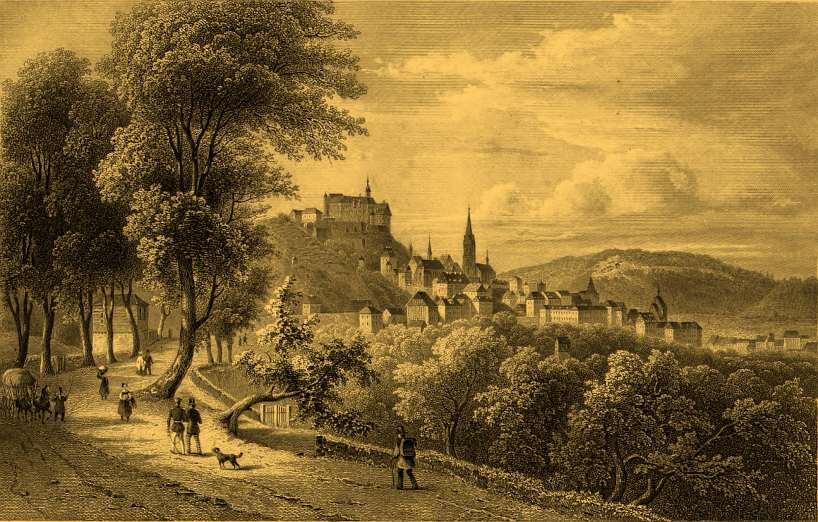
[17] Ockershausen is located slightly southwest of Marburg proper; here in relationship to Caroline’s residence at Reitgasse 14 (Kurfürstenthum Hessen: Niveau-Karte auf 112 Blättern, Karte 60: Marburg, ed. Kurfürstlich Hessischer Generalstab [Marburg n.d.]):

Here an early postcard showing Ockershausen itself and a view directly from the road Caroline and Philipp took back into town after midnight (Aloys Henninger, Marburg und seine Umgebungen [Marburg 1856], illustration following p. 4):

[18] Fr., “and she has not a jot of spirit.” Back.
[19] The Gothaischer [genealogischer] Hofkalender (Gotha [genealogical] court calendar), published in Gotha from 1763 and eventually known simply as Der Gotha (a French version appeared as well), published exhaustive information concerning the names of members of the various families of German nobility, their family trees, and coats-of-arms, as well as statistical information about various nations (such as population numbers, finances, dignitaries, diplomats, and members of the military). It appeared first in 1763 and was continued till 1944 with slightly varying titles.
Caroline’s enthusiasm for, or even gossipy obsession with, the calender was not only shared, but was also widespread and, for some at least, irksome enough to be lampooned, here in a vignette by Daniel Nikolaus Chodowiecki in 1782 (Complimentir-Narr [1782]; Herzog Anton Ulrich-Museum; Museums./Signatur DChodowiecki AB 3.519):

Here the Gothaischer Hofkalender for 1789 — the year Caroline would have been reading it in connection with this letter — along with a double-page family tree of the house of Saxony; the annual entry for Weimar and Eisenach (Karl August was thirty-two years old), the beginning of such for the Albertine line of Saxony; and several Parisian fashion plates:


[20] Unidentified. Back.
[21] Uncertain; possibly an allusion to the plans for Lotte to become a companion to Elisa von der Recke, concerning which their parents seem to have had some reservations (see Caroline’s undated letters to Lotte from Marburg in 1789 [letters 93, 95]). Back.
Translation © 2011 Doug Stott