
• 225. Friedrich Schlegel to Caroline in Jena: Berlin, late March 1799 [*]
[Berlin, late March 1799]
|513| I am quite gratified by your interest and judgment concerning Lucinde and, between us, would like to confess that at least for now I was looking more for your approval than Wilhelm’s. Particularly your offer to write a letter concerning it throws a very nice light indeed on both praise and censure. I can accept it with pleasure for the IInd volume if you would like to be given several persons, locales, etc., whereby you would, however, maintain considerable room for play. [1] —
You see, the main, central part of the first small volume is the “Apprenticeship for Manhood,” which, if not actually a story, is instead pure description (it is now finished). The counterpart in the second volume is to be “Female Perspectives,” perhaps letters from women and girls of various sorts concerning good and bad society. Descriptions of the present, since confessions concerning the past seem less feminine to me, and I doubt there is any such thing as an “apprenticeship for womanhood.” I would abuse myself shamefully for as long as necessary to bring out an unequivocal touch of femininity in both the style and color of the portrayal; in any event, the element of art would always have to recede considerably behind that of nature. —
In Juliane you probably could have recognized not yourself as such, but certainly your judgment, since you yourself wrote me about it |514| anew. [2] — Too little poesy, too much love. You would also easily have recognized the young novel with the mask as the present novel had you not already made up your mind that it is in fact not a novel at all. [3] The “apprenticeship,” however, is such as well according to the quite usual understanding. And when the other three are also there, absolutely all doubt will be removed. The knight is Faust, which I will be able to write soon. And the fact that these four belong together also represents the ultimate justification for the announcement. For I can counter you, by the way, with nothing except that that with which you are not yet acquainted will be sometimes Sapphic, sometimes cynical, and often clearly both at the same time, indeed even more so than the previous material. And hence the question concerning that particular fragment would remain unresolved, since were I to distinguish sharply between a Sapphic poem and a novel, you would only consider it sophistry. [4]
Opinions here concerning “Fidelity and Playfulness” are so unified that I can almost anticipate your assessment. [5] In the meantime, I can promise you that the first volume, too, will yet contain a good dialogue.
But now let me ask you to write me about the elegy, and to do so with religion. [6] What can those people now say who have refused to recognize Wilhelm as a genius and who would also have excoriated me had I not punched them in the face from time to time? Write and tell me about Wilhelm’s other elegiac ideas. He does not so quickly deign to talk about his own projects. But I would nonetheless like to know. —
Apropos, very impressive indeed that you also still thought it possible that Böttiger and Jenisch are mentioned in Lucinde! —
Up to the “Apprenticeship,” Henriette was also of the opinion that it was |515| not a novel but rather a novel extract out of which each person could now construct such. I am writing you this Sirenie only because Wilhelm dared to suggest that Lucinde is merely a spoiled child of Dorothea alone. [6a] —
By the way, I received Wilhelm’s elegy one evening when I was already sick, and the ensuing sleepless night was then quite poetic. [6b] I lost five whole days with it, and afterward we received a visit from the Eduard whom Dorothea once loved and whom I had already found to be quite interesting from his letters. And indeed he is, and also quite amiable. Otherwise, however, he is what one calls an aventurier, and looks approximately like the sauvage in Rousseau’s Discours sur l’inegalité who flees back into the forest. [7]
He had just come from Mainz, where he was acquainted with Rebmann. He served for a time under the Polish legion in Italy and looks exactly like someone who would be making his fortune in France. But he is one of those people who never have enough patience to remain clever all the way to the end. And now he is on his way to America, and it is on precisely this rather wondrous path that Wilhelm’s Shakespeare and Athenaeum will be going there as well. But I doubt he will remain anywhere for very long. —
They had not heard from each other for three years, and everything was new to him. He conducted himself in an extremely refined and seemly way and yet was also completely open. [8] Things did not go that well with Henriette, who in former times played the coquette with him more intensively than was probably appropriate, hence the reunion sooner evoked rather unpleasant memories for her in that regard.
One more important point now. I visited the grayish cat [10] several times but was unable to find out what she had written you with respect to your coming, and I certainly did not want to do her the favor of asking directly. [11] If they do not issue you a proper invitation, then assume you will be staying with Madam Veit, who |516| will be moving into proper and spacious logis this month. [12] She would be enormously pleased if that were to happen, as would I. All of you would then be able to enjoy the company of Schleiermacher, Tieck, and several others, and could do so far better there than in the foule at the Ungers. [13]
It should be equally easy to arrange things with Iffland, and were he not to miss the Ungerian goulash at the more frugal dinner table, then you will receive yet another demonstration of his authenticity; or would you prefer not to have it depend on something of that sort? —
Although you, too, would be doing without certain elements of luxury, you would also be doing without a certain measure of ennui. Please do consider that it would be especially difficult for you in particular to live with as grayish a cat as the old lady is. Moreover the Ifflands are on anything but good terms with Unger, that is to say, with the cat, just now.
One more thing about novels. If I believed you could write only the one novel that you intend to leave as your legacy to the world, I would be wrong to demand it while still alive. But precisely that is the point, namely, that I am convinced you would write more than just this one were it but finally published. [14] —
Give my regards to Augustinchen, and if you still feel friendship toward me, please do continue to maintain it with maternal care.
I almost forgot my material news. I received the remainder of the honorarium for Athenaeum in courant. [15] Frölich is not yet set up for assignation at all, so Wilhelm will receive 5 louis d’or as earlier through Mademoiselle Levi’s brother. The Louis d’or is exchanging for 5 2/3 Thaler. — So that makes 2 Thl. 5 gr. more than he is due, which are there to pay for the soap [?]. I will pay out the remaining guilder here.
Woltmann, it seems, is intent on not giving in or vacillating.
What are Schelling and his philosophy of nature up to, which he was intending to send me? [16] —
In addition to my other misfortunes, I recently also experienced a paroxysm of thinking prompted by Wilhelm’s elegy and Schleiermacher’s Religion, the latter of which is becoming as subjective as the former is classical. It is high time I once again get going and sound the objectivity alarm. The dabblers and bunglers are truly out of control.
Notes
[*] Also in KFSA 24:252–55, with additional passages omitted by Erich Schmidt, (1913), 513–16 (included here). — Redating from “March 1799” (Erich Schmidt, [1913) to “late March 1799” (KFSA 24:252). Back.
[1] The second volume of Lucinde never appeared. Back.
[2] Erich Schmidt, (1913), 1:737, points out that Friedrich does not use the name “Juliane” (from Dorothea’s novel Florentin. Ein Roman herausgegeben von Friedrich Schlegel, vol. 1 [Lübeck 1801] [vol. 2 never appeared]) in Lucinde. The reference, he suggests, is to the praise incorporated into the core section “Apprenticeship for Manhood” (see Supplementary Appendix 132a.1, “Caroline in Friedrich Schlegel’s Lucinde“). KFSA 24:446n153.2, however, citing Schmidt’s note above, adds that “‘Juliane’ is the title of a fragmentary piece from Friedrich Schlegel’s literary estate (KFSA 5:88–92).” Back.
[3] In the “Allegory of Impudence,” “genuine Novels, four in number and immortal like ourselves,” appear to the author in one of his “most recent waking dreams,” including a knight as Faust and a beautiful disguised youth as Lucinde. See Friedrich Schlegel’s Lucinde and the Fragments, trans. Peter Firchow (Minneapolis 1971), 53–54, concerning the youth:
[I] saw a beautiful, almost naked youth running across the green plain. He was already far away and I could barely see him swing himself onto a horse and gallop away as if trying to overtake the mild evening breeze and mock its slowness. On the hill there appeared a knight in full armor, tall and noble, almost a giant. But the precise proportions of his body and form, along with the open friendliness of his expressive eyes and ceremonious movements, lent him a kind of antiquated elegance. He inclined himself toward the setting sun, dropped slowly to one knee and seemed to be praying with great fervor, his right hand on his heart, his left on his forehead. The boy who’d been so quick before was now lying quietly on the slope and bathing himself in the last rays of the sun. Then he jumped up, undressed, plunged into the river and played with the waves, dived under the water, came up again, and again plunged into the river. . . .
Meanwhile the first youth — the sensuous one — had grown tired of his solitary gymnastics, and was hurrying with easy steps straight toward us. Now he was completely clothed, almost like a shepherd, but very colorfully and strangely. He could have gone to a masquerade like that, and in fact his fingers were playing with the laces of a mask. This fantastic boy could just as well have been mistaken for a spirited girl who had disguised herself on a whim. Up to this point he’d been coming straight toward us, but suddenly his steps became uncertain. First he went to one side, then rushed back to the other, all the time laughing to himself. “This young man doesn’t know whether he ought to give his allegiance to Impudence of Delicacy,” said my companion. Back.
[4] Concerning the “Sapphic” and “cynical,” see Caroline’s letter to Friedrich von Hardenberg on 20 February 1799 (letter 222) with note 11 and Hardenberg’s response on 27 February 1799 (letter 223). Back.
[5] The section “Treue und Scherz,” in Lucinde; “Fidelity and Playfulness,” Friedrich Schlegel’s Lucinde and the Fragments, trans. Peter Firchow (Minneapolis 1971), 68–76. Back.
[6] Concerning Wilhelm’s elegy, “Die Kunst der Griechen. An Goethe. Elegie,” Athenaeum (1799) 181–92, which has been discussed in several of the more recent letters, see Friedrich’s letter to Caroline on 19 February 1799 (letter 221) with note 13 and the further cross references, esp. to letter 216. Back.
[6a] From Gk., “Siren’s song.” Back.
[6b] (N.) Schwerdtgeburt, Moritz Müller, Ein Kranker auf seinem Lager (1814); Herzog August Bibliothek; Museums./Signatur Graph. A1: 1831:

[7] One popular aventurier during the late eighteenth century was that from the “account” in L’avanturier hollandaise, ou La Vie & les Aventures divertissants & extraordinaires d’un Hollandais, 2 vols. (Amsterdam 1767); here illustrations from vols. 1 and 2:
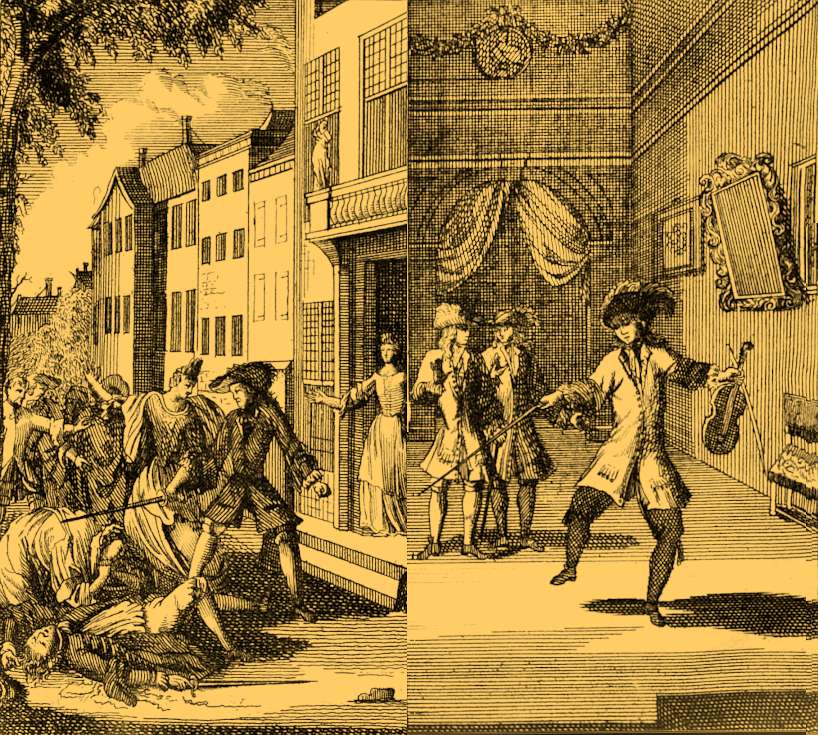
Otherwise, Friedrich is referring to Jean-Jacques Rousseau, Discours sur l’origine et les fondements de l’inégalité parmi les hommes (1754), one of the publications in which Rousseau concluded that “man is originally and by nature virtuous, free, and happy; that he has been corrupted by society, the source of property, inequality, and despotism; and that in order to restore him to some measure of happiness, it is necessary to return to nature as far as practicable” (The Oxford Companion to French Literature, ed. Sir Paul Harvey and J. F. Heseltine [Oxford 1969], 642, s.v. Rousseau). Rousseau cites from another publication concerning attempts to “civilize” the “savage” (or “savage man”) (trans. A Discourse Upon the Origin and Foundation of the Inequality Among Mankind [London 1761], 256):
The Dutch Missionaries with all their Endeavours have not been able to convert a single Hottentot. Van der Stel, Governor of the Cape, having procured a Hottentot Infant, took Care to have him brought up in the Principles of the Christian Religion, and the Manners and Customs of Europe. He cloathed him richly, had him taught several Languages; and the Boy’s Progress perfectly corresponded, with the Attention bestowed upon it. The Governor, big with Expectations from his Pupil’s Capacity, sent him to the Indies with a Commissary-General, who employed him usefully in the Company’s Affairs.
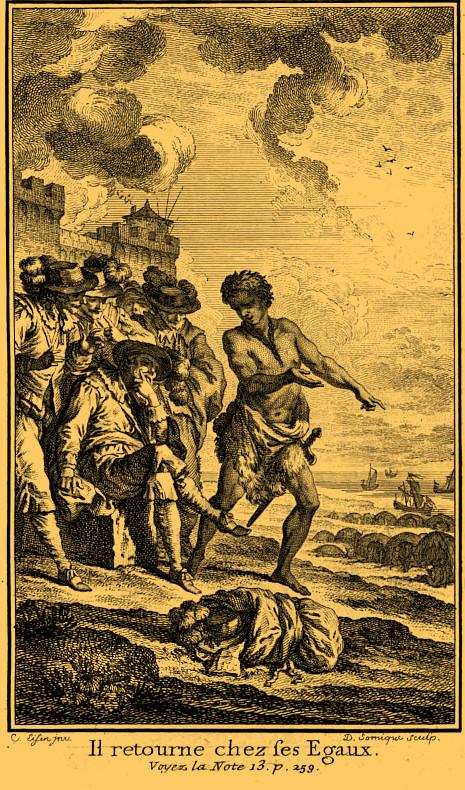
But, the Commissary dying, [he] returned to the Cape, and in a Visit he made to some of his Hottentot Relations a few Days after his Arrival, took the strange Resolution to exchange all his European Finery for a Sheep’s Skin. In this new Dress he returned to the Fort, loaded with a Bundle containing containing the Cloaths he had thrown off, and presenting himself in the following Words: “Be so kind, Sir, as to take Notice, that I for ever renounce this Apparel. I likewise for ever renounce the Christian Religion. It is my firm Resolution to live and die in the Religion, Manners and Customs of my Ancestors. All the Favour I ask from you, is to leave me the Collar and the Hanger I wear. I shall keep them for your Sake.”
These Words were scarce out of his Mouth, when he took to his Heels and was out of Sight; nor did he ever appear among the Europeans again.
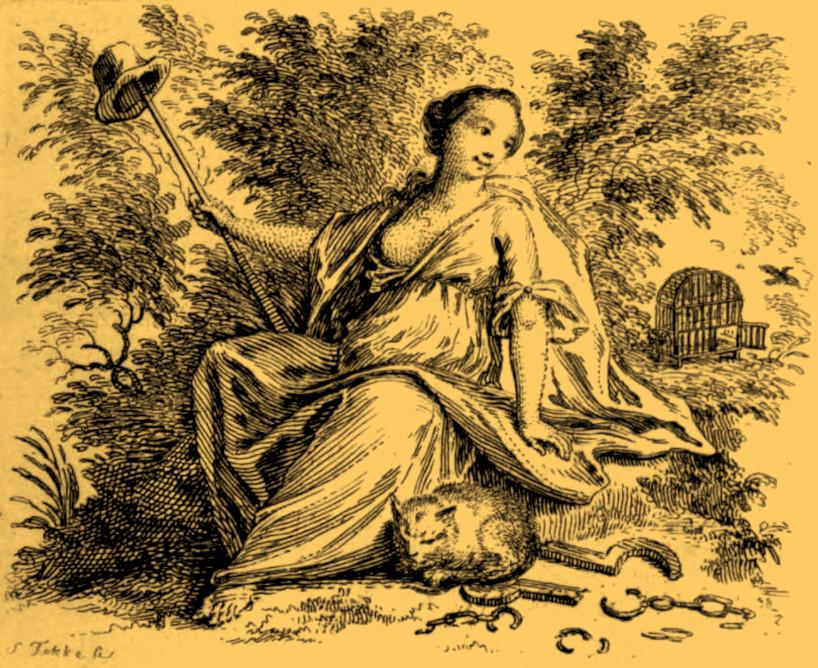
Here, from the edition Amsterdam 1755, the title vignette (note the liberated caged bird and the sundered and discarded shackles) and final plate in which the savage, clothed in a “Sheep’s Skin,” returns “the Cloaths he had thrown off” and returns to his natural environment and people (Friedrich: “flees back into the forest”):
[8] See Friedrich to Wilhelm in May 1799 (Walzel, 423; KFSA 24:286): “We recently received an extremely charming letter from Eduard. This wild man is also incredibly tactful.” D’Alton visited the couple later in Jena as well, after which Dorothea struck a quite different tone in her letters; in 1804 she writes to Karoline Paulus that three years earlier she had already had occasion to reproach d’Alton’s “baseness”; see Dorothea to Karoline Paulus from Cologne in September 1804 (letter 387b in present edition), including allusions to his unclear relationship with Recha Mendelssohn, which Dorothea soundly criticizes. Back.
[10] In this letter, Friedrich engages a multilevel play on words in German with a whole panoply of evocations in describing Friederike Unger as a “grayish cat,” Germ. gräuliche Katze, with gräulich in popular language otherwise also generally denoting “a very high degree of any disagreeable or unpleasing thing”; it is, moreover, pronounced like greulich, “execrable, frightful, dreadful, loathsome,” the latter also capable of being spelled gräulich, from grauen, “to have an aversion, abhorrence or abomination (or fear) united with shivering or shuddering,” with the other version of the adjective, graulich, homonymically meaning both “grayish, grizzled, somewhat gray,” and “feeling a fear, fright, dread, etc.” See Charles Gottlob Küttner and William Nicholson, New and Complete Dictionary of the German Language for Englishmen according to the German Dictionary of Mr. J. C. Adelung, 3 vols. (Leipzig 1805–13), here vol. 3, s.v.
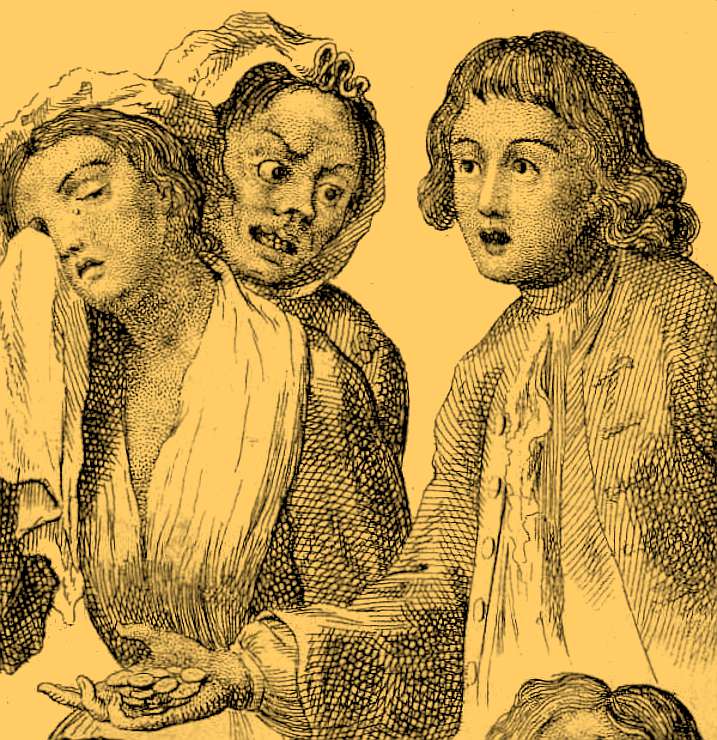
In general, Friedrich’s almost compulsive use of these epithets might evoke some of Daniel Nikolaus Chodowiecki’s more overtly severe caricatures of women in a series of issues of the Goettinger Taschen Calender beginning in the mid-1780s (here: Goettinger Taschen Calender vom Jahr 1785; Inhaltsverzeichnis deutscher Almanache, Theodor Springmann Stiftung):
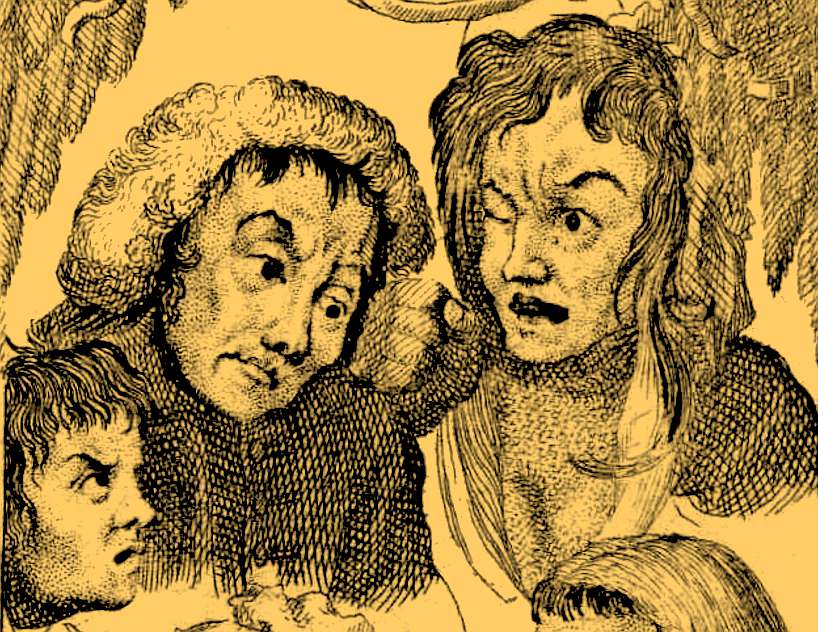
In a letter Friedrich and Dorothea wrote to Schleiermacher in late March 1799 (KFSA 24:251–52, here 52), Dorothea similarly remarks that “Friedrich is about ready to enter into an open feud with the lady cat; and it is high time, for she is becoming quite given to foul language and insufferable insolence.” Back.
[11] Caroline, Wilhelm, and Auguste were planning a trip to Berlin in connection with the anticipated premiere of their translation of Hamlet; the trip never materialized. See esp. Friedrich’s letter to Caroline in early March 1799 (letter 224c) concerning the possibility they might find lodging with the Ungers. Concerning Hamlet, see Ella Horn’s essay on the background to the premiere of Hamlet in Berlin. Back.
[12] Uncertain allusion; Dorothea had moved into a small apartment on Ziegelstrasse in early 1799, shortly before her divorce from Simon Veit and was about to move into a new apartment at an uncertain location. Back.
[13] Fr., foule, “crowd, throng, mob.” Friedrich had already mentioned the potentially unpleasant circumstances accompanying accommodations with the Ungers in his letter to Caroline in early March 1799 (letter 224c); see note 1 there (Frauenzimmer Almanach zum Nutzen und Vergnügen für das Jahr 1801; Inhaltsverzeichnis deutscher Almanache, Theodor Springmann Stiftung):

[14] See also Friedrich’s letter to Auguste in November 1798 (letter 207c). Back.
[15] See Friedrich’s letter to Caroline in late March 1799 (224b), note 12, and the following receipt from 1 March 1799 (KFSA 25:693, Beilage III, no. 2):
I herewith attest that I have received properly and fully from the bookseller Herr Heinrich Fröhlich the honorarium for the 1st issue of the 2nd volume [i.e., 1799] of Athenaeum by way of a preliminary payment of 10 Friedrichs’dor and yet again 5 Friedrichsd’or and to date 50 Reichsthaler courant summa 135 Reichsthaler courant, reckoning the Louisd’or at 5 2/3 Reichsthaler. Berlin, 1 March 1799.
Friedrich Schlegel Back.
[16] See Friedrich’s letter to Caroline on 19 February 1799 (letter 221), with note 15. Back.
Translation © 2013 Doug Stott