
• 223. Hardenberg to Caroline in Jena: Freiberg, 27 February 1799 [*]
Freyberg, 27 February 1799
|506| Two hours ago, while having my early coffee, on a stormy, blustery, snowy morning, I received your letter — and suddenly found myself in possession of the strange Lucinde, whose acquaintance I have so long been looking forward to making. [1] First I read your Julie-letter [2] — the one roof alone was worth an entire novel. [3] Only imagine our splendid circle. A year ago, 2 were still standing there as such orphans. [4] The one seemed to be standing on hot glowing ground — He continually looked around, and who knows what a keenly honed eye might often have noticed about him. [5] Now an amiable figure, like a gift from above, lifts him up in consecration and gratitude [6] — und a refreshing earthly slumber has |507| closed his eyes for a different sun. So, back in the land of dreams, and with all of you now with all his soul — you most excellent sleep companions.
Only now can genuine friendship emerge among us, just as any true society consists not of individual persons, but of families — families alone are able to form societies, the individual person is of interest to society only as a fragment and with respect to his disposition and talents for being a family member. My Julie will surely be completely suitable for you and for everyone.
But let me ask you to maintain discreet silence. My family still knows nothing — neither do her parents know anything from me. Success depends on being prudent — Although I am fairly sure of that success, it is just that I must be the first one through whom my father learns of it. [7] Hence let me ardently beseech you and Fichte to keep everything to yourselves there. It would be very ill for me indeed were news to get out ahead of time.
Julie does not even know that you know anything. I was not really in a position to say anything more extensive to our good Madam Ernst, I merely mentioned something about it to her obliquely, so to speak. We spent a most pleasant evening there — the Thielmanns, the two girls, and I. [8]
The Thielmanns are here now, and we are living quite contentedly. Just too bad I have so little time for imaginative leisure [9] now and that I am so rarely able to collect myself and listen in any imaginative fashion to my inner organs of language. I do sense, however, that this interruption is promoting a quiet, winelike fermentation and that after I have finished learning I will return with renewed, cultivated energy to my former poesy and philosophy, both of which are indispensable for a happy marriage and without which every social contact necessarily ends in weariness and boredom.
Rousseau understood the feminine character in an exclusive fashion, and his entire philosophizing had its origins in a reflective feminine |508| soul. His apology for the natural state belongs in women’s philosophy: — the woman is the genuine natural person — the true woman is the ideal of the natural person, just as the true man is the ideal of the artistic person.
The natural human being and artistic human being are the true original estates. Estates are the constituent parts of society. Marriage is the simple society, just as the lever is the simple machine. [10] In marriage one encounters the two estates. The child in marriage is what the artist is in society — a non-estate that promotes internal union — the true enjoyment of the two estates. The grand marriage, namely, the state, consists of a female and male estate, which, half correctly and half incorrectly, one calls the uncultivated and cultivated estates. The woman of the cultivated estate is the uncultivated. Unfortunately, among us the uncultivated has remained far behind the cultivated — and has become a slave. Alas! if only he might again become a woman!
But back to Lucinde. The initial acquaintance has been made. Let me share bits of my initial impressions with you.
Friedrich is everywhere present in it. There are perhaps few books that are more personal than this one. One can see clearly and wondrously before us all his internal activity, like the play of chemical forces dissolving in a beaker. A thousand varied, radiantly dark notions flow out toward us, and we lose ourselves in a spell of dizziness that turns a thinking person into mere impulse, a natural force, entangling us in the lustful existence of instinct.
There is no lack of romantic resonance in it — but the whole and the individual parts are not yet light and simple and free enough of school dust.
My own prophecy does not anticipate much in the way of a positive |509| reception. Might this novel not be premature, as was perhaps its foster brother as well [11] — and not be coming into the world a bit too early, at least according to bourgeois laws? Perhaps in ten years one might accept the “confessions of a blunderer” [12] with warmth and forbearance for the sake of its author. Just now, however, everything is still unripe. Only the man — not the youth — is permitted to reveal the outpourings of the youth’s heart. [13]
Although one cannot really raise much objection with regard to the ideas, one might very well do so with regard to the manner of expression, which at least to me seems not infrequently to be borrowed from Crates. [14] But the postulate itself — be cynical! — is not yet the common and accepted thing — and even extremely perceptive, sensitive women might reproach the beautiful Athenian woman for having chosen the marketplace as her bridal chamber. [15]
Comparisons with Heinse are inevitable. Might this reading material not be only for those with a master’s degree in the loge of morality?
The continuation ought to contain even more sketches — little Wilhelmine is absolutely charming [16] — also more of Prometheus. [17] More of similar elements and then the title:
Cynical Fantasies or Satanisks. [18]
Many will say: “Schlegel is going too far — and are we now also expected to hold up the light for him for his orgies?” Others: “We did not hear the voice of the beloved son; this is a false messiah of wit — crucify him!” [19]
And still others: Behold here the school of Göthe — the pupil over his master, [20] Venice has become Berlin. [21] Richter will be properly horrified. The virtuous judge [22] will summon forth fire from heaven. In the meantime, I am certain he will basically be quite startled at this glimpse into his own imagination — for he is unequivocally — a born voluptuoso.
Much in me is stirred in favor, and much in opposition. [23] I realize |510| that the imagination loves the most immoral elements best, the intellectual-animalistic elements; and I also realize the extent to which all imagination is like a dream that loves the night, meaninglessness, and solitude. Dreams and the imagination are our most personal possession, and are to be revealed at most to two people, never to several. We are not permitted to linger with them, and least of all to immortalize them. Their fleetingness alone is what makes the impertinence of their existence good. Perhaps the intoxication of the senses is indeed a part of love, just as sleep is part of life — but it certainly is not the most noble part, and the hale and hearty person will always prefer to be awake rather than asleep. I, too, cannot avoid sleep, but I do enjoy waking and would secretly prefer always to remain awake.
I was particularly interested in the idealization of vegetation. [24] The highest love affected the two of us in a remarkably different way. I have composed everything in an ecclesiastical style or in the style of the Doric temple, while with him everything is Corinthian. I am just now occupied with bourgeois architecture.
I am so close to midday that the shadows are the same size as the objects, and hence the constructions of my imagination correspond fairly well to the real world.
This much I can see, namely, that our first novels will be utterly and completely different. My own will probably be finished this summer in Töplitz or Carlsbad. Though when I say “finished” — that refers to the first volume — for I would like to spend my entire life working on one novel, which by itself is to constitute an entire library, perhaps even the apprenticeship years of a nation. [25] The expression apprenticeship years, however, is actually not correct — since it expresses the sense of thither, whereas for me it signifies nothing other than transitional years from the infinite to the finite. I am hoping thereby to satisfy simultaneously my historical and my philosophical yearnings. For this purpose, a journey |511| both to the south and to the north will be indispensable to me.
Norway and Scotland, on the one hand, and the Greek islands, on the other, would be the most appropriate points of destination for this purpose. Perhaps my own professional activity will extend its hand to me in carrying out what now still appears to be a rather distant plan.
Why do not you, too, reach out for a novel! Wilhelm would have to supply the poesy for it. It could be a very nice double work in that sense. I am looking forward to the elegy with excitement. [26] I will be coming straight to Jena in the middle of April. [27]
Notes
[*] Also in Novalis Briefwechsel mit Friedrich und August Wilhelm, Charlotte und Caroline Schlegel, ed. J. M. Raich (Mainz 1880), 120–27; Novalis Schriften 4:277–31, with differing paragraph divisions (reproduced here). — This letter is Hardenberg’s response to Caroline’s letter of 20 February 1799 (letter 222). Back.
[1] See Novalis Schriften 4:851:
The novel was included as an enclosure with Caroline’s letter. This was a manuscript of the first third of the first part of the novel (chs. 1–5) in the copy made by Henriette Mendelssohn. Friedrich Schlegel had sent this part to Wilhelm Schlegel on about 10 February 1799 (Walzel, 404; KFSA 24:227). The published edition of the first part appeared in June 1799. Back.
[2] In Caroline’s letter to Hardenberg on 20 February 1799 (letter 222), the initial three paragraphs. Back.
[3] Caroline in her letter on 20 February: “It is quite possible that before this year is out we will all be assembled under one roof.” Back.
[4] Hardenberg himself and Friedrich Schlegel. Back.
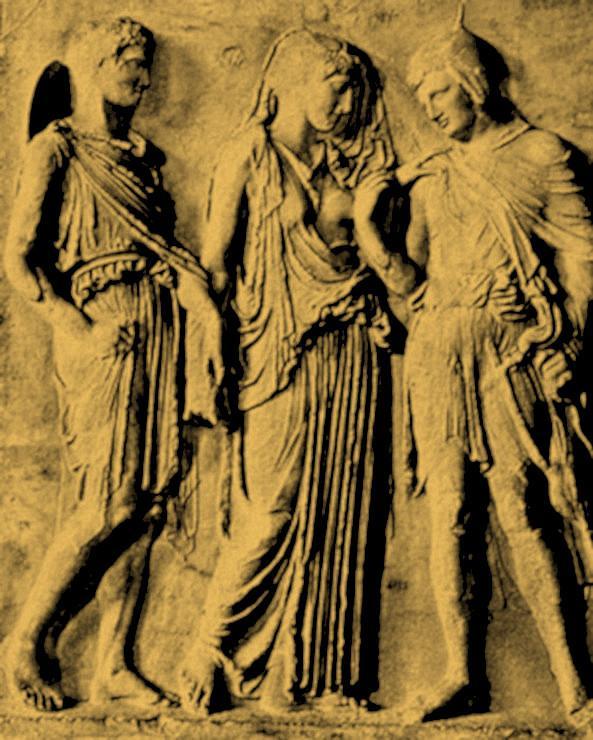
[5] Possibly an allusion to the myth of Orpheus and Euridice as a metaphor for Hardenberg’s loss of Sophie von Kühn: The musician Orpheus is able to move the god Hades through his laments into allowing him to bring Euridice, who has died from a snake bite, back from the underworld. Because Orpheus is unable, however, to follow the condition of not turning around and looking at her on the journey back to the upper world, she is taken from him again; here depicted in a fifth-century marble relief:
[6] Julie von Charpentier. Back.
[7] See Caroline’s letter to Hardenberg on 20 February (letter 222), note 7. Back.
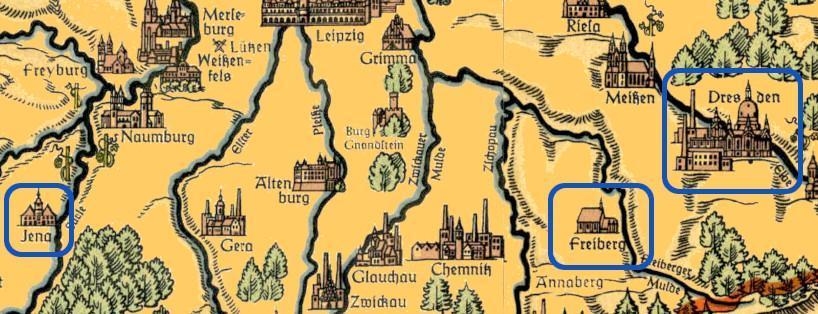
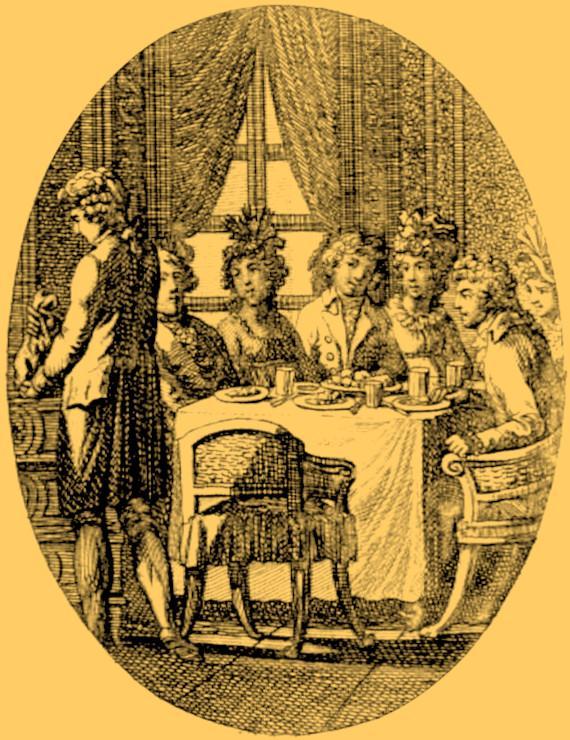
[8] Besides Thielmann and his wife, Wilhelmine, the other two girls were the latter’s sisters, Karoline and Julie von Charpentier. The meeting at Charlotte Ernst’s in Dresden took place on 15 February 1799 (Rudolf Koch and Fritz Kredel, Deutschland und angrenzende Gebiete [Leipzig 1937]; illustration: Toilettenkalender für Frauenzimmer [Vienna 1801]; Inhaltsverzeichnis deutscher Almanache, Theodor Springmann Stiftung):
[9] An allusion to chapter 5 in Lucinde, “Idylle über den Müssiggang” (translated by Peter Firchow in Friedrich Schlegel’s Lucinde and the Fragments [Minneapolis 1971], 63, as “An Idyll of Idleness”). Back.
[10] These notions recur (and indeed were composed the same day as this letter) in Hardenberg’s Allgemeines Brouillon in Novalis Schriften , Abt. ix, no. 1106, vol. 3, 470f.; trans. by David. W. Woods as Notes for a Romantic Encyclopaedia: Das Allgemeine Brouillon (Albany, New York, 2007), albeit with translation errors. Back.
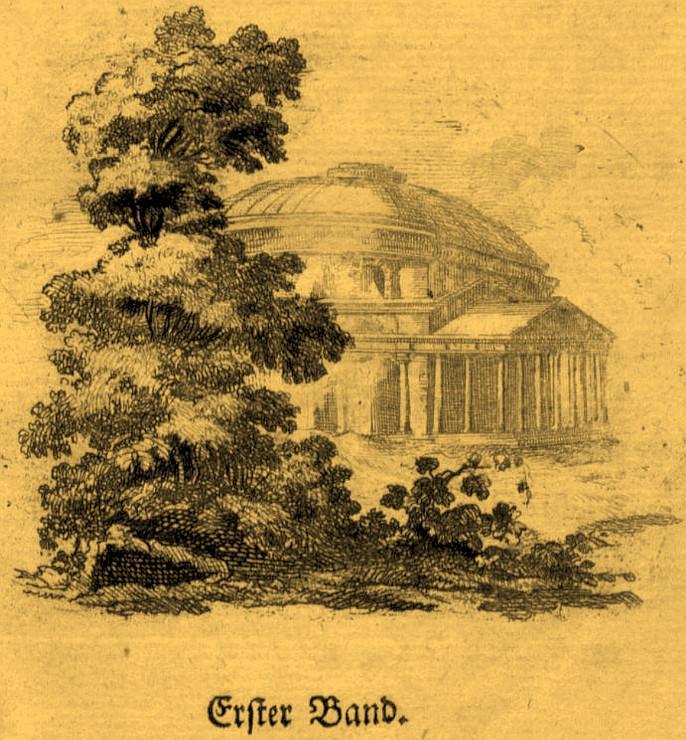
[11] An allusion to Johann Jakob Wilhelm Heinse, Ardinghello und die glückseeligen Inseln. Eine italiänische Geschichte aus dem 16. Jahrhundert, 2 vols. (Lemgo 1787), a novel, set in Italy and elsewhere, about a Florentine painter representing the ideal natural man who has various sexual escapades, even participating in orgies, one of his lovers also being named Lucinde, and who eventually establishes an island love utopia with a religion of nature. These elements notwithstanding, the novel contains numerous discussions of art and painting. Here the two frontispieces to the original edition:
[12] That is, as the subtitle characterizing not just the initial section in Lucinde, as is presently the case, but rather the entire novel. Back.
[13] Allusion to the title of Ludwig Tieck and Wilhelm Heinrich Wackenroder, Herzensergiessungen eines kunstliebenden Klosterbruders (Berlin 1797) (Outpourings of an art-loving friar). See Caroline’s review. Back.
[14] Uncertain allusion. Novalis Schriften 4:851 identifies him as “probably” the Theban cynic (ca. 333 BCE) by adducing his “philosophical parodies.” This Crates (as opposed, e.g., to the comic Athenian poet) was an itinerant cynic who preached voluntary poverty and reconciliation, but whose poems were largely revisions of those of other poets. Back.
[15] See Caroline’s letter to Hardenberg on 20 February 1799 (letter 222), with note 11. Back.
[16] The section in Lucinde with the title “Character Sketch of Little Wilhelmine,” Friedrich Schlegel’s Lucinde and the Fragments, trans. Peter Firchow (Minneapolis 1971), 50–53. See esp. also supplementary appendix 209.1. Back.
[17] Prometheus is portrayed as a new creator of human beings in the “Idylle vom Müssiggang” (“An Idyll of Idleness”). Back.
[18] The term Satanisken, translated as “little devils” in Friedrich Schlegel’s Lucinde and the Fragments, 66–67 (though see below), occurs in the chapter “An Idyll of Idleness” in the description of Prometheus “in the act of creating men”:
He was tied down by a long chain and was working with great haste and strain; and standing next to him were several monstrous creatures who were continually driving him on and whipping him. A great amount of glue and other material was lying about and he was taking fire out of a large coal-pan. Facing him on the other side was the similarly mute figure of the deified Hercules, with Hebe on his lap. Running about and talking at the front of the stage were a great many youthful figures who were very happy and who didn’t merely appear to be alive. The younger resembled cupids; the older ones the images of satyrs, but every one of them had his own peculiar manner, a striking originality of facial expression. And all of them had some similarity with the devil of the Christian painters or poets — one could have called them little devils.
The same term, now translated as “Satanisks,” recurs in Athenaeum (1798), 291–92, in fragment 379 (Friedrich Schlegel’s Lucinde and the Fragments, 223):
The Satan of Italian and English poets may be more poetical, but the German Satan is more satanic; and to that extent one might say that Satan is a German invention. Unquestionably he is a favorite of German poets and philosophers. So he probably must have his good side, and even if his character consists of unlimited willfulness and scheming, and a fondness for destroying, confusing, and leading astray, one still finds him not infrequently in the very best society. But isn’t it possible that up to now people have been mistaken about his real proportions? A great Satan always has something rough and robust about him; at best he only suits the pretensions to impeity of those caricatures who can’t get beyond a mere affectation of intelligence. Why are the “Satanisks,” the lesser Satans, not present in Christian mythology? There exists perhaps no fitter word and image for those vices en miniature which innocence is fond of feigning, and for the charmingly grotesque music of colors, consisting of the most sublime and most delicate mischief which so delights in playing about the surface of greatness. The classical Cupids are only a different species of these Satanisks. Back.
[19] Matthew 3:17 (NRSV): “And a voice from heaven said, “This is my Son, the Beloved, with whom I am well pleased” (illustration: Christoph Weigel, Historia von Iesu Christi unsers Heylandes Geburt, Lebenswandel, Wunderwercken, Gleichnußreden, Leiden, Sterben, Auferstehen und Himmelfahrt: Zur Einpflanßung von Jugend auf, und state Unterhaltung Gottseelige betrachtungen auß denen heyligen Evangelisten Mattheo, Marco, Luca, und Johanne, vorgebildet [Augsburg 1695]):
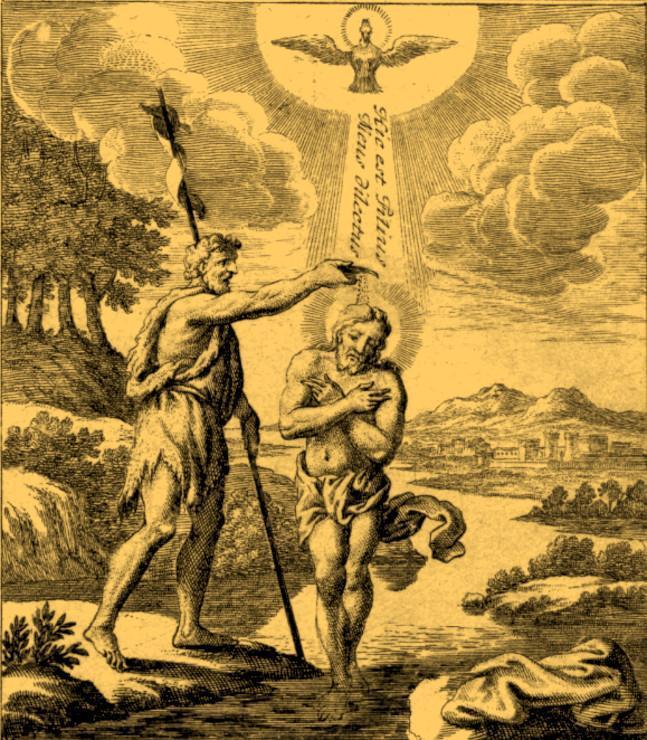
In the chapter “Allegory of Impudence” in Lucinde, a voice speaks from heaven: “You are my beloved son in whom I find favor,” to which Julius responds, “I am Wit’s beloved son” (Friedrich Schlegel’s Lucinde and the Fragments, 62).
Otherwise Hardenberg is alluding to John 19 and the appearance of Jesus before Pilate and the Jewish crowd (John 19:5–6, 15 [NRSV]; illustration: Christoph Weigel, Historia von Iesu Christi unsers Heylandes Geburt, etc.):
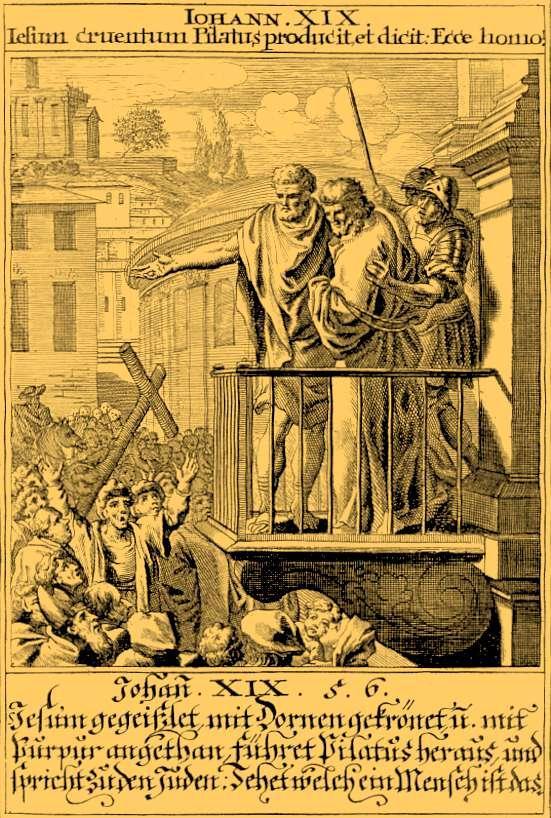
So Jesus came out, wearing the crown of thorns and the purple robe. Pilate said to them, “Here is the man!” When the chief priests and the police saw him, they shouted, “Crucify him! Crucify him!” Pilate said to them, “Take him yourselves and crucify him; I find no case against him.” . . . They cried out, “Away with him! Away with him! Crucify him!” Back.
[20] Allusion to Wilhelm Meister: Germ. Meister, “master.” Back.
[21] An allusion to Goethe’s Epigramme Venedig. 1790, published in Schiller’s Musen-Almanach für das Jahr 1796. Some of the epigrams openly celebrated a more pagan sensibility toward erotic themes, also celebrating, among others, a fictitious Venetian beauty, Bettina, though Goethe himself censored out over fifty of the more overt epigrams before publishing the rest in the Musen-Almanach; Hardenberg’s implication is that this element has been transposed to Berlin, the setting of Lucinde. Back.
[22] A play on Jean Paul’s name, Friedrich Richter, Germ. Richter, “judge.” Back.
[23] Novalis Schriften 4:852, points out that “Novalis’s critique here incorporates a series of expressions from Lucinde itself, specifically from chapter 4, ‘Allegory of Impudence’, and especially 5, ‘An Idyll of Idleness’; e.g., in the latter Friedrich said, ‘with the greatest indignation, I thought of those evil people who want to subtract sleep from life'” (trans. Friedrich Schlegel’s Lucinde and the Fragments, 65). Back.
[24] Lucinde, chapter 5: “the more divine a man or a work of man is, the more it resembles a plant; of all the forms of nature, this form is the most moral and the most beautiful. And so the highest, most perfect mode of life would actually be nothing more than pure vegetating” (Friedrich Schlegel’s Lucinde and the Fragments, 66). Back.
[25] The torso out of which presumably (no certainty is possible) Hardenberg’s fragmentary novel Heinrich von Ofterdingen was extracted (published posthumously). Back.
[26] Concerning Wilhelm’s elegy, “Die Kunst der Griechen,” see Caroline’s letter to Hardenberg on 4 February 1799 (letter 219), note 15 and the cross references (esp. to letter 216). Back.
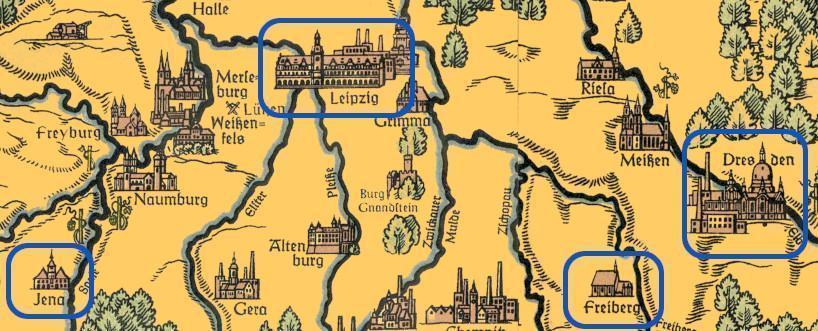
[27] See Novalis Schriften 4:852:
Novalis was in Dresden on 18 and 19 April 1799 . . . it is not documented that he went from there to Jena. At the end of April he attended the Leipzig spring book fair and was in Freiberg, where his mother and sister, Sidonie, made the acquaintance of Julie von Charpentier.
(Rudolf Koch and Fritz Kredel, Deutschland und angrenzende Gebiete [Leipzig 1937]):
Translation © 2013 Doug Stott