
• 208. Caroline to Friedrich von Hardenberg in Freiberg: Jena, 15 November 1798 [*]
Jena, 15 November 1798
|471| Yesterday I received your two letters of 7 and 11 November at the same time. [1] You need to look into why that happened. You also received my own letter rather late. [2] You can understand how anxious I was to carry out your request, [3] which was, however, expressed a bit vaguely. |472| I immediately suspected the illness of your poor lady friend; [4] Had I but known the remedy! But I did not want to leave anything to chance, since I am aware of what a frightful degree it can attain.
Hence I decided to write to Starke, since you yourself prefer him to Hufeland and since I do not stay in as constant contact with the latter as you with the former. Because in the meantime I did suspect there was some reason or other you did not turn directly to Starke yourself, I proceeded cautiously, telling him that you had written me this, that, and the other about a woman in that vicinity whose acquaintance we share — and that you thought I might seek his advice in the matter. Here you have his answer. [5] I really do hope it will contribute to putting all of you there at ease.
I immediately recognized the malady as facial pain because Böhmer had to treat it several times in the Harz Mountains and was quite occupied with discovering a cure. [6] I do recall that with one woman, the cramp became so severe that it degenerated into lockjaw and hydrophobia; she was saved by belladonna. [7] Go ahead and use the prescribed remedies. The young physician will probably not object excessively. I will not be able to rest until I have sent this letter off, since I do think it will bring help. Your patient is surely none other than your Harmonika. [8]
I have yet another long, dear letter from you, [9] one that in its own turn is a proper Harmonika, but I am not going to answer it today. I am in too much of a hurry and only have the letter in memory just now, since Friedrich received it immediately. And it is only in a very general or broad sense that I am able to rely on my memory.
We have not yet seen the Propyläen. In any event, why do we need the antecourts when we already possess the holy of holies itself? [10] |473| He dwells perpetually among us; [11] I had a souper with him yesterday, today I will have a souper with him, and very soon I will be having a fête for him myself. You ought to come as well. –
I am very much looking forward to the Propyläen; what a treat. He did not bring a copy with him; nor are we particularly inclined to chase after the copies that might be here already. He intends to have one sent to us from Weimar. The preface seems to be full of fatherly kindness. [12] In this context, you might recall a certain other preface or introduction. [13]
If you read the Allgemeine Zeitung, then you have already read the authentic account of Wallensteins’s Camp. The letter contained in it surely comes from the hand of the master. [14] That is how much he does for his friend, who in the prelude and prologue also remains his disciple — showing himself to be more Göthesque than ever. The other material by Schiller in the Almanach, however, shows that he exhausted himself in it. [15] You can receive the Almanach and my own brief statements concerning Wallensteins’s prologue from Charlotte if you ask her for them; she will not be sending you anything on her own, since I did not request that she do so.
Things have hit a snag with Athenaeum, my good friend. Vieweg is undecided whether he wants to continue it and is behaving in the most petty fashion as a pure businessman. He printed too many — 1500 copies — and on paper that was too expensive. He has come up with calculations according to which he himself would still need to be paid. He does not understand that with this journal he has something that will continue on; instead, everything is supposed to be in the clear immediately and the profit on the table in cash. They are still negotiating, so I do not want to say anything more about it. [16] Our beautiful Gemählde have not yet been published. I personally would like to see them appear in the Propyläen. [17]
My own opinion is that they, namely, the brothers, |474| should not have burdened themselves down with a journal, and that Wilhelm not have become a professor. He is so busy with lectures that this business with Athenaeum has hardly made an impression on him. Friedrich is the one whom it has hit all the more forcefully, especially from the economic side.
Our defiant Schelling was just here. He promised to bring me Prévot for you. He cannot get Le Sage. [18] I have tried to write very clearly. You might as well get used to reading my unclear scribbling. Please do send me news about the patient soon so that I can also tell Starke about it, and stay well. Our sincere love to you.
Notes
[*] Reprinted in Novalis Schriften 4:502–3 (see the notes ibid., 964, for earlier publication). Back.
[1] Concerning these references, see esp. Novalis Schriften 4:964–65. Although these letters have been lost, Hardenberg’s letter to Friedrich Schlegel of 7 November 1798, which was included in the parcel, was indeed forwarded to Friedrich in Berlin (KFSA 24:194–96; Novalis Schriften 4:262–64). Back.
[2] This letter, too, has been lost. Back.
[3] Which Hardenberg had made in his letter of 11 November regarding Julie von Charpentier; see below. Back.
[4] Hardenberg’s lady friend, and soon-to-be fiancée, Julie von Charpentier; Caroline, however, does not yet know her name. Back.
[5] Apparently an enclosure that has since been lost. Back.
[6] See Friedrich von Hardenberg (genannt Novalis). Eine Nachlese aus den Quellen des Familienarchivs (Gotha 1873; here 2nd ed. 1883) 248: “In the summer of 1798, she [Julie von Charpentier] was beset by a terrible malady, facial pain”.
See Friedrich Schlegel und Novalis 216–17, in reference to Hardenberg’s letter to Friedrich of 10 December 1798 (also KFSA 24:208–10), in which Hardenberg speaks of “illnesses”:
Uncertainty about the future has forced me to concentrate so diligently on details now that it is delaying my literary projects — especially since illness and other unpleasantness have disturbed me to such a extent and indeed continue to do so.
Hardenberg himself had spent time that autumn on medical leave in Töplitz, albeit without much success:
Amid what was “genuine November weather,” Novalis had complained in September about “spells” and “irritability” (of his respiratory tract), prompting him to schedule a consultation with Johann Christian Stark around Michaelmas. Julie’s [von Charpentier] problems [with facial pain] also took a lot out of him. Back.
[7] Atropa belladonna or Deadly Nightshade, an herb that despite its extreme toxicity was used for centuries not only as a medicine, but also in cosmetic applications (e.g., to dilate women’s pupils to enhance the appearance of the eyes, whence the name “bella donna”), and is still used in homeopathic applications today.
Scarcely twenty years later, however, in his Abbildung und populäre Beschreibung von acht und vierzig Giftpflanzen, für Jedermann, der nicht Botaniker ist (Augsburg 1819), species no. 1 (no pagination), Karl Wilhelm Juch begins his popular examination of the most poisonous plants with atropa belladonna, remarking:
Let us begin our, as we hope, instructive and useful enterprise with an illustration and description of a plant that, though perhaps not the most poisonous, is surely to be classified as one of the extremely poisonous ones. . . . The misfortune this plant has already caused is as great as the accidents are dreadful that are caused by its enjoyment.
Below the illustration from ibid., table 1:

[8] Erich Schmidt remarks: “Harmonika, probably an allusion to Julie von Charpentier’s melodious voice, not, as in its later application to Ludwig Tieck, to the lyrical sing-song quality of the voice.” The reference, however, is likely to the instrument, harmonium. Although there were several types, Caroline does not specify any particular one beyond Harmonika.
Concerning the instrument and its variations, see Grimm, Deutsches Wörterbuch, 10:486:25:
Harmonika: referring to a musical instrument capable of producing extremely harmonious tones, attested in several different varieties since the eighteenth century, including a “blowing Harmonika” [likely similar to the melodica and triola], “draw Harmonika” [more like an accordion], “glass Harmonika,” the latter of whose tones are produced by glass bells; similarly also wood, steel, straw Harmonika.
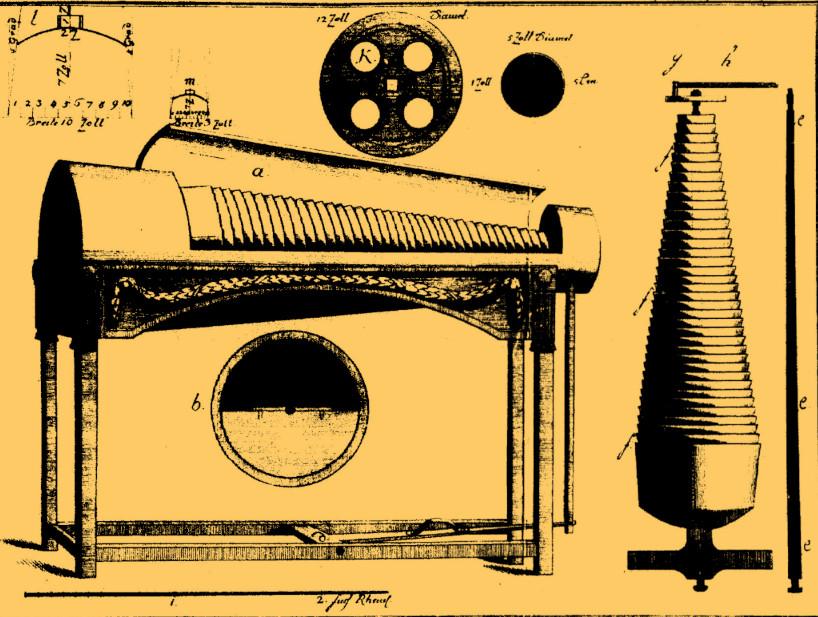
Here an illustration of a glass-bell Harmonika accompanying C. A. von Meyer zu Kronow, “Harmonica,” Journal von und für Deutschland (1784) vol. 2, no. 7 (July–December) [July], 1–4, unpaginated illustration following title page (note the foot pedal — detail at right — by which the player keeps the cylinders rotating):
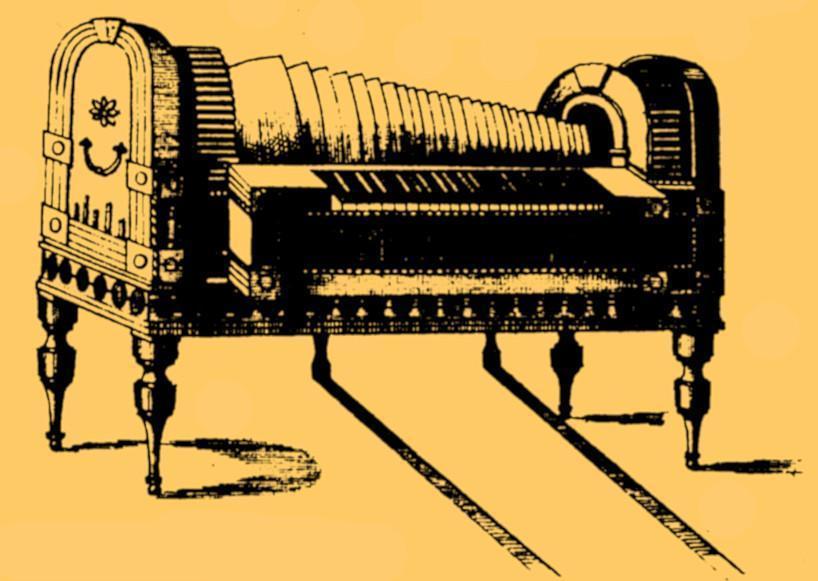
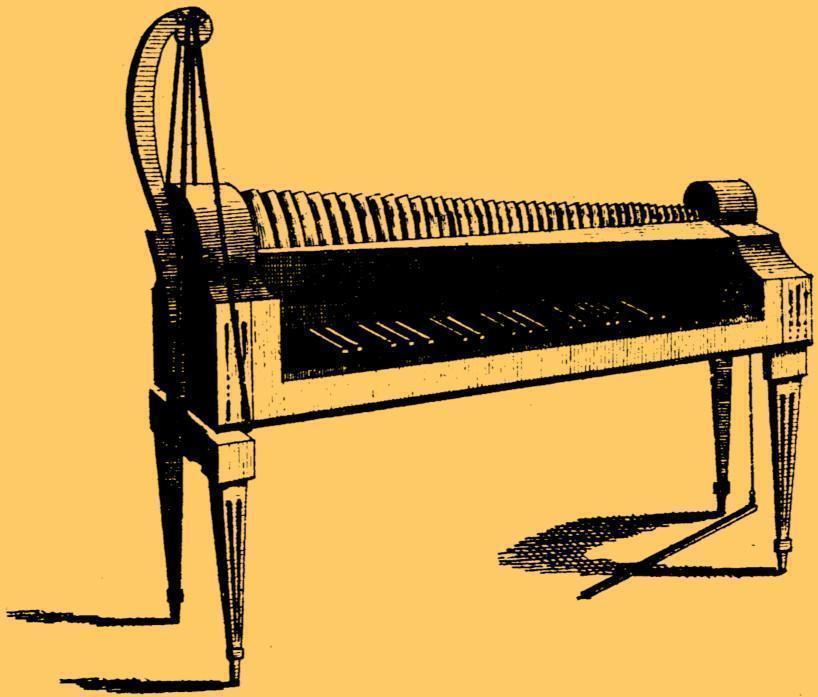
Julie von Charpentier seems to have been a virtuoso on some iteration of the instrument, for the construction and mastery of which several treatises were published at the time, including with illustrations. Here two versions with keys, which are lacking on the version above ([1] title vignette to Franz Konrad Bart, Abhandlung von der Tastenharmonika [Brünn 1798]; [2] title vignette to J. L. Köllig, Über die Harmonika: Ein Fragment [Berlin 1787]):
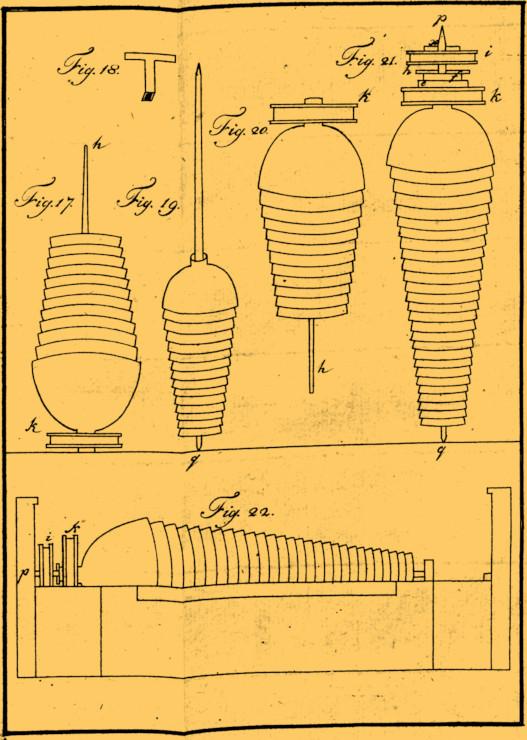
Here a closer look at the cylinder construction (Bart, Abhandlung von der Tastenharmonika, plate 4):
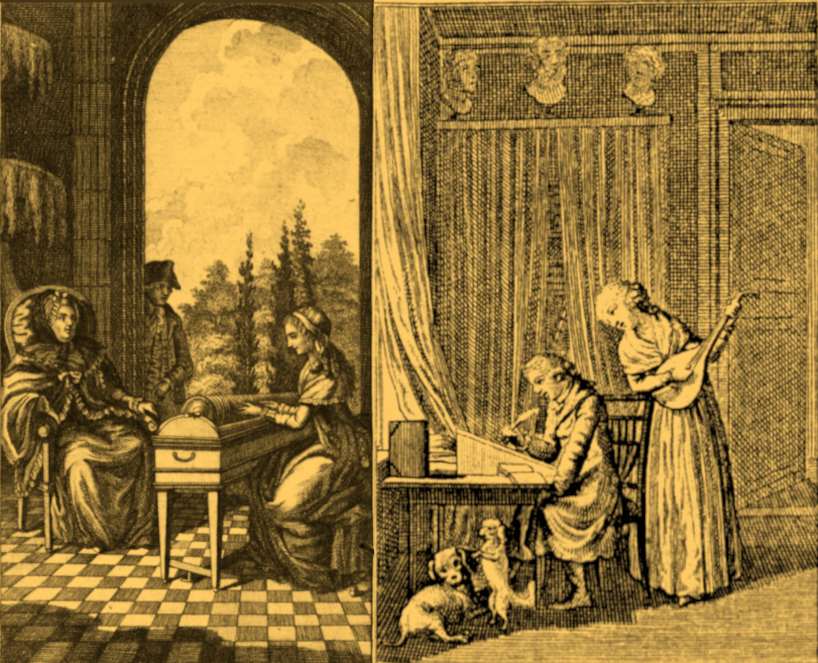
See also Hardenberg to Caroline Just from Freiberg on 5 February 1798 (Novalis Schriften 4:250): “She [Julie von Charpentier] plays only the harmonica, whereas her sister is equally skilled at all the other arts.” Here a young woman entertaining an older woman and man on the Harmonika (frontispiece to Benedikte Naubert, Emmy Reinolds Oder Thorheiten der Großen und Kleinen, vol. 1 [Frankfurt, Leipzig 1790]), and a woman entertaining with a lute (anonymous):
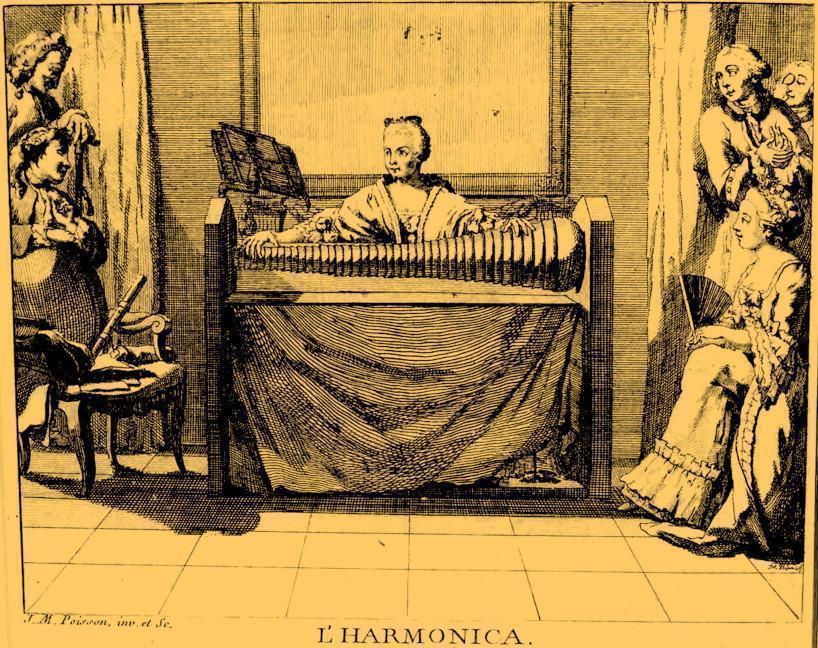
Here allegedly the painter Angelika Kauffmann performing on the Harmonika (J. M. Poisson, L’harmonica; Thomas Bloch Collection; no additional attribution provided):
Here a short piece played on a harmonium (sample from Roland SR-JV80-16 Orchestral II expansion board, XP-60 synthesizer):
And Mozart’s “Adagio for Glass Harmonica in C major” (k-617a; public domain):
The notes to Caroline’s present letter, Schmidt (1913), 1:964, remark: “Harmonika: Caroline’s reference to Julie von Charpentier, whose name Novalis had not mentioned to her, though probably, as with Caroline Just [see above], he had mentioned that she played the Harmonika.” Back.
[9] The letter of 11 November, which she forwarded on to Friedrich Schlegel. Back.
[10] Goethe’s periodical Propyläen. Eine periodische Schrifft, herausgegeben von Goethe, first issue autumn 1798:

According to Erich Schmidt, it had an anti-Romantic character after the fashion of Johann Joachim Winckelmann. Nicholas Boyle, Goethe: The Poet and the Age, 2:610, elaborates concerning the title and, by default, concerning Caroline’s allusions:
Goethe conceived the name for his “collective work” as an allusion to the gatehouse to the Athenian Acropolis and by way of reposte to the Schlegels, whose Athenaeum declared in its title that they had penetrated to “the Holy of Holies” of Art. Against their arrogantly Fichtean claim to possess the thing-in-itself, Goethe opposed the deference which accepts that we can walk only in the forecourts of Art and Beauty, amid the “phenomena,” not venturing through to what lies within . . . A fortnight after receiving the first issue of the Athenaeum from August Wilhelm, and immediately after devising the new title, Goethe began an Introduction to the periodical, a manifesto of “the grown man” who, unlike the presumptuous “youth,” does not imagine that what he constructs can vie in “art and splendour” with the holy places of antiquity. Back.
[11] Goethe was in Jena between 11 November and 29 November 1798 (Weimarer Ausgabe 3:2:222–25). Back.
[12] Goethe’s lengthy preface in Propyläen 1 (1798) 1, iii–xxxviii, concerning which see again Boyle, Goethe, 610–11. Back.
[13] I.e., the preface (“pre-reminder,” Vorerinnerung) at the very beginning of Athenaeum (1799):
The initial issues of this periodical will acquaint the reader adequately with both its purpose and its spirit. With respect to subject matter, we are striving to achieve the greatest universality possible in that which aims directly at culture, and with respect to discourse for the highest degree of free communication. To approximate this goal more closely, we considered it not entirely unuseful to combine as intimately as possible the knowledge and talents each of us engages in his own contributions. Here we are guided by the shared principle of never stating merely halfway what we consider to be the truth.
In this guise, treatises will alternate with letters, conversations, rhapsodic observations, and aphoristic fragments, just as in the content specific assessments will alternate with more general investigations, theory with historical portrayal, views of the multifaceted strivings of our nation and age with glances at foreign countries and the past, especially classical antiquity. Anything wholly unrelated to art and philosophy — both taken in their broadest meaning — will be excluded, as will be essays that are part of larger works. We will be devoting our best efforts to connoisseurs for their examination; we wish to incorporate as much attractive and lively material into our presentations for the entertainment of our readers as more serious purposes allow.
Although we share many opinions with each other, we are not intent on each making the other person’s opinion into his own. Hence each stands for his own assertions. Even less will even the slightest bit of that particular independence of spirit through which alone the office of the reflective writer can flourish be sacrificed to flaccid unanimity; hence deviating assessments may quite often arise over the course of this periodical. We are not only the editors but also the authors of the periodical, and are undertaking this enterprise without any other contributors. We will be accepting contributions from others only if we believe we can support their contributions just as we support our own, and will be mindful to distinguish them. The contributions of each of us will be designated by the beginning letter of his first name, collective contributions with both initials.
W[ilhelm] und F[riedrich] Back.
[14] Goethe’s review of the premiere of Wallenstein — namely, of the first part, Wallensteins Lager — appeared as “Eröffnung des Weimarischen Theaters (Aus einem Briefe)”; it was an analysis of Wallensteins Lager with a considerable number of verses in the supplement to Johann Friedrich Cotta’s Allgemeine Zeitung (Tübingen) on 7 November 1798 (not the Allgemeine Literatur-Zeitung as indicated in Novalis Schriften 4:965), after, that is, the Zeitung had already published its table of contents on 12 October 1798 and brief references to the two grand subsequent pieces (Wallensteins Lager premiered in Weimar on 12 October 1798, Die Piccolomini on 30 January 1799, and Wallensteins Tod on 20 April 1799). Cotta published the play in June 1800. Caroline is following Friedrich’s assessment here (see Friedrich’s letter to her on 29 October 1798 [letter 207], in which he coins the adjective “Goethesque”). Back.
[15] Schiller’s Musen-Almanach für das Jahr 1799, in which Wallensteins Lager was first published; concerning his other pieces, see Friedrich’s letter to Caroline on 29 October 1798 (letter 207). Back.
[16] Friedrich Vieweg was not only disappointed in the financial return of Athenaeum, he was also about to sell his own publishing privilege in Berlin and move to Braunschweig. Friedrich and Wilhelm considered other publishers, including Johann Friedrich Unger, Karl Friedrich Frommann, and even Georg Joachim Göschen. As it turned out, the brothers signed a new contract on 2–10 January 1799 with Heinrich Frölich, the new owner of Vieweg’s publishing privilege, and an announcement of the change of hands appeared in the Intelligenzblatt of the Allgemeine Literatur-Zeitung (1799) 6 (Saturday, 19 January 1799):
Announcement
For Scholars and BooksellersOn the occasion of Herr Friedrich Vieweg the Elder moving his own bookstore from here to Braunschweig, I have purchased his publishing privilege and at the beginning of this present year opened my own firm. I commend myself to Germany’s scholars and booksellers and ask for your trust, which I will to the best of my ability endeavor to justify and maintain and cultivate in all my business matters.
The following have already appeared in my firm: . . ..
At the Easter book fair the following will appear [Frölich lists various other pieces as well, not enumerated here]:Athenaeum. Eine Zeitschrift by A. W. and Friedr. Schlegel; vol. 2, issue 1, containing:
“Über die Philosophie an Dorothea,” by Friedr. Schlegel.
“Die Gemälde. Ein Gespräch,” by A. W. Schlegel.
“Über die natürliche Gleichheit der Menschen.”This announcement effectively refutes the assumption announced in Die Merkur that this periodical would die out after issue no. 2. . . .
Lucinde, a novel by Friedrich Schlegel.
Heinrich Frölich.
Bookseller in Berlin.
Concerning the “rumor” in Der Neue Teutsche Merkur, see Friedrich Schlegel’s letter to Caroline on 15 December 1798 (letter 212). Back.
[17] It is worth noting Caroline’s ambition to have “Die Gemählde”-descriptions published in Goethe’s Propyläen rather than in Athenaeum (ultimately published as “Die Gemählde. Ein Gespräch von W.,” Athenaeum [1799] 39–151, which appeared in early March 1799; see “Caroline’s Literary Reviews Vol. 1” with note 10). In May and June 1799, Wilhelm seems to have been planning to publish a special edition of this piece with Frölich in Berlin accompanied by sketches by Johann Franz Gareis. According to the contract of 2–10 January 1799, Frölich was to take over the publication of Athenaeum from Friedrich Vieweg. The honorarium was set at 12 Thaler per printer’s sheet, possibly 15 Thaler if the journal sold well. Back.
[18] Erich Schmidt, (1913), 1:731, originally identified these references as follows: (1) Prêvot: doubtless Antoine-François l’Abbé Prévost’s romantic novel Histoire du chevalier des Grieux et de Manon Lescaut (Amsterdam 1733); here the illustrations from the 1753 edition:
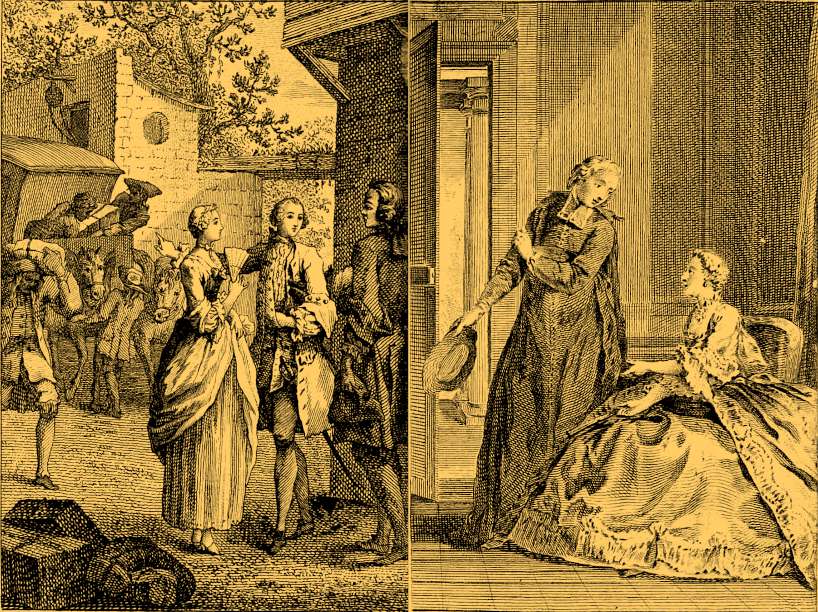
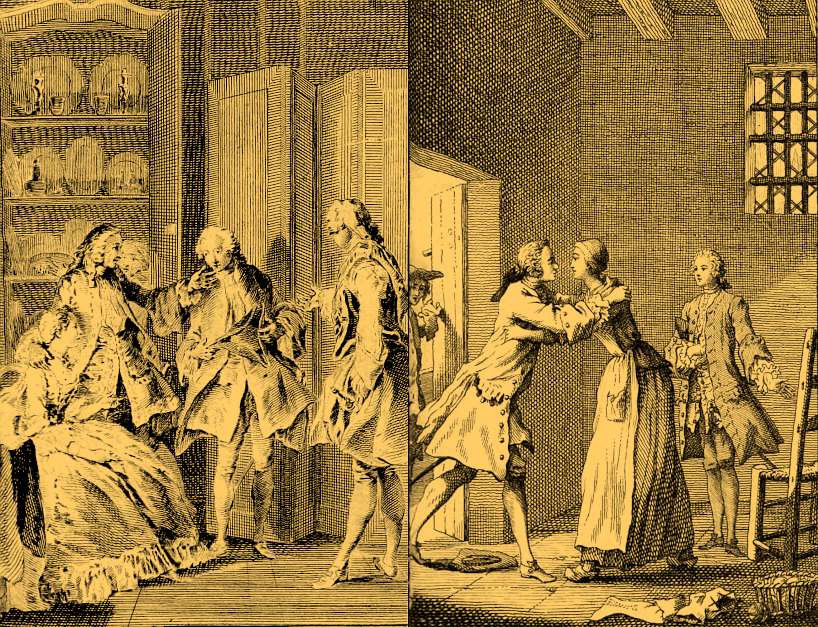
(2) Lesage: Perhaps Le diable boiteux (Amsterdam 1707)?
Here several of the sometimes unsettling illustrations in Lesage’s 1757 edition:
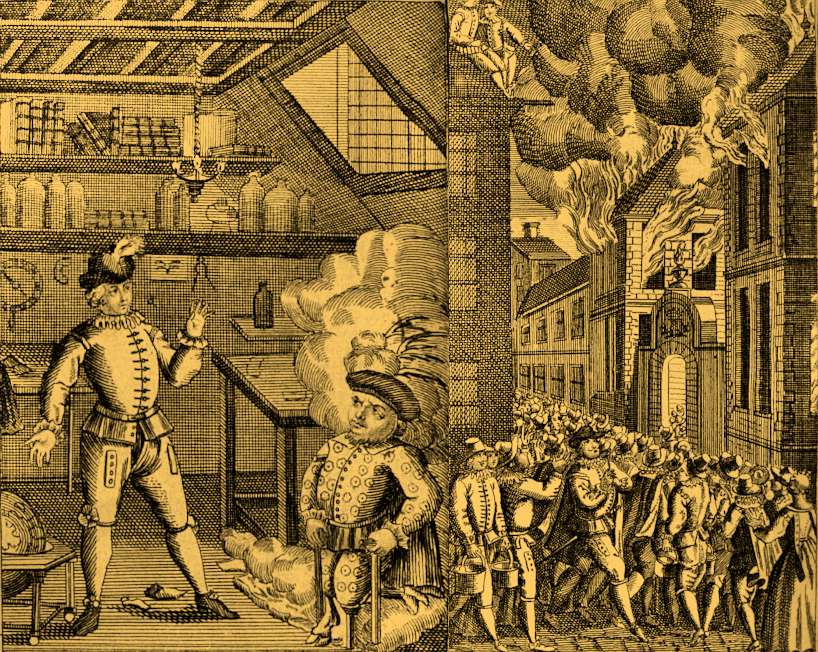
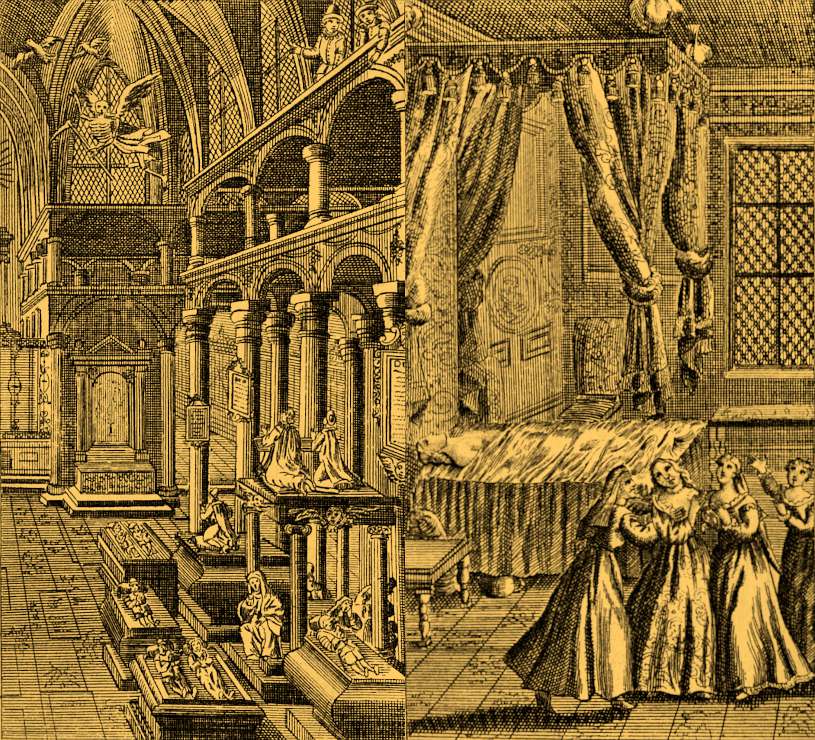
Cf., however, Novalis Schriften 4: 965:
Pierre Prévôst (1751–1839), Georges Louis Le Sage (1724–1803), French physicists and philosophers; both are repeatedly mentioned and cited in Schelling’s Ideen zu einer Philosophie der Natur (Leipzig 1797) and Von der Weltseele. Eine Hypothese der höhern Physik zur Erklärung des allgemeinen Organismus (Hamburg 1798).
Prévôst, moreover, published a piece on the life and work of Le Sage in 1805. Back.
Translation © 2013 Doug Stott