
• 169. Caroline to Luise Gotter in Gotha: Jena, 4 September 1796
[Jena] 4 September [17]96
|396| Until now, my dear Louise, you have been able to enjoy your neighboring area only through proxies, but God willing, a different time will come. The day before yesterday, [1] your sister and Dorette were here with me, and I could vividly imagine seeing your own dear face here soon as well. [2] Once we are living in town, please let no opportunity pass for making my fantasy come true, for |397| I have already anticipated your accommodations. Admittedly, you should not all come completely en famille until next summer, when each and every day we can plan on seeing a different part of the beautiful area around here. [3] You will not be quite as comfortable as at the residence of Madam Schütz, but, then, we will try to make up for that some other way.
I am still doing well beyond all measure here and have gotten quite properly settled in, feeling as if I could be staying here for a while. I have remained faithful to my resolution not to make many new acquaintances. [3a] Though I have not seen any sign of the university students, I have at least been reassured they will not be able to smash my windows, since in the future we will be overlooking a courtyard. [4]
Every evening we take a walk, and the sacred trinity of our domestic circle has recently been transformed into a partie quarrée since the arrival of my brother-in-law, [5] who has greatly amused us with his head, which is frizzy both inside and out. [6] In late autumn we will be getting the Weimar theater company. Göthe is now here again and is having the theater arrangé; [7] otherwise he spends a lot of time these days with caterpillars, which he kills and then resurrects. [8] —
When you see the Allmanach, you will also see how much time he has since spent with slaying. [9] He went around with a flyswatter, and wherever it slammed shut, an epigram emerged. [10] Schiller faithfully assisted him; and although his own weapon does not yield such comical prey, it is more lethal. Göthe came up with a parody of the Calender der Musen und Grazien that makes your heart quiver. It is called “Musen und Grazien in der Mark” [11] —
Ah, how I do rejoice, my darling,
that you are so natural today!
Our little girls, our little boys
in the future will on the dung heap play
|398| he says among other things there.
Your husband was unrelenting? Well, then, I must order myself an epigram on the subject.
We had some guest appearances, since two sisters, a brother, and a sister-in-law of Madam Hufeland from Braunschweig entered the territory. [12] The two sisters are still here, the brother went on to Dresden. Göthe was also there at the Hufelands’. The Schillers have other guests, of whom I for my small part would in any event prefer to be relieved, namely, her sister and brother-in-law, a fat Herr von Wolzogen, who spent a great deal of time in Paris during the revolution. [13] The sister is not half as natural as Madam Schiller and can bore a person faut soit peu [14] . . .
Notes
[1] Coincidentally, Caroline’s thirty-third birthday, 2 September 1796. Back.
[2] Apparently Dorette Seidler. Luise Gotter’s sister is not otherwise identified. Back.
[3] That is, with Luise’s husband, Friedrich Wilhelm Gotter, and their three daughters, Cäcilie, Julie, and Pauline (anonymous, Eine Burgruine in bewaldeter Landschaft, in der sich eine Gruppe von Spaziergängern befindet [ca. 1801 ff.]; Herzog August Bibliothek; Museums./Signatur Graph. C: 839):

Caroline does not seem to be aware of the severity of Friedrich Wilhelm Gotter’s illness, who would die only a few months later, on 18 March 1797.
In any event, the reason for Caroline’s apprehension about having a large group of visitors is that she, Auguste, and Wilhelm were still living in their small garden house outside the town gates, whence her reference “once we are living in town” (see similarly Caroline’s letter to Luise Gotter on 17–20 July 1796 [letter 166] with note 2).
Concerning Jena’s natural beauty, see esp. the almost panegyrical passage in Dorothea Veit’s letter to Rahel Levin on 28 April 1800 (letter 259l) with its accompanying footnote. Back.
[3a] Caroline remains socially wary after the experience she had in Gotha because of her reputation. Back.
[4] In early October 1796, Caroline, Auguste, Wilhelm, and possibly Friedrich Schlegel as well would be moving into an apartment in the rear edifice of a building inside the town of Jena at Leutragasse 5 (Stadtplan von Jena, 1909; Städtische Museen Jena: Stadtmuseum und Kunstsammlung; both rear edifices are still clearly shown on this town map from 1909):

As visible on the map above, the apartment was just around the corner from the market square (Marktpl.), which the following illustration shows essentially as Caroline and Auguste would have experienced it (Rathaus at left; Gustav Heinrich Schneider, Die Burschenschaft Germania zu Jena [Jena 1897], 87):

The house was also just down the street — in the other direction — from the open town square Eichplatz, which fronted on both Johannisgasse and Leutragasse (map: Stadtplan von Jena, 1909; aerial shot: 1920 postcard; illustration: Heinrich Schneider, Die Burschenschaft Germania zu Jena [Jena 1897], 123):


The apartment seems to have occupied the floors of the rear right building just behind the front building and the arched entryway to the rear, since all the windows are said to have looked out onto the courtyard as Caroline here describes, i.e., to the edifice across that courtyard rather than out into the open.
Dorothea Veit similarly describes the distribution of rooms to Schleiermacher on 11 October 1799 (letter 247c): “all the windows look out onto the courtyard. I myself live downstairs, one flight up Caroline, then Wilhelm, and finally, in the uppermost story, Friedrich.”
See also Peer Kösling, Die Frühromantiker in Jena, 11–28, also 79n51, who locates the Schlegels’ apartment in the edifice to the right. In her letter to Clemens Brentano on 27 February 1801 (Dorothea Schlegel und deren Söhne 1:[18]; KFSA 25:238), Dorothea remarks that “we live just across from him,” namely, Friedrich Immanuel Niethammer, who owned the house.
An argument might be made that Niethammer, who owned the house, might sooner live in the larger edifice to the right, and the Schlegels to the left. In any event, the family of Gottlieb Hufeland seems to have lived across that courtyard from them in the edifice to the left.
Here the entire complex ca. 1858; Eduard Helmke, Bericht über die Orthopaedisch-gymnastische Heilanstalt in Jena [Leipzig 1863], title vignette):

Here the apartment’s ground floor windows (on the left) viewed from the courtyard entrance from Leutragasse (later Leutrastrasse) on an early postcard:

Here, from essentially the same camera position, the entry to the apartments on the opposite (right) side of the courtyard (photo: Stadtmuseum Jena):
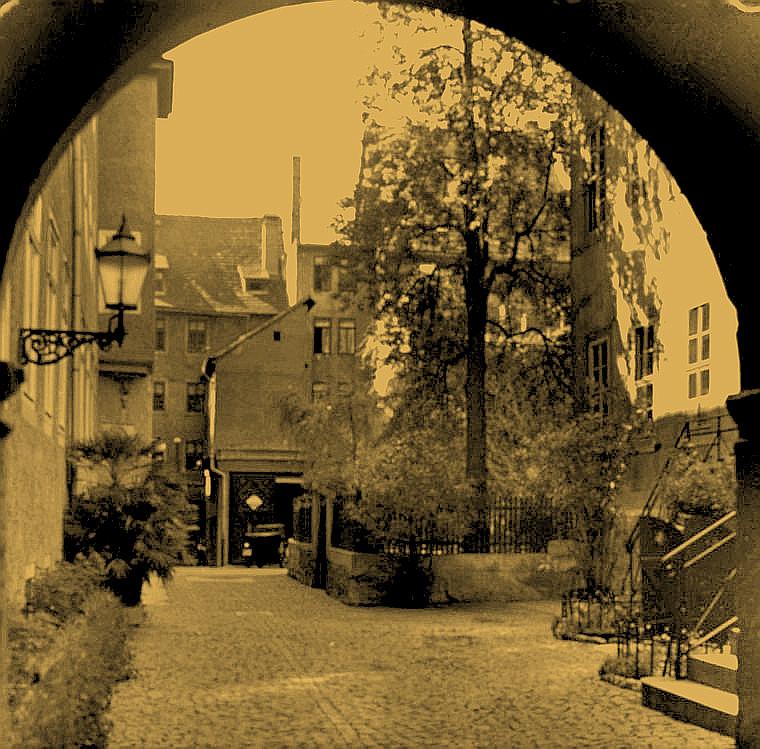
Here the rear of the house in an excerpt, albeit grainy, from the aerial shot on the 1920 postcard above:

Although no floor plan of the house at Leutragasse 5 seems to be extant, click on the image below to open a gallery of illustrations of typical mid-18th-century bourgeois residences of the sort similar houses in Jena at the time broadly resembled:

And finally, Caroline’s fears of students casting stones through professors’ windows was not unfounded, for such an episode had indeed earlier happened to Johann Gottlieb Fichte. The practice was common enough for Daniel Nikolaus Chodowiecki to provide the following noctunal illustration (Etudes academiques [1773]; Herzog August Bibliothek; Museums./Signatur Uh 4° 47 [201]; one of the illustrations for the novel by C. F. Bretzner, Das Leben einer Lüderlichen: Ein moralisch-satirisches Gemälde, 3 vols. [1787–88]):

[5] Schiller reported Friedrich Schlegel’s arrival to Goethe on 8 August 1796 (Correspondence between Schiller and Goethe 1:221): “[Wilhelm] Schlegel’s brother is here; he makes a very favorable impression, and gives promise of much.”
The “sacred trinity” is Caroline herself, Wilhelm Schlegel, and Auguste. Back.
[6] Two accounts might be adduced concerning life together with Friedrich, concerning whose lifestyle (according to Erich Schmidt [1913], 1:714) one might easily draw false conclusions.
The first is the vivid one by Henrik Steffens, Was ich erlebte, 4:302–4; see supplementary appendix 242c.1.
The second is by Wilhelm von Humboldt. After reading Friedrich’s review of Friedrich Heinrich Jacobi’s novel Woldemar [Leipzig 1779] in the journal Deutschland [3 (1796) issue 8, no. IX, 185–213], a review Humboldt found to be a repugnant “Don Quixotiade” but not really malicious (Briefe von Wilhelm von Humboldt an Friedrich Heinrich Jacobi, ed. Albert Leitzmann [Halle 1892], 54–57), Humboldt remarked further to Friedrich Heinrich Jacobi on 23 January 1797 that he found Friedrich to be a highly gifted person, unyouthful, full of “severity and obstinacy,” serious and diligent, with all the “excessive propriety and withdrawn demeanor of a mature or even excessively mature man,” eccentric, with a disposition “more bitter and gloomy than funny and cheeky”; “with a completely winning external appearance”; “he has a quiet, reflective, intelligent and modest face, says little, and even then usually only about scholarly things; his obstinate disposition manifests itself in social intercourse only in the fact that he is quick to break off an argument instead of continuing it, which is why I have never really gotten to know him better.”
Humboldt remarked in a letter to Christian Gottfried Körner on 3 May 1796 (not 23 November 1795 as in [1913] 1:714) (Ansichten über Aesthetik und Literatur von Wilhelm von Humboldt: Seine Briefe an Christian Gottfried Körner (1793–1830), ed. Fritz Jonas [Berlin 1880], 56) that Friedrich seemed to lack “clarity, development, and organization.” Back.
[7] Concerning the theater to be set up in Jena, see Goethe to Franz Kirms and Christian Gottlob Voigt on 6–8 September 1796. Goethe writes to Franz Kirms on 6 September 1796 (Weimarer Ausgabe 4:11:185):
Let me wait and see whether the dance hall manager comes to see me, in which case I will see what he remembers; in all likelihood, however, he will insist on such conditions and will hedge such that we will not be able to do anything with it.
Goethe writes Kirms again on 8 September 1796 (ibid., 188–89):
The dance hall manager and owner came to see me early today and presented the following concerning the theater to be set up in his building’s empty room:
(1) He intends to allow a theater to be set up there;
(2) when the house is no longer used for this purpose, however, all the materials used will remain his property;
(3) he alone will be allowed to sell drinks and food during performances;
(4) he will receive 80 Thaler a year rent.Rather than responding at all to these absurd demands, I instead simply dismissed him.
The whole project is still much too premature to take any further steps just now. I will request the records regarding the transference of this house from the royal administration; send me the plans and estimate of our architect as soon as possible, and I will forthwith develop a plan for further consideration.
Goethe then writes to Christian Gottlob Voigt on 9 September 1796 (ibid., 190–91):
Our speculations involving establishing a theater here are still moving along gradually, though we do not really think it possible to establish one right at this moment. Please be so kind as to send me the administrative records concerning the transference of the dance hall. Since we are having to consolidate our institution with such an unsteady building, we will need to pay close attention to both civil and architectonic solidity. Back.
[8] From Goethe’s diary of 21 August 1796: “Started observing caterpillars”; in a letter to Christiane Vulpius on 4 September 1796: “In the remaining hours, . . . I am occupied with caterpillars.” This period’s interest in such “resurrections” (and not merely of caterpillars) in connection with galvanism is addressed esp. later in this correspondence; see, e.g., Johann Wilhelm Ritter’s letter to Schelling on 24 May 1808 (letter 432d), esp. with note 4. Back.
[9] The allusion is to Schiller’s Musen-Almanach für das Jahr 1797, the more specific reference being to Schiller and Goethe’s Xenien, which Caroline mentions with increasing frequency in coming letters. Insofar as they were still in fluid manuscript form, however, she cannot yet have seen them in print; that is, she is talking about hearsay. Back.
[10] The Xenien were a collection of satirical and biting epigrams composed by Schiller and Goethe against literary enemies (the collection concluded Schiller’s Musen-Almanach für das Jahr 1797). Caroline’s flyswatter-metaphor refers to a sort of tool made of two boards or planks, the lower of which is smeared with honey; the planks are then clapped together after the fly lands (Adelung, 2:207). Back.
[11] Goethe composed his poem “Musen und Grazien in der Mark,” Musen-Almanach für das Jahr 1797, 68–71, in May 1796 as a parody of Friedrich August Wilhelm Schmidt’s Calender der Musen und Grazien für das Jahr 1796 (Berlin 1796). Here the calender’s title pages and initial illustration along with what at the time was an infrequent colored illustration (Inhaltsverzeichnis deutscher Almanache, Theodor Springmann Stiftung):


Concerning Schmidt’s Calender for 1796 and Goethe’s barb, however, see Franz Kern’s remarks in Goethes Lyrik: ausgewählt und erklärt für die oberen Klassen höherer Schulen, ed. Franz Kern (Berlin 1889), 104:
The pastor Schmidt in Werneuchen had published a Kalender der Musen und Grazien für das Jahr 1796. One critic allegedly preferred this particular piece over Schiller’s Musen-Almanach, which also contained Goethe’s “Venetian Epigrams,” the argument being that “simple, artless scenes of nature, spiced with contempt for the grand world and its vanity,” i.e., precisely the sort of poems the Calender offered, were more beautiful and noble than such [Goethean] epigrams. Goethe directs his own quite accurate wit against this particular predisposition that confuses what is natural with what is in fact trivial.
Goethe gave the manuscript to Schiller in June and to Karl Friedrich Zelter on 4 September as preliminary galley proofs (first-printing proofs hung out publicly to dry and be examined by the public; those who found typographical or other errors received a premium). Back.
[12] That is, a brother, two sisters, and the sister-in-law of Madam Hufeland, née Wiedemann. Possibly the brother was Eberhard Wiedemann, the sister-in-law his wife; one of the two sisters was presumably Sophie Wiedemann; the other is unidentified (Daniel Nikolaus Chodowiecki, “Besuch bei den Fräulein von Rosenberg,” Von Berlin nach Danzig: Eine Künstlerfahrt im jahre 1773, von Daniel Chodowiecki. 108 Lichtdrucke nach den originalen in der Staatl. akademie der künste in Berlin, mit erläuterndem text und einer einführung von Wolfgang von Oettingen [Leipzig 1923], plate 74):

[13] Caroline and Wilhelm von Wolzogen remained in Jena from August into November. Back.
[14] Fr., “a little bit, ever so little”; possibly incorrect French for peu s’en faut; or a misreading of the manuscript by Waitz (1871), 1:178, for tant soit peu. Back.
Translation © 2012 Doug Stott