
• 97. Caroline to Philipp Michaelis [?] in Göttingen: Marburg, December 1789 [*]
[The beginning of the letter, a double sheet, is missing.]
[Marburg, December 1789]
|197| . . . she seemed to see something in quiet fantasies and then to stretch out her lovely arms toward it such that even her fingers seemed to be reaching out. Then she grabbed my hair tightly — one time she pulled my hand firmly to her heart — she plucked at the bed sheet in slight cramps — and yet I still refused to acknowledged these signs. All the while she was still quite conscious — she still understood me when I told her about the things Grandmother would be sending her for Christmas [1] — she was still able to answer — “to Guste, too.”
To relieve her cramps, Fritz prescribed a warm bath, into which I placed her with unutterable fear in my heart. I was delighted to see how good she felt in it, [2] something I could tell just by looking at her, and even she herself said: “Good! Good!” with the same heartfelt tone of voice with which she uttered her “yes,” and when I had laid her back into the bed and she seemed to be so much better — this was toward 4:00 in the afternoon — I could not doubt now that she would recover . . .
Toward 8:00 . . . a second warm bath — into which I was able to place her only with terrible strain on myself, while everyone was trembling for the life of our precious dear, and Lotte lay on the ground, senseless, amid a violent attack of sobbing and convulsions — strong doses of musk — everything was tried — though I now no longer really expected any success — nor, presumably, did the others. Her cramps came not in convulsions or spasms, but only in gentle stretches, followed by stiffness. [3]
I kept busy until I found nothing else to do — then I sat down on the canapé next to Lotte — my Rose became |198| very quiet — Madam von Malsburg and Madam Breidenstein [4] knelt down beside her bed — none of the maidservants was present — everyone became quiet — and I wished so longingly that this quietness might never be interrupted. I quaked at the moment when, motionless, and with a heavy heart, I would have to get up again. “Where art thou, O spirit of my slumbering one?” [5] This question rose up for me amid images, amid ideas of which limited humankind can have but dull intimations — and though this dullness and torpor become mixed with yearning for clearer, more distinct knowledge — and though the feeling of loss also awakens in those same notions — my heart resisted with a power — with which I am well acquainted — but which I had never yet engaged quite thus —
Finally I remained alone with Lotte — and now called the others that they might remain with the deceased that night. They came and did not yet know she was dead. Whether I myself slept or stayed awake afterward, I simply know not. I stayed quiet — I was concerned about Auguste — she did not seem to realize what had happened — she went into the room alone — came out again without any further remark, and finally I told her that Röschen would no longer be able to play with her.
And then it broke forth — she screamed in an almost repulsively violent tone of voice: “You are not to say that to me, Mother!” as if she had been trying to conceal it from herself until then. [6] I cannot really describe to you what was so strange about it — some inner depth in her seemed to be linked with such a peculiar vacancy of thought — I could not perceive that anything was at work within her — and yet, even though she did indeed come to tears afterward, it seemed more like an eruption of concealed agitation. Now she is infusing all sorts of childish frivolity into her memories, which come to her extremely often. She calls to Röschen, saying, “I see her, but she does not want to come, she is with her father.” [7]
|199| I spent the rest of the day in a state of apathy, unaware of the extent to which I myself was protracting it — my exhaustion told me. That evening I was so weak I could not even walk, and when [I] went to bed I began feeling extremely ill and coughing up blood, something that lasted the entire night and was followed by enormous weakness. But I regained my strength quickly and at the very least tried to keep busy.
Since then, my health has been just as you might imagine given my constitution — except that my chest suffered and tightened up so much that I could not sit upright, and from time to time I was still coughing up a bit of blood, presumably because it had collected in my lower abdomen. But I am now in tolerable spirits — I have gone for walks twice — and my coughing is only of the spasmodic sort now — the fresh air has strengthened my lungs again. . . .
Stay well; I can write no more. Madam La Roche wrote me today that she was expecting you — so you were presumably there. Tell Therese that I will probably be writing her on the next postal day — because I do really want to. May God preserve for her that which I do not have and which I will never be more aware of no longer having, feeling it now as I do with complete presence of mind. [8] Only one child now — and the lovely one who filled me with such sweet anticipation — gone — along with everything I could have done for her.
Notes
[*] Addressee uncertain; attribution by Waitz (1871), 1:60, followed by Schmidt (1913), 1:197. Philipp Michaelis was now back in Göttingen to continue his medical studies. — Caroline’s daughter Therese was two and a half years old at the time of this letter. Back.
[1] Either Madam Michaelis or Madam Böhmer. Back.
[2] In a letter to Julie Gotter on 17 October 1802 (letter 372), Caroline mentions that Fritz Michaelis was reproached publicly for his treatment of Therese during this episode.
Otherwise see the following illustration from a children’s picture book in 1810 portraying the kind of bathing vessel presumably similar to that which Caroline would have used for Therese in this situation, and quite unlike the bathtubs adults used (anonymous, Erste Lehren und Bilder oder unterhaltende Verstandesbeschäftigungen für Kinder, auch für solche, welche noch nicht lesen [Vienna 1810], plate 1):

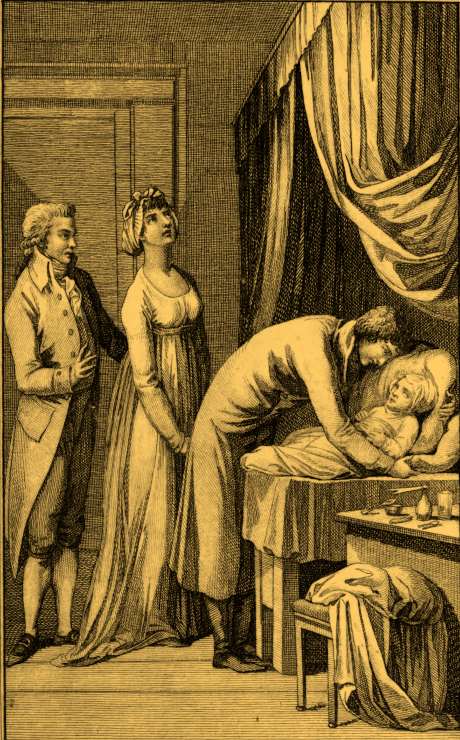
[3] Here three illustrations reflecting the situation Caroline describes. In the first, the child seems just to have died (frontispiece to August G. Eberhard, Ferdinand Warner, der arme Flötenspieler [Leipzig (Wien) 1803])::
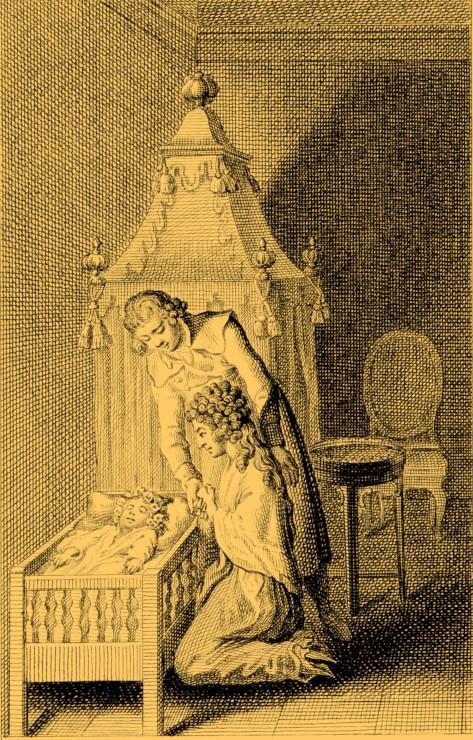
Here two post-mortem scenes by Daniel Nikolaus Chodowiecki. The first portrays a couple at the crib of their deceased child, bears the title “May he who gave him to us now take him back”; the second, a portrayal of a recently deceased child, is one of the illustrations to Johann Caspar Lavater, Physiognomische Fragmente zur Beförderung der Menschenkenntniß und Menschenliebe [Leipzig, Winterthur 1775] (see Caroline’s letter to Julie von Studnitz on 14 March 1783 [letter 36], note 7) (present illustrations in order: Nehm er ihm hin der uns ihn gab [1790]; Herzog Anton Ulrich-Museum; Museums./Signatur DBerger WB 3.4; Totes Kind [1774–75]; Herzog August Bibliothek; Museums./Signatur Chodowiecki Sammlung [1-56]):

[4] Madam (Mademoiselle?) Breidenstein/Breitenstein, possibly to be identified as Friederike Sophie Charlotte von Malsburg’s sister; or perhaps her mother or otherwise someone who had married into the Breidenstein family? Back.
[5] Distant allusion to Friedrich Gottlob Klopstock’s religious epic poem Der Messias, 4 vols. (1755–73), with its use of the repetitive invocation “where art thou” in several passages with its reference, in canto 19, to the “spirit of the slumbering dead” in connection with the resurrected Jesus:
Jesus descended from Mount Tabor and now stood
On the shore of the Sea of Galilee, next to him angels,
Seen by him alone. They brought tidings from afar,
Perceived quick commands that determined the fate of worlds.
Others came, others went, hastening,
Burdened with commands that astonished them, and which
Will one day astonish us as well when the husk of this first
Life we discard and the spirit of the slumbering dead
Permeates, fills that new, serene one. Back.
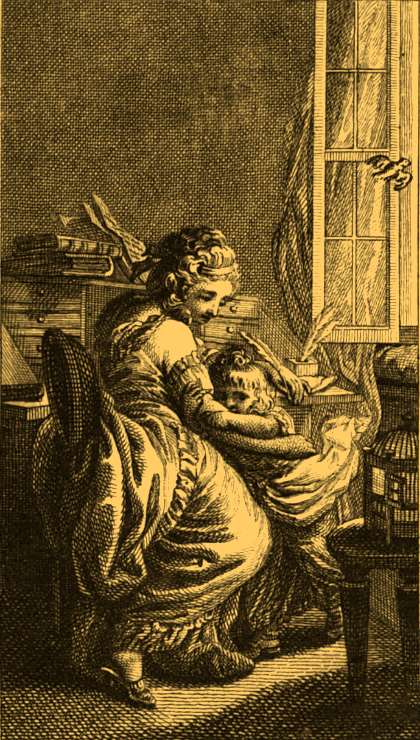
[6] Frontispiece to Stéphanie Félicité de Genlis, Adelheid und Theodor oder Briefe über die Erziehung, vol. 1 (Gera 1783):
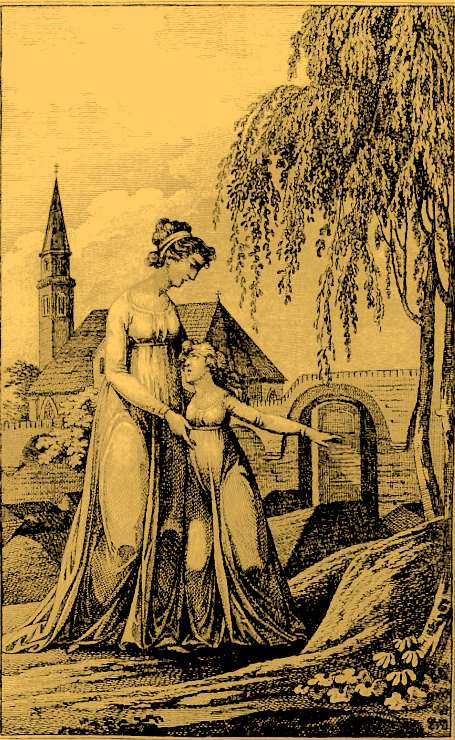
[7] Frontispiece to Friedrich Rochlitz, Amaliens Freuden und Leiden als Jungfrau, Gattin und Mutter, vol. 2 (Leipzig 1803):
[8] Of the ten children to whom Therese Forster, née Heyne, would give birth in two marriages, only four would reach adulthood. Caroline, of course, had now lost two. See in general her letter to Luise Gotter on 22 June 1785 (letter 57), note 2. Back.
Translation © 2011 Doug Stott