
• 36. Caroline to Julie von Studnitz in Gotha: Göttingen, 14 March 1783 (Fr.)
Göttingen, 14 March 1783
|72| So, peace has been concluded, and your friend is happy. [1] Peace has also been returned to my heart, and joy has returned as well. . . .
Nevertheless it is not as a patriot that I rejoice in this peace. There could not have been a more humiliating one for England. Our own Englishmen are also condemning it a thousand times over each day, and the king is aggrieved by it in secret.
Woe to those who at the beginning of the war were already preparing this peace by dragging things out, seduced by the basest of motives, embarking on a course of collision with the well-being of the fatherland itself: namely, the desire to enrich themselves; and woe to Fox and all those who concluded it, motivated by the perverse and corrupt spirit of the opposition.
Could you really believe that the Landgrave of Hesse surrendered his troops to the king of England just to save the cost of bringing them back? He simply sold his own subjects, and received 31 pounds sterling for each man. [2] Those who will want to return can do so, but their number will be quite small. They will give tillable farms to those who stay; their wives will follow them, they will attract others, and the land of Hesse will become a desert where there will be more antique statues and pounds sterling than men. [3] —
The landgrave has reconciled with his three sons. [4] It is especially his spouse to whom we owe that grand revolution, one that fills the entire land with joy. The younger son was the first to arrive and throw himself at his father’s feet. His father did not recognize him, taking him instead for a madman, though he did accept him as soon as he realized it was his own son; then the second came, and after them the crown prince. |73| This gave rise to the most touching scenes. The [step-]mother joined with them publicly. [5]
They made it possible for their father to regain the respect he had lost, even that due to etiquette, by themselves showing him respect. The people are eager to see their sovereign’s sons and welcome them with enthusiastic acclamations of pleasure. In a word, everyone is content; and if the landgrave still has feelings, how good it must be for him to be a father once more before he dies. [5a]
I would rejoice with all my heart could your travel plans be carried out. I know of nothing more enjoyable than traveling, even though I myself have traveled so rarely, and even though perhaps I am more enamored of it because of the beautiful, fanciful ideas in my head than because of what I have genuinely experienced myself. How my ideas sometimes flit all over the world! and yet then, upon returning, I tell myself sadly, like Yorick’s bird: I can’t get out! [6]
A journey through Germany and Switzerland — how delightful! Were envy not so inconvenient, I would envy all those who take such a journey, and it is only with great effort that I keep myself from doing so. People here are not yet losing the taste for Switzerland, and I believe they will set out anew on pilgrimages to that place of sanctity, that image of holiness for all those who love the true and the beautiful in both people and nature.
Madame Less was there last summer, and she often tells me about the miraculous impressions it made on her; she has also made me love Lavater, and I entreat you to love him as well, and to read him, except for his works on physiognomy. When I hear people talk about him, and when I read his writings, which breathe the true meaning of Christianity throughout, I see in him one of Christ’s principal disciples. [7] He is at the same time the most spirited, cheerful of men, and is the soul of every society of which he is a part.
|74| The misfortunes of Sicily and Calabria are the subject of every discussion here, and whom could they not fill with compassion? It is the most terrible event, a reversal of all of nature itself. The most beautiful country destroyed and 40,000 people dead. One shudders! [8]
Are you still learning English? I am reading only in that language, I write it, speak it, and derive great joy from it. There is nothing that better rewards the effort one expends in having learned it. I cannot get enough Pope, Young, Milton, Hume, etc., and Shakespear! Indeed, Shakespear alone would make it all worthwhile. Despite that which so-called national pride may have to say about it, England has indeed produced the greatest authors. As for the greatest men, those I willingly cede to Germany. I read Mrs. Asgill’s letter to the Comte de Vergennes in the original as it was published in the newspapers; it suffered greatly in translation. While reading the passage in which she mentioned her daughter “raving about her brother,” my tears flowed. [9] . .
Notes
[1] The Peace of Paris (consisting of Britain’s Treaty of Paris with the United States, preliminary articles being settled on 30 November 1782; and Britain’s Treaties of Versailles with France and Spain, preliminary articles being settled on 20 January 1783), finalized in Paris on 3 September 1783. Back.
[2] For a brief and general account of Hessian participation in the American Revolutionary War, see supplementary appendix 4.1. Friedrich II, Landgrave of Hesse-Kassel from 1760 to 1785, had concluded a treaty with Great Britain on 15 January 1776 to supply soldiers. See “The Hire of Mercenaries: What King George paid for his Hessian troops,” New York Times, 13 December 1880:
The Landgrave of Hesse Cassel was to furnish 12,000 men under this treaty, completely equipped and with artillery if desired. He was to be paid levy money at the same rate as the Duke of Brunswick, viz. 30 crowns banco, or £7 4s. 4 1/2d for every man. His subsidy, however, was larger in proportion, amounting to 450,000 crowns banco, or £108,281 5s per annum, to be continued for one year after the actual return of the troops to Hesse.
(Late-eighteenth-century engraving portraying the emotional departure of Hessian mercenaries for America:)
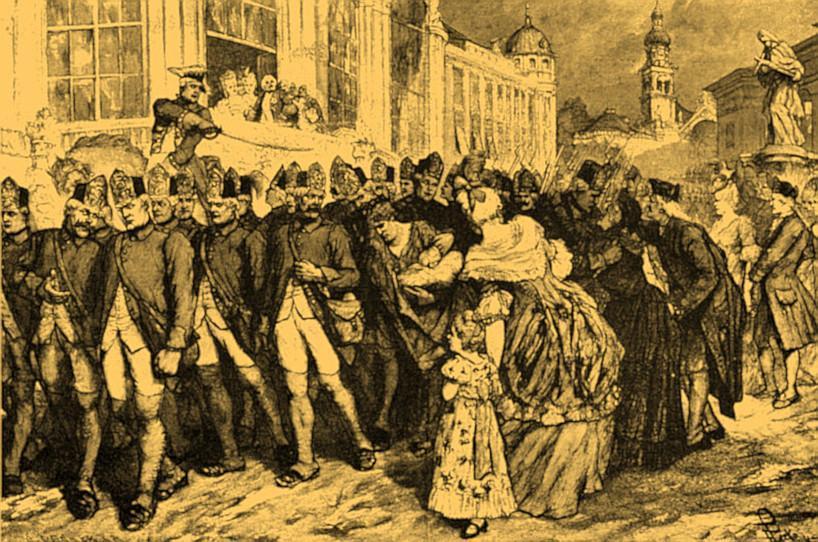
The Landgrave subsequently furnished various smaller contingents, making special bargains for them, but his advantage over the Duke [of Brunswick] may be roughly estimated from the fact that, barring the blood-money above spoken of [three wounded men being reckoned as one killed], and concerning which we have no data, barring, also, whatever pickings and stealings the most serene rivals managed to gather in, and counting only levy money and subsidies, the Landgrave of Hesse Cassel received, on an average, nearly £74 per man sent to America, and the Duke of Brunswick little over £31. In addition to this, and outside of the treaty, the Landgrave insisted on the payment of an old claim, dating from the Seven Years’ War, previously disallowed by England and amounting to £41,820 14s. 5d.
Friedrich II, moreover, seems to have been the only German ruler whose mercenary soldiers’ pay was routed through him rather than being issued directly to the soldiers in America (as was the case with the Duke of Braunschweig). Back.
[3] The United States Congress authorized the offer of fifty acres of land to individual Hessian soldiers to encourage them to desert. After the war, approximately five thousand Hessians settled in North America. Back.
[4] After it became known that Friedrich II had secretly converted to Catholicism in 1749, he and his first wife (a sister of George III) separated in 1754, she taking his three sons to Denmark in 1756. This was the first time he had seen his sons since then (Genealogischer Kalender auf das Jahr 1810; Inhaltsverzeichnis deutscher Almanache, Theodor Springmann Stiftung):
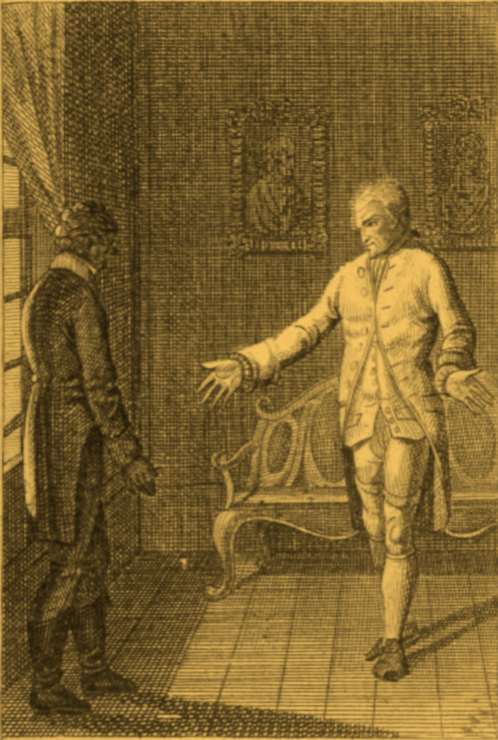
[5] Carlo Goldoni, Sämmtliche Lustspiele, vol. 5 (Leipzig 1769), preceding p. 221:
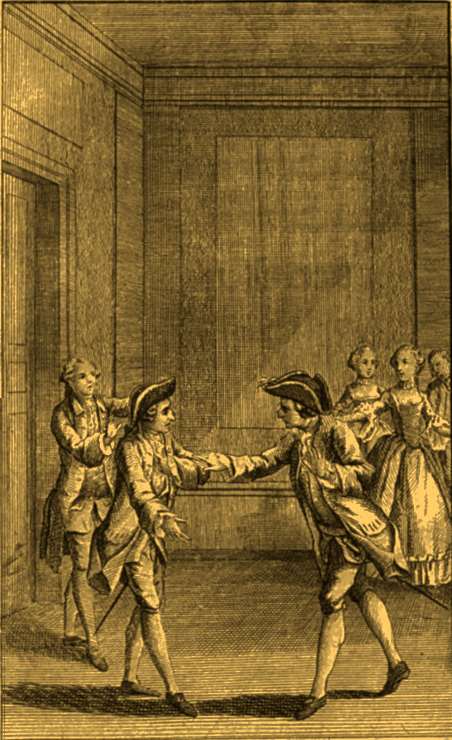
[5a] He died two years later, in 1785. Back.
[6] The starling in Lawrence Sterne, A Sentimental Journey through France and Italy by Mr. Yorick, 2 vols. (London 1768), 2:22–26 (in the chapter “The Passport. The Hotel at Paris”), which wakes the traveler from his Parisian bastille dreams with his eternal “I can’t get out” (supplementary appendix 36.1) Back.
[7] The most recent work by Lavater apart from his Physiognomische Fragmente (see below) was his Christian verse epic Jesus Messias, oder die Zukunft des Herrn: Nach der Offenbarung Johannes (Zürich 1780), a luxuriant and devout poetic paraphrase of the Revelation of John in the New Testament in which he in part followed the New Testament text itself and in part — to the exasperation of some reviewers — engaged in seemingly endless rhapsodic digressions. Given Caroline’s almost reverent description of both Lavater and his Christian works, a look at the sometimes sentimental, sometimes bizarre, and sometimes slightly unnerving illustrations to this volume may provide at least a visual background to Caroline’s reaction to this particular Christian sensibility. Click to open a gallery of selected illustrations from the volume by Daniel Nikolaus Chodowiecki.

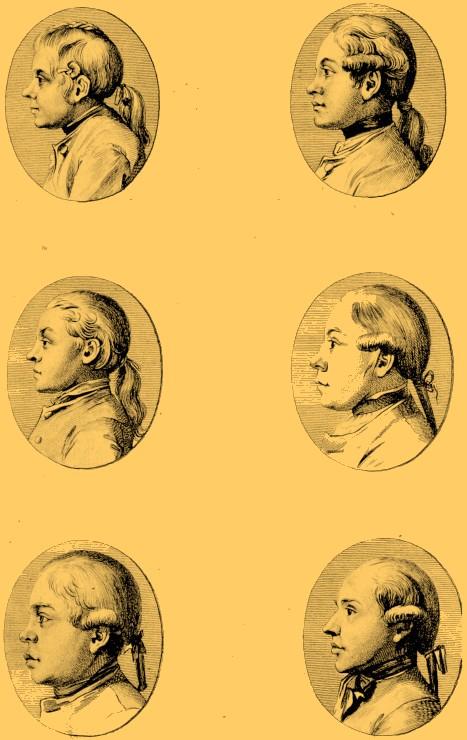
Caroline’s remonstrations notwithstanding, Lavater’s arguably best-known work was his Physiognomische Fragmente zur Beförderung der Menschenkenntnis und Menschenliebe, 4 vols. (Leipzig 1775–78), an abundantly illustrated attempt to interpret the relationship between a person’s face and soul.
Among Lavater’s illustrations, some are contemporary, some older, some prepared especially for these volumes; some portray a collection of individuals or types, and some single individuals. The following vignette from volume 1 is actually a test for readers to determine how well they understand Lavater’s explications (Physiognomische Fragmente, zur Beförderung der Menschenkenntniss und Menschenliebe, 4 vols. [Leipzig, Winterthur 1775–78], vol. 1 [1775], plate following p. 186):
In the second vignette, by coincidence, Lavater examines and assesses in volume 3 a portrait of Luise Gotter’s husband, Friedrich Wilhelm Gotter, using a copy of the same portrait as in the biograms of this project (vol. 3 [1777], 211):
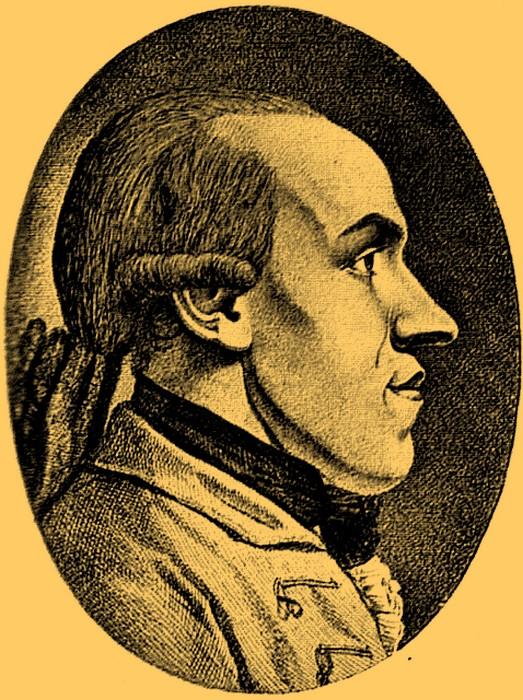
Third Fragment
A Profile, toned. Gr.
On the whole one of the most peculiar, distinguished faces. In nature even more so than in the not entirely accurate but certainly similar copy here — An expression of suppleness and genius!
The forehead is not that of someone who penetrates deeply, but rather of someone who sees with clairvoyance, and who comprehends much and quickly, and who then forms such comprehension anew.
The eye is far beneath nature. Brown in a light blue eyeball; bright and quick in movement — In this copper engraving, it also shows a decisive element of noble aesthetic sensibility.
In the lengthy, forward-extruding nose with the horizontal lower part, in its transition to the mouth, and in the quite extraordinary upper lip I find an expression of pliable sufferance, of the purest sensibility for beauty; the seat of changeable moods — considerable feminine sensitivity in the jawbone; in the chin’s unusual length an element of extended strength of the rarest sort.
The ear is among the best and most distinct I have seen. The breadth of the forehead and the back of the head — demonstrate a capacity for comprehensive understanding and serenity. Back.
[8] In 1783–85 the most violent and persistent seismic crisis in the last two thousand years shook southern Calabria and the Messina area of Sicily. Five extremely powerful earthquakes, followed by tsunamis, occurred between 5 February and 28 March 1783, causing enormous destruction. These earthquakes caused more than 30,000 casualties and, commensurate with Caroline’s remarks here, radically changed the physiography of the local landscape. Here an illustration by Daniel Nikolaus Chodowiecki (Verwüstungen des Erdbebens in Kalabrien [1789]; Herzog Anton Ulrich-Museum; Museums./Signatur DChodowiecki AB 3.837):
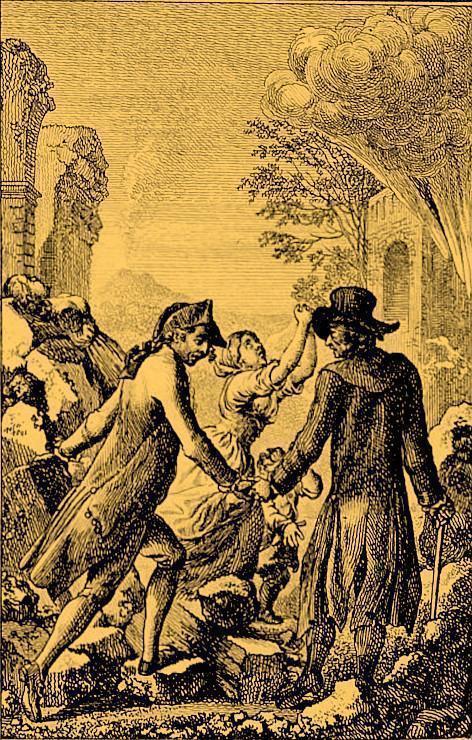
See the detailed account in supplementary appendix 36.3 (with illustrations). Back.
[9] Caroline is citing quite accurately; the daughter was described as “seized with a fever and delirium, raving about her brother, and without one interval of reason, save to hear the heart-alleviating circumstance.”
Georg Waitz, “Aus Jugendbriefen Carolines, Schluss,” Preussische Jahrbücher 33, no. 4 (1874), 386, misread Caroline’s handwriting as referring to a “Mrs. Argill.” Erich Schmidt, (1913), 1:74, who did not have access to the manuscript of this letter even in 1913, followed Waitz’s reading but then inexplicably spelled it “Argyll” in his notes (1:679); Schmidt also mentions having unsuccessfully consulted the Dictionary of National Biography. The correct name, however, is Asgill, and the woman Theresa Asgill.
The “Asgill affair” involved hostilities between patriots and loyalists in New Jersey and New York at the end of the American Revolution and a British officer, Charles Asgill, captured at Yorktown, what has been called “the new nation’s first international incident”; Asgill was to be executed if the officer (Tory Captain Richard Lippencott) thought to be responsible for ordering a patriot hanging was not turned over to George Washington (documentation in supplementary appendix 36.2). Back.
Translation © 2011 Doug Stott