
• 98. Caroline to Lotte Michaelis in Göttingen: Marburg, 18 August 1790
[Marburg] Wednesday
midday, 18 August [1790]
|199| I just received your note. Madam La Roche did answer me, and I am enclosing it here for you — so, only a bit more |200| patience. . . .
Schlegel did not complain about you — he merely said — “I wish your sister were happier than she is; she seems to have too little trust in me really to open up; but I am then teased all the more.” You were wrong to treat him like that, and I cannot get involved. —
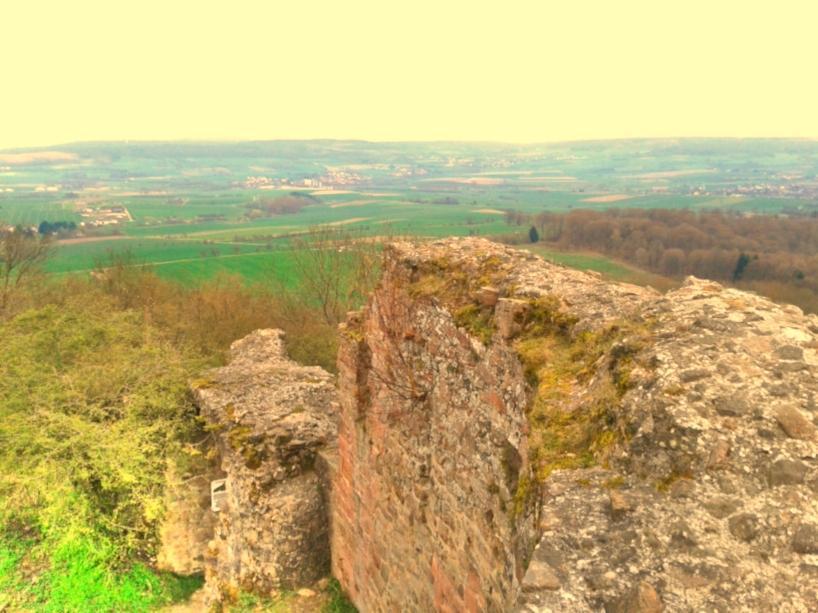
On Sunday we enjoyed a delightful company, almost 100 people, though by a long shot not all our better society. The setting was heavenly, out in the open countryside with tall oaks towering over us at the foot of the Frauenberg castle and with a view so heavenly it simply defies description — we ate under tents, everything free and easy and sumptuous. [1]
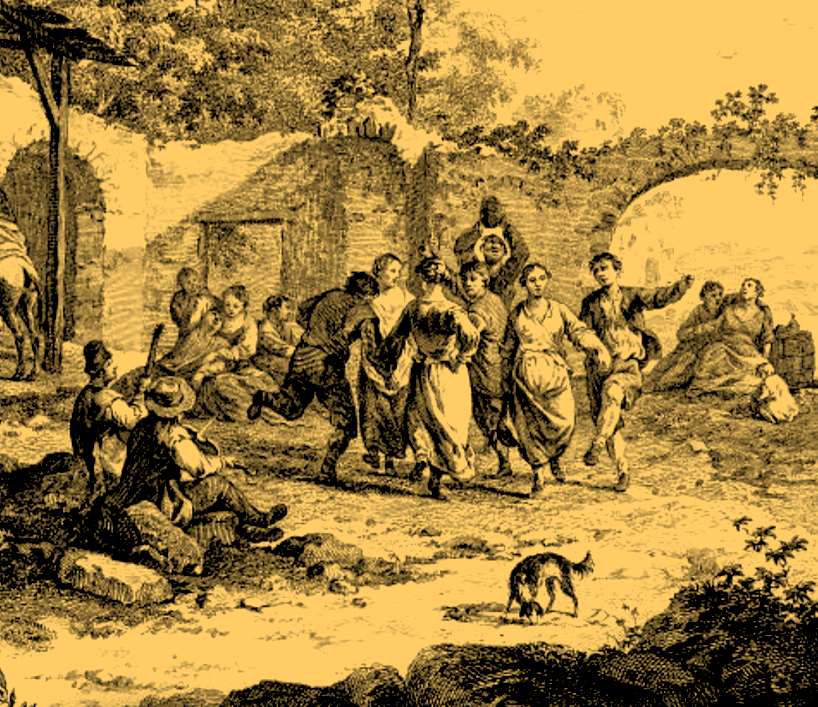
During the afternoon, when the farmers assembled, the girls were drawn into the dancing; the gentlemen borrowed farmers’ smocks, which fit some of them quite well, especially the diminutive Count Degenfeld. [2] Saturnalias were celebrated that came close to being Bacchanalias, though they stopped just in time. [3]
Will Louise ever smarten up? [4] such wretched pushiness is the source of all ill. Here there is a little mamsell who is exactly the way Louise was at the age of 12 — I can almost see her — she was wearing farmer’s clothes at the celebration and was certainly pleased enough with herself in it. [5] Only tell Madam Dahme that nothing will come of all their projects, not even if they were to sharpen them to the point that they would fit through the eye of a needle. [6]
Give my regards to Louise. I will not budge from here — I tremble at the very thought of returning [to Göttingen] — it is enough to have overcome things once, and the victor may have exhausted her strength. I do not want to see anyone again — not there. Poor dear. Poor sister. My regards to Tatter — he will, I hope, not be imagining I will write him today — or in the future either. But tell him I do have all his letters, including the one today. [7] Adieu, dear.
Notes
[1] Caroline is writing on Wednesday, 18 August 1790; the preceding Sunday would have been 15 August 1790.
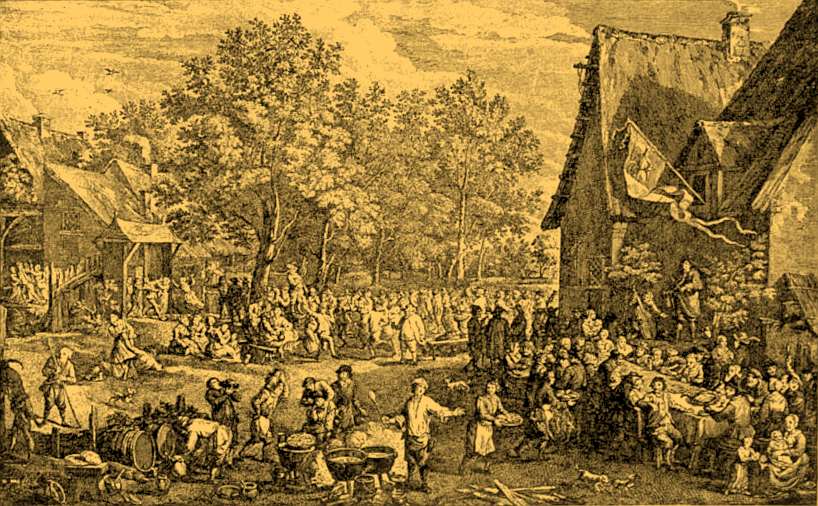
Here a rural village “picnic” with tables, food, and dancing of the sort on which Caroline and her friends’ outing was essentially modeled (Deutsches Leben der Vergangenheit in Bildern, vol. 2 [Jena 1908], no. 977):
Here the Frauenberg Castle ruins in an illustration from 1788 — the year before Caroline is writing; the illustration includes the grove of towering trees at the foot of the castle just as she describes (Joseph Friedrich Engelschall, etching by Johann Ludwig Stahl; Hessisches Staatsarchiv Marburg, Slg 7/c 333):

Here the “heavenly” view from the Frauenberg ruins today (photo: Martin Reulecke):
[2] Either Gustav Eugen Friedrich Christoph von Degenfeld-Schonburg (or Schomburg) (1764–1807) or his brother, Friedrich Christoph Graf von Degenfeld-Schonburg (or Schomburg) (1769–1848). See Wilhelm von Humboldt’s diary from Marburg in September 1788 (Gesammelte Schriften, vol. 14, Tagebücher 1, ed. Albert Leitzmann [Berlin 1916], 24):
At the ball I made the acquaintance of Count Degenfeld, who, as I was told and as his external appearance suggests, is a good and knowledgeable person. He is now going to Wetzlar, where he will be employed at the Imperial Superior Court.
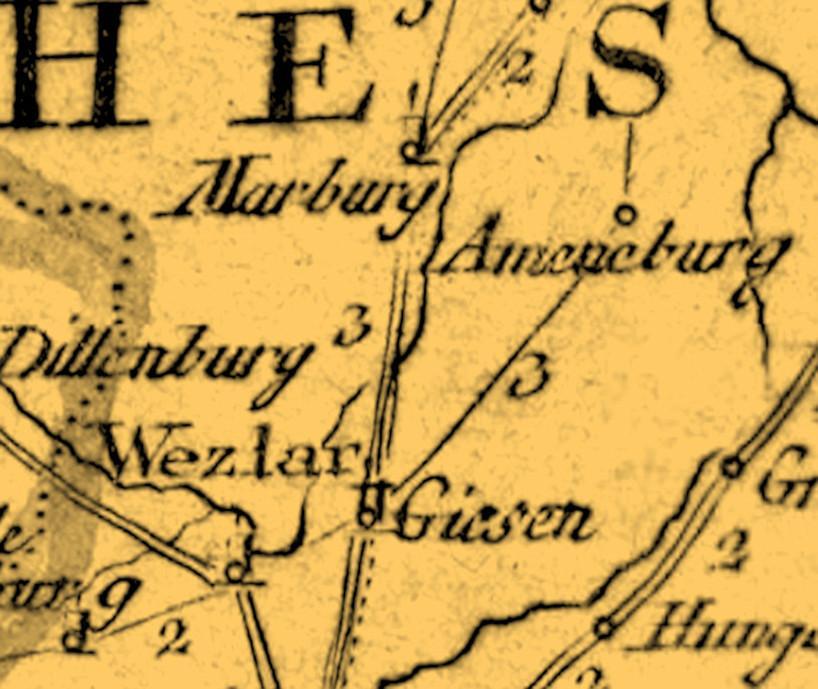
Wezlar (today: Wetzlar) is located just southwest of Marburg (Post Karte Durch ganz Deutschland, ed. J. Walch [Augsburg 1795]):
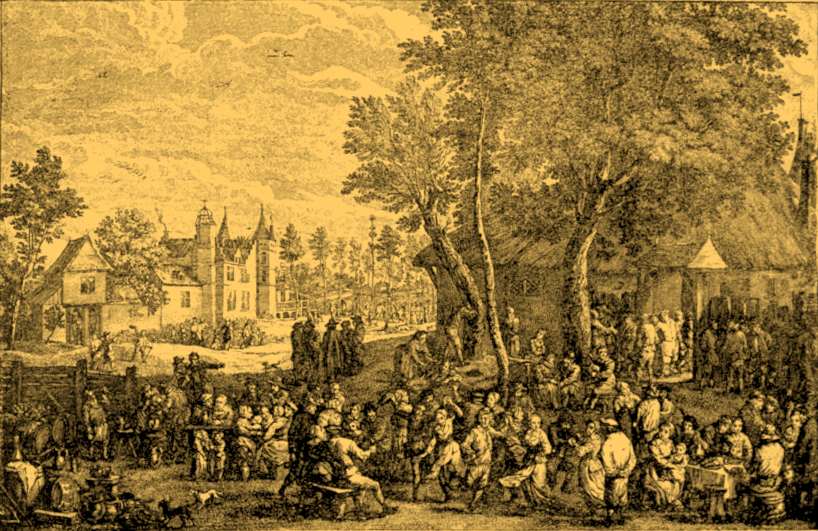
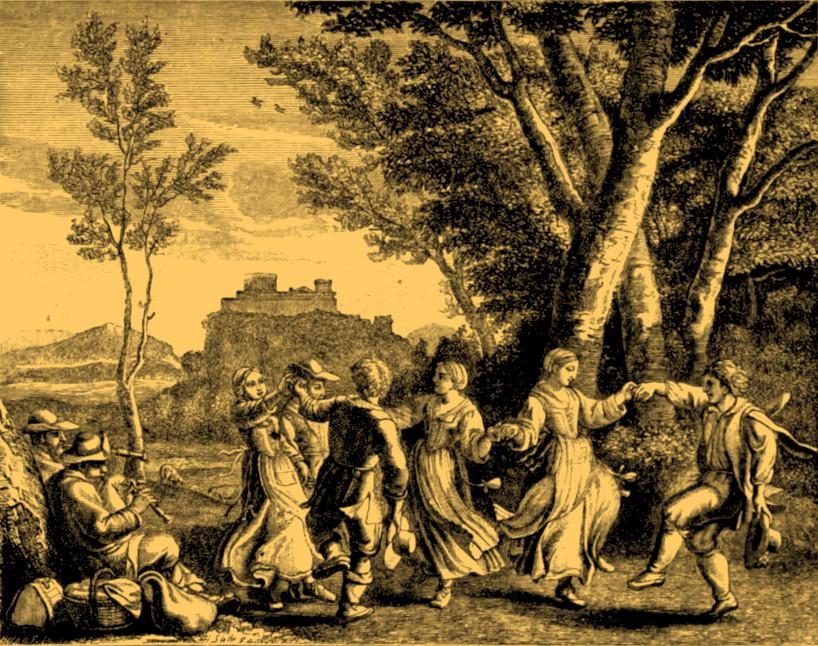
[3] Here an illustration of a “peasants’ dance” in a village during the late-eighteenth century (Deutsches Leben der Vergangenheit in Bildern, vol. 2 [Jena 1908], no. 976):
The illustration by Dutch artist Gerard Valck, Danse en branle (1651–1726; Herzog Anton Ulrich-Museum, Signatur GValck Verlag AB 3.9) approximates Caroline’s description here, the difference between “Saturnalia” and “Bacchanalia” presumably being that between merely “wild” and, on the other hand, “drunken” revelry:
Concerning Caroline’s description of the rural dress, see Joseph Wagner, Volksfest (1706–80; Herzog Anton Ulrich-Museum, Signatur JWagner WB 3.2):
[4] Uncertain reference; presumably Luise Michaelis rather than Louise Böhmer, since Caroline goes on to recall “Louise’s” personality at twelve years old, i.e., more in the fashion of a family memory. Back.
[5] As seen above, society dancing was generally quite different from “country dancing,” thus also the title of the following more sedate illustration of “dancing entertainment in the country” by Daniel Nikolaus Chodowiecki, Tanzvergnügen auf dem Lande (1801) (Herzog Anton Ulrich-Museum; Museums./Signatur DChodowiecki-Kopie Z AB 3.22):

[6] Uncertain reference. Back.
[7] Regrettably, Georg Tatter’s correspondence with Caroline seems no longer to be extant, a great loss insofar as she seems later to have had a genuine romantic interest in him. Back.
Translation © 2011 Doug Stott