
258w. Auguste Böhmer to Luise Wiedemann in Braunschweig: Jena, 30 March 1800 [*]
Jena, 30 March [1800]
Unfortunately, my dear aunt, I cannot yet deliver the good news you were so eagerly hoping to receive. Even though Mother’s nervous fever has passed, she now has extremely severe cramps that are causing her to suffer greatly, probably the result of the excruciating pain caused by the mustard plaster.
Two nights ago was the first time she has slept even a little in 7 nights, but then she spent last night again quite sleepless, and in general she is not doing as well today as yesterday and the day before, her cramps are more violent, and just now she even suffered a mild fainting spell. [1]
But Hufeland says it is absolutely nothing to worry about and that the cramps were diminishing even though they were not abating entirely, and that probably even more such spells were to come. But he is nonetheless hopeful that in a few days Mother will again be able to go out for a ride and that once she is that far along things should improve very quickly.
Baths and opium are almost the only treatments that help Mother somewhat. She has to bathe twice a day, and yesterday, when she could not sleep at all, she also bathed at night, but it did not really help her sleep, though it does considerably ease her cramps. Today it has already been 4 weeks since she has been this sick, it really has been simply too much and has to improve soon or we will all surely perish.
Winkelmann, who is taking this letter along with him, will perhaps be able to tell you more about the course of the illness, since even though he himself has not seen Mother, as a physician he has doubtless been informed by the others. He is also bringing along for you a copy of Wilhelm’s poems. [2]
Madam Hufeland already had someone inform us about the death of Madam Stargard, [3] just as in general she is always so kind; she recently sent Mother some jelly, and also made it known that should it not excessively disturb Mother, she would probably come visit her. [4] But she, too, has a burden to bear at home, since Sophie has been extremely ill, so much so that they have not yet been able to tell her about Madam Stargard’s death.
The Mumme arrived safely and was consumed quite with an eye on good health; everyone was extremely pleased with it. [5]
Although the Tischbeins are indeed still in Dresden, at Easter they will be moving to Leipzig, so if we go they will no longer be there. Once Mother is healthy again, Aunt Ernst from Dresden will come stay with us and have her child inoculated here. [6]
Everything you write about your little Emma is absolutely superhuman; what a Wunderkind she must be, I would certainly like to see her sometime. You could similarly tell her all about cousin Utteline, and about how fond she is of her, and then when she heard something about me, she would also say “Dear” just as you do about poor Aunt Schlegel, who is so ill just now. By the way, she sends her warm regards to all of you and asks that you please not worry too much, that she will soon be better. But you should send Emma to us sometime, since she would very much like to see her.
But now I must close, dear Luise; Mother is going to her bath, and Winkelmann wants the letter. Regards and kisses to everyone! and I kiss my dear grandmother’s hands. [7]
Your obedient niece,
Auguste B.
Notes
[*] Source: Waldemar von Olshausen, “Neues aus dem Caroline-Kreis,” Euphorion 28 (1927), 350–62, here 351. Olshausen writes in his introduction to the letter (351):
The documents [of Luise Wiedemann] also contain a letter from Auguste Böhmer to Luise Wiedemann on 30 March 1800. It should be positioned before Auguste’s letter to Luise Gotter on 31 March [letter 259].
Though it contains nothing particularly significant [!], it is nonetheless an extremely characteristic expression of the precocious, charmingly agile spirit of this unique child, whose death a few months later some quite serious men, probably none more than her stepfather Wilhelm Schlegel, would with considerable melancholy mourn along with her mother, the latter having been struck at the very center of her being by Auguste’s death.
The opportunity to compare this family letter to an aunt with the more formal letter of the following day to her motherly friend Madam Gotter [letter 259] is especially attractive.
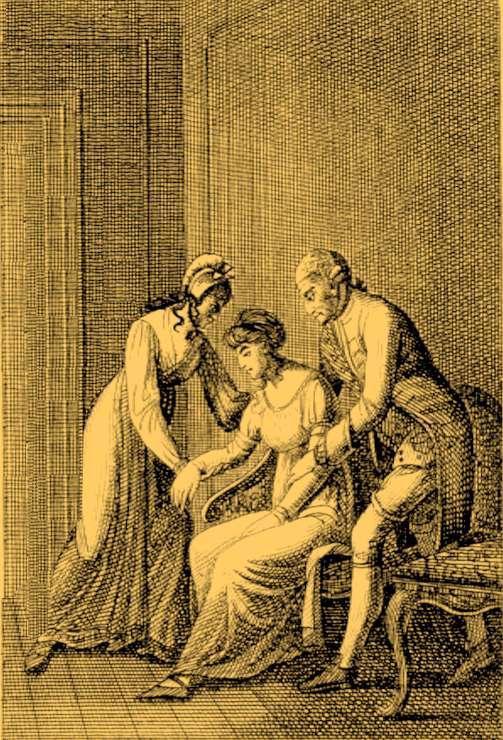
Virtually all the letters in this present edition during March and April 1800 discuss the course of Caroline’s illness, its symptoms, and the various treatments (illustration from Christophe Schmid [Christoph von Schmid], La guirlande de houblon [1836], Oeuvres choisies, vol. 4, new ed. [Tours 1867], plate following p. 262):

[1] Genealogischer Kalender auf das Jahr 1810; Inhaltsverzeichnis deutscher Almanache, Theodor Springmann Stiftung:
[2] Gedichte (Tübingen 1800). Back.
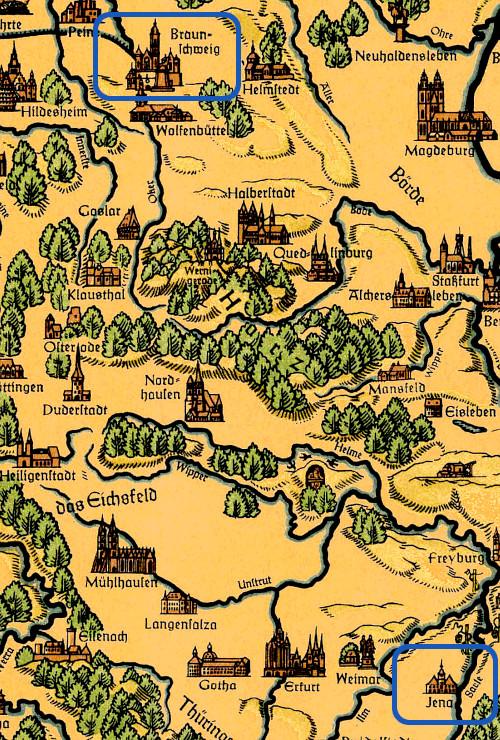
[3] Unidentified (presumably spelled “Stargardt”), from the context an acquaintance of the Wiedemann family in Braunschweig (Rudolf Koch and Fritz Kredel, Deutschland und angrenzende Gebiete [Leipzig 1937]):
[4] Here “jelly” (Gelee) refers to a congealed meat gravy, at the time also commonly known as Gallerte, generally considered more nutritional than simple meat and easier on the stomach; see Adelung s.v. Gelee, and The New and Complete Dictionary of the German and English Languages, composed chiefly after the German Dictionaries of Mr. Adelung and of Mr. Schwan, 3 vols. (Leipzig 1796–99), vol. 3, s.v. Gallerte.
Auguste’s report that Madam Hufeland had brought Caroline a gift and was even thinking about visiting her is perhaps rather surprising, since in her letter to Johann Diederich Gries on 27 December 1799 Caroline had written that “since Schlegel’s break with the A.L.Z., we do not even see our closest neighbors [the Hufeland’s across the courtyard] anymore,” something Wilhelm had then confirmed in his own letter to Gries on 16 March 1800 (letter 258r): “We still, by the way, are not seeing the Hufelands socially at all now.”
That said, Auguste is recounting this news to Luise Wiedemann because Madam Hufeland, of course, was Luise’s sister-in-law, a fact that likely influenced the latter’s more kindly gestures toward Caroline at this time despite the break between the families. Back.
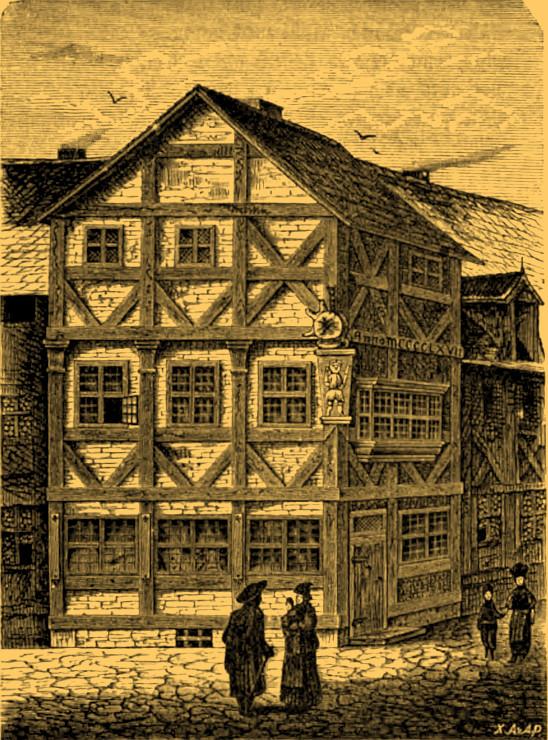
[5] Mumme, or mum, mom, named for Christian Mumme, who first brewed it in 1492: a strong-hopped Braunschweig specialty beer suitable for shipping longer distances (it was shipped as far as India). Allegedly tasted like stout beer but with a sweetish liquorish flavor; the beer even prompted various drinking songs in Braunschweig. Here Christian Mumme’s house in Braunschweig (Vaterländische Geschichten und Denkwürdigkeiten der Vorzeit der Lande Braunschweig und Hannover, ed. Wilhelm Görges, 2nd ed. ed. Ferdinand Spehr [Braunschweig 1881], 1:71–78, here 73; verse ibid.):
Thou all-beloved Mummken beer,
How glad am I your name to hear!
When by that house I lively stride,
I sing, "Dear Mummken lives inside!"
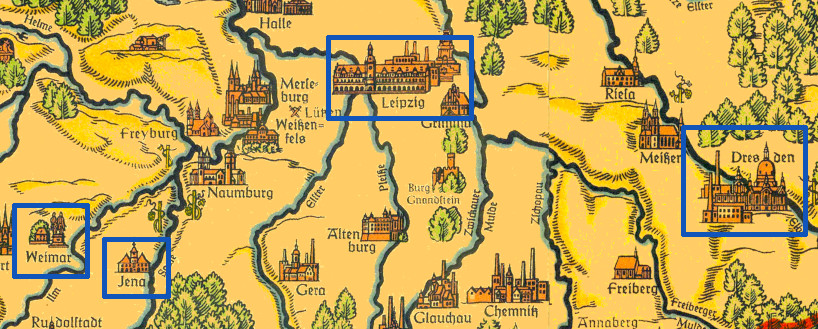
[6] Charlotte Ernst’s visit never materialized, much to Dorothea Veit’s chagrin, among others, who had not yet met her (Rudolf Koch and Fritz Kredel, Deutschland und angrenzende Gebiete [Leipzig 1937]):
[7] Schauplatz der Natur und der Künste, vol. 5 (Vienna 1777), plate 47:

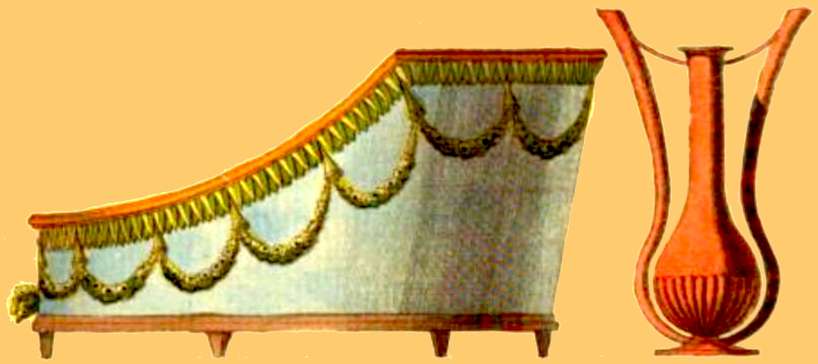
Illustration of a metal bathtub on a wooden frame from 1799 along with a flask for heated coals that is dipped into the tub to warm the water (Magazin für Freunde des guten Geschmacks, vol. 5, no.1, “Ideen zu Zimmerverzierungen,” [Leipzig 1799], figures 29 and 30):
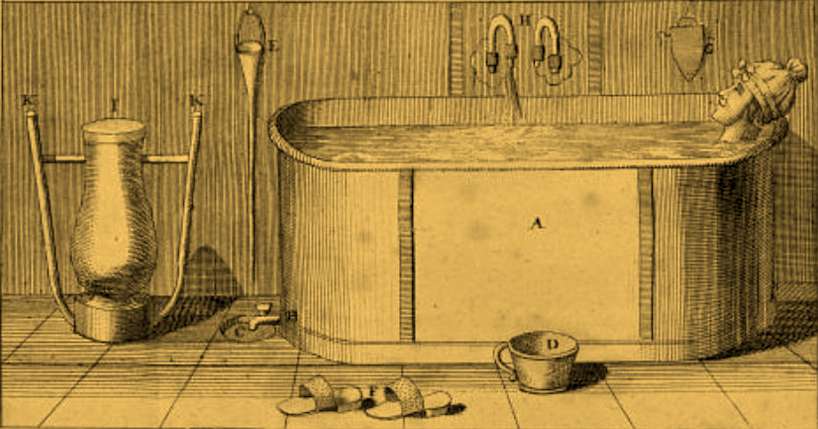
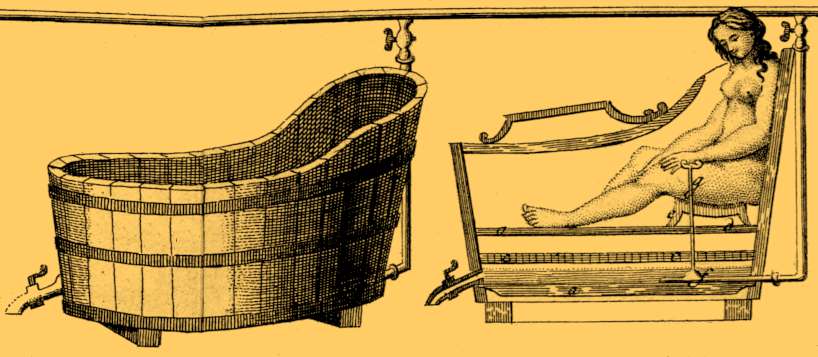
Illustrations from slightly earlier (1769) and later (1817) of a standard home bathtub at the time, the second experimentally fitted out as a steam bath ([1] Schauplatz der Natur und der Künste, vol. 8 [Vienna 1769], plate 5; [2] I. G. Dingler, Oekonomische Dampf-Apparate zum Kochen Darren u. Heitzen [Augsburg 1817], plate iv):
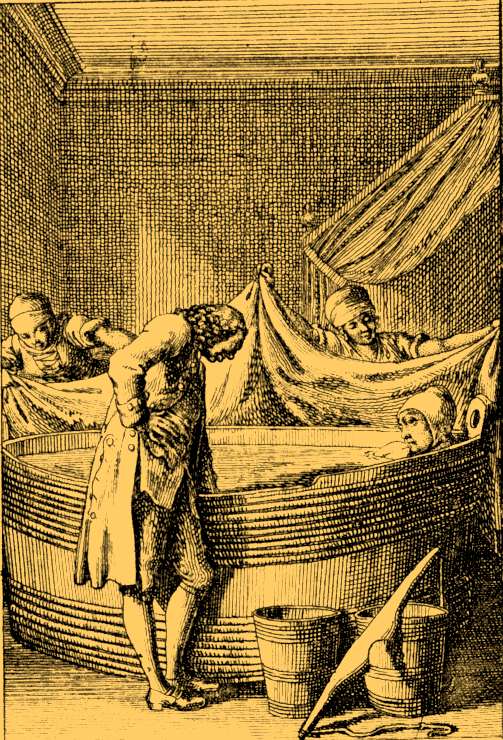
And a larger version (Daniel Nikolaus Chodowiecki, Österreichische Nationalbibliothek, Signatur/Inv-Nr. LAV 454/15904 POR MAG):
Otherwise concerning Auguste’s remarks: According to Dorothea Veit in her letter to Schleiermacher on 17 March 1800 (letter 258t), Schelling had “badgered” Christoph Wilhelm Hufeland, Caroline’s personal physician in Jena whom Auguste mentions above, into abandoning his anti-Brunonian method of treating Caroline in favor of implementing some of John Brown’s principles.
Hufeland, however, during an age when medicine was an imprecise science at best and dangerously unpredictable at worst, was consistently intent on establishing effective medical principles for treatment based on objective, tested, and reliable procedures, a posture that made him increasingly mistrustful of the Brunonian method and increasingly put him at odds with its adherents, including Schelling here.
Concerning the use of baths as described by Auguste in this letter: Back in 1790, Hufeland had published the article “Nöthige Erinnerung an die Bäder und ihre Wiedereinführung, in Teutschland; nebst einer Beschreibung der Rußischen Dampfbäder,” Journal des Luxus und der Moden 5 (1790) July:377–405, tracing the history of baths in German homes, the ill-advised abandonment of their use, and presenting copious reasons for their reintroduction, benefits, and effective, safe home implementation to address a plethora of maladies, some of the latter of which, however, he astutely viewed as being as much products of the age as of genuinely physical causes.
It is doubtless in this spirit that an anonymous author of an obituary for Professor Frederick Albrecht Charles Gren in Halle (1 May 1760–26 November 1798) referred to the frequently mentioned illness of “nervous fever,” the illness from which Caroline was ostensibly suffering, as “the endemic disease of the German literati” (“Medical and Physical Intelligence,” The Medical and Physical Journal etc., ed. T. Bradley and A. F. M. Willich, 1 [March–July 1799], no. 11 [April 1799], 206).
A revised edition of Hufeland’s original article was published, perhaps not merely coincidentally, just a year after he treated Caroline, in his book Dr. C. W. Hufelands nöthige Erinnerung an die Bæder und ihre Wiedereinführung in Teutschland nebst einer Anweisung zu ihrem Gebrauche und bequemen Einrichtung derselben in den Wohnhäusern, ed. F. J. Bertuch (Weimar 1801). The book’s editor, Friedrich Justin Bertuch, remarks in his introduction (ibid., 3):
During the past eleven years, we have together had the frequent experience that although everyone talks about the importance of home baths, they nonetheless do not themselves use such baths, invariably excusing themselves with references to the difficulty in integrating such into daily life, preferring instead to continue being ill or sickly rather than pursuing some easier means of attaining such a goal.
Hufeland then writes as follows in part of his discussion of the various maladies for which home baths, properly undertaken, offer a measure of amelioration (ibid., 13–15):
At the top of the list we find the ills of gout and all the variations of so-called rheumatism, all of which have never been as widespread or attested in so many variations or been as tightly integrated into our physical constitution. Such “gout,” instead of being a specific, rare malady, is now a condition of valetudinary sickliness that from youth onward becomes a teasing, wildly varying, distorted element in a person’s constitution. Rather than constituting a physical illness associated with external features and the more obvious organs, it has now become a fleeting but subtle toxin that haunts our most sensitive emotional organs and nervous system, indeed our very soul.
One hardly hears about the venerable maladies of podagra and chiragra of the sort our forefathers experienced. Instead, our society seethes with “head gout,” “nervous gout,” “stomach gout,” etc.; no social class, not age group, no lifestyle escapes this development.
The first malady that joins this array, one with extremely severe consequences, is the incredibly enhanced sensitivity to any and all changes in the atmosphere, or rather an enduring, palpable connection with the influence of that atmosphere. It is not enough that a person is far more sensitive than otherwise for even the slightest changes in temperature, now we even have persons who in a closed room, indeed even in bed can precisely describe what the weather outside is, from which direction the wind is blowing, etc.
That is: living barometers who, consulting solely their own physical disposition and far better than artificial barometers, are able to indicate not only present atmospheric conditions, but also forecast future changes, and who — I would never have believed it had I not myself so often witnessed it — can sense internally when a cloud passes over them, a talent attested solely in our age, and which would amaze our cherished forefathers without, however, prompting them to envy. . . .
Just as characteristic of our age, and even more tedious, are the ubiquitous maladies of the nervous system and hypochondria: terrible, creeping plagues that poison not only our physical well-being, but also our peace, contentedness, and the overall positive disposition of our soul. Without constituting mortal illnesses, they nonetheless transform our lives into an unbearable burden and make us yearn for death without granting it. They rob even young men and women of the pure pleasures of life and existence. They turn the otherwise horrible question of “What is the use of living?” into one that is asked daily. They cripple strength and activity in even the best minds, generate darkness, emptiness, and insensibility and apathy in even the most noble of hearts and amid even the purest enjoyment of human happiness, and — unbeknownst, concealed — create the living dead. And finally, they dispel hope, open-mindedness, trust, courage, and steadfastness, and instead spread ill-will, disharmony, and a weariness of creation itself.
The list of all the variations of these maladies has no end. Suffice it to say that as sublime as the expression of these maladies may indeed occasionally appear, on the whole their causes can generally nonetheless be traced back to specific physical conditions, and that insofar as they have become so predominant concurrent with the variations of gout mentioned above, and insofar as experience shows that they often alternate within one and the same person and indeed even coalesce, — that it is highly likely that they are also of one and the same nature and derive from one and the same primary source that is characteristic solely of our own present age.
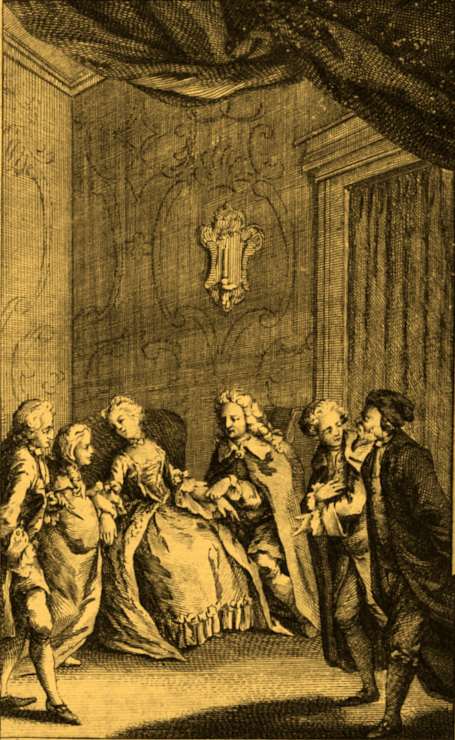
The Caroline-biographer Eckart Klessmann remarked in September 2009 in Maulbronn in connection with an oral presentation at the commemoration of the two-hundredth anniversary of Caroline’s death that one of the recurring patterns in Caroline’s life was, simply put, to fall ill, sometimes gravely so, in times of personal crisis, in at least two instances (and intimated elsewhere) in connection with nervous fever (see also Julie Gotter’s letter to Luise Gotter on 18/21 August 1801 (letter 327d.1) (illustration: Carlo Goldoni, Des Herrn Carl Goldoni sämmtliche Lustspiele, vol. 2 [Leipzig 1768], following p. 328):
At the same time, Wilhelm remarks to Goethe on 23 March 1800 (letter 258v) that Caroline was drinking “constant servings of Hungarian wine” as a Brunonian “fortifier” “as the only aid for her exhausted strength,” a fortifier, moreover, “which she has had to use to an extent she would otherwise, in a normal, healthy condition, not at all have been able to tolerate.”
These remarks beg the question of the extent to which Caroline’s nervous fever was indeed “the endemic disease of the German literati” as described not least in her own physician’s remarks concerning how physical and emotional maladies can “coalesce” “within one and the same person.” Auguste similarly reports that despite Caroline’s ostensibly severe symptoms (cramps, fainting), Hufeland was maintaining that there was “absolutely nothing to worry about,” and notwithstanding that “even more such spells were to come,” Caroline would likely soon improve, and that “once she is that far along things should improve very quickly.” Clearly, for some reason Hufeland was not as concerned about Caroline’s condition as either she or her housemates.
At the same time, however, and considering Eckart Klessman’s observations, Caroline’s “constant servings of Hungarian wine” “to an extent she would otherwise, in a normal, healthy condition, not at all have been able to tolerate,” were clearly addressing her exhausted emotional condition rather than fortifying her physical strength in what for her was a time of extreme marital and relational crisis.
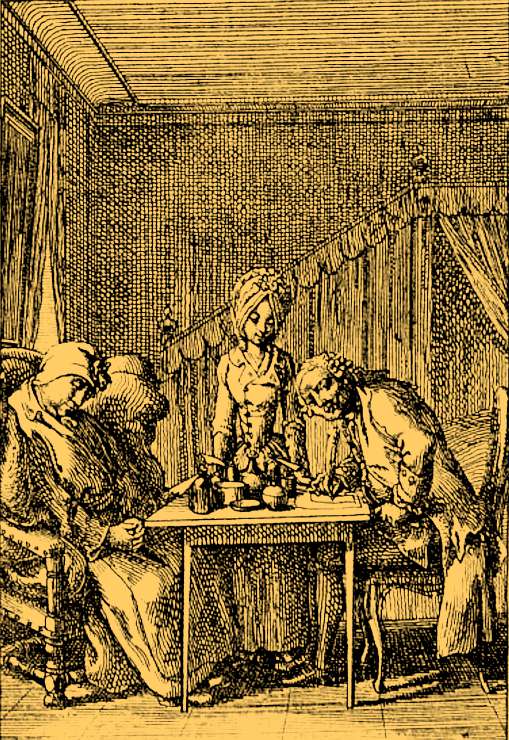
The phenomenon of hypochondria, of course, was certainly otherwise familiar at the time. The following illustration portrays a physician — wryly — prescribing medications for a hypochondriac, presumably inspired by Molière’s Le malade imaginaire (1673) (Daniel Nikolaus Chodowiecki, Artzney-Narr [1782]; Herzog Anton Ulrich-Museum; Museums./Signatur DChodowiecki AB 3.513; orig. published in the Goettinger Taschen Kalender vom Jahr 1783 [1782]):
Translation © 2013 Doug Stott