
259r. Friedrich Schlegel to Schleiermacher in Berlin: Jena, 5 May 1800 [*]
Jena, 5 May 1800
Finally, my friend, it is time to write you a detailed and thorough letter. I was in Weimar, Hardenberg was here, we accompanied him, Caroline has departed. [1] All this alongside the usual permanent excuses will probably suffice. Dorothea must be excused simply because she is still occupied with finishing the first part of Florentin. [2] . . .
When I was in Weimar, I spent considerable time with Friedrich Richter and got on with him quite well. He is unfathomable, indescribable, and inordinately, extravagantly upright, and will be pilgrimaging very soon to Berlin, where he has quite tormented me to relate to him the names of interesting women. With anxiety in my soul, I finally also mentioned Madam Herz to him; she will doubtless not find it wholly unpleasant should he genuinely visit her.
I also advised him to visit you, since he already generally knows what the world is saying about you. As a trial I also gave him a copy of the Monologen to read; I do not at all regret it, since he spoke not entirely without understanding and even quite movingly especially about the passage concerning when friends die etc. [3]
That said, however, he sniffs hidden Fichteanism everywhere in your work, and that is precisely the nerve where his understanding senses the presence of ghosts. It is simply too bad that he keeps such ill company, company that is quite ruining him. With us he really would be able to become young again. [4] —
Hardenberg was not here long enough to read the Monologen, so I gave them to him. — Ritter believes they are even more sublime and sacred than the Reden, whose rather sumptuous style, by the way, sooner repels than attracts him. —
Well, there you have a whole collection of experimental results with which you can now experiment yourself! . . .
The answer from Dorothea’s mother arrived, which I am enclosing for you. [5] Given this answer, Dorothea cannot very well return to Berlin now, something of which she will also inform Veit in a few days as soon as she has finished Florentin, though she does ask that you yourself, should you not already have done so, wait until you receive her next letter. [6]
Charlotte has invited us to Dresden, and I think we will probably accept the invitation. [7] The only problem is the toll; but I spoke with Hardenberg on the matter, and I do not think there will be problems. [8]
Then you must definitely visit us this summer, since Dresden in any case has so much to offer you that is new and beautiful. I myself would very much like, were money and time not a problem, to come to Berlin for 4 weeks in the autumn. But since I am greatly lacking both at the moment, that visit will probably have to wait until better times. . . .
Notes
[*] Sources: Aus Schleiermacher’s Leben 3:172–77 (frag.); KGA V/4 18–24; KFSA 25:104–7. Back.
[1] Friedrich was in Weimar on 28 and 29 April 1799 with the intention of seeing Goethe, though the latter had already left for Leipzig (Rudolf Koch and Fritz Kredel, Deutschland und angrenzende Gebiete [Leipzig 1937]):

Friedrich von Hardenberg stopped in Jena around 1 May on his way to Tennstedt on business, and Caroline and Auguste, possibly with a maidservant, left Jena for Bamberg on 5 May (Schelling had already left on 2 May and was awaiting them in Saalfeld). Back.
[2] Dorothea’s novel, Florentin. Ein Roman herausgegeben von Friedrich Schlegel, vol. 1 (Leipzig 1801). Back.
[3] Schleiermacher’s anonymously published, ethically focused Monologen (Berlin 1800), which had appeared just after the turn of the year in 1800. The piece develops an ethically transfigured understanding of individuality that is at once also nourished by the notion of community. Eng. trans. by Horace Leland Friess, Schleiermacher’s Soliloquies: An English Translation of the Monologen, with a Critical Introduction and Appendix (Chicago 1926).
Here, albeit not accompanied by its entire context on friendship, is the passage to which Friedrich is referring (ibid., 86–87):
Ah, what is death, but a greater distance?
Sombre thought, that implacably shadows all meditation upon life and the future! I can assert that death will never part my friends from me, for I take up their lives in mine, and their influence upon me never ceases. But it is I myself who slowly perish in their death. The life of friendship is a sequence of harmonizing chords, to a keynote which dies out when the friend passes away.
Of course, within oneself reechoing tones are heard without cease for a long while and the music is carried on; but the accompanying harmony in him, of which I was the keynote, has died away, and it was this that gave me my key, just as I gave him his. What I produced in him is no more, and thereby a part of my life is lost.
Every creature that loves another kills something in that other through its death, and he who loses many of his friends is finally slain himself at their hands, since cut off from influencing those who were his world, his spirit is driven inward and forced to consume itself.
There are two cases in which man’s end is inevitable. He must perish for whom the death of friends has irretrievably destroyed the balance between the inner and the outer life. And he too must perish for whom this balance is otherwise destroyed, he who has attained the perfection of his individuality, and in whom, therefore, no further activity is essential, even though he be surrounded by the richest of worlds. A completely perfected being is a god, it could not endure the burden of life, and has no place in the world of mankind.
Death, therefore, is a necessity, and may it be the mission of my freedom to bring me nearer to this necessity. May it be my highest goal to be able to wish to die! Back.
[4] “With us” is referring to the Romantic circle in Jena; it may be recalled that Friedrich was not always so positively inclined toward Jean Paul (see Caroline’s letter to Friedrich on 14/15 October 1798 [letter 204]; Wilhelm Schlegel’s letter to August Ferdinand Bernhardi on 30 September 1799 [letter 245a]). Back.
[5] In a letter to Schleiermacher on 17 March 1800 (letter 258t; text not included there), Dorothea mentions having written to her mother, Fromet Mendelssohn, regarding several tense issues, including converting to Christianity (Briefe von Dorothea Schlegel an Friedrich Schleiermacher 45; KGA V/3 428; KFSA 25:76):
I wrote my mother and told her straightforwardly about everything. Courage has never yet incurred guilt for anything bad, but I am increasingly coming to detest half measures; if she is reasonable, eh bien — but if she chooses not to accommodate herself, then I will never see Berlin again, period! Back.
[6] During early 1800, Dorothea had written on several occasions about returning to Berlin during the spring or summer. See her letter to Schleiermacher on 14 February 1800 (letter 258m) with note 1. Back.
[7] Rudolf Koch and Fritz Kredel, Deutschland und angrenzende Gebiete (Leipzig 1937):
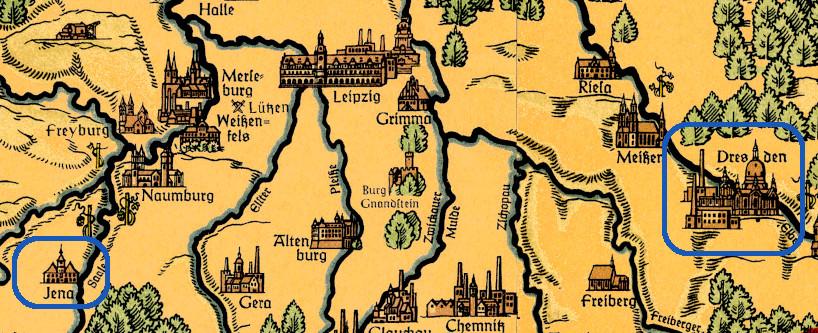
[8] The Jewish toll (Germ. Leibzoll), to be paid by Jews when crossing territorial customs borders to ensure their safe conduct and physical safety. Because the tax was also required for livestock, it was understandably often viewed as undignified. Perhaps Hardenberg had agreed to advance them the money (KFSA 25:452fn27). In a letter on 10 July 1800, Schleiermacher expresses his surprise concerning Friedrich’s decision in the matter (abridged in Aus Schleiermacher’s Leben 3:204; KGA V/4 148; KFSA 25:139):
Tiek told me something else I do not understand — namely, that you did not really write to Hardenberg concerning the Jewish toll, and yet it would have been a trifle for him to have taken care of [cover] it [or: circumvent it]. So was it for that reason that you changed your decision [to go to Dresden]?
Schleiermacher uses the German verb auswirken, which according to Grimm, Deutsches Wörterbuch 1:1019, could in such context mean either “ausrichten, erlangen, bewirken” in the sense of “bring about,” or “bring into line” — perhaps Hardenberg would have covered the payment himself — or “entledigen” in the sense of absolve, viz., circumvent it and thereby absolve Dorothea of the associated shame (see KFSA 25:481fn25).
In any event, Caroline herself mentions the toll in connection with Dorothea in her letters to Wilhelm on 8 March 1802 (letter 352) and Julie Gotter on ca. 11 March 1802 (letter 354), in the latter of which she seems to assume that Dorothea did genuinely have to pay the toll. Back.
Translation © 2014 Doug Stott