
259s. Dorothea Veit to Schleiermacher in Berlin: Jena, 15 May 1800 [*]
[Jena] 15 May 1800
Although our postal day is not until tomorrow, I am writing today because I simply do not feel like working.
The first part of Florentin is now finished, and I am valiantly copying it out. Friedrich has for all practical purposes come to terms with Bohn about Florentin. [1] I will be losing nothing for Unger having not accepted it. It will now probably not be published before Easter 1801, and then in its totality, in all three of its volumes; if such be the case, I will send you the manuscript beforehand if possible so you can enter things in the margins for me that might be useful and salutary for the novel. Bohn quite voluntarily offered to pay me 200 rth. straightaway at Michaelmas, and in other respects as well has offered us the most gallant conditions with respect to format and printing; I for my part will do what I can to ensure that this man be kept and treated well, for he is certainly being inordinately cordial toward us. . . .
Karoline has left, and since Wilhelm is in Leipzig, we are the unrestricted lords here now. [2] But do not ask me for much in the way of details about this story, for it is too tangled, and anyone who was not there in person does not know the whole story and indeed cannot know it. —
You may well be right with respect to my harsh judgment concerning Caroline’s mind and intellect; [3] Friedrich is of the same opinion. I was incorrect in the larger sense; the intellect or spirit was the most important thing for me, not the understanding, which I overly confused with cleverness.
But my own initial judgment [4] cannot be cited against me; at that time, I really was simply too overwhelmed by so many happy feelings to have much room left for the mistrust that did indeed creep up on me precisely during that initial period (and precisely concerning her intellect); the things that did not really seem so clear to me I considered to be a result of my own ponderousness and lack of understanding; and certainly because at the same time I felt quite beholden to her because of how she received me, I simply closed my ears to any disapproving remarks.
But her illness has not depressed her in the least; quite the contrary, she has emerged with even sharper edges insofar as the grace that earlier softened her personality has quite abandoned her. Her own judgment, whether of people or of works of art, is always guided by her petty interests and intentions, which is also why I do not really put much trust in her sense for poesy, for she has often enough talked abundant nonsense on the subject, and in the sharpest, most cutting tone.
So you yourself concur that Signora Zarticosa correctly describes the spirit of her artistic judgment. [5] She understands nothing of Friedrich’s work, and certainly absolutely nothing of Friedrich himself. And though she may well possess wit and intellect and spirit and life, there is no fullness or richness in any of it; in any case, her heart is certainly not overflowing with such. Instead it is all securely stored away in a safe, cool place, with clever, frugal economy, whence at the right time it is then engaged for coquettish ends. As soon as she is no longer pursuing any particular goal by being obliging, she ceases being so. And so her character is coquettish and profound, while her intellect and mind is prudish and superficial. —
It is absolutely, completely undignified for a woman of the sort she represents, with all the life experiences she has had, not even to have learned enough tact to realize that Wilhelm is in fact not a convenient husband, and that Schelling cannot be cultivated or refined by love (at least not through happy love). Although one would certainly expect her to pursue her goal with considerable skill and deftness, such is in fact not the case at all; instead, she quite unknowingly departs from the path she originally had in mind, and then suddenly, together with her pupils, finds herself right at the brink of the abyss.
She will doubtless not be happy with Schelling any longer than she was with Wilhelm; for she won him only with considerable artifice. He had a resolute disinclination toward her just as he does toward all intelligent, distinguished women; so how can she possibly believe that a creature so predestined for crudeness will take on a different nature simply for her sake (for she was quite aware of his disinclination toward cultivated women)? How can she mistake a beginner’s passion for love and then surrender herself to it à tête perdu? [6] Something like that is certainly not the sort of thing she should ever have done.
Wilhelm genuinely does still love her and will no doubt continue to love her until some other woman similarly finds it compliant with her own purposes to ensnare him. For Caroline has never loved him! not even when she married him, and he knows it, [7] and yet is wholly inclined to let her flatter and dominate him; but then in his own turn, he cannot refrain from playing the despot toward her publicly, whereas she does the same to him in private — so deeply has he settled down into the husband’s role. Neither he nor she has behaved in a particularly dignified manner in this whole business of theirs.
Her hatred toward Friedrich is actually a result of her belief that he is the reason Wilhelm is against Schelling, and she is quite right, he is indeed also at fault, for I am quite of her opinion that if Wilhelm had not been ashamed in front of Friedrich, everything would have remained quite peaceful and enlightened between the three of them, Caroline would have belonged to the one today, the other tomorrow, and some pretty chambermaid or other, or perhaps even Auguste herself, would have made the marriage en quatre complete. [8] —
But when Caroline explained to Wilhelm what had transpired, Friedrich initially believed everyone else would behave in an equally dignified manner and was extremely opposed to any relationship that was entering with such ponderous steps onto a web so fragile that only French feet might venture there without breaking it.
Moreover, he found it repulsive the way Caroline was trying to keep two men together against their own inclinations [9] (for they squabbled almost daily in the most unpleasant fashion), and urged a complete separation from one or the other. Wilhelm, in order not to be niggardly, pulled himself together more resolutely than she was accustomed to, which is why she was admittedly very dissatisfied with Friedrich for having come up with the idea of infecting his brother with his own energy.
She saw absolutely nothing in his noble personality except his efforts to push her aside with Wilhelm, she did not at all perceive in how dignified a fashion he accepted and treated her. He admittedly was thinking that Caroline would, frankly, be glad to get loose and live for herself, from her own work, whereas she could not have been further from such a notion, considering it a grander triumph to have two men working for her, and, indeed, what sort of figure does the modest opening “dignity” cut compared to the grandiose triumphal arch? [10] —
She kept me, too, away from her room for several days through sheer disagreeableness (Friedrich had not come to see her for several weeks), and she in her own turn used that time to take in Wilhelm entirely for herself again, and to reconcile him with Schelling, the result being that Wilhelm is now utterly unable to see through the deception and instead simply surrenders entirely, out of weakness, or habit, or God knows what negative personality quirk. It never occurs to him that the whole world knows about it and finds him ridiculous, and if anyone alludes to such, he immediately counters with, “Well, if they know everything in any case, then they also know that it was no secret to me, hence no ridicule falls on me”; and if one risks telling him the truth, he immediately tells Caroline, who then has no trouble twisting it in the most spiteful, hateful light and turning it against us.
Hence two days before she herself departed, Schelling had to leave on foot, [11] that is, as if his trip had nothing to do with hers, and yet not only we, but everyone in town knew that Schelling would be waiting for her in Rudolstadt, 6 miles from here, whither Wilhelm would then accompany her and hand her off to him; [12] she has traveled on with him to Bamberg, where she intends to stay until the spa season. [13] Wilhelm cannot even stand it when one of us perchance smiles when, in our presence, he relates with the most serious, imposing expression on his face how “his wife, accompanied by Schelling, has gone to consult Röschlaub“! —
But enough — let me stop now; although I have been kind enough to begin to relate at least some of this information to you, that particular enterprise is in reality as foolish as it is useless. It simply cannot be described so straightforwardly. The whole world, everything that has since appeared in the way of polemical writing in the literary sphere, is part of this whole thing, as either consequence or cause; in a word, if I do not set myself down and present it thoroughly, in a properly organized and motivated narrative, you will simply not be able to understand it, and will not be able to make heads or tails of it.
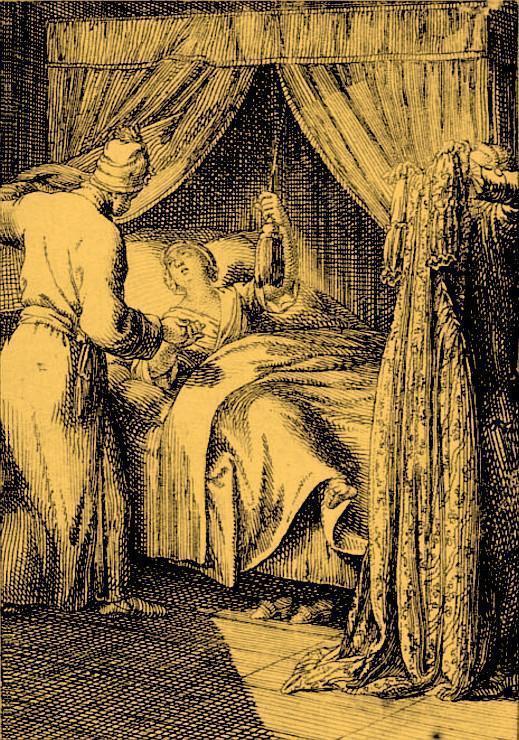
There is no way to determine how much of her illness was real and how much ideal. But this much is certain, namely, that ultimately she could not avoid being brought into a wretched condition by all the horrific remedies poured into her. I would, however, consider it abominable, and thus utterly impossible, that she, who always went on and on so enthusiastically about “nature” and about the “beautiful area” around here, that precisely she would be capable of spending this entire, divine spring in bed, in a closed room, morose, and amid all sorts of disgusting smells and arrangements, merely to create a mask with which she might then be able to exit. [14]
For who would have held her back had she left entirely on her own initiative and of her own free will? Might it also be possible that on top of everything else she could have turned Wilhelm’s sympathy into a motivation for her trip in the eyes of the world? But truly, that would be more than at least I could ever imagine in the way of muck!
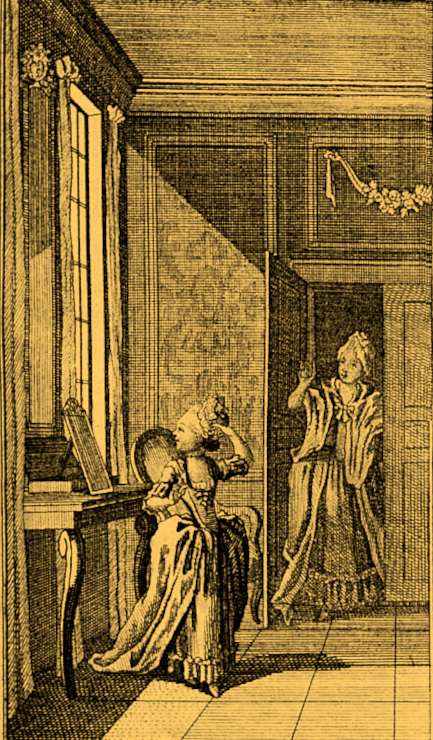
Auguste is an extremely amiable creature who clings to her mother with the most ardent affection — which is precisely also her great misfortune, since she depends wholly on her mother instead of thinking for herself. She has also already been completely ruined, thinks of nothing but her external appearance, [15] believes everyone notices her, loves — as does her mother — the external appearance of energy, thinks constantly about marriage and about the misfortune of ending up an old maid, is utterly incapable of any measure of proper understanding because she has too much genuine, girlish pride, and because she loves only those whom her mother loves, and yet because the latter is more adroit at such things, she quickly attracts all the men to herself, and once little Auguste finally realizes this, she withdraws again into her shell; for (as she once quite naively told me herself) she would like to be loved solely for herself, and for people to come to the house once in a while solely for her sake.
Although her mother initially fooled her into thinking that Schelling was to marry her, when Auguste finally saw what the real state of affairs was, she withdrew, even though Schelling was instructed to court her. [16]
Now, however, her mother has drawn her attention to Röschlaub and pointed out to her in a fairly crude fashion what a good match it would be for Auguste were he to marry her! And so the girl has been conditioned never to view any person or any situation except in a calculating fashion.
She is probably satisfied enough that her mother is now with Schelling, since she cannot stand Wilhelm even though she follows her mother’s example in flattering him. She has learned nothing, absolutely nothing! Is such a thing permissible? She primps, gossips, and dreams about aventures.
When one considers under what favorable circumstances she has grown up and what a magnificent personality she was born with, it just makes you weep that more has not become of her.
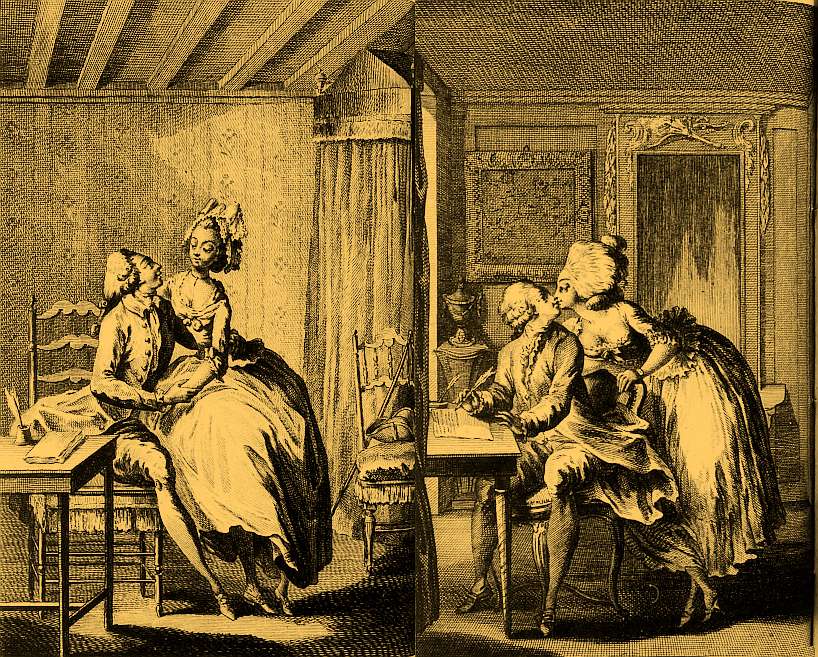
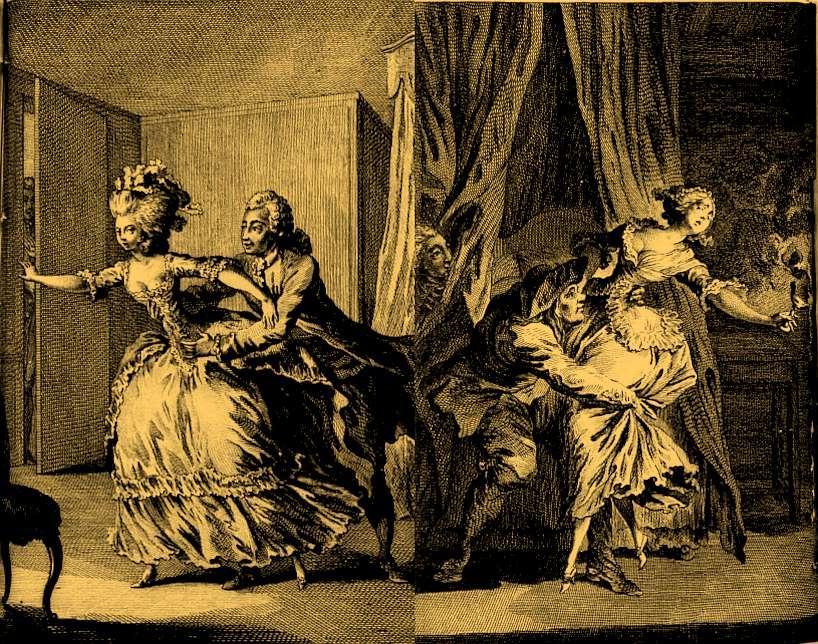
Wilhelm, however, is so blinded that he insists she has been brought up excellently, with an understanding of Goethe, Shakespeare, ancient poetry, his own poetry, and God knows what else! He simply does not see that this child, with the most intense carnal desires, checks out all the filthiest material from the lending library; [17] he probably sees it but tells himself she does it perhaps out of a thirst for knowledge. He does not see that the child speaks not a single word that does not reflect her mother’s opinions; he does not see that the latter, too, has absolutely no true understanding for poesy, he does not suspect that, should she not return to him, she will perhaps never again pick up a real book, and that she will now splash about in Schelling’s philosophy of nature and poesy just as she earlier did in Wilhelm’s poesy!
But enough; I will not be seeing her again!
Thank heaven Friedrich’s bitter suffering is now over! The foolish woman! from such a heart has she now violently torn herself away! Indeed, she has torn herself away from a divinely blessed garden in full blossom and with golden fruits that she might reign in a barren wasteland!
I will never see her again! [18] . . .
Notes
[*] Sources: Aus Schleiermacher’s Leben 3:179–80 (frag.); Briefe von Dorothea Schlegel an Friedrich Schleiermacher 61–68; KGA V/4 37–44; KFSA 25:107–11. Back.
[1] Friedrich Bohn published Dorothea’s novel Florentin. Ein Roman herausgegeben von Friedrich Schlegel after negotiations with Johann Friedrich Unger in Berlin were unsuccessful. Although the first volume appeared in January 1801 (Lübeck, Leipzig 1801), Dorothea never finished the second. Back.
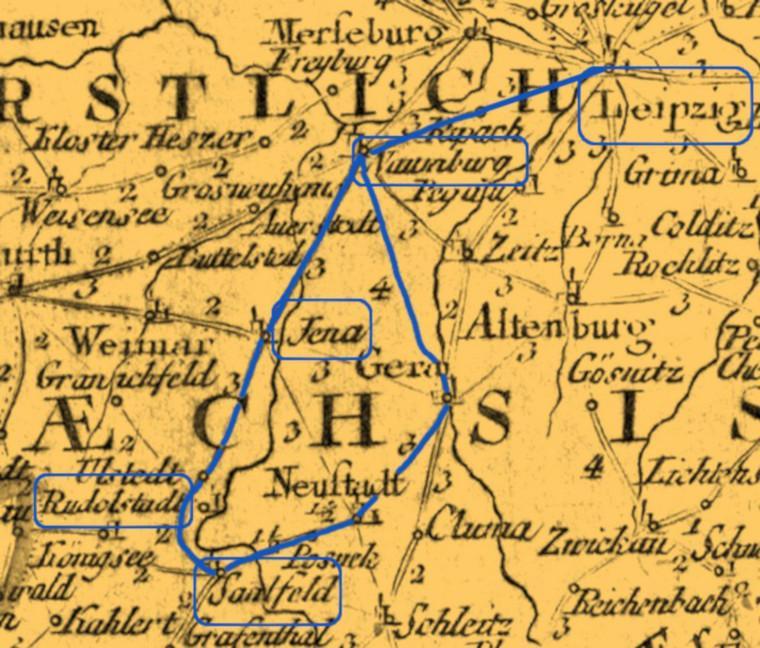
[2] Caroline and Auguste, possiby with a maidservant, had left Jena on 5 May 1800, with Wilhelm accompanying them as far as Saalfeld; they continued on to Bamberg with Schelling, while Wilhelm journeyed to Leipzig (on which see below) (Post Karte Durch ganz Deutschland, ed. J. Walch [Augsburg 1795]):

[3] Dorothea had mentioned this issue in her letter to Schleiermacher on 28/30 April 1800 (letter 259m); his response, to which she is here responding, is not extant. Back.
[4] In her letters to Schleiermacher on 11 and 28 October 1799 (letters 247c, 252a). Back.
[5] In a bit of “deviltry,” a satire about the Romantic circle in Jena, Dorothea had referred to Caroline as “Signora Zarticosa,” a portrayal to which Caroline seems to have taken offense; see Dorothea’s letter to Schleiermacher on 4 April 1800 (letter 259c), also with note 5 there. Back.
[6] Fr., “recklessly, thoughtlessly, utterly without thinking.” Back.
[7] Wilhelm, ever the gallant ladies’ man, consistently engaged in dalliances and flirting during his marriage with Caroline (more occur even before their divorce in May 1803) (anonymous, Galante Szene mit Handkuss [1776–1800]; Herzog August Bibliothek; Museums./Signatur Graph. Res. A: 179):

On the other hand, and in both Wilhelm’s and Caroline’s defense, Caroline openly maintains in a letter to Julie Gotter on 18 February 1803 (letter 375) that their marriage was from the outset “an alliance that the two of us otherwise never viewed as being anything but completely free.” Back.
[8] Fr., here: “as a foursome.” Back.
[9] A qualifier seems to be missing from this clause in the original, which reads literally “he found the way etc.,” which should probably read in effect: “he found it repulsive the way” or “he found the way . . . to be repulsive etc.” Back.
[10] Dorothea is asking rhetorically why Caroline would prefer to take the “dignified” but less impressive course of action (the “modest opening”) of separating from one of the two men or indeed of living and working for herself, rather than the “triumphal” and more impressive course (the “triumphal arch”) of having not one but two men working for her. Back.
[11] Schelling left early on 2 May 1800, stopping in Saalfeld to await Wilhelm, Caroline, and Auguste; see his letter to Adalbert Friedrich Marcus on 3 May (letter 259o); similarly Wilhelm’s letter to Goethe on 4 May (letter 259p). Back.
[12] Six German miles = ca. 44 km; Dorothy is exaggerating a bit, since Rudolstadt is approx. 30 km southwest of Jena, Saalfeld approx. 35 km. Schelling was in any case waiting in Saalfeld rather than Rudolstadt (Daniel Nikolaus Chodowiecki, Schnell und ungleich ist die Fahrt, die uns durch das Leben träget [1778] Herzog Anton Ulrich-Museum; Museums./Signatur DChodowiecki AB 3.252):

Wilhelm was in any case on his way to the Leipzig book fair (illustration of the Church of St. Paul in Leipzig and the Grimma Town Gate, from Emil Friedberg, Die Universität Leipzig in Vergangenheit und Gegenwart [Leipzig 1898], 31):
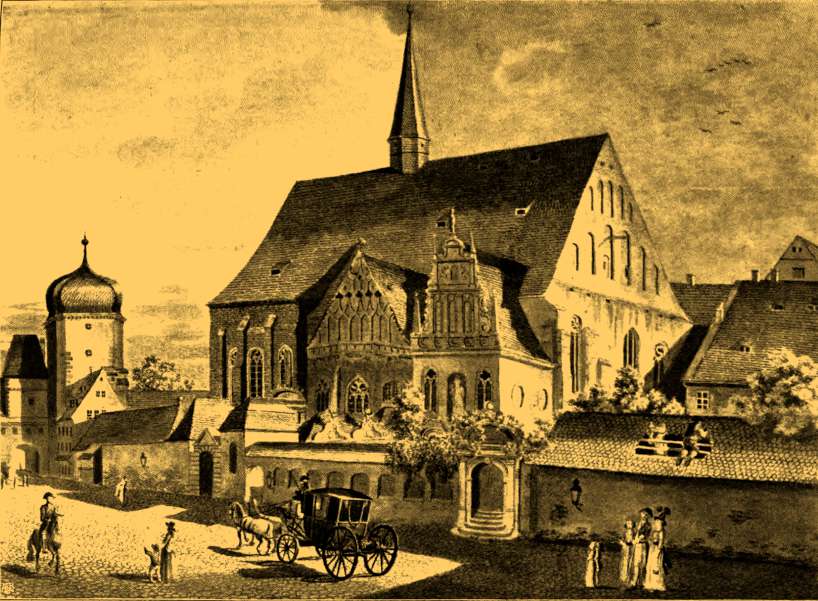
On the way, he passed through Weissenfels, where he visited Friedrich von Hardenberg and also spent an evening with Louise Brachmann (see her letter to Wilhelm on 7 November 1799 [letter 254a] and her impressions after his visit in Weissenfels in her letter to him of 28 May 1800 [cited in letter 254a]).
That is, Wilhelm seems to have accompanied Caroline and Auguste as far as Saalfeld, where he “handed them off” to Schelling, as Dorothea puts it. Had he done so in Rudolstadt, it may have been easier to travel back through Jena on his way to Weissenfels (which is located between Naumburg and Leipzig). From Saalfeld, he could have taken the postal coach through Neustadt and Gera on his way to Naumburg and farther on to Weissenfels rather than returning through Jena. No evidence suggests which route he took (Post Karte Durch ganz Deutschland, ed. J. Walch [Augsburg 1795]):
As Walter E. Ehrhardt points out in “Eine romantische Wanderung nach Leonberg: Carolines letzter Weg mit Schelling” (unpaginated lecture in Leonberg on 24 September 2006), it was in any case necessary for Wilhelm to accompany them at least that far “since without her accompanying husband, Caroline would not have been permitted to enter Schwarzburg territory at Rudolstadt.”
Although Schelling and Caroline may well have been planning time together in Bamberg, initially they may not have been planning to travel there together; see Schelling’s letter to Schiller on 25 April 1800 (letter 259h), note 1, and his letter to Adalbert Friedrich Marcus on 3 May 1800 (letter 259o), note 2. Back.
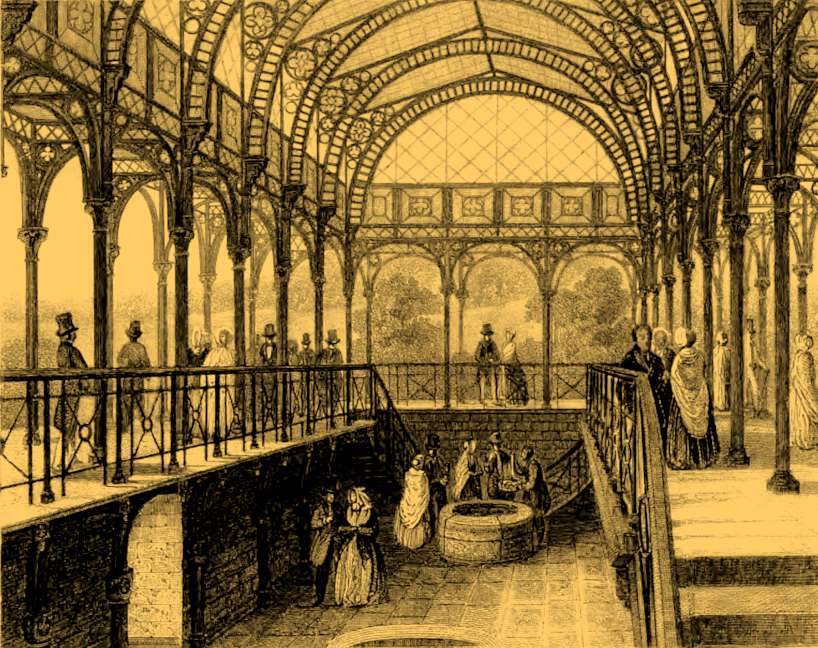
[13] In 1847, the spa season in Bocklet opened on 15 June; see Vincenz Müller, Specielle Beschreibung der Heilquellen, Mineralbäder und Molkencur-Anstalten des Königreichs Bayern (Augsburg 1847), 24, 88 (illustrations of guests at the mineral-springs pavilion in Kissingen, just south of Bocklet, from the Album von Kissingen, Bocklet und Brückenau in Stahlstichen, nach Original-Zeichnungen [Frankfurt 1845], unpaginated plates):

The summer months in the narrower sense are the best time for spa guests to use the mineral springs, specifically between 15 June and 15 September. In Germany, May is rarely a genuinely pleasant month and in fact is often cold and stormy, which, of course, does not at all promote the healing powers of mineral springs. . . . Bocklet, which opens each year on 15 June, derives its name from the nearby village of Bocklet.
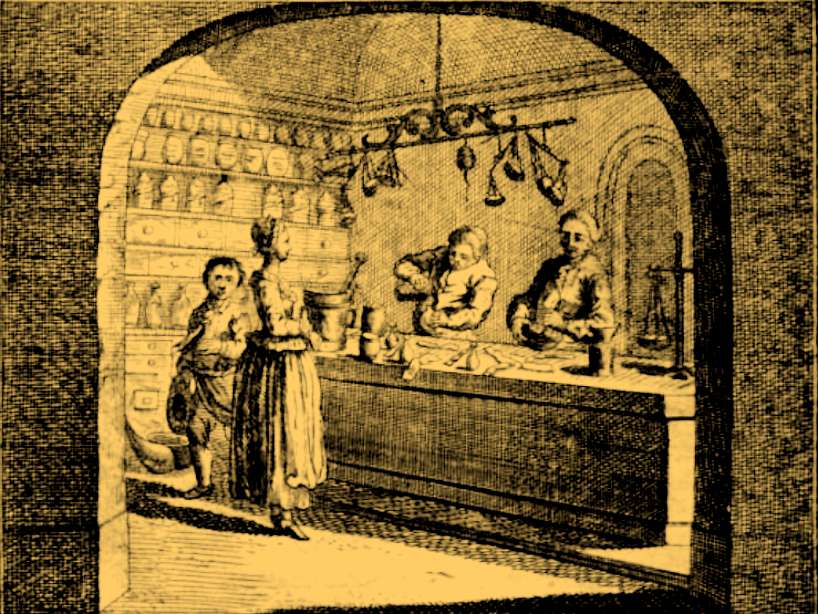
[14] “Disgusting smells,” that is, not least from apothecary concoctions (Schauplatz der Natur und der Künste, vol. 4 [Vienna 1776], plate 34):
Daniel Nikolaus Chodowiecki, Die Krancke Frau (The ill woman) (1776); Herzog August Bibliothek; Museums./Signatur Uh 4° 47 (107):
See Dorothea’s own description of the spring of 1800 in Jena in her letter to Rahel Levin on 28 April 1800 (letter 259l).
Dorothea’s reference to “real” and “ideal” illness plays on concepts from Schelling’s philosophy, and indeed in a certain sense on philosophy at large at the time. Those terms reappear in the sarcastic remarks of a pamphlet in 1802 following Auguste’s death in July 1800 insinuating that Schelling had contributed to Auguste’s death by, as Dorothea herself puts it later, having “meddled” in her treatment in Bocklet. The pamphleteer (Franz Berg) concludes his remarks with a reference to one of Schelling’s followers and fellow Brunonian, the physician Joseph Reubel: “Except may heaven forbid that he suffer the misfortune of killing in reality those whom he heals in ideality, a misfortune that befell Schelling, the One and Only, in Boklet in Franconia in the case of M[ademoiselle]. B[öhmer].*, as malicious people maintain.”
Finally, concerning Dorothea’s insinuation that Caroline’s illness was ultimately a ploy “merely to create a mask with which she might then be able to exit,” i.e., that her illness was not, or at least not entirely genuine, see Auguste’s letter to to Luise Wiedemann on 30 March 1800 (letter 258w), note 7, in connection with the home baths and mineral springs Caroline’s physician Christoph Wilhelm Hufeland was recommending. Back.
[15] Apparently a common enough occurrence, as in the following illustrations with the mirrors ([1] Christian Felix Weiße, “Der” Kinderfreund: Ein Wochenblatt 2 (1777), following p. 68; [2] “Das leichtsinnige Mädchen” [“The frivolous young girl”], Berlinischer Damen-Kalender auf das Gemein-Jahr 1809); and with attendants and admirers ([3] Frontispiece to Moritz August von Thümmel, Reise in die mittäglichen Provinzen von Frankreich im Jahr 1785 bis 1786, vol. 4 [Leipzig 1810]; [4] Göttinger Taschen Calender Für das Iahr 1798; both illustrations: Inhaltsverzeichnis deutscher Almanache, Theodor Springmann Stiftung):


[16] Possibly an indication, however tentative, of the real state of affairs with respect to Schelling’s alleged romantic interest in Auguste, long an unresolved question among scholars, since no extant documentation answers it unequivocally either way. Back.
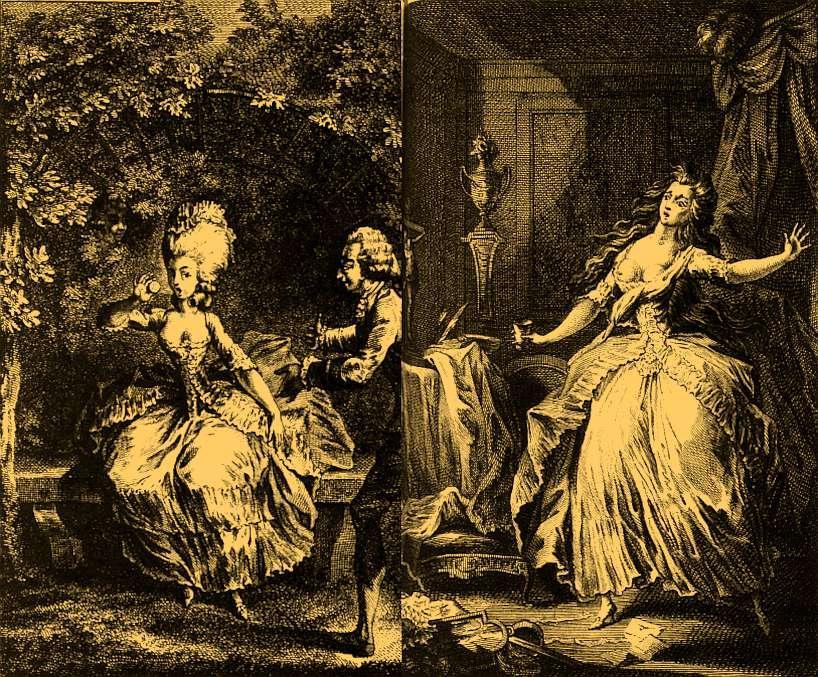
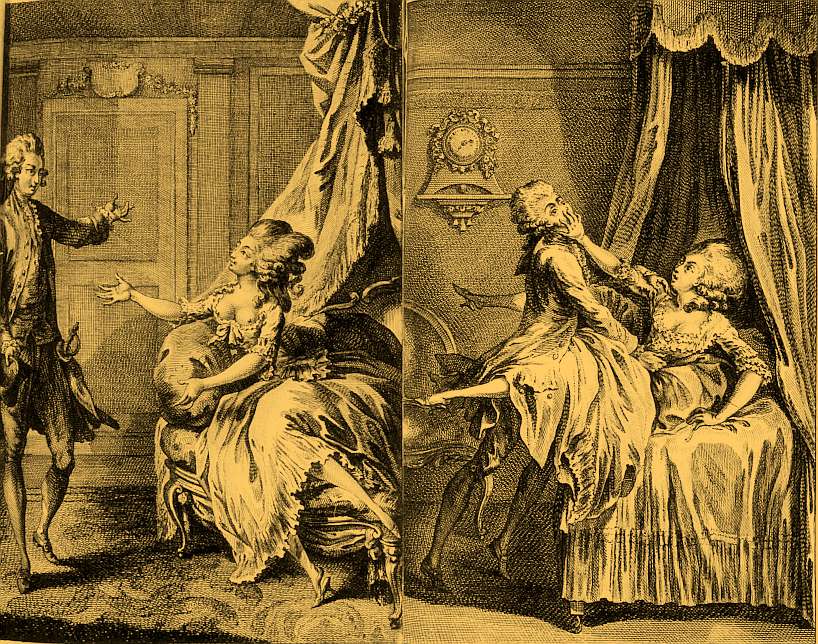
[17] Presumably something of the sort Caroline and her sisters themselves had become familiar with during their youth, such as Claude-Prosper Jolyot de Crébillon’s L’écumoire, ou Tanzaï et Néadarné, histoire japonoise, 2 vols. (Pekin 1734) (with illustrations) or Retif de la Bretonne’s Les contemporaines; ou, Avantures des plus jolies femmes de l’âge présent, 42 vols. in 12 (Leipsick 1780–85) (with illustrations).
Here sample illustrations from Retif de la Bretonne’s Le Paysan perverti ou les dangers de la ville, 4 vols. (Paris 1776) (Nicolas-Edmé Rétif de la Bretonne, Le Paysan perverti ou les dangers de la ville, illustrations by Louis Binet, engravings by Louis-Sébastian Berthet and Sébastian Le Roy [Paris 1776]; Bibliothèque nationale de France):
[18] Such was then genuinely the case, though Caroline did see Friedrich again after her return to Jena in April 1801. Back.
Translation © 2014 Doug Stott