
• 221. Friedrich Schlegel to Caroline in Jena: Berlin, 19 February 1799 [*]
Berlin, 19 February [1799]
|500| Piccolomini was performed here yesterday! [1] but not for me, perhaps not all that soon either. I am completely immersed in Lucinde and for the moment will make do with your portrayal of the Weimar performance, since in any event yours is itself of a higher potence even than the play itself. [2] You gave me a great deal of pleasure with it, |501| and I wish I could compensate you. But everything has gone wrong for me today: I have not received the printer’s sheets of Don Quixote, [3] the 10th galley sheet of Athenäum is still missing and with it the conclusion of your “Gemählde.” [4] Hence I would prefer to wait until the next postal day to send the two, and then perhaps also a continuation of Lucinde if Henriette has time, [5] since Dorothea is occupied with copying the one and is also already at work on Faublas, which we are translating and adapting for Fröhlich. [6]
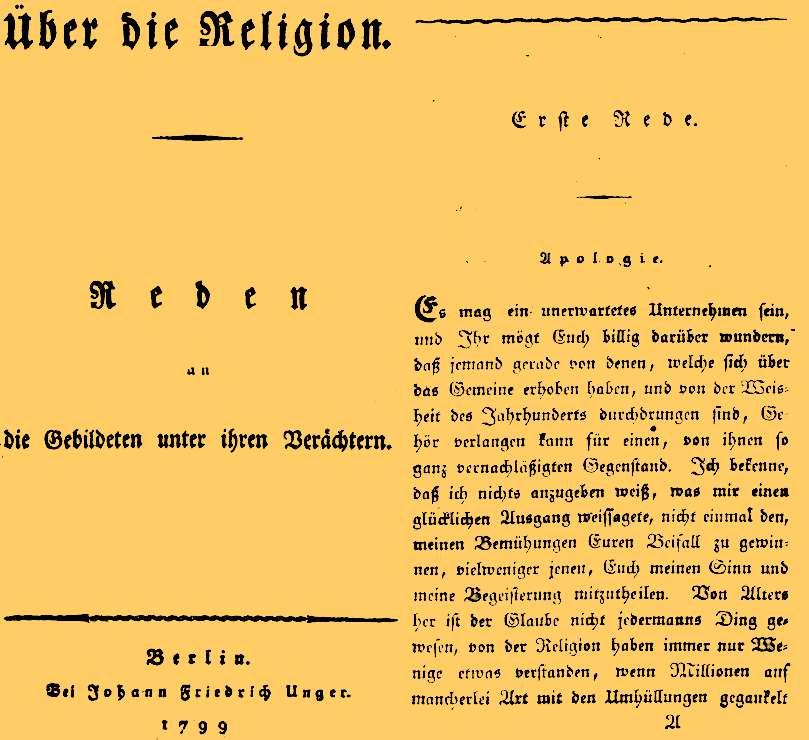
Schleiermacher is currently in Potsdam on official business, hence I am by myself here now. He will probably have to remain until Easter, and is himself alone there except for the Religion. It will be printed like the Fürstenspiegel, so we are doing our part concerning the new font. [7]
There is, by the way, not much religion in it except to say that every person is the image of God and that death is to be destroyed. For the rest, however, it is a book like my own Studium of ancient poesy, that is, revolutionary and the first glimpse of a new world. [8] I believe you will like it, for it is cultivated and refined, a classic essay!
You probably already know now that it was a misunderstanding with the reptiles [sic!] and that all of you mistakenly identified Lucinde with the novellas I intend to contribute to Athenäum. The latter, God willing, will be thoroughly witty and have no need to feel bereft if it just so happens that they satirize the same sort of personalities as does perhaps Tieck in the classic mill of good taste. [9] Hence both of you please write and relate to me anew your provisional opinion with respect to Athenäum until I send them. I will soon be far enough along in Lucinde that I will be able to get back to serious work on the IVth issue of Athenäum. [10] —
|502| Prince Reuss died, declaring beforehand that he was secretly married to Marianne. I have not yet seen her, she is unwell and practically sick. One hopes everything was thoroughly and correctly taken care of and she will have plenty to live on. Then she will probably move to Weimar with all of you, since it would probably embarrass her here now that she is Her Serene Highness. [11]
It is splendid, divine, and more than divine that you are so resolved to come to Berlin. If you do not do so after all, then I will mortgage house and home and come to you there. — In this regard it is also good that you wrote the old lady Beast so charming and proper a letter. It merely annoyed me that besides being charming and proper, the letter was also beautiful, and, moreover, that in it you take such a horrible book under your protection, a book that deserves such protection as little as the Ungermonster deserves your letters. But do not take it so hard. Only preferably write nothing at all, but do come, c’est le principal. [12]
I am looking forward to the elegy with unspeakable anticipation. [13] People are yearningly anticipating it, since that is what I usually talk about. I will send Wilhelm the poems from the Greek quite soon; that will be good and fine. I can have nothing against including the οαριστυς for Athenäum; hence you ought to discuss it with Wilhelm. Why not? — After all, Reichard’s seven daughters do not need to read us. [14]
I will write to Fichte with the next post; to Schelling as well, who has promised to send me his philosophy of nature. [15]
I do believe we have a jewel in the essay by Hülsen. [16] It is a holy scripture in the real sense. I do like his religion of family, parents, and children even better than Schleiermacher’s, and all the more because he does not even realize it is religion in the first place. Moreover, it has more nerve and vigor |503| than does Schleiermacher, who slinks around like a badger trying to sniff out the universe in every possible subject.
Many, many regards and all my friendship to Auguste and Wilhelm. I will relate everything else on the next postal day. Dorothea and Henriette send their regards to whomever they can. [17]
Friedrich
Fröhlich would very much like for the IVth issue of Athenäum to appear soon. Elegy, elegy!
Notes
[*] Also in KFSA 24:230–32. Back.
[1] Schiller’s Die Piccolomini premiered in Berlin on 18 February 1799, Wallensteins Tod on 17 May 1799, Wallensteins Lager not until 28 November 1803. Concerning the Berlin performance of the Piccolomini, see Wilhelm Schlegel’s letter to Goethe on 4 February 1799 (letter 219a), note 3.
Concerning the Piccolomini otherwise, see Caroline’s letter to Luise Gotter in early 1799 (letter 215) and the second half of Auguste’s letter to Cäcilie Gotter on 18 February 1799 (letter 220). Back.
[2] Although Caroline apparently wrote to Friedrich about the performance in the Weimar theater, that report seems to have been lost. See her letter to Luise Gotter in early 1799 (letter 215) mentioned above, note 1. Back.
[3] Ludwig Tieck’s translation of Don Quixote, 4 vols. (Berlin 1799–1801). Back.
[4] Caroline’s and Wilhelm Schlegel’s “Die Gemählde. Ein Gespräch von W.,” in Athenaeum (1799) 39–151 (the first issue of Athenaeum in 1799; it would appear in early March). Concerning this essay, see the introduction to Caroline’s literary reviews for volume 1, note 10. Back.
[5] I.e., to copy it out. Back.
[6] Dorothea had begun to translate the novel by Jean-Baptist Louvet de Couvray, Les amours du chevalier de Faublas (1789–90; a revised edition had appeared in Paris in 1796 and a third edition in 1798), whose somewhat ticklishly graceful quality (“typical of many frivolous, licentious novels of its time,” Oxford Companion to French Literature, ed. Paul Harvey and J. E. Heseltine [Oxford 1959], 17) Friedrich had extolled in fragment 41 of his “Kritische Fragmente” in Lyceum (Jugendschriften 2:188): “Few books can compare with Faublas’s novel as regards social wit and social gaiety. He is the champagne of his genre.”
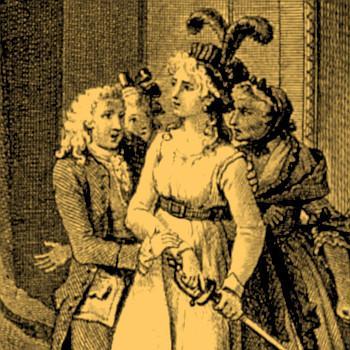
Although the translation was never finished, the edition from which Dorothea was presumably working — the four volumes of the third edition — features a generous selection of expressive, dramatic, and fetching illustrations representative of the typical and in part better illustrations of the period in such popular and widely read books. To view these illustrations, click on the following gallery:
[7] Potsdam is just southwest of Berlin (Rudolf Koch and Fritz Kredel, Deutschland und angrenzende Gebiete [Leipzig 1937]):

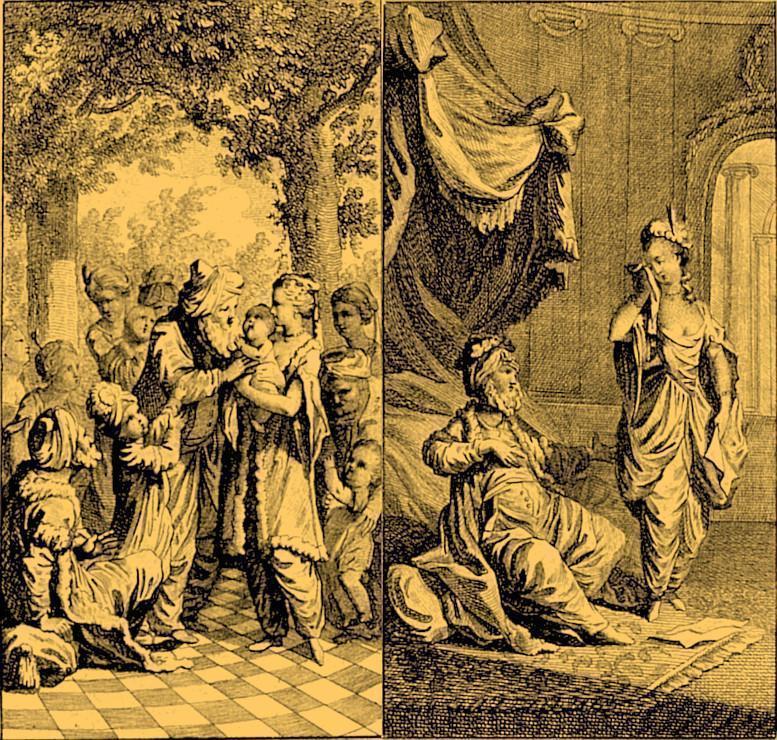
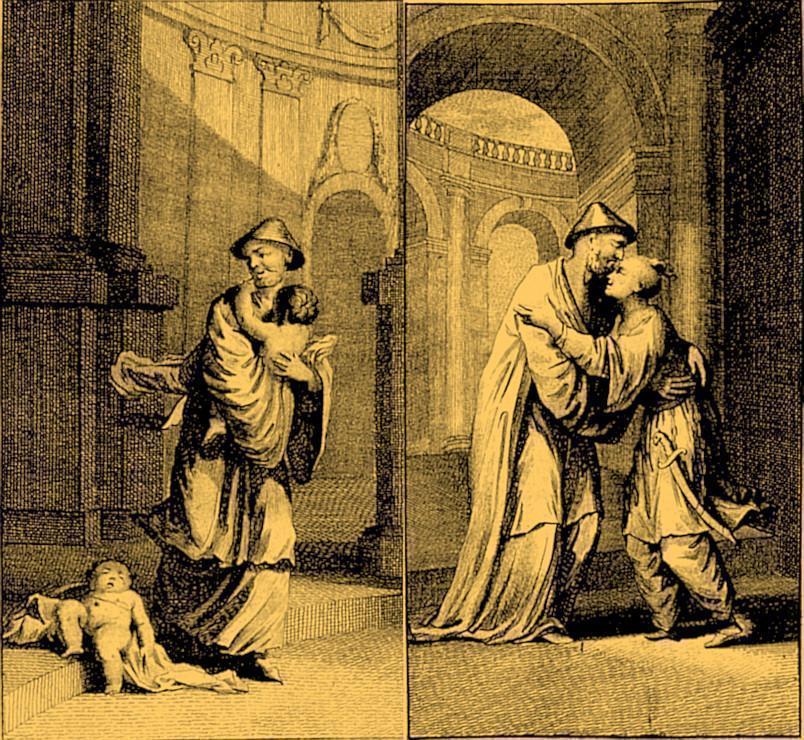
Friedrich is otherwise possibly making an allusion to font used in Christoph Martin Wieland’s novel Der goldene Spiegel oder Die Könige von Scheschian, eine wahre Geschichte, 4 vols. (Leipzig 1772; rev. ed. 1794. Here the four frontispieces to this exotic story:
Here font samples on the title pages and first pages of text to Wieland’s and Schleiermacher’s publications:

See Erich Schmidt’s notes to this letter, (1913), 1:736, concerning Schleiermacher:
For years Schleiermacher was Friedrich’s intimate friend, something Wilhelm Dilthey portrays with unsurpassable delicacy in Leben Schleiermachers 1:205–37 [3rd ed. (1970), 1:229–59]. Schleiermacher was then also Dorothea’s trusted confessor, a cool admirer of Wilhelm’s critical and formal gifts, probably as impartial as one could be in the “Carolinian quarrels” while nonetheless anticipating the couple’s ultimate separation; that said, he never developed any more personal relationship with Caroline.
In this present edition, see in this regard also Friedrich to Schleiermacher on 21 September 1801 (letter 329g); Schleiermacher to Charlotte Schleiermacher on 27 December 1800 and 10 November 1801 (letters 277e; 329s).
Although Schelling was powerfully moved by Über die Religion (Schelling to Wilhelm Schlegel on 3 July 1801 [letter 323a]), he nonetheless rejected it in his (Schelling’s) Epikurisch Glaubensbekenntniss Heinz Widerporstens (autumn 1799, Schelling submitting the latter unsuccessfully to Wilhelm for inclusion in Athenaeum) in a tone reminiscent of the young Goethe (Plitt 1:282–92). Concerning Schelling’s poem and its position within Schelling’s philosophical development, see the “Note on Heinz Widerporst’s Epicurean confession of Faith,” in Philippe Lacoue-Labarth and Jean-Luc Nancy, The Literary Absolute: The Theory of Literature in German Romanticism, trans. Philip Barnard and Cheryl Lester (Albany, New York 1988), 79–80, who also refer the reader for a “complete analysis of the poem, of its content, and of its relations with Schleiermacher and Novalis, as well as with the thought of Schelling himself,” to Roger Ayrault, La Genèse du romantisme allemand, 4 vols. (Paris 1961–76), 3:525ff and 4:13 and 528. For the translated text, see the supplementary appendix Heinz Widerporst’s Epicurean Confession of Faith.
Goethe, who himself felt considerable kinship with Schelling’s thought, received Schleiermacher’s book from Wilhelm to read — actually, Friedrich’s own copy — returning it on 14 October 1799; Friedrich recounts to Schleiermacher in a letter on 10 October 1799 (Aus Schleiermacher’s Leben 3:125; KGA V/3:212; KFSA 25:10):
Goethe was given my own splendid copy, and after eagerly reading the first two or three discourses could not praise highly enough the cultivation and manifold character of this phenomenon to Wilhelm. That said, the more neglectful the style became, and the more Christian the religion, all the more was this initial effect transformed into its opposite, until finally the whole thing ended in a healthy and merry disinclination.
Erich Schmidt, (1913), 1:736, adds that, like Wilhelm, Caroline was cool toward things religious, and that too much should not be made of Karl Gustav von Brinckmann’s remark to his friend Schleiermacher on 15 April 1802, that he had recently spoken “a great deal about you with Caroline Schlegel,” and that she “seems to have a very high opinion of you indeed” (Briefe von Karl Gustav V. Brinckmann an Friedrich Schleiermacher, ed. Heinrich Meisner and Erich Schmidt [Berlin 1912], 34; KGA V/5 386). Back.
[8] “Ueber das Studium der griechischen Poesie.” Griechen und Römer, 1–250, Jugendschriften 1:85–178; excerpted in Deutschland (1796) 6, no. 8, 393–415. Back.
[9] Ludwig Tieck’s comedy Prinz Zerbino, oder, Die Reise nach dem guten Geschmack; gewissermassen eine Fortsetzung des gestiefelten Katers. Ein Spiel in sechs Aufzügen (Leipzig, Jena 1799) guides the spectator episodically into a “taste mill” whose workers, of course, are literati. One of the writers lampooned by Tieck was Karl von Grosse; the scene in act 4 takes place in a “mill” at dawn:
The Miller. Herr Grosse there is also a fine, fine fellow,
Just not yet quite as stable,
That is, because he has indeed seen a bit of the world,
He still finds things here — as one is wont to say —
Somewhat strange.Herr Grosse. But I can make a fine batch of flour! —
The Miller. Yes, yes, quite so, for once he starts
Talking about himself, there is simply no end to it.
Here the frontispiece from the edition Vienna 1819:
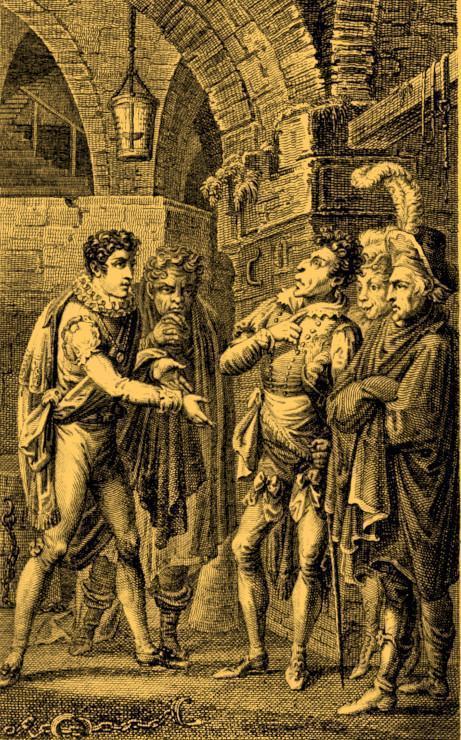
[10] The fourth issue of Athenaeum was the second issue of 1799, which would appear in August. Back.
[11] Marianne von Eybenberg moved to Vienna (Daniel Nikolaus Chodowiecki, Besetztere und illuminierte Landkarte von Deutschland Elementarwerk, from the (Kupfersammlung zu J[ohann] B[ernhard] Basedows Elementarwerke für die Jugend und ihre Freunde: Erste Lieferung in 53 Tafeln. Zweyte Lieferung in 47 Tafeln von L bis XCVI [Leipzig, Dessau, Berlin 1774], plate xlv):

[12] Fr., in effect: “that is the most important thing.” — Caroline’s letter to Friederike Unger seems not to have survived, and the reference to the “book” remains uncertain. — The Berlin trip did not materialize. Back.
[13] Concerning Wilhelm’s elegy, see Caroline to Friedrich von Hardenberg on 4 February 1799 (letter 219), note 15. Back.
[14] Uncertain which Reichard (or Reichardt?) is meant. Neither Schmidt (1913) nor KFSA 24 identify him. The musician and composer Reichardt had several daughters and step-daughters.
In any event, Friedrich is presumably alluding to the decidedly risqué nature of the poem in Athenaeum (1800) 216–32, “Idyllen aus dem Griechischen,” here 218–24. The Greek — οαριστυς — originally referred to a dialogue between a man and wife, was later understood figuratively as an intimate rendezvous, and in the present context is an intimate conversation between a youth and maiden, here with the youth named Daphnis.
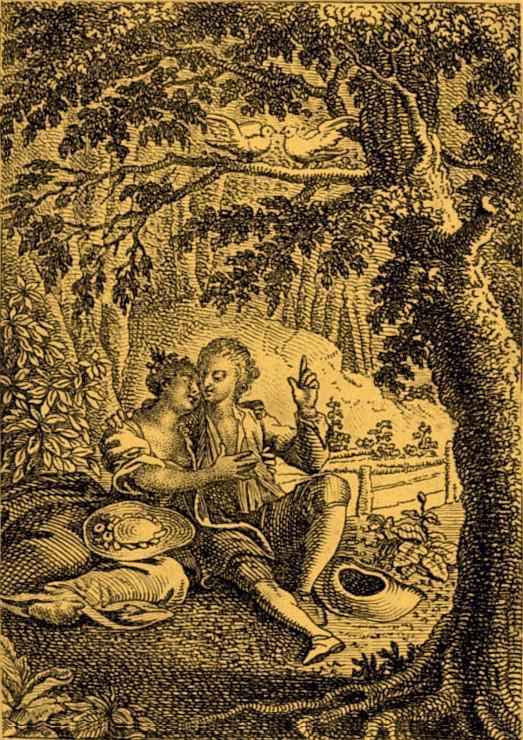
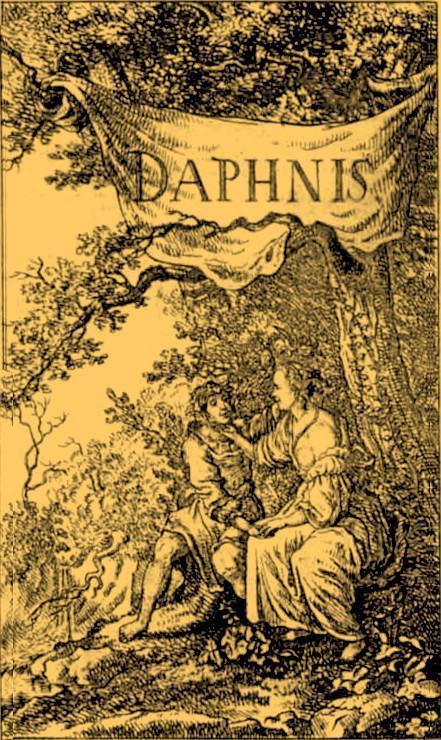
Here illustrations of eighteenth-century treatments of the basic scene (1) by Daniel Nikolaus Chodowiecki, Damon Phillis [1771–73] (Herzog August Bibliothek; Museums./Signatur Uh 4° 47 [93]), for Salomon Gessner’s Idyllen von dem Verfasser des Daphnis (Zürich 1756), but originally published in the Berliner Genealogischer Calender auf das Jahr 1773 to accompany the lines: “Listen, Phillis! It just occurred to me: What if these were kisses?”; and (2) the frontispiece to Gessner’s original Daphnis, 2nd ed. (Zürich 1756):
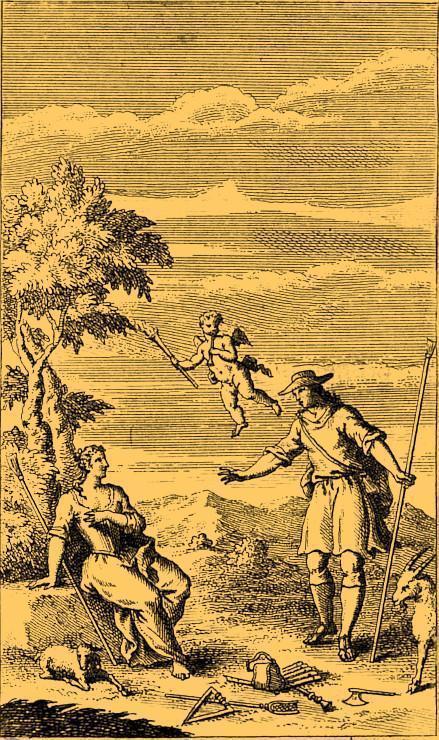
The Athenaeum piece, in hexameters, is attributed to Bion (ca. 100 B.C.E.) and proceeds from verse to verse to the point of complete erotic union. It is a variation by Bion on the topos as represented by the Greek poet Longus in his sexually explicit The Pastoral Amours of Daphnis and Chloe … Translated Into English [by James Craggs]; Adorn’d with Cutts, 4nd ed. (London 1733) (here the frontispiece):
Friedrich provides the following remarks (Athenaeum [1800] 228–29):
With its [the present piece’s] naiveté and roguishness, it occupies the beautiful middle ground between the unenhanced and often repugnant natural veracity of Theocritus, on the one hand, and the insipid ideality of so many modern pastoral poems [Gessner? see above], on the other, moving instead in the measured, alternating dialogue with graceful lightness and ease.
Theocritus, Bion and Moschus rendered into English prose, trans. Andrew Lang (London 1880), 138–45. “Idyll xxvii, The Wooing of Daphnis” (though attributed there to Theocritus, scholars generally view it as an imitation and date it later):
The Maiden. Helen the wise did Paris, another neatherd, ravish!

Daphnis. 'Tis rather this Helen that kisses her shepherd, even me!

The Maiden. Boast not, little satyr, for kisses they call an empty
favour.

Daphnis. Nay, even in empty kisses there is a sweet delight.

The Maiden. I wash my lips, I blow away from me thy kisses!

Daphnis. Dost thou wash thy lips? Then give me them again to kiss!

The Maiden. 'Tis for thee to caress thy kine, not a maiden unwed.

Daphnis. Boast not, for swiftly thy youth flits by thee, like a
dream.

The Maiden. The grapes turn to raisins, not wholly will the dry rose
perish.

Daphnis. Come hither, beneath the wild olives, that I may tell thee
a tale.

The Maiden. I will not come; ay, ere now with a sweet tale didst
thou beguile me.

Daphnis. Come hither, beneath the elms, to listen to my pipe!

The Maiden. Nay, please thyself, no woful tune delights me.

Daphnis. Ah maiden, see that thou too shun the anger of the Paphian.

The Maiden. Good-bye to the Paphian, let Artemis only be friendly!

Daphnis. Say not so, lest she smite thee, and thou fall into a trap
whence there is no escape.

The Maiden. Let her smite an she will; Artemis again would be my
defender. Lay no hand on me; nay, if thou do more, and touch me with
thy lips, I will bite thee.

Daphnis. From Love thou dost not flee, whom never yet maiden fled.

The Maiden. Escape him, by Pan, I do, but thou dost ever bear his
yoke.

Daphnis. This is ever my fear lest he even give thee to a meaner
man.

The Maiden. Many have been my wooers, but none has won my heart.

Daphnis. Yea I, out of many chosen, come here thy wooer.

The Maiden. Dear love, what can I do? Marriage has much annoy.

Daphnis. Nor pain nor sorrow has marriage, but mirth and dancing.

The Maiden. Ay, but they say that women dread their lords.

Daphnis. Nay, rather they always rule them, — whom do women fear?

The Maiden. Travail I dread, and sharp is the shaft of Eilithyia.

Daphnis. But thy queen is Artemis, that lightens labour.

The Maiden. But I fear childbirth, lest, perchance, I lose my
beauty.

Daphnis. Nay, if thou bearest dear children thou wilt see the light
revive in thy sons.

The Maiden. And what wedding gift dost thou bring me if I consent?

Daphnis. My whole flock, all my groves, and all my pasture land
shall be thine.

The Maiden. Swear that thou wilt not win me, and then depart and
leave me forlorn.

Daphnis. So help me Pan I would not leave thee, didst thou even
choose to banish me!

The Maiden. Dost thou build me bowers, and a house, and folds for
flocks?

Daphnis. Yea, bowers I build thee, the flocks I tend are fair.

The Maiden. But to my grey old father, what tale, ah what, shall I
tell?

Daphnis. He will approve thy wedlock when he has heard my name.

The Maiden. Prithee, tell me that name of thine; in a name there is
often delight.

Daphnis. Daphnis am I, Lycidas is my father, and Nomaea is my
mother.

The Maiden. Thou comest of men well-born, but there I am thy match.

Daphnis. I know it, thou art of high degree, for thy father is
Menalcas.

The Maiden. Show me thy grove, wherein is thy cattle-stall.

Daphnis. See here, how they bloom, my slender cypress-trees.

The Maiden. Graze on, my goats, I go to learn the herdsman's
labours.

Daphnis. Feed fair, my bulls, while I show my woodlands to my lady!

The Maiden. What dost thou, little satyr; why dost thou touch my
breast?

Daphnis. I will show thee that these earliest apples are ripe.

The Maiden. By Pan, I swoon; away, take back thy hand.

Daphnis. Courage, dear girl, why fearest thou me, thou art over
fearful!

The Maiden. Thou makest me lie down by the water-course, defiling my
fair raiment!

Daphnis. Nay, see, 'neath thy raiment fair I am throwing this soft
fleece.

The Maiden. Ah, ah, thou hast snatched my girdle too; why hast thou
loosed my girdle?

Daphnis. These first-fruits I offer, a gift to the Paphian.

The Maiden. Stay, wretch, hark; surely a stranger cometh; nay, I
hear a sound.

Daphnis. The cypresses do but whisper to each other of thy wedding.

The Maiden. Thou hast torn my mantle, and unclad am I.

Daphnis. Another mantle I will give thee, and an ampler far than
thine.

The Maiden. Thou dost promise all things, but soon thou wilt not
give me even a grain of salt.

Daphnis. Ah, would that I could give thee my very life.

The Maiden. Artemis, be not wrathful, thy votary breaks her vow.

Daphnis. I will slay a calf for Love, and for Aphrodite herself a
heifer.

The Maiden. A maiden I came hither, a woman shall I go homeward.

Daphnis. Nay, a wife and a mother of children shalt thou be, no more
a maiden.
So, each to each, in the joy of their young fresh limbs they were murmuring: it was the hour of secret love. Then she arose, and stole to herd her sheep; with shamefast eyes she went, but her heart was comforted within her. And he went to his herds of kine, rejoicing in his wedlock. Back.
[15] Schelling, Erster Entwurf eines Systems der Naturphilosophie. Zum Behuf seiner Vorlesungen (Jena, Leipzig 1799). Back.
[16] On the natural equality of human beings, “Über die natürliche Gleichheit der Menschen,” Athenaeum (1799) 152–80. Back.
[17] Henriette Mendelssohn had added a few lines to Wilhelm Schlegel in one of Friedrich’s earlier letters at the beginning of February 1799 (Walzel, 404–5; KFSA 24:227) (illustration: Daniel Nikolaus Chodowiecki, Wie er mich würde geliebt haben [1786]; Herzog Anton Ulrich-Museum; Museums./Signatur DChodowiecki AB 3.709):
For heaven’s sake do not think any worse or more unkindly of me, my dear friend, now that I neither am coming [to Jena, though she will visit the Schlegels in April 1799] nor write to you, nor even have thanked you or your gracious wife.
If my writing can reconquer your cordial kindliness toward me, I certainly intend not to put it off much longer. A thousand warm regards to both you and your wife and Auguste, the latter of whom has no doubt utterly given up on me.
Henriette
Translation © 2013 Doug Stott